
Pyrophosphoric acid
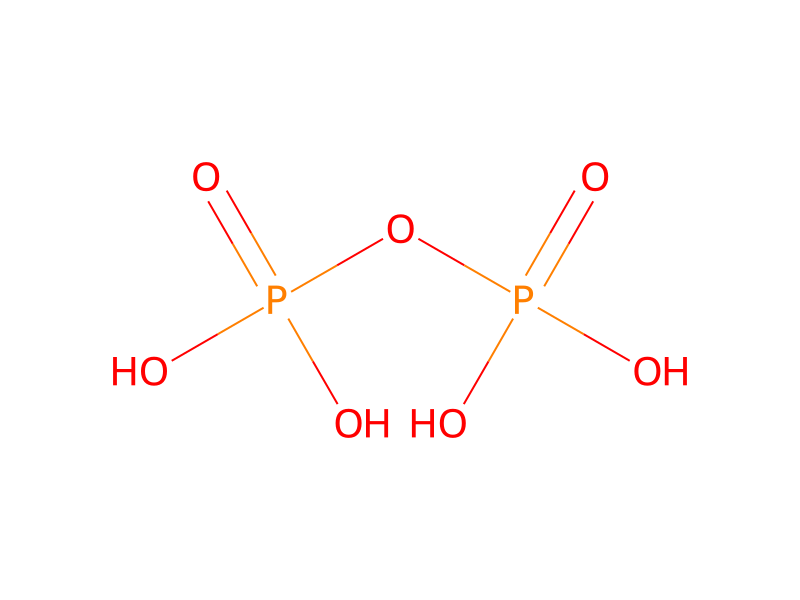
Grundinformationen
- CAS
14000-31-8- Standard-SMILES
O=P(O)(O)OP(=O)(O)O- InChIKey
XPPKVPWEQAFLFU-UHFFFAOYSA-N- Summenformel
- H4O7P2
- Durchschnittliche Molmasse
- 177,98 g/mol
- Monoisotopische Masse
- 177,94322646
Überblick
Diphosphoric acid is an acyclic phosphorus acid anhydride obtained by condensation of two molecules of phosphoric acid. It has a role as an Escherichia coli metabolite. It is a phosphorus oxoacid and an acyclic phosphorus acid anhydride. It is a conjugate acid of a diphosphate(1-).
Namen und Bezeichner
- Bevorzugter Name
- Pyrophosphoric acid
- IUPAC
- phosphono dihydrogen phosphate
- Englischer Name
- Diphosphate
- Summenformel
- O7P2
- Molmasse
- 173.94
Namen und Synonyme
Diphosphoric acidPyrophosphoric acid2466-09-3phosphono dihydrogen phosphate(phosphonooxy)phosphonic acid4E862E7GRQH4P2O7CHEBI:29888DTXSID4075035RefChem:55955DTXCID4037118219-574-0
Weitere Namen anzeigen
Diphosphatediphosphate(4-)
hydron;phosphonato phosphateDiphosphorsaeurePhosphonooxyphosphonic acidPyrophosphorsaeureacide diphosphoriquepyrophosphate TMS4Pyrophosphoric Acid (Technical Grade)PPV
Datenbank-Bezeichner
- CAS
14000-31-8、2466-09-3、33943-49-6- PubChem CID
- 1023
- DTXSID
DTXSID4075035- ChEMBL
CHEMBL1160571- ChEBI
CHEBI:29888- UNII
- 4E862E7GRQ
- EC Number
- 219-574-0
- Nikkaji
- J43.595C
Eigenschaften
Berechnete Struktureigenschaften
- XLogP
- -3,2
- Polarare Oberfläche (TPSA)
- 124 Ų
- H-Brücken-Donoren
- 4
- H-Brücken-Akzeptoren
- 7
- Frei drehbare Bindungen
- 2
- Schwere Atome
- 9
- Formalladung
- 0
- Komplexität
- 147
Experimentelle und physikochemische Eigenschaften
Chemical ClassesToxic Gases & Vapors -> Acids, Inorganic
Melting Point61 °C
Physical Description
Hygroscopic solid; [Merck Index] Light yellow hygroscopic solid; [Acros Organics MSDS]
Solid
Collision Cross Section
145.58 Ų [M+Na]+ [CCS Type: DT; Method: stepped-field]
144.7 Ų [M+Na]+
Physikochemische Eigenschaften
- EPA chemische Informationen
- Diphosphate (14000-31-8)
Sicherheit und Regulatorisches
Sicherheitsangaben dienen nur zur Orientierung und ersetzen weder das Sicherheitsdatenblatt (SDB) des Lieferanten noch geltende Vorschriften oder eine fachliche Bewertung.
GHS-Klassifizierung
GHS Classification
Danger
H302 (63.9%): Harmful if swallowed [Warning Acute toxicity, oral]
P260, P264, P264+P265, P270, P280, P301+P317, P301+P330+P331, P302+P361+P354, P304+P340, P305+P354+P338, P316, P317, P321, P330, P363, P405, and P501 (click each P-code to see the statement)
Aggregated GHS information provided per 119 reports by companies from 3 notifications to the ECHA C&L Inventory. Each notification may be associated with multiple companies.
Danger
H314: Causes severe skin burns and eye damage [Danger Skin corrosion/irritation]
Gefahrenhinweise
Regulatory Information
Chemical: Diphosphoric acid
Diphosphoric acid: Does not have an individual approval but may be used under an appropriate group standard
Other Safety InformationIMAP assessments - Polyphosphoric acids: Human health tier II assessment
Hazards SummaryCauses somnolence, ataxia, and dyspnea in oral lethal-dose studies of rats; [RTECS] Causes burns; Inhalation may cause corrosive injuries to upper respiratory tract and lungs; [Acros Organics MSDS]
Hazard Classes and Categories
Acute Tox. 4 (63.9%)
Acute toxicity - category 4
Toxikologische Informationen
Adverse EffectsDermatotoxin - Skin burns.
Sicherheitsdaten
Chemie und Industrie
Pharmakologische Informationen
Tissue LocationsEpidermis
Cellular LocationsCytoplasm
Metabolite Pathways2-Hydroxyglutric Aciduria (D And L Form)
Verwendung und Herstellung
UsesPyrophosphates are used with technetium 99m for bone scanning; [REPROTOX]
Vor- und nachgelagerte Produkte
Vorgelagerte Rohstoffe
Zugehörige Reaktionen
37


Notizen zur Verbindung
Wird geladen…