Phenylbis(trifluoracetato-O)iod
Bis(trifluoroacetoxy)iodobenzene
Daten werden ergänzt – lade die Seite später neu, um den aktuellen Stand zu sehen

Grundinformationen
- CAS
2712-78-9- Standard-SMILES
O=C(OI(OC(=O)C(F)(F)F)c1ccccc1)C(F)(F)F- InChIKey
PEZNEXFPRSOYPL-UHFFFAOYSA-N- Summenformel
- C10H5F6IO4
- Durchschnittliche Molmasse
- 430,04 g/mol
- Monoisotopische Masse
- 429,91367596
Namen und Bezeichner
- Bevorzugter Name
- Bis(trifluoroacetoxy)iodobenzene
- IUPAC
- [phenyl-(2,2,2-trifluoroacetyl)oxy-λ3-iodanyl] 2,2,2-trifluoroacetate
- Lokaler Name
- Phenylbis(trifluoracetato-O)iod
- Englischer Name
- [Bis(trifluoroacetoxy)iodo]benzene
- Summenformel
- C10H5F6IO4
- Molmasse
- 430.04
Namen und Synonyme
[Bis(trifluoroacetoxy)iodo]benzene2712-78-9(Bis(trifluoroacetoxy)iodo)benzeneBIS(TRIFLUOROACETOXY)IODOBENZENEBis(I,I-trifluoroacetoxy)iodobenzene659SFV27XSDTXSID40181584TAIB cpdBIITFAIBRefChem:69882DTXCID80104075Iodine, phenylbis(trifluoroacetato-kappaO)-
Weitere Namen anzeigen
BTIDFAIBBacillus thuringiensis israelensis[Bis(trifluoroacetoxLABOTEST-BB LT00454809uoroacetoxy)iodo]benzene[Bis(trifluoroacetoxy)iodo]ben1Bis-trifluoroacetoxyiodobenzeneBIS(TRIFLUORACETOXY)- IODOBENZENE
220-308-0PIFAMFCD00009672iodobenzene bis(trifluoroacetate)[phenyl-(2,2,2-trifluoroacetyl)oxy-lambda3-iodanyl] 2,2,2-trifluoroacetatePhI(OCOCF3)2Iodine, phenylbis(trifluoroacetato-O)-phenyliodine bis(trifluoroacetate)
Datenbank-Bezeichner
- CAS
2712-78-9- PubChem CID
- 102317
- DTXSID
DTXSID40181584- UNII
- 659SFV27XS
- EC Number
- 220-308-0
- Nikkaji
- J376.762K
Eigenschaften
Berechnete StruktureigenschaftenWird ergänzt
- XLogP
- 5
- Polarare Oberfläche (TPSA)
- 52,6 Ų
- H-Brücken-Donoren
- 0
- H-Brücken-Akzeptoren
- 10
- Frei drehbare Bindungen
- 5
- Schwere Atome
- 21
- Formalladung
- 0
- Komplexität
- 360
Physikochemische Eigenschaften
- Schmelzpunkt
- 121 · 121-125 °C(lit.)
- storage temp.
- 2 · Keep in dark place,Inert atmosphere,2-8°C
- Löslichkeit
- Chloroform (Slightly), Dichloromethane (Slightly), DMSO (Slightly)
- Aggregatzustand
- Crystalline Powder
- Farbe
- White to pale yellow
- Wasserlöslichkeit
- insoluble
- BRN
- 764767 · 764767
- Stabilität
- Air and Moisture Sensitive
- InChI
- InChI=1S/C10H5F6IO4/c11-9(12,13)7(18)20-17(6-4-2-1-3-5-6)21-8(19)10(14,15)16/h1-5H
- InChIKey
- PEZNEXFPRSOYPL-UHFFFAOYSA-N
- SMILES
- I(C1C=CC=CC=1)(OC(=O)C(F)(F)F)OC(=O)C(F)(F)F
- CAS Datenbank
- 2712 · 2712-78-9(CAS DataBase Reference)
Sicherheit und Regulatorisches
Sicherheitsangaben dienen nur zur Orientierung und ersetzen weder das Sicherheitsdatenblatt (SDB) des Lieferanten noch geltende Vorschriften oder eine fachliche Bewertung.
GHS-Klassifizierung
GHS Classification
Warning
H315 (100%): Causes skin irritation [Warning Skin corrosion/irritation]
P261, P264, P264+P265, P271, P280, P302+P352, P304+P340, P305+P351+P338, P319, P321, P332+P317, P337+P317, P362+P364, P403+P233, P405, and P501 (click each P-code to see the statement)
Aggregated GHS information provided per 50 reports by companies from 7 notifications to the ECHA C&L Inventory. Each notification may be associated with multiple companies.
Gefahrenhinweise
Regulatory Information
Chemical: Iodine, phenylbis(trifluoroacetato-O)-
Bis(trifluoroacetoxy)iodobenzene: Does not have an individual approval but may be used under an appropriate group standard
Hazard Classes and CategoriesSkin Irrit. 2 (100%)
Sicherheitsdaten
- F
- 4.10-8-9-21
- wgk
- 3
- hs_code
- 29036990
- risk_code
- 36/37/38
- hazard_code
- Xi
- hazard_note
- Irritant/Keep Cold
- safety_code
- 26-36-37/39
- hazard_class
- IRRITANT, KEEP COLD, LIGHT SENSITIVE
- Speicherklasse
- 11 - Combustible Solids
- Hazard Classifications
- Eye Irrit. 2Skin Irrit. 2STOT SE 3
Chemie und Industrie
Anwendungen
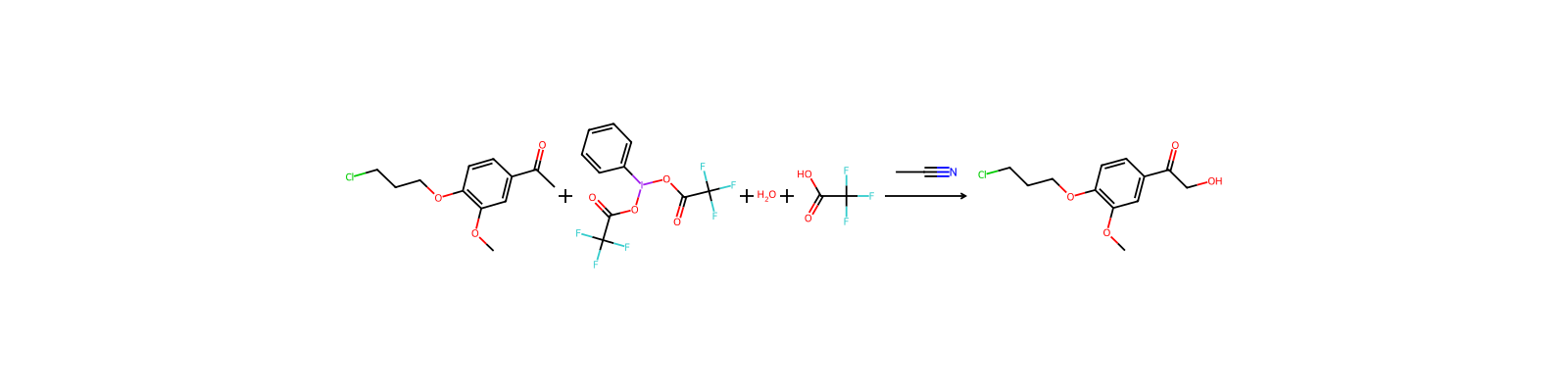
Verwenden[Bis(trifluoroacetoxy)iodo]benzene acts as a reagent in Pummerer-like reactions. It plays an important role in the direct alfa-hydroxylation of ketones under acidic conditions. It is involved in the cyclization of styryl amines to N-alkyl or N-aryl indoles. It serves as a reagent for the chemoselective deprotection of dimethoxybenzyl ethers and tosyloxylation of anilides. Further, it is used in the synthesis of 1,3,4-oxadiazoles by the oxidation of N-acylhydrazones. In addition to this, it is employed in the Hofmann rearrangement for the conversion of cyclobutanecarboxamide to cyclobutylamine hydrochloride.
Vor- und nachgelagerte Produkte
Vorgelagerte Rohstoffe
Nachgelagerte Produkte
Zugehörige Reaktionen
168


Notizen zur Verbindung
Wird geladen…