
Indan-1,2,3-trion
Ninhydrin
Daten werden ergänzt – lade die Seite später neu, um den aktuellen Stand zu sehen

Grundinformationen
- CAS
485-47-2- Standard-SMILES
O=C1c2ccccc2C(=O)C1(O)O- InChIKey
FEMOMIGRRWSMCU-UHFFFAOYSA-N- Summenformel
- C9H6O4
- Durchschnittliche Molmasse
- 178,14 g/mol
- Monoisotopische Masse
- 178,02660867
Namen und Bezeichner
- Bevorzugter Name
- Ninhydrin
- IUPAC
- 2,2-dihydroxyindene-1,3-dione
- Lokaler Name
- Indan-1,2,3-trion
- Englischer Name
- Ninhydrin hydrate
- Summenformel
- C9H6O4
- Molmasse
- 178.14
Namen und Synonyme
NINHYDRIN485-47-2Ninhydrin hydrate1,2,3-Indantrione monohydrate2,2-Dihydroxy-1H-indene-1,3(2H)-dione1H-Indene-1,3(2H)-dione, 2,2-dihydroxy-Triketohydrindene hydrate2,2-Dihydroxy-1,3-indandione2,2-Dihydroxy-1,3-indanedione1,2,3-Indantrione, 2-hydrateDTXSID70257161,3-Indandione, 2,2-dihydroxy-
Weitere Namen anzeigen
2,2-Dihydroxyindane-1,3-dione1H-Indene-1,2,3-trione2,2-dihydroxyindene-1,3-dioneNinhydrin, reagent ACS 25GRNINNinthydrin
HCL6S9K23ADTXCID605716CHEBI:86374Indantrione MonohydrateMonohydrate, IndantrioneRefChem:854157207-618-1Ninhydrine
Datenbank-Bezeichner
- CAS
485-47-2- PubChem CID
- 10236
- DTXSID
DTXSID7025716- ChEMBL
CHEMBL1221925- ChEBI
CHEBI:86374- UNII
- HCL6S9K23A
- Nikkaji
- J6.001A
Eigenschaften
Berechnete StruktureigenschaftenWird ergänzt
- XLogP
- 0,1
- Polarare Oberfläche (TPSA)
- 74,6 Ų
- H-Brücken-Donoren
- 2
- H-Brücken-Akzeptoren
- 4
- Frei drehbare Bindungen
- 0
- Schwere Atome
- 13
- Formalladung
- 0
- Komplexität
- 243
Physikochemische Eigenschaften
- Schmelzpunkt
- 250 °C · 250 °C (dec.) (lit.)
- Siedepunkt
- 230.35 °C · 230.35°C (rough estimate)
- Dichte
- 0.862 · 0.862
- Dampfdichte
- 6.16 · 6.16 (vs air)
- Brechungsindex
- 1.4209 · 1.4209 (estimate)
- Flammpunkt
- 13 °C · 13 °C
- storage temp.
- Keep in dark place,Inert atmosphere,Room temperature
- Löslichkeit
- Soluble in water (50 mg/ml,with sonication), ethanol (100 mg/ml), chloroform (Slightly), ether (Slightly), and methanol (100 mg/ml).
- Aggregatzustand
- Powder/Solid
- pka
- 8.47 · 8.47±0.20(Predicted)
- Wichte
- 0.788 · 0.788
- Farbe
- white to brownish-white, crystals
- PH
- 4.6 · 4.6-5.0 (10g/l, H2O, 20℃)
- Geruch (Odor)
- Odorless
- Wasserlöslichkeit
- 0.1 · 0.1-0.5 g/100 mL at 20 ºC
- Merck
- 14 · 14,6554
- BRN
- 1910963 · 1910963
- Stabilität
- Stable. Incompatible with amines, alkalies, strong bases. Light-sensitive.
- Kosmetik-Inhaltsstoffe Funktionen
- REDUCING
- InChI
- 1S/C9H6O4/c10-7-5-3-1-2-4-6(5)8(11)9(7,12)13/h1-4,12-13H
- InChIKey
- FEMOMIGRRWSMCU-UHFFFAOYSA-N
- SMILES
- OC1(O)C(=O)c2ccccc2C1=O
- LogP
- 0.67 · 0.670
- CAS Datenbank
- 485 · 485-47-2(CAS DataBase Reference)
- NIST chemische Informationen
- Ninhydrin(485-47-2)
- EPA chemische Informationen
- Ninhydrin (485-47-2)
Sicherheit und Regulatorisches
Sicherheitsangaben dienen nur zur Orientierung und ersetzen weder das Sicherheitsdatenblatt (SDB) des Lieferanten noch geltende Vorschriften oder eine fachliche Bewertung.
Sicherheitsdaten
- F
- 8
- wgk
- 3
- tsca
- TSCA listed
- ridadr
- UN 1170 3/PG 2
- hs_code
- 29144000
- RTECS-Nr.
- NK5425000
- risk_code
- 22-36/37/38-39/23/24/25-20/21/22-11
- Toxizität
- LD50 orally in Rabbit: 600 mg/kg
- hazard_code
- Xn,T,F
- safety_code
- 26-28A-45-16-36
- hazard_class
- 3
- packing_group
- II
- Speicherklasse
- 11 - Combustible Solids
- Hazard Classifications
- Acute Tox. 4 OralEye Irrit. 2Skin Irrit. 2
Chemie und Industrie
Anwendungen
BeschreibungNinhydrin is historically the most common reagent for processing fingerprints on porous substrates. It has been used as a fingerprint reagent since the 1950s but has been used as a cell stain since the early 1900s. Ninhydrin molecules form a complex with amino acids resulting in a purple product known as Ruhmann's purple. Purple fingerprints are easily visible on light-colored porous substrates but may be difficult to see on patterned or dark-colored substrates. DFO reacts with amino acids to produce a fluorescent product that is not readily seen with the naked eye. This makes it a useful reagent on dark or patterned porous items. DFO prints are viewed with an alternate light source or laser set to 530–570 nm (green light) through a red barrier filter. 1,2-indanedione is an emerging fingerprint reagent that results in visible pink fingerprints that are also fluorescent. The fluorescence is viewed under the same conditions as DFO. These chemicals can be used on their own or in sequence to develop latent prints on porous substrates. If they are used in sequence, they are used in the following order: indanedione, DFO, ninhydrin. If a reagent is used out of sequence, it will inhibit or limit the effectiveness of the other reagents. In this laboratory exercise you will develop fingerprints on a porous substrate using indanedione, DFO, and ninhydrin. ninhydrin structure
HistoryNinhydrin was discovered in 1910 by the German-English chemist Siegfried Ruhemann (1859–1943). In the same year, Ruhemann observed ninhydrin's reaction with amino acids. In 1954, Swedish investigators Oden and von Hofsten proposed that ninhydrin could be used to develop latent fingerprints.
Vor- und nachgelagerte Produkte
Vorgelagerte Rohstoffe
Nachgelagerte Produkte
Ergänzende Hinweise
DefinitionChEBI: Ninhydrin is a member of the class of indanones that is indane-1,3-dione bearing two additional hydroxy substituents at position 2. It has a role as a colour indicator and a human metabolite. It is a member of indanones, a beta-diketone, an aromatic ketone and a ketone hydrate.
Zugehörige Reaktionen
256
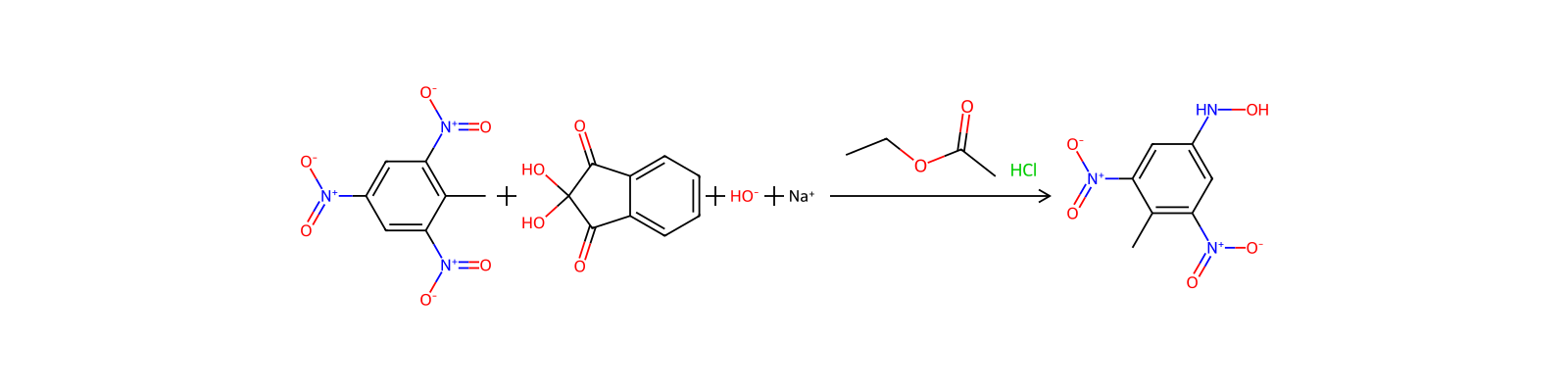


Notizen zur Verbindung
Wird geladen…