
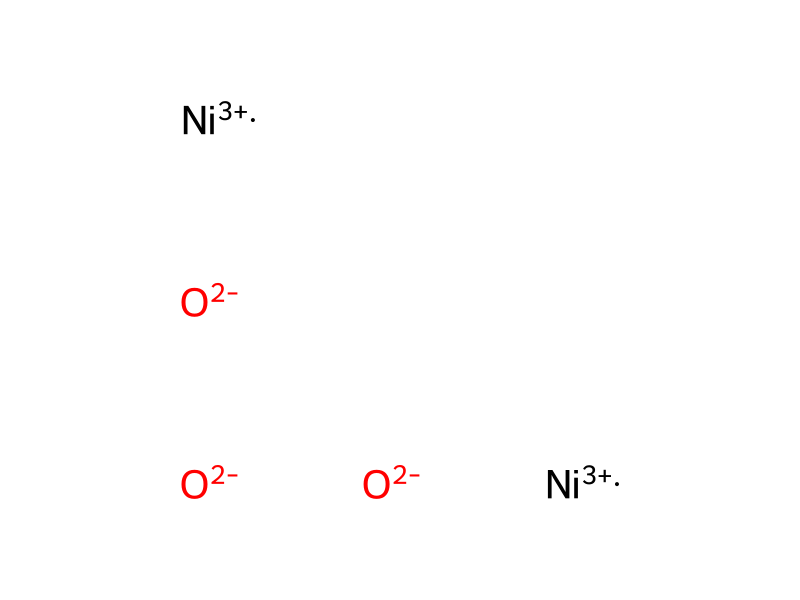
Grundinformationen
- CAS
1314-06-3- Standard-SMILES
[Ni+3].[Ni+3].[O-2].[O-2].[O-2]- InChIKey
GNMQOUGYKPVJRR-UHFFFAOYSA-N- Summenformel
- Ni2O3
- Durchschnittliche Molmasse
- 165,385 g/mol
- Monoisotopische Masse
- 163,85542966
Namen und Bezeichner
- Bevorzugter Name
- Nickel oxide (Ni2O3)
- IUPAC
- bis(nickel(3+));tris(oxygen(2-))
- Lokaler Name
- Dinickeltrioxid
- Englischer Name
- Nickel oxide
- Summenformel
- Ni2O3
- Molmasse
- 165.385
Namen und Synonyme
1314-06-3Nickel oxide (Ni2O3)Nickel sesquioxideDinickel trioxide07BD7540U5DTXSID60893854RefChem:1092356DTXCID701323894215-217-8NICKEL(III) OXIDENickel peroxideNickelic oxide
Weitere Namen anzeigen
PowderNICKEL (III) OXIDEGreyblackoxonickelketonickelNICKEL OXIDENickel(Ⅲ)oxidenickeltrioxideNicke(III) oxide
Nickel(III)oxideNickel oxide peroxideNickel() oxidenickel(3+);oxygen(2-)UNII-07BD7540U5MFCD00011143Nickel oxide blackEINECS 215-217-8
Datenbank-Bezeichner
- CAS
1314-06-3- PubChem CID
- 10313272
- DTXSID
DTXSID60893854- UNII
- 07BD7540U5
- EC Number
- 215-217-8
Eigenschaften
Berechnete Struktureigenschaften
- Polarare Oberfläche (TPSA)
- 3 Ų
- H-Brücken-Donoren
- 0
- H-Brücken-Akzeptoren
- 3
- Frei drehbare Bindungen
- 0
- Schwere Atome
- 5
- Formalladung
- 0
- Komplexität
- 0
Experimentelle und physikochemische Eigenschaften
Chemical ClassesMetals -> Nickel Compounds, Inorganic
SpringerMaterials Propertiescrystal structure
Physical DescriptionGray-black solid, soluble in water; [Merck Index] Insoluble in water; [Hawley]
Physikochemische Eigenschaften
- Schmelzpunkt
- 600 ℃ · decomposes at ~600℃ [CRC10]
- Dichte
- 4.83 · 4.83
- storage temp.
- Store at room temperature, keep dry and cool
- Löslichkeit
- 2 O; · insoluble in H2O; soluble in hot acid solutions
- Aggregatzustand
- gray-black cubic crystals
- Farbe
- gray-black cubic crystals, crystalline
- Wasserlöslichkeit
- 2 O; · insoluble H2O; very slightly soluble cold acid; dissolves in hot HCl releasing Cl2; dissolves in hot H2SO4 or HNO3 evolving O2 [MER06]
- Stabilität
- Stable.
- InChI
- InChI=1S/Ni.O/q+2;-2
- InChIKey
- KVAWBJDCAFOHRG-UHFFFAOYSA-N
- SMILES
- [Ni+2].[O-2]
- CAS Datenbank
- 1314 · 1314-06-3(CAS DataBase Reference)
- EPA chemische Informationen
- Nickel(III) oxide (1314-06-3)
Sicherheit und Regulatorisches
GHS-Klassifizierung
GHS Classification
Danger
H317: May cause an allergic skin reaction [Warning Sensitization, Skin]
P203, P260, P261, P264, P270, P272, P273, P280, P302+P352, P318, P319, P321, P333+P317, P362+P364, P405, and P501 (click each P-code to see the statement)
Danger
H317 (100%): May cause an allergic skin reaction [Warning Sensitization, Skin]
P203, P260, P261, P264, P270, P272, P273, P280, P302+P352, P318, P319, P321, P333+P317, P362+P364, P405, and P501 (click each P-code to see the statement)
Gefahrenhinweise
Regulatory Information
Chemical: Nickel oxide (Ni2O3)
Hazard Traits - Carcinogenicity
Restricted substance: Dinickel trioxide
Other Safety InformationIMAP assessments - Nickel oxide (Ni2O3): Human health tier I assessment
Hazards SummaryMay cause skin sensitization; [ESIS] Danger of skin and airway sensitization; [MAK] See Nickel and linked occupational diseases.
Hazard Classes and Categories
Skin Sens. 1 (100%)
Respiratory sensitization - Category 1
Carc. 1A
Sicherheit und Schutzausrüstung
Threshold Limit Values (TLV)0.2 [mg/m3], inhalable fraction, as Ni
Permissible Exposure Limit (PEL)1.0 [mg/m3], as Ni
Immediately Dangerous to Life or Health (IDLH)10.0 [mg/m3], as Ni
Toxikologische Informationen
Adverse EffectsSkin Sensitizer - An agent that can induce an allergic reaction in the skin.
Sicherheitsdaten
- F
- 10
- wgk
- 1
- tsca
- TSCA listed
- ridadr
- UN 1479 5.1/PG 2
- RTECS-Nr.
- QR8420000
- risk_code
- 49-43-53
- Toxizität
- mouse,LD50,subcutaneous,50mg/kg (50mg/kg),Zhurnal Vsesoyuznogo Khimicheskogo Obshchestva im. D.I. Mendeleeva. Journal of the D.I. Mendeleeva All-Union Chemical Society. Vol. 19, Pg. 186, 1974.
- hazard_code
- T
- safety_code
- 53-45-61
- hazard_class
- 5.1
- packing_group
- III
- Speicherklasse
- 6.1C - Combustible acute toxic Cat.3toxic compounds or compounds which causing chronic effects
- Hazard Classifications
- Aquatic Chronic 4Carc. 1A InhalationSkin Sens. 1STOT RE 1 Inhalation
Chemie und Industrie
Verwendung und Herstellung
Uses
Used in storage batteries; [Hawley]
Battery Manufacturing [Category: Industry]
General Manufacturing InformationNickel oxide (Ni2O3): ACTIVE
Anwendungen
BeschreibungNickel oxide (Ni2O3) is an important metal oxide used as a plating agent, surface treatment agent, and photocatalyst. Ni2O3 is also used as an electrode material in the manufacture of fuel cells and as a catalytic material in the production of electrolytic cells.
VerwendenNickel oxide (NiO) is produced from nickel minerals to form nickel oxide when heated to 400°C, which is then reduced at a temperature of 600°C, resulting in the formation of nickel oxide. It is used as electrodes in fuel cells.
Vor- und nachgelagerte Produkte
Vorgelagerte Rohstoffe
Nachgelagerte Produkte
Anbieter100 Anbieter
国药集团化学试剂有限公司86-21-63210123 · [email protected]
北京华美互利生物化工010-56205725 · [email protected]
天津市光复科技发展有限公司022-85689490 13132141716 · [email protected]
武汉欣扬瑞和化学科技有限公司13720274133 · [email protected]
廊坊乾耀科技有限公司0316-2617888 17301291189 · [email protected]
武汉楚江浩宇化工科技发展有限公司027-85881289; 15871235046 · [email protected]
江苏星科元信息科技有限公司400-605-7200 15335295587
Baoji Guokang Healthchem co.,ltd+8615604608665 15604608665 · [email protected]
Dayang Chem (Hangzhou) Co.,Ltd.+86-0571-88938639 17705817739 · [email protected]
江苏豪隆化工有限公司0513-89083520 13328092525 · [email protected]
上海迈瑞尔生化科技有限公司4006356688 18621169109 · [email protected]
上海晶抗生物工程有限公司021-54721350 13524668266 · [email protected]
湖北兴琰新材料科技有限公司13129948835 · [email protected]
梯希爱(上海)化工贸易有限公司021-61109150 · [email protected]
上海瀚鸿科技股份有限公司021-54306202 13764082696 · [email protected]
雨木(宁波)新材料有限公司13116661121
上海景颜化工科技有限公司13817811078 · [email protected]
上海杳田新材料科技有限公司021-64110338 18939791287 · [email protected]
合肥天健化工有限公司551-65418679 15856988503;15837135945 · [email protected]
天津金汇太亚化学试剂有限公司022-59582624 18622766592 · [email protected]
广东谦进化学试剂有限公司0751-2818792 13435114148 · [email protected]
山东西亚化学有限公司13355009207 13355009207 · [email protected]
四川库利南科技有限公司400-1166-196 18981987031 · [email protected]
天津希恩思生化科技有限公司400 638 7771 · [email protected]
斯百全化学(上海)有限公司021-021-021-67601398-809-809-809 15221380277 · [email protected]
艾科试剂4008-755-333 18080918076 · [email protected]
武汉卡诺斯科技有限公司153-37111468 15337111468 · [email protected]
武汉普洛夫生物科技有限公司17612776928 · [email protected]
上海将来实业股份有限公司021-61552785 · [email protected]
郑州鸿晟医药科技有限公司0371-0371-13526885213 15637198702 · [email protected]
美岚实业(上海)有限公司021-58958189 · [email protected]
上海爱蝶实业有限公司021-58957966 18930537195 · [email protected]
成都零六生物科技有限公司400-1166-196 13458535857 · [email protected]
杭州杰恒化工有限公司0571-87396432 · [email protected]
武汉弘德悦欣医药科技有限公司027-83855396 15271852016
上海兴鲁化工科技有限公司02120970332 · [email protected]
池州凯隆进出口贸易有限公司[email protected]
Sigma-Aldrich西格玛奥德里奇(上海)贸易有限公司021-61415566 800-8193336 · [email protected]
Alfa Chemistry1-516-6625404 · [email protected]
九鼎化学(上海)科技有限公司4009209199 · [email protected]
广东翁江化学试剂有限公司0751-2886766 13927870850 · [email protected]
上海玻尔化学试剂有限公司19102157732 · [email protected]
Alfa Chemistry+1-5166625404 · [email protected]
浙江珲达生物科技有限公司0571-89903022 18679456698 · [email protected]
廊坊乾耀科技有限公司0316-2132008 19932680339 · [email protected]
陕西缔都医药化工有限公司029-029-81120477 17792793610 · [email protected]
启源(广东)医药化工有限公司18026564465 · [email protected]
成都润泽本土化工有限公司028-88469284 18000562381 · [email protected]
浙江亚美纳米科技有限公司400-8200386 13456373028 · [email protected]
北京华威锐科化工科技有限公司89508211 18501085097 · [email protected]
Zugehörige Reaktionen
21


Notizen zur Verbindung
Wird geladen…