
5-Methylresorcin
Orcinol
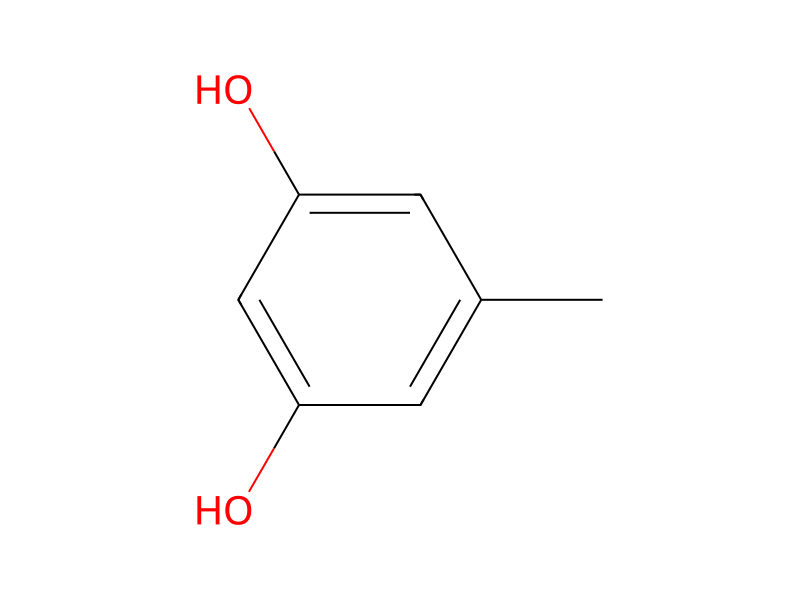
Grundinformationen
- CAS
504-15-4- Standard-SMILES
Cc1cc(O)cc(O)c1- InChIKey
OIPPWFOQEKKFEE-UHFFFAOYSA-N- Summenformel
- C7H8O2
- Durchschnittliche Molmasse
- 124,14 g/mol
- Monoisotopische Masse
- 124,0524295
Überblick
Orcinol is a 5-alkylresorcinol in which the alkyl group is specified as methyl. It has a role as an Aspergillus metabolite. It is a 5-alkylresorcinol and a dihydroxytoluene.
Namen und Bezeichner
- Bevorzugter Name
- Orcinol
- IUPAC
- 5-methylbenzene-1,3-diol
- Lokaler Name
- 5-Methylresorcin
- Englischer Name
- Orcinol
- Summenformel
- C7H8O2
- Molmasse
- 124.14
Namen und Synonyme
Orcinol3,5-Dihydroxytoluene504-15-45-METHYLRESORCINOL1,3-Dihydroxy-5-methylbenzeneOrcin5-Methyl-1,3-benzenediol1,3-Benzenediol, 5-methyl-3-Hydroxy-5-methylphenol3,5-Toluenediol534PMB3438DTXSID2060123
Weitere Namen anzeigen
Methylresorcinol5-Methyl-benzene-1,3-diolOrcilCrinoline
CHEBI:16536NSC-12441RefChem:168440DTXCID0040830207-984-25-methylbenzene-1,3-diol5-MethylresorcinResorcinol, 5-methyl-
Datenbank-Bezeichner
- CAS
504-15-4- PubChem CID
- 10436
- DTXSID
DTXSID2060123- ChEMBL
CHEMBL110059- ChEBI
CHEBI:16536- UNII
- 534PMB3438
- EC Number
- 207-984-2
- Nikkaji
- J6.215D
Eigenschaften
Berechnete Struktureigenschaften
- XLogP
- 1,6
- Polarare Oberfläche (TPSA)
- 40,5 Ų
- H-Brücken-Donoren
- 2
- H-Brücken-Akzeptoren
- 2
- Frei drehbare Bindungen
- 0
- Schwere Atome
- 9
- Formalladung
- 0
- Komplexität
- 82,9
Experimentelle und physikochemische Eigenschaften
Chemical ClassesOther Classes -> Phenols
SpringerMaterials PropertiesBoiling point
Vapor Pressure0.0028 [mmHg]
Physical DescriptionSolid; [Sigma-Aldrich MSDS]
Physikochemische Eigenschaften
- Schmelzpunkt
- 106 · 106-112 °C(lit.)
- Siedepunkt
- 290 °C · 290 °C
- Dichte
- 1.29 · 1.2900
- Brechungsindex
- 1.4922 · 1.4922 (estimate)
- Flammpunkt
- 159 °C · 159 °C
- storage temp.
- 20 °C · Store at <= 20°C.
- Löslichkeit
- 80 g/l · 80g/l
- pka
- 9.56 · 9.56±0.10(Predicted)
- Aggregatzustand
- Crystalline Powder or Crystals
Sicherheit und Regulatorisches
Sicherheitsangaben dienen nur zur Orientierung und ersetzen weder das Sicherheitsdatenblatt (SDB) des Lieferanten noch geltende Vorschriften oder eine fachliche Bewertung.
GHS-Klassifizierung
GHS Classification
Warning
H302 (100%): Harmful if swallowed [Warning Acute toxicity, oral]
P261, P264, P264+P265, P270, P271, P273, P280, P301+P317, P302+P352, P304+P340, P305+P351+P338, P319, P321, P330, P332+P317, P337+P317, P362+P364, P391, P403+P233, P405, and P501 (click each P-code to see the statement)
Aggregated GHS information provided per 66 reports by companies from 13 notifications to the ECHA C&L Inventory. Each notification may be associated with multiple companies.
Gefahrenhinweise
Regulatory Information
Chemical: 1,3-Benzenediol, 5-methyl-
Orcinol: Does not have an individual approval but may be used under an appropriate group standard
Other Safety InformationEvaluation - Chemicals that are unlikely to require further regulation to manage risks to environment
Hazards Summary
Causes convulsions and coma in subcutaneous lethal-dose studies of guinea pigs and rats; [RTECS] A skin and strong eye irritant; Harmful by ingestion; Prolonged or repeated exposure may cause eye injury; [Sigma-Aldrich MSDS] See 2-Methyl-1,4-hydroquinone, 1,3-Benzenediol, 2-methyl-, Resorcinol, and Cresol, all isomers.
Hazard Classes and CategoriesAcute Tox. 4 (100%)
Sicherheitsdaten
- wgk
- 3
- tsca
- TSCA listed
- ridadr
- 2811
- hs_code
- 2907299090
Chemie und Industrie
Pharmakologische Informationen
MeSH Pharmacological Classification
Substances used for the detection, identification, analysis, etc. of chemical, biological, or pathologic processes or conditions. Indicators are substances that change in physical appearance, e.g., color, at or approaching the endpoint of a chemical titration, e.g., on the passage between acidity and alkalinity. Reagents are substances used for the detection or determination of another substance by chemical or microscopical means, especially analysis. Types of reagents are precipitants, solvents, oxidizers, reducers, fluxes, and colorimetric reagents. (From Grant & Hackh's Chemical Dictionary, 5th ed, p301, p499)
Verwendung und Herstellung
UsesFound in many lichen species; Used as a reagent for pentoses, lignin, beet sugar, saccharoses, arabinose, and diastase; [Merck Index]
General Manufacturing Information1,3-Benzenediol, 5-methyl-: ACTIVE
Anwendungen
VerwendenOrcinol can be used to synthesize:Orcinol-containing azacryptands for use in optical amplifiers and light-emitting devices.Ternary co-crystal with 4,4′-bipyridine.Low-density carbon aerogels in the presence of formaldehyde.PEG-orcinol coumarins with potent tyrosinase inhibitory activity.
Darstellung
synthetischeOrcinol has been isolated from numerous lichen fungi (Robiquet, 1829) and can be synthesized by decarboxylation of orsellinic acid in Umbilicaria papulosa and Gliocladium roseum (Pettersson, 1965; Mosbach and Ehrensvard, 1966).Orcinol was first prepared by dehydroacetic acid, a conversion that involved ring-opening of the pyrone to a triketone. This early experiment helped establish the rich condensation chemistry of polyketides. It can be obtained by fusing extract of aloes with potash, followed by acidification.US3865884A: Preparation of orcinol
Zugehörige Reaktionen
55


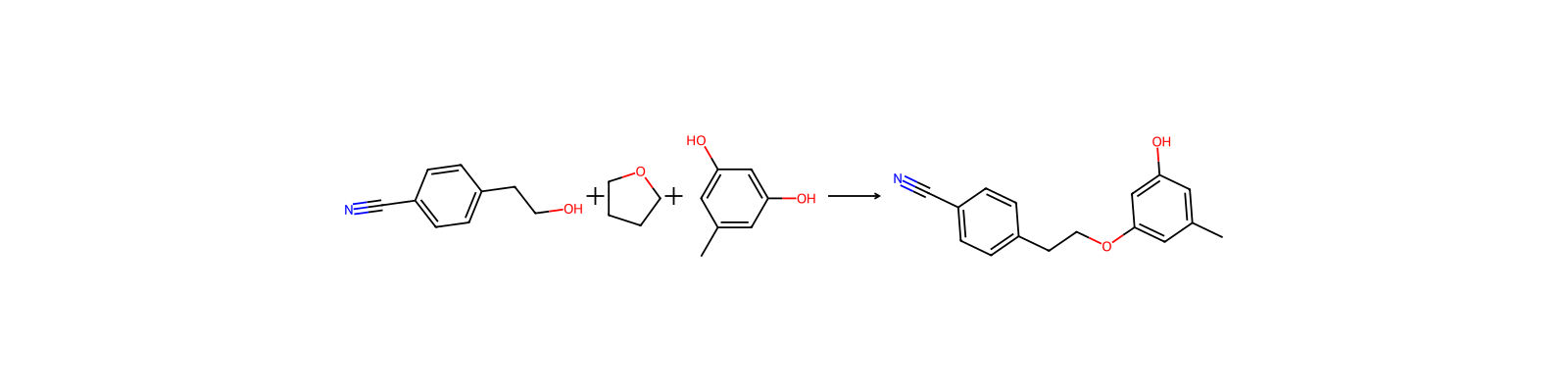


Notizen zur Verbindung
Wird geladen…