StartseiteMCPWorkbenchSkills
StartseiteWorkbenchBenachrichtigungenMein Bereich
llms.txt · MCP-AnleitungDatenschutz · Nutzungsbedingungen · Supportv1.8.0
  1. Startseite
  2. /Verbindung

1,4-Dithian

1,4-Dithiane

HCID 10452
Neue NotizNeue ReaktionAnfrage stellen
Druckvorschau
GrundinformationenÜberblickNamen und BezeichnerEigenschaftenSicherheit und RegulatorischesChemie und IndustrieZugehörige ReaktionenNotizen zur Verbindung
TeilstruktursucheÄhnliche Strukturen suchen

Grundinformationen

CAS
505-29-3
Standard-SMILES
C1CSCCS1
InChIKey
LOZWAPSEEHRYPG-UHFFFAOYSA-N
Summenformel
C4H8S2
Durchschnittliche Molmasse
120,2 g/mol
Monoisotopische Masse
120,0067426

Überblick

1,4-dithiane is a dithiane that is cyclohexane in which the -CH2- units at positions 1 and 2 have been replaced by sulfur atoms.

Namen und Bezeichner

Bevorzugter Name
1,4-Dithiane
IUPAC
1,4-dithiane
Lokaler Name
1,4-Dithian
Englischer Name
1,4-Dithiane
Summenformel
C4H8S2
Molmasse
120.24

Namen und Synonyme

1,4-DITHIANE505-29-3p-Dithiane1,4-DithiacyclohexaneDiethylene disulfidep-Dithanep-Dithiin, tetrahydro-DTXSID3024077NSC-24178CHEBI:5403274B1T5A0DTXCID304077
Weitere Namen anzeigen
FEMA 38311,4-DITHIANE 98%1,4-dithioalkane1 4-DITHIANE 97+%diethylenedisulfideDIETHYLENEDISULPHIDE
FEMA NO. 3831RefChem:73347208-007-2para-Dithiane1,4-Dithiin, tetrahydro-1,4-dithian[1,4]dithianeCCRIS 3240

Datenbank-Bezeichner

CAS
505-29-3
PubChem CID
10452
DTXSID
DTXSID3024077
ChEMBL
CHEMBL3183037
ChEBI
CHEBI:540
UNII
3274B1T5A0
EC Number
208-007-2
Nikkaji
J6.222G

Eigenschaften

Berechnete Struktureigenschaften

XLogP
1,3
Polarare Oberfläche (TPSA)
50,6 Ų
H-Brücken-Donoren
0
H-Brücken-Akzeptoren
2
Frei drehbare Bindungen
0
Schwere Atome
6
Formalladung
0
Komplexität
26,5

Experimentelle und physikochemische Eigenschaften

Chemical ClassesOther Classes -> Sulfur Compounds
SpringerMaterials PropertiesBoiling point
PesticidesPesticide -> EPA IRIS
LogP · 2 Einträge

log Kow = 0.77

0.77

Food AdditivesFLAVORING AGENT OR ADJUVANT -> FDA Substance added to food
Flavoring AgentsEU Flavoring substances
Color/FormWhite crystals
Solubility · 5 Einträge

Soluble in ethanol, ether, carbon tetrachloride, acetic acid and carbon disulfide.

In water, 3,000 mg/L at 25 °C

3 mg/mL at 25 °C

slightly soluble in hot water;soluble in hot alcohol, oil

(in ethanol)

Boiling Point · 3 Einträge

115.6 °C at 60 mm Hg

199.00 to 200.00 °C. @ 760.00 mm Hg

Sicherheit und Regulatorisches

Sicherheitsangaben dienen nur zur Orientierung und ersetzen weder das Sicherheitsdatenblatt (SDB) des Lieferanten noch geltende Vorschriften oder eine fachliche Bewertung.

GHS-Klassifizierung

GHS Classification · 4 Einträge

Warning

H315 (100%): Causes skin irritation [Warning Skin corrosion/irritation]

P261, P264, P264+P265, P271, P280, P302+P352, P304+P340, P305+P351+P338, P319, P321, P332+P317, P337+P317, P362+P364, P403+P233, P405, and P501 (click each P-code to see the statement)

Aggregated GHS information provided per 77 reports by companies from 4 notifications to the ECHA C&L Inventory. Each notification may be associated with multiple companies.

Gefahrenhinweise

Regulatory Information1,4-Dithiane: Does not have an individual approval but may be used under an appropriate group standard
Hazards Summary · 1 Eintrag

A contaminant of mustard gas; Occupational exposure may occur where mustard gas has been used or stored; Causes ataxia, lacrimation, and crusts on eyes and nose in acute lethal studies of rats; Anatomic changes to nose, liver, and kidneys observed in 90-day gavage study of rats; [HSDB] Safe when used as a flavoring agent in food; [JECFA] Causes changes in bladder and spleen weight in 90-day intermittent oral studies of rats; [RTECS]

Hazard Classes and CategoriesSkin Irrit. 2 (100%)

Sicherheit und Schutzausrüstung

Disposal Methods · 1 Eintrag

SRP: The most favorable course of action is to use an alternative chemical product with less inherent propensity for occupational exposure or environmental contamination. Recycle any unused portion of the material for its approved use or return it to the manufacturer or supplier. Ultimate disposal of the chemical must consider: the material's impact on air quality; potential migration in soil or water; effects on animal, aquatic, and plant life; and conformance with environmental and public health regulations.

Chemie und Industrie

Pharmakologische Informationen

Cellular LocationsCytoplasm

Verwendung und Herstellung

Uses · 2 Einträge

Associated with production and storage of munitions; [ChemIDplus] Used in organic synthesis; [HSDB] Used as flavoring agent; [JECFA]

Used in organic synthesis

Methods of ManufacturingInteraction of dichloroethyl sulfide with sodium or potassium sulfide.
Use Classification · 4 Einträge

Flavouring Agent -> FLAVOURING_AGENT -> JECFA Functional Classes

Flavoring Agents -> JECFA Flavorings Index

Flavouring Agent -> FLAVOURING_AGENT -> JECFA Functional Classes

Flavouring Agent -> FLAVOURING_AGENT -> JECFA Functional Classes

General Manufacturing Information · 2 Einträge

1,4-Dithiane: ACTIVE

A common degradation product of HD (purified form of sulfur mustard) that persists in the environment.

Anwendungen

Verwenden1,4-Dithiane has been studied to be used as a way for more efficient rechargeable iron-air and nickel-iron batteries through small addition of organo-sulur compounds to metal electrodes.

Vor- und nachgelagerte Produkte

Vorgelagerte Rohstoffe

2-chloroethanethiolHydrogenchlorid

Nachgelagerte Produkte

Ethylensulfid

Zugehörige Reaktionen

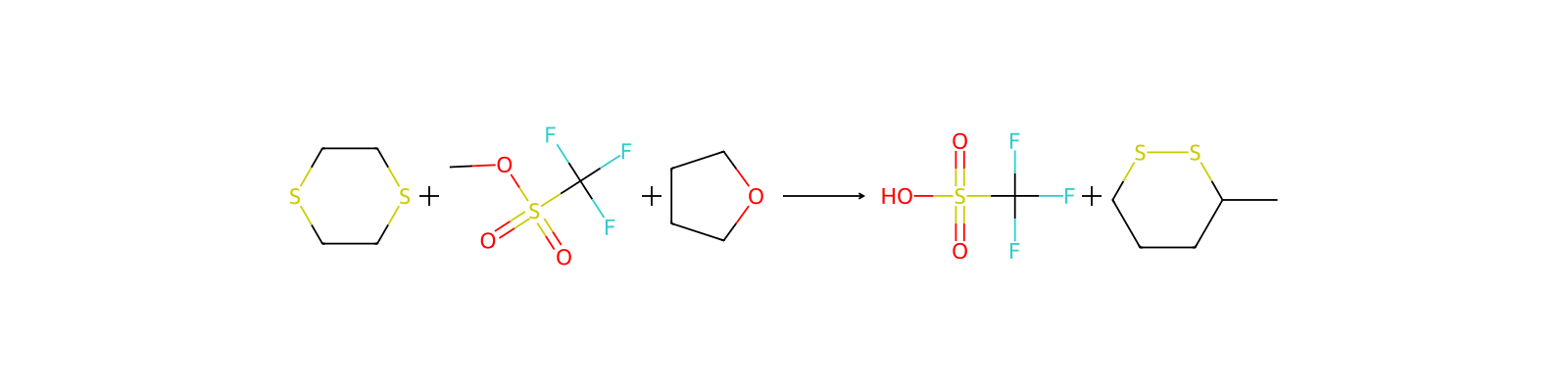
1
Reaktionsaufzeichnung erstellen
Reaktionsgleichung von HRID 43296
HRID 43296als Eduktuspto-grants-2013_09

Notizen zur Verbindung

Wird geladen…

Auf dieser SeiteGrundinformationenÜberblickNamen und BezeichnerEigenschaftenSicherheit und RegulatorischesChemie und IndustrieZugehörige ReaktionenNotizen zur Verbindung
Weitere Aktionen
Neue NotizNeue ReaktionAnfrage stellen

199-200 °C

DecompositionWhen heated to decomposition it emits toxic vapors of /sulfur oxides/.
Melting Point · 2 Einträge

112.3 °C

112 - 113 °C

Vapor Pressure · 2 Einträge

1.57 [mmHg]

0.80 mm Hg at 25 °C

Physikochemische Eigenschaften

Schmelzpunkt
107 · 107-113 °C (lit.)
Siedepunkt
200 °C · 200 °C (lit.)
Dichte
1.062 · 1.062 (estimate)
Brechungsindex
1.5981 · 1.5981 (estimate)
FEMA
3831 · 3831 | 1,4-DITHIANE
storage temp.
2 · 2-8°C
Löslichkeit
Chloroform (Sparingly), DMSO (Slightly)
Aggregatzustand
solid
Geruch (Odor)
0.1 % · at 0.10 % in propylene glycol. sulfurous solvent garlic onion pyridine
Geruchsart
seafood
Spezifische Wärmekapazität
0.91 J/ · Cp(gas): 0.91 J/(g·K), at 25℃
JECFA Number
456 · 456
Henry's Law Constant
2.4 · 2.4×10-1 mol/(m3Pa) at 25℃, Duchowicz et al. (2020)
Stabilität
Stable. Incompatible with strong oxidizing agents. Probably combustible.
InChI
1S/C4H8S2/c1-2-6-4-3-5-1/h1-4H2
InChIKey
LOZWAPSEEHRYPG-UHFFFAOYSA-N
SMILES
C1CSCCS1
LogP
1.12 · 1.12
CAS Datenbank
505 · 505-29-3(CAS DataBase Reference)
NIST chemische Informationen
1 · 1,4-Dithiane(505-29-3)
EPA chemische Informationen
1 · 1,4-Dithiane (505-29-3)

Toxikologische Informationen

Toxicological InformationRanking: 422 (total points: 507.76)
Target OrgansNervous
Ecotoxicity ValuesEC50 Daphnia magna (Water flea; intoxication, immobilization) 23.2 mg/L/24 hr /formulated product/ /Conditions of bioassay not specified in source examined/
Environmental Fate · 3 Einträge

TERRESTRIAL FATE: Based on a classification scheme(1), a Koc value of 63(2), indicates that 1,4-dithiane is expected to have high mobility in soil(SRC). Volatilization of 1,4-dithiane from moist soil surfaces is expected to be an important fate process(SRC) given an estimated Henry's Law constant of 4.2X10⁻⁵ atm-cu m/mole(SRC), derived from its vapor pressure, 0.8 mm Hg(3), and water solubility, 3,000 mg/l(3). 1,4-Dithiane is not expected to volatilize from dry soil surfaces(SRC) based upon its vapor pressure(3). No biodegradation data were located for 1,4-dithiane(SRC,2006); however, its detection in environmental samples long after the release of mustard gas suggests it may persist in the environment(3).

AQUATIC FATE: Based on a classification scheme(1), a Koc value of 63(2), indicates that 1,4-dithiane is not expected to adsorb to suspended solids and sediment(SRC). Volatilization from water surfaces is expected(3) based upon an estimated Henry's Law constant of 4.2X10⁻⁵ atm-cu m/mole(SRC), derived from its vapor pressure, 0.8 mm Hg(4), and water solubility, 3,000 mg/l(4). Using this Henry's Law constant and an estimation method(3), volatilization half-lives for a model river and model lake are 16 hours and 11 days, respectively(SRC). According to a classification scheme(5), an estimated BCF of 3(SRC), from a log Kow of 0.77(4) and a regression-derived equation(6), suggests the potential for bioconcentration in aquatic organisms is low(SRC). No biodegradation data were located for 1,4-dithiane(SRC,2006); however, its detection in environmental samples long after the release of mustard gas suggests it may persist in the environment(4).

ATMOSPHERIC FATE: According to a model of gas/particle partitioning of semivolatile organic compounds in the atmosphere(1), 1,4-dithiane, which has a vapor pressure of 0.80 mm Hg at 25 °C (2), is expected to exist solely as a vapor in the ambient atmosphere. Vapor-phase 1,4-dithiane is degraded in the atmosphere by reaction with photochemically-produced hydroxyl radicals(SRC); the half-life for this reaction in air is estimated to be 10 hours(SRC), calculated from its rate constant of 3.9X10⁻¹¹ cu cm/molecule-sec at 25 °C(SRC) that was derived using a structure estimation method(3).

Adverse EffectsNeurotoxin - Other CNS neurotoxin
EPA IRIS Information · 3 Einträge

1,4-Dithiane

Nervous

1 x 10 ^-2 mg/kg-day

Soil Adsorption/MobilityThe Koc value of 1,4-dithiane was reported as 63(1) in an unspecified soil. According to a classification scheme(2), this Koc value suggests that 1,4-dithiane is expected to have high mobility in soil(SRC).
Artificial Pollution Sources · 1 Eintrag

1,4-Dithiane's production and use as an organic synthesis reagent(1) may result in its release to the environment through various waste streams(SRC). 1,4-Dithiane has also been identified as an impurity and thermal decomposition product of mustard gas(2).

Environmental BiodegradationAEROBIC: No biodegradation data were located for 1,4-dithiane(SRC,2006); however, its detection in environmental samples long after the release of mustard gas suggests it is persistent in the environment(1).
Sediment/Soil Concentrations · 1 Eintrag

SOIL: 1,4-Dithiane was identified, not quantified, in soil samples, sheep wool, and a bomb casing in November 1988, from a region of Iraq near the Turkish and Iranian border(1). 1,4-Dithiane was identified, not quantified, in soil samples from Fort McClellan, Alabama(2).

Environmental Bioconcentration · 1 Eintrag

An estimated BCF of 3 was calculated for 1,4-dithiane (SRC), using a log Kow of 0.77(1) and a regression-derived equation(2). According to a classification scheme(3), this BCF suggests the potential for bioconcentration in aquatic organisms is low(SRC).

Volatilization from Water/Soil · 1 Eintrag

The Henry's Law constant for 1,4-dithiane is estimated as 4.2X10⁻⁵ atm-cu m/mole(SRC), from its vapor pressure of 0.80 mm Hg and water solubility of 3,000 mg/L(1). This Henry's Law constant indicates that 1,4-dithiane is expected to volatilize from water surfaces(2). Based on this Henry's Law constant, the volatilization half-life from a model river (1 m deep, flowing 1 m/sec, wind velocity of 3 m/sec)(2) is estimated as 16 hours(SRC). The volatilization half-life from a model lake (1 m deep, flowing 0.05 m/sec, wind velocity of 0.5 m/sec)(2) is estimated as 11 days(SRC). 1,4-Dithiane is not expected to volatilize from dry soil surfaces(SRC) based upon its vapor pressure(1).

Sicherheitsdaten

wgk
2
tsca
TSCA listed
ridadr
UN 3335
RTECS-Nr.
JO5069000
risk_code
36/37/38
hazard_code
Xi
safety_code
26-36
Speicherklasse
11 - Combustible Solids
Giftige Stoffe Daten
505-29-3(Hazardous Substances Data)
Hazard Classifications
Eye Irrit. 2Skin Irrit. 2STOT SE 3

Ergänzende Hinweise

DefinitionChEBI: A dithiane that is cyclohexane in which the -CH2- units at positions 1 and 2 have been replaced by sulfur atoms.