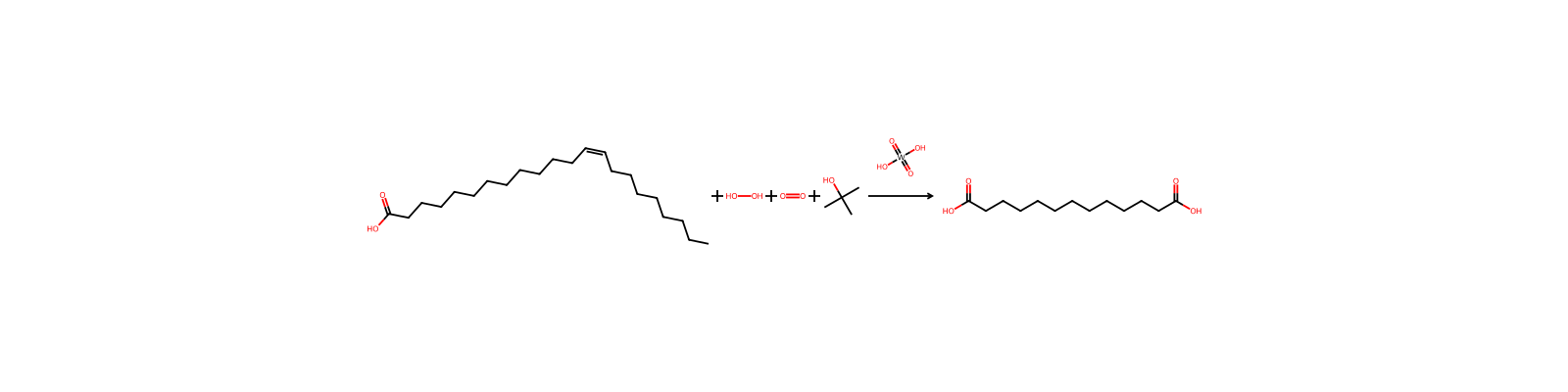
Tridecandisaeure
Tridecanedioic acid
HCID 10458
Daten werden ergänzt – lade die Seite später neu, um den aktuellen Stand zu sehen

Grundinformationen
- CAS
505-52-2- Standard-SMILES
O=C(O)CCCCCCCCCCCC(=O)O- InChIKey
DXNCZXXFRKPEPY-UHFFFAOYSA-N- Summenformel
- C13H24O4
- Durchschnittliche Molmasse
- 244,33 g/mol
- Monoisotopische Masse
- 244,16745925
Überblick
Tridecanedioic acid is an alpha,-dicarboxylic acid that is undecane substituted by carboxylic acid groups at positions C-1 and C-11. It has a role as a metabolite.
Namen und Bezeichner
- Bevorzugter Name
- Tridecanedioic acid
- IUPAC
- tridecanedioic acid
- Lokaler Name
- Tridecandisaeure
- Englischer Name
- 1,11-Undecanedicarboxylic acid
- Summenformel
- C13H24O4
- Molmasse
- 244.33
Namen und Synonyme
TRIDECANEDIOIC ACID505-52-21,11-Undecanedicarboxylic acidBrassylic acid1,13-Tridecanedioic acidDTXSID9021683PL3IQ40C34CHEBI:73718NSC-9498DTXCID901683RefChem:191445208-011-4
Weitere Namen anzeigen
UNDECANE-1TRIDECANDIOIC ACID1,13-Brassylic acidTridecanedionicacid11-DECARBOXYLIC ACID1,11-Undecanedicarbo
Brassilic acidtridecanedioateBrassilateUndecane-1,11-dicarboxylic acidMFCD00002740SCHEMBL20802NSC9498Tox21_302982
Datenbank-Bezeichner
- CAS
505-52-2- PubChem CID
- 10458
- DTXSID
DTXSID9021683- ChEMBL
CHEMBL3187746- ChEBI
CHEBI:73718- UNII
- PL3IQ40C34
- EC Number
- 208-011-4
- Nikkaji
- J102.933I
Eigenschaften
Berechnete StruktureigenschaftenWird ergänzt
- XLogP
- 3,7
- Polarare Oberfläche (TPSA)
- 74,6 Ų
- H-Brücken-Donoren
- 2
- H-Brücken-Akzeptoren
- 4
- Frei drehbare Bindungen
- 12
- Schwere Atome
- 17
- Formalladung
- 0
- Komplexität
- 191
Experimentelle und physikochemische Eigenschaften
LipidsFatty Acyls [FA] -> Fatty Acids and Conjugates [FA01] -> Dicarboxylic acids [FA0117]
SpringerMaterials PropertiesCrystal structure
Solubility1.5 mg/mL at 21 °C
Melting Point111 °C
Physical Description
Other Solid
Solid
Physikochemische Eigenschaften
- Schmelzpunkt
- 112 · 112-114 °C(lit.)
- Siedepunkt
- 415.5 °C · 415.5°C (rough estimate)
- Dichte
- 1.15 g/cm3 · 1.15 g/cm3 (25℃)
- Dampfdruck
- 0 Pa · 0Pa at 20℃
- Brechungsindex
- 1.4453 · 1.4453 (estimate)
- storage temp.
- Sealed in dry,Room Temperature
Sicherheit und Regulatorisches
Sicherheitsangaben dienen nur zur Orientierung und ersetzen weder das Sicherheitsdatenblatt (SDB) des Lieferanten noch geltende Vorschriften oder eine fachliche Bewertung.
GHS-Klassifizierung
GHS Classification
Warning
H315 (25.6%): Causes skin irritation [Warning Skin corrosion/irritation]
P261, P264, P264+P265, P271, P273, P280, P302+P352, P304+P340, P305+P351+P338, P319, P321, P332+P317, P337+P317, P362+P364, P403+P233, P405, and P501 (click each P-code to see the statement)
Aggregated GHS information provided per 168 reports by companies from 6 notifications to the ECHA C&L Inventory. Each notification may be associated with multiple companies.
Gefahrenhinweise
Regulatory Information
Tridecanedioic acid is listed on the EPA's Chemical Data Reporting (CDR) system. Manufacturers and importers of Tridecanedioic acid are required to report information about their production and use of this chemical to the EPA under the Toxic Substances Control Act (TSCA). (40 eCFR Part 711)
Status: Active Update: 07-01-2014 https://echa.europa.eu/registration-dossier/-/registered-dossier/5931
Tridecanedioic acid: Does not have an individual approval but may be used as a component in a product covered by a group standard. It is not approved for use as a chemical in its own right.
Hazard Classes and CategoriesSkin Irrit. 2 (25.6%)
Sicherheitsdaten
- wgk
- 3
- tsca
- TSCA listed
- hs_code
- 29171990
- risk_code
- 36/37/38
- hazard_code
- Xi
- safety_code
- 26-37/39
- Speicherklasse
- 11 - Combustible Solids
Chemie und Industrie
Pharmakologische Informationen
Cellular LocationsMembrane
Verwendung und Herstellung
U.S. Production2023: 50,000 - <250,000 lb
Industry UsesBinder
General Manufacturing Information
Adhesive Manufacturing
Tridecanedioic acid: ACTIVE
Anwendungen
Verwenden1,11-Undecanedicarboxylic Acid is used in the synthesis of two Bis(tetrahydroisoquinoline) which were highly cytotoxic for cancer-cell cultures and less toxic to healthy cells and exhibited noticeable antimicrobial activity against Gram-positive and Gram-negative bacteria and fungal strain Candida albicans.
Vor- und nachgelagerte Produkte
Vorgelagerte Rohstoffe
Nachgelagerte Produkte
Zugehörige Reaktionen
3

