HuagongsheHuagongshe Chemie-Druckbericht · Nur für Forschungszwecke
Kohlensure, Cesiumsalz
Caesiumbicarbonate · Hydrogen cesium carbonate · CESIUM HYDROGEN CARBONATE · carbonic acid, cesium salt · Carbonic acid/cesium,(1:x) salt · CESIUM HYDROGEN CARBONATE, 99.9% · CUP Cesium Hydroden Carbonate · Cesium hydrogen carbonate, 98% (metals basis)
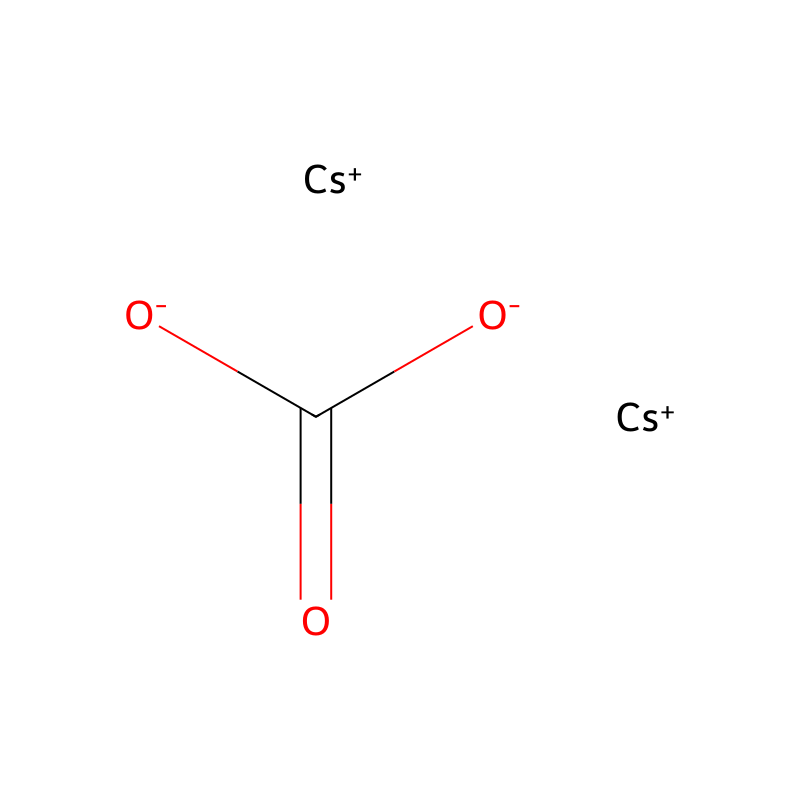
Identifikatoren & physikalische Daten
| CAS No. | 29703-01-3 |
|---|---|
| Summenformel | CCs2O3 |
| Durchschnittliche Molmasse | 325,82 g/mol |
| Monoisotopische Masse | 325,7956478 g/mol |
| SMILES | O=C([O-])[O-].[Cs+].[Cs+] |
| InChIKey | FJDQFPXHSGXQBY-UHFFFAOYSA-L |
| PubChem CID | 10796 |
| EC No. | 208-591-9 |
| DTXSID | DTXSID0052178 |
| Lokaler Name | Kohlensure, Cesiumsalz |
Chemische & physikalische Eigenschaften
| Polarare Oberfläche (TPSA) | 63,2 |
|---|---|
| H-Brücken-Donoren | 0 |
| H-Brücken-Akzeptoren | 3 |
| Frei drehbare Bindungen | 0 |
| Schwere Atome | 6 |
| Formalladung | 0 |
| Komplexität | 18 |
| Dichte | 4.24 @25 °C |
| Schmelzpunkt | 793 °C175°C |
| Physical Description | Dry PowderLiquidHighly deliquescent solid[Merck Index] White odorless powder or granulesHygroscopic[Alfa Aesar MSDS] |
| Aggregatzustand | Crystalline Aggregates |
| Löslichkeit | Soluble in water. |
| InChI | InChI=1S/CH2O3.Cs/c2-1(3)4/h(H2,2,3,4)/q+1/p-1 |
| InChIKey | ZMCUDHNSHCRDBT-UHFFFAOYSA-M |
| SMILES | C([O-])(=O)O.[Cs+] |
| CAS Datenbank | 29703-01-3(CAS DataBase Reference) |
Sicherheit & Vorschriften
| GHS-Einstufung | This chemical does not meet GHS hazard criteria for 1% (2 of 200) of reports.DangerH315 (41.5%): Causes skin irritation [Warning Skin corrosion/irritation]H318 (59%): Causes serious eye damage [Danger Serious eye damage/eye irritation]H319 (40%): Causes serious eye irritation [Warning Serious eye damage/eye irritation]H335 (41%): May cause respiratory irritation [Warning Specific target organ toxicity, single exposureRespiratory tract irritation]H361f (54.5%): Suspected of damaging fertility [Warning Reproductive toxicity]H373 (58.5%): May causes damage to organs through prolonged or repeated exposure [Warning Specific target organ toxicity, repeated exposure]P203, P260, P261, P264, P264+P265, P271, P280, P302+P352, P304+P340, P305+P351+P338, P305+P354+P338, P317, P318, P319, P321, P332+P317, P337+P317, P362+P364, P403+P233, P405, and P501 (click each P-code to see the statement)Aggregated GHS information provided per 200 reports by companies from 22 notifications to the ECHA C&L Inventory. Each notification may be associated with multiple companies.Reported as not meeting GHS hazard criteria per 2 of 200 reports by companies.There are 21 notifications provided by 198 of 200 reports by companies with hazard statement code(s).Information may vary between notifications depending on impurities, additives, and other factors. The percentage value in parenthesis indicates the notified classification ratio from companies that provide hazard codes. Only hazard codes with percentage values above 10% are shown. For more detailed information, please visit ECHA C&L website. |
|---|---|
| Regulatorische Informationen | Chemical: Carbonic acid, dicesium saltCarbonic acid, cesium salt (1:2) is listed on the EPA's Chemical Data Reporting (CDR) system. Manufacturers and importers of Carbonic acid, cesium salt (1:2) are required to report information about their production and use of this chemical to the EPA under the Toxic Substances Control Act (TSCA). (40 eCFR Part 711)Status: Active Update: 27-01-2023 https://echa.europa.eu/registration-dossier/-/registered-dossier/11170Carbonic acid, dicaesium salt: Does not have an individual approval but may be used under an appropriate group standard |
| Weitere Sicherheitsinformationen |
Anwendungen & Verwendung
Verwenden
Cesium hydrogen carbonate is used as pharmaceutical intermediate.