StartseiteMCPWorkbenchSkills
StartseiteWorkbenchBenachrichtigungenMein Bereich
llms.txt · MCP-AnleitungDatenschutz · Nutzungsbedingungen · Supportv1.8.0
  1. Startseite
  2. /Verbindung

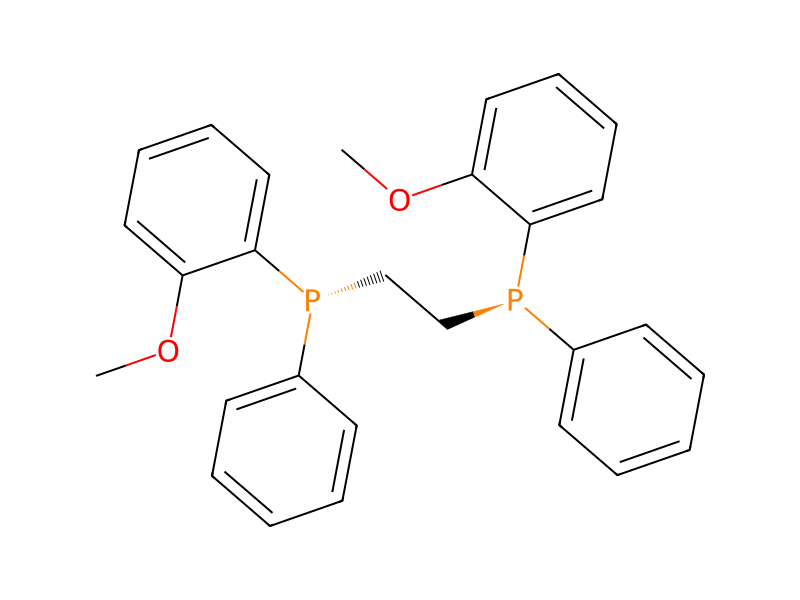
Dipamp, (R,R)-

HCID 10884975
Neue NotizNeue ReaktionAnfrage stellen
Druckvorschau

Daten werden ergänzt – lade die Seite später neu, um den aktuellen Stand zu sehen
GrundinformationenNamen und BezeichnerEigenschaftenSicherheit und RegulatorischesChemie und IndustrieZugehörige ReaktionenNotizen zur Verbindung
TeilstruktursucheÄhnliche Strukturen suchen

Grundinformationen

CAS
55739-58-7
Standard-SMILES
COc1ccccc1[P@](CC[P@](c1ccccc1)c1ccccc1OC)c1ccccc1
InChIKey
QKZWXPLBVCKXNQ-ROJLCIKYSA-N
Summenformel
C28H28O2P2
Durchschnittliche Molmasse
458,5 g/mol
Monoisotopische Masse
458,15645413

Namen und Bezeichner

Bevorzugter Name
Dipamp, (R,R)-
IUPAC
(2-methoxyphenyl)-[2-[(2-methoxyphenyl)-phenylphosphanyl]ethyl]-phenylphosphane
Englischer Name
(R,R)-DIPAMP
Summenformel
C28H28O2P2
Molmasse
458.47

Namen und Synonyme

(R,R)-DIPAMP55739-58-71,2-Bis((R)-(2-methoxyphenyl)(phenyl)phosphino)ethaneDipamp, (R,R)-(-)-Pamp(R,R)-Dipamp [MI](-)-DIPAMPPamp, (-)-BLJ831OWLW(R,R)-1,2-Ethanediylbis((2-methoxyphenyl)phenylphosphine)DTXSID401027540Phosphine, 1,1'-(1,2-ethanediyl)bis(1-(2-methoxyphenyl)-1-phenyl-, (1R,1'R)-rel-
Weitere Namen anzeigen
R)-DIPAMP(R,R)-Dipamp ,0%(R,R)-DIPAMP,97%Ethylenebis(2-methoxyphenylphenylphosphine)Ethylenebis[phenyl(2-methoxyphenyl)phosphine]Ethylenebis[(2-methoxyphenyl)phenylphosphine](R,R)-Diphenylbis-[(o-anisyl)-methylenephosphine]
(R,R)-1,2-Ethanediylbis[(2-methoxyphenyl)phenylphosphine](R,R)-1,2-Bis[(2-methoxyphenyl)phenylphosphino]ethane1,2-Bis[(R)-(2-methoxyphenyl)(phenyl)phosphino]ethaneRefChem:588780(R,R)-1,2-Bis((2-methoxyphenyl)phenylphosphino)ethaneDTXCID301513132622-540-1MFCD05863546

Datenbank-Bezeichner

CAS
55739-58-7
PubChem CID
10884975
DTXSID
DTXSID401027540
UNII
BLJ831OWLW
EC Number
622-540-1

Eigenschaften

Berechnete StruktureigenschaftenWird ergänzt

XLogP
5,8
Polarare Oberfläche (TPSA)
18,5 Ų
H-Brücken-Donoren
0
H-Brücken-Akzeptoren
2
Frei drehbare Bindungen
9
Schwere Atome
32
Formalladung
0
Komplexität
472

Physikochemische Eigenschaften

Schmelzpunkt
102 · 102-104 °C
Siedepunkt
580.2 · 580.2±45.0 °C(Predicted)
Brechungsindex
-85 ° · -85 ° (C=1, CHCl3)
Aggregatzustand
Crystalline Powder
Farbe
White
InChI
1S/C28H28O2P2/c1-29-25-17-9-11-19-27(25)31(23-13-5-3-6-14-23)21-22-32(24-15-7-4-8-16-24)28-20-12-10-18-26(28)30-2/h3-20H,21-22H2,1-2H3/t31-,32-/m1/s1
InChIKey
QKZWXPLBVCKXNQ-ROJLCIKYSA-N
SMILES
COc1ccccc1P(CCP(c2ccccc2)c3ccccc3OC)c4ccccc4
CAS Datenbank
55739 · 55739-58-7

Sicherheit und Regulatorisches

Sicherheitsangaben dienen nur zur Orientierung und ersetzen weder das Sicherheitsdatenblatt (SDB) des Lieferanten noch geltende Vorschriften oder eine fachliche Bewertung.

GHS-Klassifizierung

GHS Classification · 4 Einträge

Warning

H315 (100%): Causes skin irritation [Warning Skin corrosion/irritation]

P261, P264, P264+P265, P271, P273, P280, P302+P352, P304+P340, P305+P351+P338, P319, P321, P332+P317, P337+P317, P362+P364, P403+P233, P405, and P501 (click each P-code to see the statement)

Aggregated GHS information provided per 40 reports by companies from 3 notifications to the ECHA C&L Inventory. Each notification may be associated with multiple companies.

Gefahrenhinweise

Hazard Classes and CategoriesSkin Irrit. 2 (100%)

Sicherheitsdaten

wgk
3
tsca
No
hs_code
29319090
risk_code
36/37/38
hazard_code
Xi
safety_code
37/39-26-36/37
Speicherklasse
11 - Combustible Solids
Hazard Classifications
Aquatic Chronic 4Eye Irrit. 2Skin Irrit. 2STOT SE 3

Chemie und Industrie

Anwendungen

Verwenden(R,R)-DIPAMP is a reactant used in the synthesis of Rhodium diphosphine trinuclear complexes.

Vor- und nachgelagerte Produkte

Vorgelagerte Rohstoffe

Kupfer(II)-chloridn-HexanAcetonitrilEphedrinTrichlorsilanTributylaminDiethylamin, in wässriger LösungDi-iso-PropylaminTetrachlormethanPentachlorphosphoran2-BromanisolTetrahydrofuranEthylacetatDichlor(phenyl)phosphinKupfer(I)-chloridL-MentholHydrogenchloridPyridinThionyldichloridMagnesiumMethyljodid

Zugehörige Reaktionen

272
Reaktionsaufzeichnung erstellen
Reaktionsgleichung von HRID 1299376
HRID 1299376als KatalysatorHigh-throughput exploration of 50,688 Pd-, Ni- and Cu-catalysed C–N coupling reactions
Reaktionsgleichung von HRID 1299377
HRID 1299377als KatalysatorHigh-throughput exploration of 50,688 Pd-, Ni- and Cu-catalysed C–N coupling reactions
Reaktionsgleichung von HRID 1299378
HRID 1299378als KatalysatorHigh-throughput exploration of 50,688 Pd-, Ni- and Cu-catalysed C–N coupling reactions
Reaktionsgleichung von HRID 1299379
HRID 1299379als KatalysatorHigh-throughput exploration of 50,688 Pd-, Ni- and Cu-catalysed C–N coupling reactions
Reaktionsgleichung von HRID 1299380
HRID 1299380als KatalysatorHigh-throughput exploration of 50,688 Pd-, Ni- and Cu-catalysed C–N coupling reactions
Reaktionsgleichung von HRID 1299381
HRID 1299381als KatalysatorHigh-throughput exploration of 50,688 Pd-, Ni- and Cu-catalysed C–N coupling reactions
Reaktionsgleichung von HRID 1299382
HRID 1299382als KatalysatorHigh-throughput exploration of 50,688 Pd-, Ni- and Cu-catalysed C–N coupling reactions
Reaktionsgleichung von HRID 1299383
HRID 1299383als KatalysatorHigh-throughput exploration of 50,688 Pd-, Ni- and Cu-catalysed C–N coupling reactions
Seite 1 von 34

Notizen zur Verbindung

Wird geladen…

Auf dieser SeiteGrundinformationenNamen und BezeichnerEigenschaftenSicherheit und RegulatorischesChemie und IndustrieZugehörige ReaktionenNotizen zur Verbindung
Weitere Aktionen
Neue NotizNeue ReaktionAnfrage stellen
Butyllithium