
Dimoxystrobin

Grundinformationen
- CAS
149961-52-4- Standard-SMILES
CNC(=O)/C(=N/OC)c1ccccc1COc1cc(C)ccc1C- InChIKey
WXUZAHCNPWONDH-DYTRJAOYSA-N- Summenformel
- C19H22N2O3
- Durchschnittliche Molmasse
- 326,4 g/mol
- Monoisotopische Masse
- 326,16304257
Namen und Bezeichner
- Bevorzugter Name
- Dimoxystrobin
- IUPAC
- (2E)-2-[2-[(2,5-dimethylphenoxy)methyl]phenyl]-2-methoxyimino-N-methylacetamide
- Englischer Name
- DIMOXYSTROBIN PESTANAL
- Summenformel
- C19H22N2O3
- Molmasse
- 326.39
Namen und Synonyme
Dimoxystrobin149961-52-4Dimoxystrobin [MI]BAS-505SSF-129UNII-27J9BR16KUdimoxystrobine27J9BR16KUDTXSID3057981CHEBI:83218(2E)-2-[2-[(2,5-dimethylphenoxy)methyl]phenyl]-2-methoxyimino-N-methylacetamideBenzeneacetamide, 2-((2,5-dimethylphenoxy)methyl)-alpha-(methoxyimino)-N-methyl-
Weitere Namen anzeigen
dimoxystrolinPCB No 118 OEKANALDimoxystrobin solutionDIMOXYSTROBIN PESTANALC12775000 DimoxystrobinDimethomorph Impurity 6Kresoxim-methyl Impurity 5Dimoxystrobin in AcetonitrileDimoxystrobin 100 μg/ml AcetonitrileDimoxystrobin 10.0 μg/ml Ethyl acetate
(2E)-2-{2-[(2,5-dimethylphenoxy)methyl]phenyl}-2-(methoxyimino)-N-methylacetamideBenzeneacetamide, 2-((2,5-dimethylphenoxy)methyl)-alpha-(methoxyimino)-N-methyl-, (alphaE)-(alphaE)-2-[(2,5-dimethylphenoxy)methyl]-alpha-(methoxyimino)-N-methylbenzeneacetamide(E)-2-(methoxyimino)-N-methyl-2-[alpha-(2,5-xylyloxy)-o-tolyl]acetamideBENZENEACETAMIDE, 2-((2,5-DIMETHYLPHENOXY)METHYL)-.ALPHA.-(METHOXYIMINO)-N-METHYL-Benzeneacetamide, 2-[(2,5-dimethylphenoxy)methyl]-alpha-(methoxyimino)-N-methyl-, (alphaE)-BENZENEACETAMIDE, 2-((2,5-DIMETHYLPHENOXY)METHYL)-.ALPHA.-(METHOXYIMINO)-N-METHYL-, (.ALPHA.E)-(E)-2-(methoxyimino)-N-methyl-2-(alpha-(2,5-xylyloxy)-o-tolyl)acetamide
Datenbank-Bezeichner
- CAS
149961-52-4- PubChem CID
- 10936292
- DTXSID
DTXSID3057981- ChEMBL
CHEMBL2269453- ChEBI
CHEBI:83218- UNII
- 27J9BR16KU
- EC Number
- 604-712-8
- Nikkaji
- J1.077.232J、J1.114.970G
Eigenschaften
Berechnete Struktureigenschaften
- XLogP
- 3,9
- Polarare Oberfläche (TPSA)
- 59,9 Ų
- H-Brücken-Donoren
- 1
- H-Brücken-Akzeptoren
- 4
- Frei drehbare Bindungen
- 6
- Schwere Atome
- 24
- Formalladung
- 0
- Komplexität
- 438
Physikochemische Eigenschaften
- Dichte
- 1.09 · 1.09±0.1 g/cm3(Predicted)
- storage temp.
- 2 · 2-8°C
- Löslichkeit
- DMSO (Slightly), Methanol (Slightly)
- pka
- 11.29 · 11.29±0.46(Predicted)
- BRN
- 8430159 · 8430159
- Henry's Law Constant
- 2.2 · 2.2×107 mol/(m3Pa) at 25℃, Maniere et al. (2011)
- Major Application
- agricultureenvironmental
- InChI
- 1S/C19H22N2O3/c1-13-9-10-14(2)17(11-13)24-12-15-7-5-6-8-16(15)18(21-23-4)19(22)20-3/h5-11H,12H2,1-4H3,(H,20,22)/b21-18-
- InChIKey
- WXUZAHCNPWONDH-UZYVYHOESA-N
- SMILES
- CNC(=O)C(=N/OC)\c1ccccc1COc2cc(C)ccc2C
- LogP
- 5.08 · 5.080 (est)
Sicherheit und Regulatorisches
GHS-Klassifizierung
GHS Classification
Warning
H332: Harmful if inhaled [Warning Acute toxicity, inhalation];H351: Suspected of causing cancer [Warning Carcinogenicity];H361d: Suspected of damaging the unborn child [Warning Reproductive toxicity];H400: Very toxic to aquatic life [Warning Hazardous to the aquatic environment, acute hazard];H410: Very toxic to aquatic life with long lasting effects [Warning Hazardous to the aquatic environment, long-term hazard]
P203, P261, P271, P273, P280, P304+P340, P317, P318, P391, P405, and P501 (click each P-code to see the statement)
Warning
Gefahrenhinweise
Regulatory Information
Council Directive (EEC) No 414/1991 (Repealed by Reg. EC No 1107/2009 (amended))
Dir 06/75/EC, Reg. (EU) 2018/1796, Reg. (EU) 2019/2094, Reg. (EU) 2021/2068, Reg. (EU) 2021/52, Reg. (EU) 2023/1436, Reg. (EU) No 1136/2013, Reg. (EU) No 2023/115, Reg. (EU) No 540/2011, Reg.(EU) 84/2018
Hazard Classes and Categories
Acute Tox. 4 (100%);Carc. 2 (79.9%);Repr. 2 (63.5%);Repr. 2 (16.4%);Aquatic Acute 1 (100%);Aquatic Chronic 1 (79.9%)
Carcinogenicity - category 2;Reproductive toxicity - category 2;Acute toxicity - category 4;Hazardous to the aquatic environment (acute) - category 1;Hazardous to the aquatic environment (chronic) - category 1
Acute toxicity (Inhalation: Dusts and mists) - Category 4;Carcinogenicity - Category 2;Reproductive toxicity - Category 2;Specific target organ toxicity - Single exposure - Category 2 (systemic);Specific target organ toxicity - Repeated exposure - Category 2 (gastrointestinal tract);Hazardous to the aquatic environment (Acute) - Category 1;Hazardous to the aquatic environment (Long-term) - Category 1
Carc. 2;Repr. 2;Acute Tox. 4;Aquatic Acute 1;Aquatic Chronic 1
Regulatorische Informationen
Regulatory Information
Council Directive (EEC) No 414/1991 (Repealed by Reg. EC No 1107/2009 (amended))
Dir 06/75/EC, Reg. (EU) 2018/1796, Reg. (EU) 2019/2094, Reg. (EU) 2021/2068, Reg. (EU) 2021/52, Reg. (EU) 2023/1436, Reg. (EU) No 1136/2013, Reg. (EU) No 2023/115, Reg. (EU) No 540/2011, Reg.(EU) 84/2018
Sicherheitsdaten
- wgk
- 2
- ridadr
- UN3077 9/PG 3
- risk_code
- 20-50/53
- hazard_code
- Xn,N
- safety_code
- 60-61
- Speicherklasse
- 11 - Combustible Solids
- Hazard Classifications
- Acute Tox. 4 InhalationAquatic Acute 1Aquatic Chronic 1Carc. 2Repr. 2
Chemie und Industrie
Verwendung und Herstellung
Use Classification
Fungicides
Pharmaceuticals
Anbieter21 Anbieter
Career Henan Chemica Co+86-0371-86658258 +86-13203830695 · [email protected]
广州佳途科技股份有限公司81960175 18933936954 · [email protected]
梯希爱(上海)化工贸易有限公司021-61109150 · [email protected]
上海毕楷科技有限公司18516304666
天津普西唐生物医药科技有限公司010-60605840 · [email protected]
天津阿尔塔科技有限公司022-6537-8550 15522853686 · [email protected]
艾吉析科技(上海)有限公司17721401538;17717235263 17721401538 · [email protected]
上海一飞生物科技有限公司021-65675885 18964387627 · [email protected]
上海源叶生物科技有限公司13636370518 · [email protected]
湖北世腾化工科技有限公司19086915685 18971850150 · [email protected]
上海泰坦科技股份有限公司18616708014 · [email protected]
深圳市丽晶生化科技有限公司0755-85201366 18938635012 · [email protected]
北京沃凯生物科技有限公司010-62971590 18548936886 · [email protected]
深圳聚合生化科技有限公司+86-400-002-6226 · [email protected]
上海贝万塔生物科技有限公司021-67187366 19901745723 · [email protected]
上海安谱实验科技股份有限公司18502138905 · [email protected]
上海相辉医药科技有限公司13611835272 13611835272 · [email protected]
北京百灵威科技有限公司18210857532 18210857532 · [email protected]
武汉青衫合源生物科技有限公司027-18327024450 18327024450 · [email protected]
Hefei TNJ Chemical Industry Co.,Ltd.+86-0551-65418684 +86-18949823763 · [email protected]
江苏艾康生物医药研发有限公司025-58859352 18651614124 · [email protected]
Ergänzende Hinweise
DefinitionChEBI: A monocarboxylic acid amide obtained by formal condensation of the carboxy group of (2E)-{2-[(2,5-dimethylphenoxy)methyl]phenyl}(methoxyimino)acetic acid with the amino group of methylamine. A fungicide used for disease control in cereals, vegetables and turf.
Zugehörige Reaktionen
10


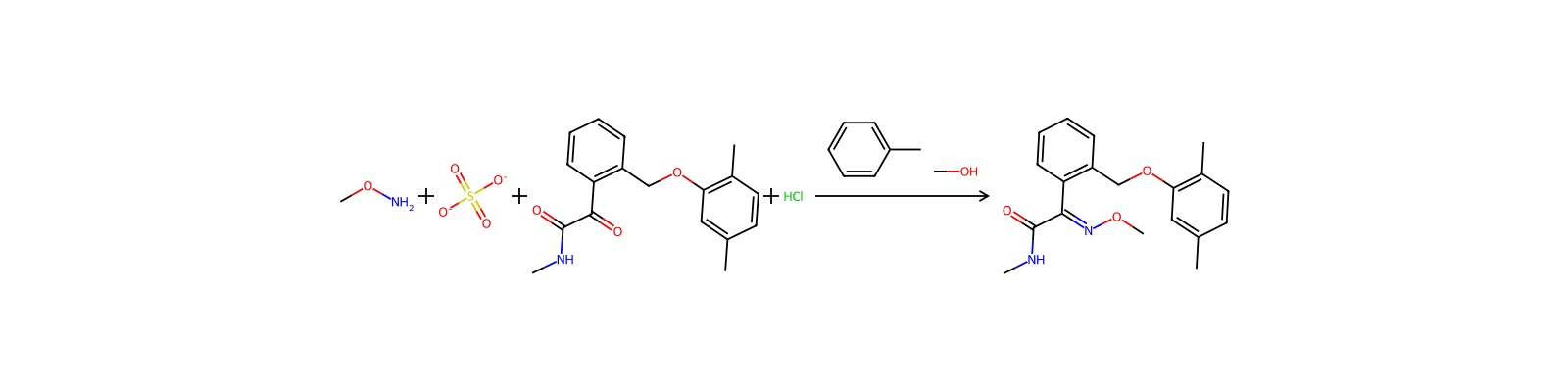


Notizen zur Verbindung
Wird geladen…