

Grundinformationen
- Standard-SMILES
C1CCOC1.[B]- InChIKey
UWTDFICHZKXYAC-UHFFFAOYSA-N- Summenformel
- C4H8BO
- Durchschnittliche Molmasse
- 82,92 g/mol
Namen und Bezeichner
- Bevorzugter Name
- Borane-tetrahydrofuran
- Lokaler Name
- Tetrahydrofuran-Boran
- Englischer Name
- Borane-tetrahydrofuran complex
- Summenformel
- C4H11BO
- Molmasse
- 85.94
Namen und Synonyme
14044-65-6Borane-tetrahydrofuranBorane tetrahydrofuranTetrahydrofuran boranetetrahydrofuran-boraneBoron, trihydro(tetrahydrofuran)-, (T-4)-5EAR4ERR1L(TETRAHYDROFURAN)BORANEBORANE-THF (1:1)TETRAHYDROFURAN-BORANE (1:1)TRIHYDRO(TETRAHYDROFURAN)BORANEBORON HYDRIDE (BH3)-THF (1:1)
Weitere Namen anzeigen
BH3-THFBORANE(T-4)-Trihydro(tetrahydrofuran)boronBORANE TETRAHYDROFURAN COMPLEXTrihydro(tetrahydrofuran)boronBTHFBORAN-TETRAHYDROFURANCOMPLEXBorane, 1M in tetrahydrofuranBorane-tetrahydrofurane complex
Tetrahydrofuran--boraneCCRIS 3411BoraneTHFEINECS 237-881-8RefChem:569839EC 237-881-8DTXCID201359545(T4)Trihydro(tetrahydrofuran)boron
Datenbank-Bezeichner
- CAS
14044-65-6- PubChem CID
- 11062302
- UNII
- 5EAR4ERR1L
- EC Number
- 237-881-8
Eigenschaften
Berechnete Struktureigenschaften
- Polarare Oberfläche (TPSA)
- 9,2 Ų
- H-Brücken-Donoren
- 0
- H-Brücken-Akzeptoren
- 1
- Frei drehbare Bindungen
- 0
- Schwere Atome
- 6
- Formalladung
- 0
- Komplexität
- 22,8
Experimentelle und physikochemische Eigenschaften
Chemical ClassesMetals -> Metalloid Compounds (Boron)
Density0.898 @25 °C
Physical DescriptionLiquid; [Merck Index] 10% Solution in tetrahydrofuran: Colorless liquid with an acrid odor; [Alfa Aesar MSDS]
Physikochemische Eigenschaften
- Schmelzpunkt
- -17 °C · -17 °C
- Siedepunkt
- 35 °C · 35 °C
- Dichte
- 0.898 g/mL · 0.898 g/mL at 25 °C
- Flammpunkt
- 1 °F · 1 °F
- storage temp.
- 20 °C · Store at <= 20°C.
- Aggregatzustand
- Liquid
- Farbe
- Colorless
- Explosionsgrenze
- 1.58 · 1.58-12.42% (v/v)
- Wasserlöslichkeit
- REACTS
- BRN
- 3668402 · 3668402
- Stabilität
- Stable, but may form explosive peroxides in contact with air. Incompatible with acids, acid chlorides, acid anhydrides, oxidizing agents, alcohols. Reacts violently with water. Highly flammable. Store under inert gas.
- InChI
- 1S/C4H8O.BH3/c1-2-4-5-3-1;/h1-4H2;1H3
- InChIKey
- RMCYTHFAWCWRFA-UHFFFAOYSA-N
- SMILES
- B.C1CCOC1
- CAS Datenbank
- 14044 · 14044-65-6(CAS DataBase Reference)
- EPA chemische Informationen
- Boron, trihydro(tetrahydrofuran)-, (T-4)- (14044-65-6)
Sicherheit und Regulatorisches
GHS-Klassifizierung
GHS Classification
This chemical does not meet GHS hazard criteria for 5.9% (11 of 188) of reports.
Danger
H225 (94.1%): Highly Flammable liquid and vapor [Danger Flammable liquids]
P210, P223, P231+P232, P233, P240, P241, P242, P243, P261, P264, P264+P265, P270, P271, P280, P301+P317, P302+P335+P334, P302+P352, P303+P361+P353, P304+P340, P305+P351+P338, P305+P354+P338, P317, P319, P321, P330, P332+P317, P337+P317, P362+P364, P370+P378, P402+P404, P403+P233, P403+P235, P405, and P501 (click each P-code to see the statement)
Aggregated GHS information provided per 188 reports by companies from 10 notifications to the ECHA C&L Inventory. Each notification may be associated with multiple companies.
Gefahrenhinweise
Regulatory Information
Status: Active Update: 27-03-2018 https://echa.europa.eu/registration-dossier/-/registered-dossier/12062
Boron, trihydro(tetrahydrofuran)-, (T-4)-: Does not have an individual approval but may be used under an appropriate group standard
Hazards Summary
Reacts violently with water; [Merck Index] 10% Solution in tetrahydrofuran (CAS# 109-99-9): Reacts violently with water evolving extremely flammable gases; May form explosive peroxides; An irritant that may cause serious eye injury; Harmful by ingestion; [Alfa Aesar MSDS] See Borane.
Hazard Classes and CategoriesFlam. Liq. 2 (94.1%)
CSL Reaction Information
CSL00083
BORANE-TETRAHYDROFURAN COMPLEX
temperatures over 40C may lead to a self-sustaining exothermic reaction—if temperature reaches 60C, a violent decomposition reaction may occur
Explosive
User-Reported
7/8/18
Sicherheit und Schutzausrüstung
Protective Action Criteria (PAC)
12 [mg/m3]
130 [mg/m3]
790 [mg/m3]
Sicherheitsdaten
- F
- 1-10-13-34
- wgk
- 3
- tsca
- TSCA listed
- ridadr
- UN 3399 4.3/PG 1
- hs_code
- 29321900
- risk_code
- 14/15-19-22-36/37/38-41-37/38-11-67-66-40-36/37
- hazard_code
- F,Xn,Xi
- safety_code
- 16-33-36/37/39-7/9-7/8-43-37/39-26-36-29-36/37
- hazard_class
- 4.3
- packing_group
- I
- Speicherklasse
- 4.3 - Hazardous materials which set free flammable gases upon contact with water
- Hazard Classifications
- Acute Tox. 4 OralCarc. 2Eye Dam. 1Flam. Liq. 2STOT SE 3Water-react 1
- Selbstentzündungstemperatur
- 103°C
Chemie und Industrie
Verwendung und Herstellung
UsesUsed in synthetic organic chemistry; [Merck Index]
General Manufacturing InformationBoron, trihydro(tetrahydrofuran)-, (T-4)-: ACTIVE
Anwendungen
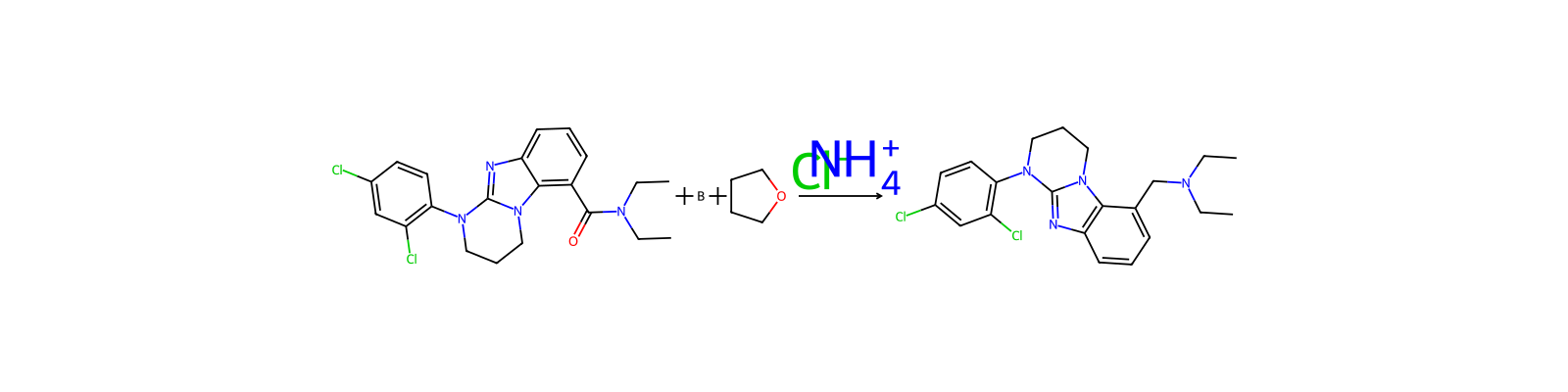
BeschreibungBorane tetrahydrofuran complex (BH3-THF) is widely used as a reducing agent in organic synthesis. It is also used as a reagent in hydroboration reactions.It is a charge-transfer complex that is a useful surrogate for diborane1 in organic synthesis. It can be used to reduce carboxylic acids to alcohols or nitriles to primary amines. It reacts with olefins to add the BH2 functional group. Alkyl- or arylboranes formed in this way can further react with unsaturated compounds such as olefins, imines, ketones, and alkynes (the hydroboration reaction) to make useful boron-containing intermediates.
VerwendenBorane-tetrahydrofuran complex is used to reduce Nylon surface amide groups to secondary amines.It is an important reagent used in the reduction of certain functional groups viz. aldehyde, ketone, carboxylic acid, amide, oxime, imine and nitrile. It is also used as hydro borating agent. It acts as a borane source for oxazaborolidine catalyzed asymmetric reductions.
Vor- und nachgelagerte Produkte
Nachgelagerte Produkte
Anbieter50 Anbieter
国药集团化学试剂有限公司86-21-63210123 · [email protected]
梯希爱(上海)化成工业发展有限公司021-67121386 · [email protected]
上海阿拉丁生化科技股份有限公司400-6206333 13167063860 · [email protected]
山东玖玥生物科技有限公司18853316981
爱斯特(成都)生物制药股份有限公司+86-28-85122536 85324413 · [email protected]
科瑞迪化学400-821-5857 021-64326257 · [email protected]
平顶山隆维生物科技有限公司15343756688 · [email protected]
上海迈瑞尔生化科技有限公司4006356688 18621169109 · [email protected]
北京华威锐科化工有限公司0757-86329057 18934348241 · [email protected]
阿法埃莎(中国)化学有限公司400-6106006 · [email protected]
安耐吉化学&3A(安徽泽升科技股份有限公司)400-0056266 · [email protected]
上海瀚鸿科技股份有限公司021-54306202 13764082696 · [email protected]
上海格物致知医药科技有限公司21-21-54301573 13917723525 · [email protected]
上海相辉医药科技有限公司13761987713 · [email protected]
上海景颜化工科技有限公司13817811078 · [email protected]
嘉兴市艾森化工有限公司0573-85285100 18627885956 · [email protected]
南京蓝白化工有限公司025-85499326 15366059326;13813836665 · [email protected]
四川库利南科技有限公司400-1166-196 18981987031 · [email protected]
河南萬象化工有限公司(优势生产供应!)0371-56669001 13949088811 · [email protected]
南京维奥化工有限公司Please Send Email 18652950785 · [email protected]
上海迪外化工科技有限公司021-61551100
河南多贝化工有限公司0370-2785118 17550508557 · [email protected]
斯百全化学(上海)有限公司021-021-021-67601398-809-809-809 15221380277 · [email protected]
艾科试剂4008-755-333 18080918076 · [email protected]
上海思域化工科技有限公司86-21-34053660 · [email protected]
赛默飞世尔科技(中国)有限公司800-810-5118 · [email protected]
北京伊诺凯科技有限公司400-810-7969 010-59572699 · [email protected]
TOKYO CHEMICAL INDUSTRY CO., LTD.03-36680489 · [email protected]
深圳康特腾科技有限公司86-0755-86635001 · [email protected]
越林试剂021-62960152 · [email protected]
山东博洛达生物科技有限公司0531-68659041 · [email protected]
上海乐晨国际贸易有限公司021-67256163 · [email protected]
上海泽信化工科技有限公司021-60136491 15901897992
北京环宇世纪化学科技有限公司hysj_bj.com
郑州阿尔法化工有限公司0371-53732842 15981811963 · [email protected]
成都零六生物科技有限公司400-1166-196 13458535857 · [email protected]
雷丁试剂0510-85629785 18013409632 · [email protected]
上海恒岳化工科技有限公司51691706 13391095697 · [email protected]
上海御略医药科技有限公司021-60345187 13671753212 · [email protected]
郑州聚硼新能源科技有限公司15136485523 · [email protected]
上海麦克林生化科技股份有限公司15221275939 15221275939 · [email protected]
杭州杰恒化工有限公司0571-87396432 · [email protected]
上海嵩爰化工科技有限公司010-1234567 18521000990 · [email protected]
湖北巨胜科技有限公司027-59599241 18871490274 · [email protected]
池州凯隆进出口贸易有限公司[email protected]
Sigma-Aldrich西格玛奥德里奇(上海)贸易有限公司021-61415566 800-8193336 · [email protected]
盘锦研峰科技有限公司400-1062016 18612996721 · [email protected]
上海福兴医药科技有限公司21-21-64961388 18918697718 · [email protected]
郑州科豫隆化工产品有限公司17319789407 17319789407 · [email protected]
成都瑞欧克科技有限公司028-64353063 · [email protected]
Zugehörige Reaktionen
5



Verknüpfte Notizen
Wird geladen…