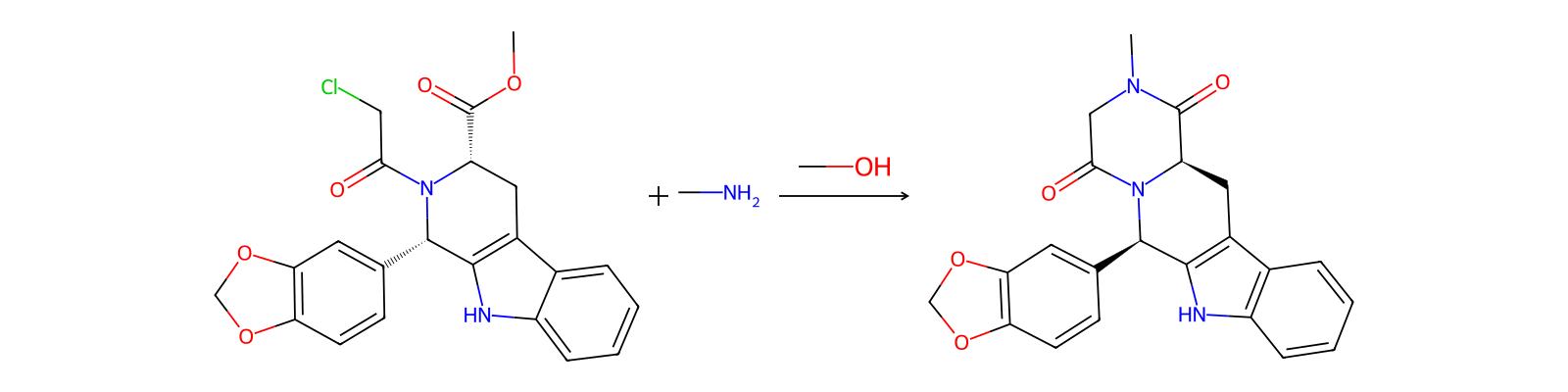
HRID 351941als Edukt
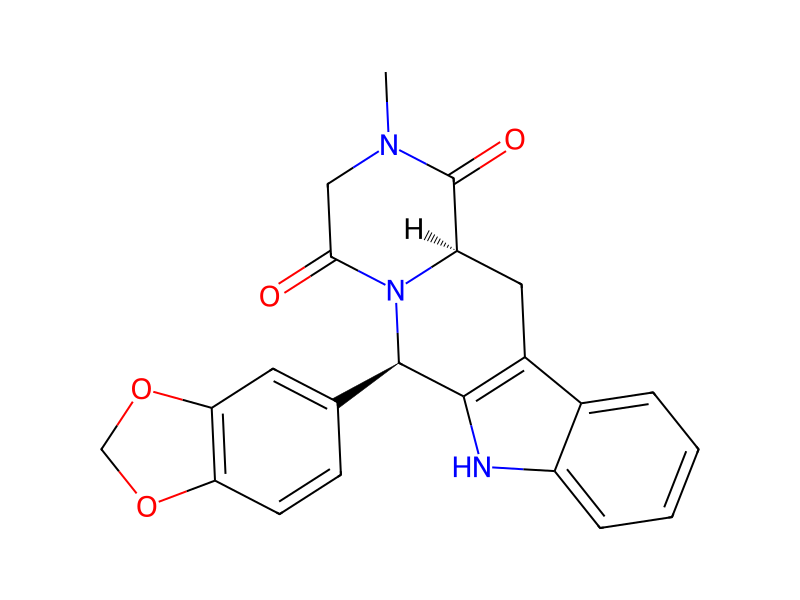
171596-29-5CN1CC(=O)N2[C@H](c3ccc4c(c3)OCO4)c3[nH]c4ccccc4c3C[C@@H]2C1=OWOXKDUGGOYFFRN-IIBYNOLFSA-NTadalafil is a pyrazinopyridoindole that is 2,3,6,7,12,12a-hexahydropyrazino[1',2':1,6]pyrido[3,4-b]indole-1,4-dione substituted at position 2 by a methyl group and at position 6 by a 1,3-benzodioxol-5-yl group (the 6R,12aR-diastereomer). A phosphodiesterase V inhibitor inhibitor, currently marketed in pill form for treating erectile dysfunction under the name Cialis; and under the name Adcirca for the treatment of pulmonary arterial hypertension. It has a role as a vasodilator agent and an EC 3.1.4.35 (3',5'-cyclic-GMP phosphodiesterase) inhibitor. It is a member of benzodioxoles and a pyrazinopyridoindole.
171596-29-5DTXSID9046786CHEMBL779CHEBI:71940log Kow = 1.42 /Estimated/
1.7
2.6
Practically insoluble in water
In water, 220 mg/L at 25 °C /Estimated/
2.50e-01 g/L
3.2 [ug/mL] (The mean of the results at pH 7.4)
FDA approved drugs -> Active ingredient
EMA approved medicines: Human medicine
EMA approved medicines: Human medicine
EMA approved medicines: Human medicine
EMA approved medicines: Human medicine
EMA approved medicines: Human medicine
301-302 °C
301 - 302 °C
199.71 Ų [M+K]+ [CCS Type: TW; Method: calibrated with polyalanine and drug standards]
189.4 Ų [M+H]+ [CCS Type: TW; Method: Major Mix IMS/Tof Calibration Kit (Waters)]
188.7 Ų [M+H]+ [CCS Type: TW; Method: calibrated with polyalanine and drug standards]
Sicherheitsangaben dienen nur zur Orientierung und ersetzen weder das Sicherheitsdatenblatt (SDB) des Lieferanten noch geltende Vorschriften oder eine fachliche Bewertung.
Warning
H302 (54.8%): Harmful if swallowed [Warning Acute toxicity, oral]
P261, P264, P264+P265, P270, P271, P280, P301+P317, P302+P352, P304+P340, P305+P351+P338, P317, P319, P321, P330, P332+P317, P337+P317, P362+P364, P403+P233, P405, and P501 (click each P-code to see the statement)
Aggregated GHS information provided per 104 reports by companies from 12 notifications to the ECHA C&L Inventory. Each notification may be associated with multiple companies.
The Approved Drug Products with Therapeutic Equivalence Evaluations List identifies currently marketed prescription drug products, incl tadalafil, approved on the basis of safety and effectiveness by FDA under sections 505 of the Federal Food, Drug, and Cosmetic Act.
SRP: The most favorable course of action is to use an alternative chemical product with less inherent propensity for occupational exposure or environmental contamination. Recycle any unused portion of the material for its approved use or return it to the manufacturer or supplier. Ultimate disposal of the chemical must consider: the material's impact on air quality; potential migration in soil or water; effects on animal, aquatic, and plant life; and conformance with environmental and public health regulations.
Simultaneous administration of an antacid (magnesium hydroxide/aluminum hydroxide) and tadalafil reduced the apparent rate of absorption of tadalafil without altering the exposure (AUC) to tadalafil.
A significant interaction between tadalafil and nitroglycerin was observed to last up to 48 hours; at least 48 hours should elapse after the last dose of tadalafil before nitrate administration is considered.
Administration of tadalafil to patients who are using any form of organic nitrates, either regularly and/or intermittently, is contraindicated; in clinical pharmacology studies tadalafil was shown to potentiate the hypotensive effects of nitrates; this is thought to result from the combined effects of nitrates and tadalafil on the nitric oxide/cGMP pathway.
The safety and efficacy of combinations of tadalafil and other erectile dysfunctions have not been studied; use of combinations is not recommended.
For more Interactions (Complete) data for TADALAFIL (15 total), please visit the HSDB record page.
Despite fairly extensive use, tadalafil has been linked to only rare reports of serum aminotransferase elevations and clinically apparent liver injury. In a single case report, tadalafil was linked to cholestatic hepatitis arising within a few days of starting the medication. Immunoallergic features and autoantibodies were not present. The injury was self-limiting without residual evidence of bile duct injury. The related PDE5 inhibitor, sildenafil, has also been associated with rare cases of acute cholestatic liver injury with jaundice.
TERRESTRIAL FATE: Based on a classification scheme(1), an estimated Koc value of 53,000(SRC), determined from a structure estimation method(2), indicates that tadalafil is expected to be immobile in soil(SRC). Volatilization of tadalafil from moist soil surfaces is not expected to be an important fate process(SRC) given an estimated Henry's Law constant of 5.0X10⁻¹⁸ atm-cu m/mole(SRC), determined by a fragment constant estimation method(3). Tadalafil is not expected to volatilize from dry soil surfaces(SRC) based upon an estimated vapor pressure of 2.2X10⁻¹⁴ mm Hg(SRC), determined from a fragment constant method(4). Biodegradation data were not available(SRC, 2005).
AQUATIC FATE: Based on a classification scheme(1), an estimated Koc value of 53,000(SRC), determined from a structure estimation method(2), indicates that tadalafil is expected to adsorb to suspended solids and sediment(SRC). Volatilization from water surfaces is not expected(3) based upon an estimated Henry's Law constant of 5.0X10⁻¹⁸ atm-cu m/mole(SRC), developed using a fragment constant estimation method(4). According to a classification scheme(5), an estimated BCF of 2.5(SRC), from an estimated log Kow of 1.42(6) and a regression-derived equation(7), suggests the potential for bioconcentration in aquatic organisms is low(SRC). Biodegradation data were not available(SRC, 2005).
ATMOSPHERIC FATE: According to a model of gas/particle partitioning of semivolatile organic compounds in the atmosphere(1), tadalafil, which has an estimated vapor pressure of 2.2X10⁻¹⁴ mm Hg at 25 °C(SRC), determined from a fragment constant method(2), is expected to exist solely in the particulate phase in the ambient atmosphere. Particulate-phase tadalafil may be removed from the air by wet and dry deposition(SRC).
Using a structure estimation method based on molecular connectivity indices(1), the Koc for tadalafil can be estimated to be 53,000(SRC). According to a classification scheme(2), this estimated Koc value suggests that tadalafil is expected to be immobile in soil.
/SIGNS AND SYMPTOMS/ Single doses up to 500 mg have been given to healthy subjects, and multiple daily doses up to 100 mg have been given to patients. Adverse events were similar to those seen at lower doses.
/HUMAN EXPOSURE STUDIES/ Administration of tadalafil to patients who are using any form of organic nitrates, either regularly and/or intermittently, is contraindicated; in clinical pharmacology studies tadalafil was shown to potentiate the hypotensive effects of nitrates; this is thought to result from the combined effects of nitrates and tadalafil on the nitric oxide/cGMP pathway.
/HUMAN EXPOSURE STUDIES/ Cardiovascular status of patients should be considered since there is a degree of risk associated with sexual activity; treatments for erectile dysfunction, including tadalafil, should not be used in men for whom sexual activity is inadvisable as a result of their underlying cardiac status.
/HUMAN EXPOSURE STUDIES/ Left Ventricular Outflow Obstruction -- Patients with left ventricular outflow obstruction, (e.g., aortic stenosis and idiopathic hypertrophic subaortic stenosis) can be sensitive to the action of vasodilators, including PDE5 inhibitors.
For more Human Toxicity Excerpts (Complete) data for TADALAFIL (6 total), please visit the HSDB record page.
Drug Induced Liver Injury Rank (DILIrank 2.0)
Tadalafil
vLess-DILI-concern
3
Adverse reactions
DOI:10.1016/j.drudis.2016.02.015
An estimated BCF of 2.5 was calculated for tadalafil(SRC), using an estimated log Kow of 1.42(1) and a regression-derived equation(2). According to a classification scheme(3), this BCF suggests the potential for bioconcentration in aquatic organisms is low(SRC).
The Henry's Law constant for tadalafil is estimated as 5.0X10⁻¹⁸ atm-cu m/mole(SRC) using a fragment constant estimation method(1). This Henry's Law constant indicates that tadalafil is expected to be essentially nonvolatile from water surfaces(2). Tadalafil's Henry's Law constant indicates that volatilization from moist soil surfaces is not expected to occur(SRC). Tadalafil is not expected to volatilize from dry soil surfaces(SRC) based upon an estimated vapor pressure of 2.2X10⁻¹⁴ mm Hg(SRC), determined from a fragment constant method(3).
/LABORATORY ANIMALS: Subchronic or Prechronic Exposure/ Animal studies showed vascular inflammation in tadalafil-treated mice, rats, and dogs. In mice and rats, lymphoid necrosis and hemorrhage were seen in the spleen, thymus, and mesenteric lymph nodes ... In dogs, an increased incidence of disseminated arteritis was observed in 1- and 6-month studies at unbound tadalafil exposure of 1- to 54-fold above the human exposure (AUC) at the MRHD.
/LABORATORY ANIMALS: Chronic Exposure or Carcinogenicity/ Tadalafil was not carcinogenic to rats or mice when administered daily for up to two years at doses up to 400 mg per kg per day. Systemic drug exposures, as measured by AUC of unbound tadalafil, were approximately 10-fold for mice, and 14- and 26-fold for male and female rats, respectively, the exposures in human males given Maximum Recommended Human Dose (MRHD).
/LABORATORY ANIMALS: Chronic Exposure or Carcinogenicity/ In a 12-month dog study, no disseminated arteritis was observed, 2 dogs exhibited marked decreases in white blood cells (neutrophils) and moderate decreases in platelets with inflammatory signs at unbound tadalafil exposures of approximately 14- to 18-fold the human exposure at the MRHD.
/LABORATORY ANIMALS: Developmental or Reproductive Toxicity/ In beagle dogs given tadalafil daily for 3 to 12 months, there was treatment-related non-reversible degeneration and atrophy of the seminiferous tubular epithelium in the testes in 20 to 100% of the dogs that resulted in decreased spermatogenesis in 40 to 75% of the dogs at doses of > or = 10 mg per kg per day. Systemic exposure (based on AUC) at no-observed-adverse-effect-level (NOAEL) (10 mg/kg/day) for unbound tadalafil was similar to that expected in humans at the MRHD.
For more Non-Human Toxicity Excerpts (Complete) data for TADALAFIL (7 total), please visit the HSDB record page.
The Approved Drug Products with Therapeutic Equivalence Evaluations List identifies currently marketed prescription drug products, incl tadalafil, approved on the basis of safety and effectiveness by FDA under sections 505 of the Federal Food, Drug, and Cosmetic Act.
G04BE08
G - Genito urinary system and sex hormones
QG - Genito urinary system and sex hormones
Tadalafil exerts a therapeutic effect in ED by increasing sexual stimulation-dependant smooth muscle relaxation in the penis, allowing the corpus cavernosum to fill with blood to produce an erection. Smooth muscle relaxation in the pulmonary vasculature helps to produce vasodilation in PAH which reduces blood pressure in the pulmonary arteries. In BPH, tadalafil may contribute to decreased smooth muscle cell proliferation which may reduce the size of the prostate and relieve the anatomical obstruction which produces urinary symptoms of BPH. The decreased affinity of tadalafil for PDE6 compared to other PDE5 inhibitors may explain the reduced incidence of visual side effects.
Tadalafil is a selective phosphodiesterase-5 (PDE5) inhibitor that produces several downstream effects with the most common therapeutic effect being smooth muscle relaxation. Patients may experience ED due to a variety of causes including psychogenic, neurogenic, vasculogenic, iatrogenic, or endocrine. These causes result in dysfunction of penile smooth muscle relaxation through either disrupted neuronal signaling or direct influence on smooth muscle cells. During sexual arousal, non-adrenergic non-cholinergic (NANC) neurons release nitric oxide (NO). Nitric oxide stimulates guanylate cyclase which converts guanosine triphosphate to cyclic guanosine monophosphate (cGMP). cGMP activates the cGMP-dependent kinase (PKG) in a signal cascade which activates K+ channels leading to inhibition of Ca2+ channels, inhibits platelet activation, and inhibits smooth muscle cell proliferation while inducing apoptosis. This signal cascade is attenuated by PDE5 which breaks the phosphodiester bond of cGMP, converting it to GMP. Inhibition of PDE5 by tadalafil increases signaling via the PKG cascade which supports penile smooth muscle relaxation during sexual arousal by decreasing Ca2+ entry into smooth muscle cells. This smooth muscle relaxation allows blood to fill the corpus cavernosum thereby producing an erection. In PAH, blood pressure in the pulmonary arteries is raised due to a variety of mechanisms stemming from endothelial dysfunction. Decreased production of NO and prostacyclin reduce vasodilatory signaling while overproduction of endothelin-1 and thromboxane increase vasoconstriction. Inflammation, thromboses, and hypoxia later contribute to vascular remodeling which further reduces luminal size. The resultant increase in blood pressure reduces the capacity for gas exchange and increases afterload at the right ventricle, producing symptoms of dyspnea, fatigue, and dizziness as well as leading to right-sided heart failure. Tadalafil exerts its therapeutic effect in PAH through boosting NO-cGMP signaling to contribute to smooth muscle relaxation as with ED. Lastly, tadalafil is used to treat BPH. BPH produces urinary dysfunction through hyperproliferation of the epithelial and smooth muscle layers of the prostate. The increased size of the prostate blocks urine flow through the urethra resulting in higher residual volumes due to incomplete emptying. Tadalafil does not appear to exert its benefit via smooth muscle relaxation of the prostate. It may instead exert its effect through a mix of increased oxygenation and decreased inflammation, which decreases tissue remodeling, and inhibition of cell proliferation through the cGMP cascade. The decreased affinity for PDE6 compared to other PDE5 inhibitors may explain the decreased incidence of visual side effects as PDE6 is present in the eye and contributes to color vision.
In vitro studies have shown that the effect of tadalafil is more potent on phosphodiesterase type 5 (PDE5) than on other phosphodiesterases. These studies have shown that tadalafil is >10,000-fold more potent for PDE5 than for PDE1, PDE2, PDE4, and PDE7 enzymes, which are found in the heart, brain, blood vessels, liver, leukocytes, skeletal muscle, and other organs. Tadalafil is >10,000-fold more potent for PDE5 than for PDE3, an enzyme found in the heart and blood vessels. Additionally, tadalafil is 700-fold more potent for PDE5 than for PDE8, PDE9, PDE10 and 14-fold more potent for PDE5 than for PDE11A1, an enzyme found in human skeletal muscle. Tadalafil inhibits human recombinant PDE11A1 activity at concentrations within the therapeutic range. The physiological role and clinical consequence of PDE11 inhibition in humans have not been defined.
Studies in vitro have demonstrated that tadalafil is a selective inhibitor of phosphodiesterase type 5 (PDE5). PDE5 is found in corpus cavernosum smooth muscle, vascular and visceral smooth muscle, skeletal muscle, platelets, kidney, lung, cerebellum, and pancreas.
Penile erection during sexual stimulation is caused by increased penile blood flow resulting from the relaxation of penile arteries and corpus cavernosum smooth muscle. This response is mediated by the release of nitric oxide (NO) from nerve terminals and endothelial cells, which stimulates the synthesis of cyclic GMP in smooth muscle cells. Cyclic GMP causes smooth muscle relaxation and increased blood flow into the corpus cavernosum. The inhibition of phosphodiesterase type 5 (PDE5) enhances erectile function by increasing the amount of cyclic GMP. Tadalafil inhibits PDE5. Because sexual stimulation is required to initiate the local release of nitric oxide, the inhibition of PDE5 by tadalafil has no effect on the absence of sexual stimulation.
The mean half-life of elimination of tadalafil is 15-17.5h in healthy adults. The mean half-life of elimination in adults with PAH is reported as 35h.
Terminal: 17.5 hours
Tadalafil undergoes hepatic metabolism via CYP3A4 to a catechol metabolite. This catechol metabolite undergoes subsequent methylation and glucuronidation with the methyl-glucuronide metabolite becoming the primary metabolite in circulation. None of the known metabolites are considered to be active.
Biotransformation: Hepatic metabolism, mainly by CYP3A4. Tadalafil is predominantly metabolized by CYP3A4 to a catechol metabolite. The catechol metabolite undergoes extensive methylation and glucuronidation to form the methylcatechol and methylcatechol glucuronide conjugate, respectively. The major circulating metabolite is the methylcatechol glucuronide. Methylcatechol concentrations are less than 10% of glucuronide concentrations. In vitro data suggests that metabolites are not expected to be pharmacologically active at observed metabolite concentrations.
742SXX0ICT
TADALAFIL
Established Pharmacologic Class [EPC] - Phosphodiesterase 5 Inhibitor
Mechanisms of Action [MoA] - Phosphodiesterase 5 Inhibitors
Tadalafil is a Phosphodiesterase 5 Inhibitor. The mechanism of action of tadalafil is as a Phosphodiesterase 5 Inhibitor.
TADALAFIL
Drugs used to cause dilation of the blood vessels.
Compounds that specifically inhibit PHOSPHODIESTERASE 5.
Drugs used in the treatment of urological conditions and diseases such as URINARY INCONTINENCE and URINARY TRACT INFECTIONS.
Tadalafil has a tmax of 0.5-6h with a median of 2h in healthy adults. The tmax in adults with PAH is reported as 2-8h with a median of 4h. There does not appear to be a significant effect on absorption when tadalafil is taken with food.
Tadalafil is primarily eliminated via hepatic metabolism. These metabolites are mainly excreted in the feces (61%) and to a lesser extent in the urine (36%)
Tadalafil has a mean apparent volume of distribution of 63L in healthy adults. The mean apparent volume of distribution is reported as 77L in adults with PAH.
The mean apparent oral clearance of tadalafil is 2.5-3.4L/h in healthy adults. The mean apparent oral clearance in adults with PAH is reported as 3.5L/h
Tmax: 30 minutes to 6 hours (median 2 hours). Absolute bioavailability has not been determined; rate and extent of absorption are not influenced by food.
Volume of distribution: 63 L; indicating distribution into tissues. Less than 0.0005% of administered dose was found in the semen of healthy subjects. 94% protein bound.
Medication
... Treatment of erectile dysfunction. /Included in US product labeling/
Use (kg; approx.) in Germany (2009): >100
Information available in 2005 indicated that Tadalafil was used in the manufacture of pharmaceutical preparations in the following countries: Argentina, Australia, Austria, Belgium, Denmark, Finland, France, Germany, Greece, Hungary, Iceland, Ireland, Italy, Luxembourg, Netherlands, Norway, Portugal, Romania, Singapore, Spain, Sweden, Switzerland, United Kingdom, United States (1,2)
BeschreibungTadalafil (market name “Cialis” or “Adcirca”) was developed by American pharmaceutical company Lilly. It is a kind of PDE5 inhibitor used for the treatment of erectile dysfunction, benign prostatic hypertrophy and pulmonary arterial hypertension.The effect of Tadalafil is relaxing the blood vessels muscles and increasing the blood flow into the corpus cavernosum. Studies show that Cialis works very quickly, taking effect in around 15-20 minutes, and has a prolonged effect that can last for up to 36 hours. T1/2 is 17.5h.
DefinitionChEBI: Tadalafil is a pyrazinopyridoindole that is 2,3,6,7,12,12a-hexahydropyrazino[1',2':1,6]pyrido[3,4-b]indole-1,4-dione substituted at position 2 by a methyl group and at position 6 by a 1,3-benzodioxol-5-yl group (the 6R,12aR-diastereomer). A phosphodiesterase V inhibitor inhibitor, currently marketed in pill form for treating erectile dysfunction under the name Cialis; and under the name Adcirca for the treatment of pulmonary arterial hypertension. It has a role as an EC 3.1.4.35 (3',5'-cyclic-GMP phosphodiesterase) inhibitor and a vasodilator agent. It is a pyrazinopyridoindole and a member of benzodioxoles.