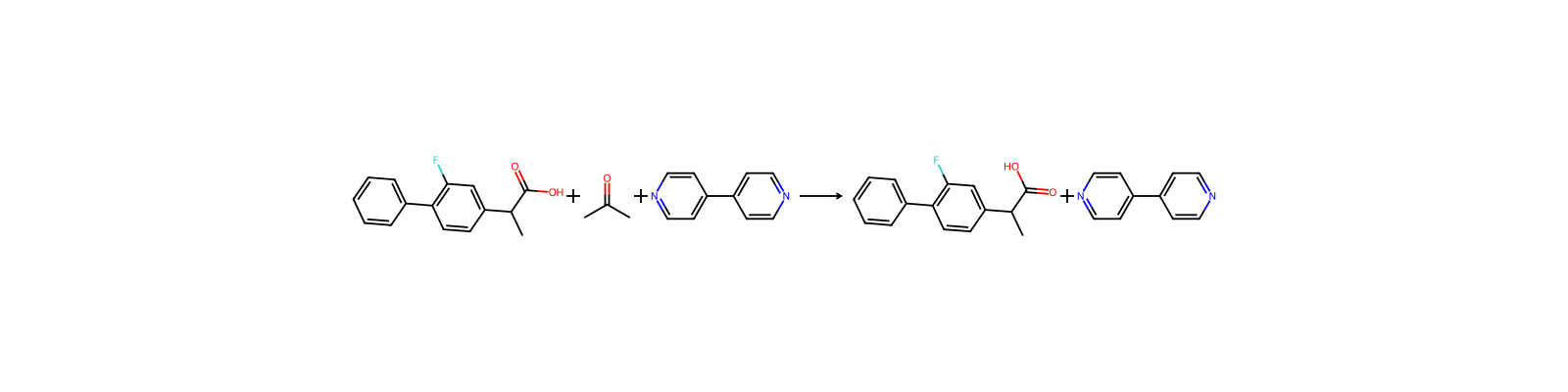

Grundinformationen
- Standard-SMILES
c1cc(-c2ccncc2)ccn1- InChIKey
MWVTWFVJZLCBMC-UHFFFAOYSA-N- Summenformel
- C10H8N2
- Durchschnittliche Molmasse
- 156,18 g/mol
- Monoisotopische Masse
- 156,06874826
Überblick
4,4'-bipyridine is a bipyridine in which the two pyridine moieties are linked by a bond between positions C-4 and C-4'.
Namen und Bezeichner
- Bevorzugter Name
- 4,4'-Bipyridine
- IUPAC
- 4-pyridin-4-ylpyridine
- Lokaler Name
- 4,4'-Bipyridyl
- Englischer Name
- 4,4'-Bipyridine
- Summenformel
- C10H8N2
- Molmasse
- 156.18
Namen und Synonyme
4,4'-Bipyridine553-26-44,4'-DIPYRIDYL4,4'-Bipyridyl4-(4-Pyridyl)pyridine4,4'-Dipyridinegamma,gamma'-Bipyridylgamma,gamma'-DipyridylDTXSID2027200X4O2OD61CBNSC-404423DTXCID107200
Weitere Namen anzeigen
4,4-BIPYRIDINE4'-Bipyridine4,4''-BipyridineGAMMA,GAMMA-DIPYRIDYL'LGC' (1608)
CHEBI:30985RefChem:506524209-036-3628-542-94,4-Bipyridyl4-pyridin-4-ylpyridine4,4-Dipyridyl4,4'-Dipyridyl hydrate
Datenbank-Bezeichner
- CAS
123333-55-1、37275-48-2、553-26-4- PubChem CID
- 11107
- DTXSID
DTXSID2027200- ChEMBL
CHEMBL1374568- ChEBI
CHEBI:30985- UNII
- X4O2OD61CB
- EC Number
- 209-036-3、628-542-9
- Nikkaji
- J45.972K
Eigenschaften
Berechnete Struktureigenschaften
- XLogP
- 1,4
- Polarare Oberfläche (TPSA)
- 25,8 Ų
- H-Brücken-Donoren
- 0
- H-Brücken-Akzeptoren
- 2
- Frei drehbare Bindungen
- 1
- Schwere Atome
- 12
- Formalladung
- 0
- Komplexität
- 108
Experimentelle und physikochemische Eigenschaften
Chemical ClassesNitrogen Compounds -> Pyridines
SpringerMaterials PropertiesSchoenflies notation
LogP1.33
Vapor Pressure0.0000556 [mmHg]
Physical DescriptionSolid; [IUCLID] White crystalline solid with a pungent odor; [Alfa Aesar MSDS]
Collision Cross Section135.5 Ų [M+H]+ [CCS Type: DT; Buffer gas: N2; Ionization: APCI+; Dataset: TOXCAST; Source Identifier: DTXSID2027200]
Physikochemische Eigenschaften
- Schmelzpunkt
- 109 · 109-112 °C(lit.)
- Siedepunkt
- 305 °C · 305 °C(lit.)
- Dichte
- 1.2814 · 1.2814 (rough estimate)
- Brechungsindex
- 1.6057 · 1.6057 (estimate)
- Flammpunkt
- 304 · 304-305°C
- storage temp.
- 30 °C · Store below +30°C.
- Löslichkeit
- 4.5 g/l · 4.5g/l
- Aggregatzustand
- Powder
- pka
- 1 · pK1:3.17(+2);pK2:4.82(+1) (25°C)
- Farbe
- Off-white to beige
- Wasserlöslichkeit
- slightly soluble
- Merck
- 14 · 14,3348
- BRN
- 113176 · 113176
- Henry's Law Constant
- 3.9 · 3.9×103 mol/(m3Pa) at 25℃, Duchowicz et al. (2020)
- Stabilität
- Stable. Incompatible with strong oxidizing agents, strong acids.
- InChI
- 1S/C10H8N2/c1-5-11-6-2-9(1)10-3-7-12-8-4-10/h1-8H
- InChIKey
- MWVTWFVJZLCBMC-UHFFFAOYSA-N
- SMILES
- c1cc(ccn1)-c2ccncc2
- CAS Datenbank
- 553 · 553-26-4(CAS DataBase Reference)
- NIST chemische Informationen
- 4 · 4,4'-Bipyridine(553-26-4)
- EPA chemische Informationen
- 4 · 4,4'-Bipyridine (553-26-4)
Sicherheit und Regulatorisches
GHS-Klassifizierung
GHS Classification
Danger
H301+H311 (35.4%): Toxic if swallowed or in contact with skin [Danger Acute toxicity, oral; acute toxicity, dermal]
P261, P262, P264, P264+P265, P270, P271, P273, P280, P301+P316, P302+P352, P304+P340, P305+P351+P338, P316, P319, P321, P330, P332+P317, P337+P317, P361+P364, P362+P364, P391, P403+P233, P405, and P501 (click each P-code to see the statement)
Aggregated GHS information provided per 79 reports by companies from 10 notifications to the ECHA C&L Inventory. Each notification may be associated with multiple companies.
Danger
H302 (100%): Harmful if swallowed [Warning Acute toxicity, oral]
Gefahrenhinweise
Regulatory Information
Chemical: 4,4'-Bipyridine
SP - indicates a substance that is identified in a proposed Significant New Use Rule.
4,4'-Bipyridine: Does not have an individual approval but may be used under an appropriate group standard
Hazards Summary
Skin lesions of the face, neck, and arms reported in 30 employees in a manufacturing plant; Histological evaluation revealed a progression from keratosis to Bowen's disease, and squamous cell carcinoma in 6 cases; A study of 246 employees at 28 factories during 1984-1985 showed 34% with hyperpigmented macules and 20% with marked hyperkeratotic lesions; Not irritating to rabbit skin; Not sensitizing in guinea pig maximization test; Changes in the lung, some changes in kidney and spleen, lachrymation, swelling around eyes, and occasional convulsions observed in oral lethal-dose studies of rats; Histopathological changes to liver and kidney reported in skin irritation study of rats; Dermal LD50 (rabbit) = 400-800 mg/kg; [IUCLID] Causes lacrimation, somnolence, and dyspnea in oral lethal-dose studies of rats; [RTECS] Generally not irritating to skin; Toxic by ingestion and skin absorption; [Alfa Aesar MSDS] See 2,3'-Bipyridine and 2,2'-Bipyridine.
Hazard Classes and Categories
Acute Tox. 3 (98.7%)
Acute Tox. 4 (100%)
Acute toxicity (Oral) - Category 3
Toxikologische Informationen
Adverse EffectsNeurotoxin - Other CNS neurotoxin
Sicherheitsdaten
- wgk
- 3
- tsca
- TSCA listed
- ridadr
- UN 2811 6.1/PG 3
- hs_code
- 29333999
- RTECS-Nr.
- DW1760000
- risk_code
- 25-36/37/38-20/21-23/24/25
- Toxizität
- LD50 orally in Rabbit: 172 mg/kg
- hazard_code
- T,Xi
- hazard_note
- Irritant
- safety_code
- 26-36/37/39-45
- hazard_class
- 6.1
- packing_group
- III
- Speicherklasse
- 6.1C - Combustible acute toxic Cat.3toxic compounds or compounds which causing chronic effects
- Hazard Classifications
- Acute Tox. 3 Oral
Chemie und Industrie
Verwendung und Herstellung
Uses
Formed as a pyrolysis product in tobacco smoke and also from the degradation of the herbicide paraquat; [Reference #1]
Smoking cigarettes [Category: Food & Drugs]
General Manufacturing Information4,4'-Bipyridine: ACTIVE
Anwendungen
Verwenden4,4'-Bipyridine is used in transition-metal complex catalyst chemistry for uniform polymerization, in luminescence chemistry and in spectrophotometric analysis. It plays an important role as a photosensitizer and luminescent material. It is also used as a precursor to paraquat viz. N,N'-dimethyl-4,4'-bipyridinium.
Vor- und nachgelagerte Produkte
Vorgelagerte Rohstoffe
Nachgelagerte Produkte
Anbieter50 Anbieter
国药集团化学试剂有限公司86-21-63210123 · [email protected]
梯希爱(上海)化成工业发展有限公司021-67121386 · [email protected]
衢州润东化工有限公司0570-8789886 18892685668 · [email protected]
上海阿拉丁生化科技股份有限公司400-6206333 13167063860 · [email protected]
INTATRADE GmbH+49 3493/605464 · [email protected]
爱斯特(成都)生物制药股份有限公司+86-28-85122536 85324413 · [email protected]
张家港博迈化学有限公司15601563028
上海如吉生物科技发展有限公司+86-21-65211385-8001 36031160 · [email protected]
山东前元高分子材料有限公司18678041314 18765609661 · [email protected]
科瑞迪化学400-821-5857 021-64326257 · [email protected]
上海将来实业股份有限公司400-0066400 13621662912 · [email protected]
上海迈瑞尔生化科技有限公司4006356688 18621169109 · [email protected]
武汉易泰科技有限公司上海分公司18930552037 · [email protected]
上海永增科技有限公司021-021-021-65281118 15921781258 · [email protected]
阿法埃莎(中国)化学有限公司400-6106006 · [email protected]
太原市瑞和丰科贸有限公司+86 351 7031519 · [email protected]
安耐吉化学&3A(安徽泽升科技股份有限公司)400-0056266 · [email protected]
上海瀚鸿科技股份有限公司021-54306202 13764082696 · [email protected]
上海相辉医药科技有限公司13761987713 · [email protected]
上海景颜化工科技有限公司13817811078 · [email protected]
嘉兴市艾森化工有限公司0573-85285100 18627885956 · [email protected]
Pure Chemistry Scientific Inc.001-857-928-2050 or 1-888-588-9418 · [email protected]
武汉丰泰威远科技有限公司027-87465837 19945049750 · [email protected]
上海忆嵘生物科技有限公司18049974220 · [email protected]
孝感深远化工有限公司15527621225; 15527621225 · [email protected]
山东西亚化学有限公司13355009207 13355009207 · [email protected]
玛雅试剂+86 (573) 82222445 (0)18006601000 452520369 · [email protected]
四川库利南科技有限公司400-1166-196 18981987031 · [email protected]
上海耐士化工科技有限公司400-188-0725 +86 21 34310725 13611771617
天津希恩思生化科技有限公司400 638 7771 · [email protected]
北京泰亚杰科技有限公司021-33690831-8001 13552411790;18616022633 · [email protected]
上海源叶生物科技有限公司13636370518 · [email protected]
南京爱莉生物科技有限公司025-83208295 18913388297 · [email protected]
上海思域化工科技有限公司86-21-34053660 · [email protected]
赛默飞世尔科技(中国)有限公司800-810-5118 · [email protected]
北京伊诺凯科技有限公司400-810-7969 010-59572699 · [email protected]
张家港保税区凯利特化工有限公司18606289633 15862625988 · [email protected]
上海遐瑞医药科技有限公司+86 21 61551611
江苏艾康生物医药研发有限公司025-66113011 13913916777 · [email protected]
TCI AMERICA800-4238616 · [email protected]
TOKYO CHEMICAL INDUSTRY CO., LTD.03-36680489 · [email protected]
TCI Europe320-37350700 · [email protected]
上海贤鼎生物科技有限公司4009209199 · [email protected]
深圳康特腾科技有限公司86-0755-86635001 · [email protected]
越林试剂021-62960152 · [email protected]
广东顺奥化学试剂有限公司19928586137 · [email protected]
常州中集化工有限公司0519-85156279-811,812 · [email protected]
北京环宇世纪化学科技有限公司hysj_bj.com
上海湄水化工科技有限公司021-60549325 18616193163
上海将来实业股份有限公司400-0066400 13621662912 · [email protected]
Ergänzende Hinweise
DefinitionChEBI: A bipyridine in which the two pyridine moieties are linked by a bond between positions C-4 and C-4'.
Zugehörige Reaktionen
27


Verknüpfte Notizen
Wird geladen…