
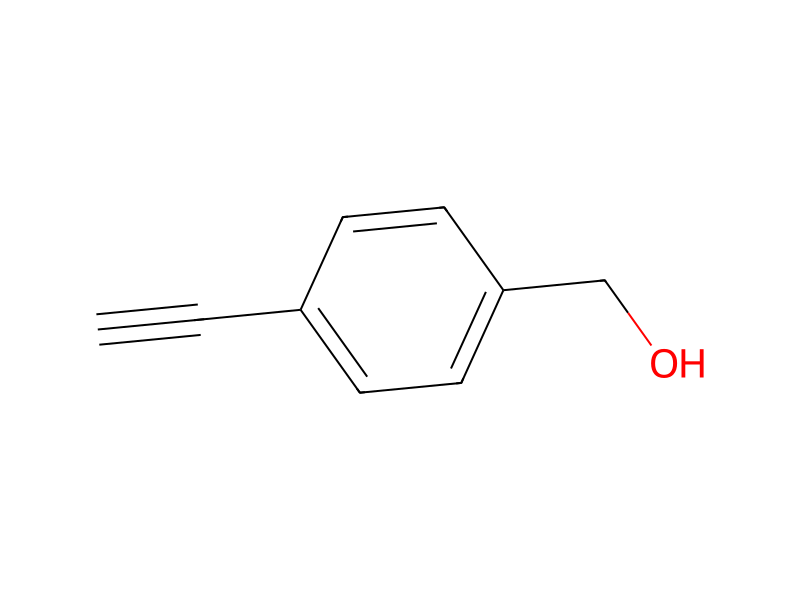
Grundinformationen
- Standard-SMILES
C#Cc1ccc(CO)cc1- InChIKey
QCZORVSTESPHCO-UHFFFAOYSA-N- Summenformel
- C9H8O
- Durchschnittliche Molmasse
- 132,16 g/mol
- Monoisotopische Masse
- 132,05751488
Namen und Bezeichner
- Bevorzugter Name
- (4-Ethynylphenyl)methanol
- IUPAC
- (4-ethynylphenyl)methanol
- Englischer Name
- 4-Ethynylbenzyl alcohol 97
- Summenformel
- C9H8O
- Molmasse
- 132.16
Namen und Synonyme
(4-ethynylphenyl)methanolRefChem:402800627-942-010602-04-74-Ethynylbenzyl alcohol4-ethynyl-benzenemethanolMFCD056642054-ethynylbenzylalcohol(4-ethynylphenyl)-methanol(4-ethynyl-phenyl)-methanolSCHEMBL5165124-Ethynylbenzyl alcohol, 97%
Weitere Namen anzeigen
Benzenemethanol,4-ethynyl-4-Ethynylbenzyl alcohol 97%(4-ethynylphenyl)methanol, 97%mim(4-Ethynylphenyl)methanol - [E51546]
H10642Z1255489573Benzenemethanol, 4-ethynyl-4-hydroxymethylphenylacetylene1-Ethynyl-4-(hydroxymethyl)benzene4-ETHYNYLBENZYL ALCOHOL 97BCP069534-ethinyl benzylalcohol
Datenbank-Bezeichner
- CAS
10602-04-7- PubChem CID
- 11170993
- DTXSID
DTXSID70457502- EC Number
- 627-942-0
- Nikkaji
- J1.621.897I
Eigenschaften
Berechnete Struktureigenschaften
- XLogP
- 1,5
- Polarare Oberfläche (TPSA)
- 20,2 Ų
- H-Brücken-Donoren
- 1
- H-Brücken-Akzeptoren
- 1
- Frei drehbare Bindungen
- 2
- Schwere Atome
- 10
- Formalladung
- 0
- Komplexität
- 134
Physikochemische Eigenschaften
- Schmelzpunkt
- 40 · 40-44 °C(lit.)
- Siedepunkt
- 239.6 · 239.6±23.0℃ (760 Torr)
- Dichte
- 1.08 · 1.08±0.1 g/cm3 (20 ºC 760 Torr)
- Flammpunkt
- 230 °F · >230 °F
- storage temp.
- Keep in dark place,Sealed in dry,Room Temperature
- Aggregatzustand
- powder to crystal
- pka
- 14.13 · 14.13±0.10(Predicted)
- Farbe
- White to Orange to Green
- InChI
- InChI=1S/C9H8O/c1-2-8-3-5-9(7-10)6-4-8/h1,3-6,10H,7H2
- InChIKey
- QCZORVSTESPHCO-UHFFFAOYSA-N
- SMILES
- C1(CO)=CC=C(C#C)C=C1
Sicherheit und Regulatorisches
GHS-Klassifizierung
GHS Classification
Warning
H302 (100%): Harmful if swallowed [Warning Acute toxicity, oral]
P264, P264+P265, P270, P280, P301+P317, P305+P351+P338, P330, P337+P317, and P501 (click each P-code to see the statement)
Aggregated GHS information provided per 40 reports by companies from 2 notifications to the ECHA C&L Inventory. Each notification may be associated with multiple companies.
Gefahrenhinweise
Hazard Classes and CategoriesAcute Tox. 4 (100%)
Sicherheitsdaten
- wgk
- 2
- hs_code
- 2906290090
- risk_code
- 22-36-42/43
- hazard_code
- Xn
- safety_code
- 26-36
- Speicherklasse
- 11 - Combustible Solids
- Hazard Classifications
- Acute Tox. 4 OralEye Irrit. 2
Chemie und Industrie
Anwendungen
Verwenden4-Ethynylbenzyl alcohol can be used in the synthesis of platinum-acetylide dendrimers, rotaxanes and arylacetylenes.It was employed in the preparation of arylalkyne-tagged sugars for the photoinduced glycosylation of cysteine-containing peptides.It can also act as a precursor to synthesize fluorescent probes via Cu(I)-catalyzed azide-alkyne cycloaddition (CuAAC) click reaction.
Vor- und nachgelagerte Produkte
Vorgelagerte Rohstoffe
Anbieter50 Anbieter
上海康恩博医药科技有限公司17510465506 · [email protected]
Hangzhou Milon Pharmatech Co.,Ltd.+86-18083715844 · [email protected]
江苏泰瑞特医药科技有限公司15151368970 · [email protected]
武汉英诺医药科技有限公司+86-027-59232304 15387063101 · [email protected]
上海麦克林生化科技股份有限公司021-50706066 15221275939 · [email protected]
合肥翰刚医药科技有限公司+8618062405514 · [email protected]
上海药森生物科技有限公司18916117619 18916117619
咸宁深蓝生物医药研发有限公司18171815831 · [email protected]
Suzhou ARTK Medchem Co., Ltd.+86-18168183658 · [email protected]
陕西缔都化学有限公司029-029-81123119 17391733320 · [email protected]
湖北科乐精细化工有限公司027-59101668 19945030958 · [email protected]
郑州鸿晟医药科技有限公司0371-55695890 15637198702 · [email protected]
韶远科技(上海)有限公司021-50795510 4000665055 · [email protected]
毕佳索(上海毕得医药科技股份有限公司)400-6005915 · [email protected]
郑州德元凯化工有限公司17837139533 · [email protected]
Syntechem Co.,Ltd[email protected]
北京华威锐科化工有限公司0757-86329057 18934348241 · [email protected]
常州科化生物科技有限公司0519-68985668 13685222090 · [email protected]
欧利希(湖北)医药科技有限公司17316404525 17316404525 · [email protected]
武汉丰泰威远科技有限公司+86-27-8746-5837 +86-18627785180 · [email protected]
上海攀鸿化工科技有限公司021-56491756 13512199871 · [email protected]
NANJING YINGWEN BIOTECHNOLOGY CO LTD+86-13382787392 · [email protected]
武汉丰泰威远科技有限公司027-87465837 19945049750 · [email protected]
吉林中科研伸科技有限公司18143011203 · [email protected]
上海舒盟医药科技有限公司021-54540637 18621091017 · [email protected]
上海华思格医药科技有限公司13611612777 · [email protected]
Shanghai Scibiotron Pharmaceutical Co., Ltd+86-16621589600 · [email protected]
江苏艾康生物医药研发有限公司025-66113011 13913916777 · [email protected]
TCI AMERICA800-4238616 · [email protected]
TOKYO CHEMICAL INDUSTRY CO., LTD.03-36680489 · [email protected]
TCI Europe320-37350700 · [email protected]
上海熙誉化学科技有限公司021-15000143735 15221126179 · [email protected]
苏州爱玛特生物科技有限公司0512-56316828 4008675858 · [email protected]
安庆济达生物科技有限公司0556-5881618 18956990316 · [email protected]
Labnetwork lnc.+86-27-50766799 +86-18062016861 · [email protected]
湖南华腾制药有限公司400-8592883 · [email protected]
杭州杰恒化工有限公司0571-87396432 · [email protected]
Sigma-Aldrich西格玛奥德里奇(上海)贸易有限公司021-61415566 800-8193336 · [email protected]
安耐吉化学&3A(安徽泽升科技股份有限公司)400-0056266 · [email protected]
嘉兴市德亿化工有限公司0573-85866609 13325730825 · [email protected]
南京合巨药业有限公司25-57027686 17372956142 · [email protected]
上海阿拉丁生化科技股份有限公司6206333 13167063860 · [email protected]
武汉多普乐生物医药有限公司+86-02787215551 19945035818 · [email protected]
南京药石科技股份有限公司4000255188 · [email protected]
上海源叶生物科技有限公司13636370518 · [email protected]
武汉沃格达生物科技有限公司15071299552 · [email protected]
南京博米尔生物科技有限公司025-83453382-8005 · [email protected]
常州合晶化工有限公司85528066 13775048983 · [email protected]
湖北鑫源顺医药化工有限公司027-50664929, 13971561712 · [email protected]
郑州汇聚化工有限公司0371-55900031 18137872243 · [email protected]
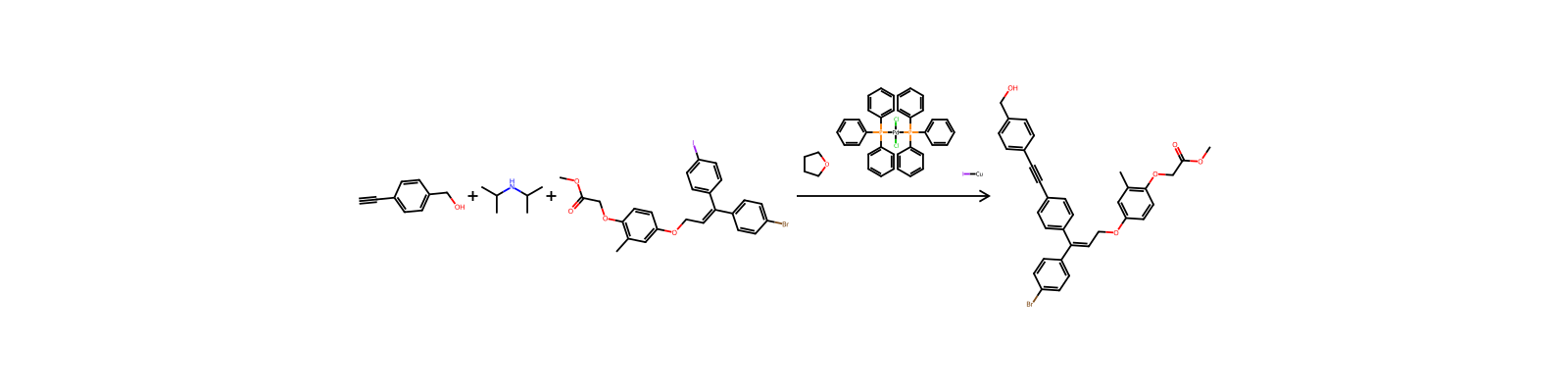
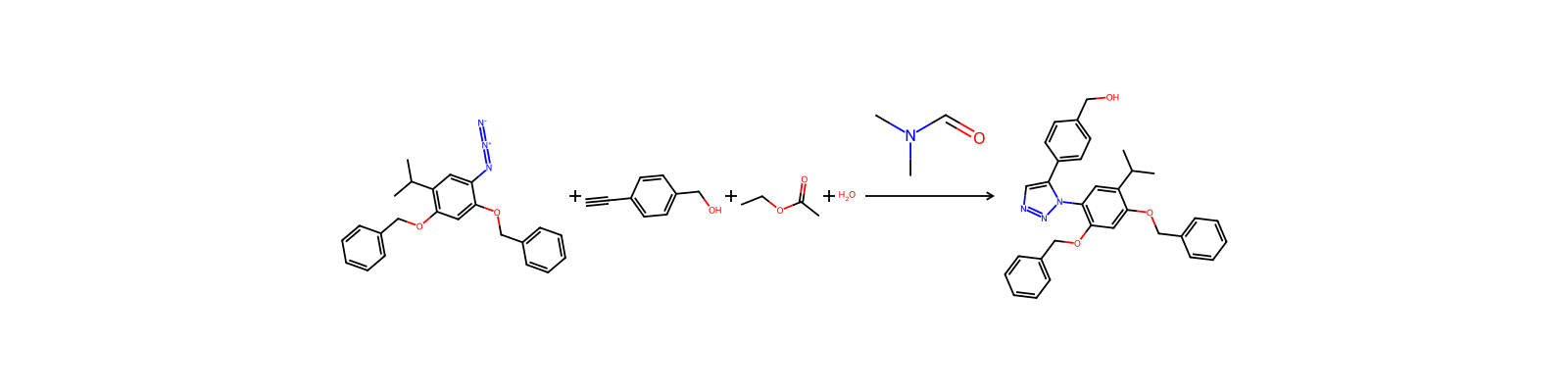
Zugehörige Reaktionen
22




Verknüpfte Notizen
Wird geladen…