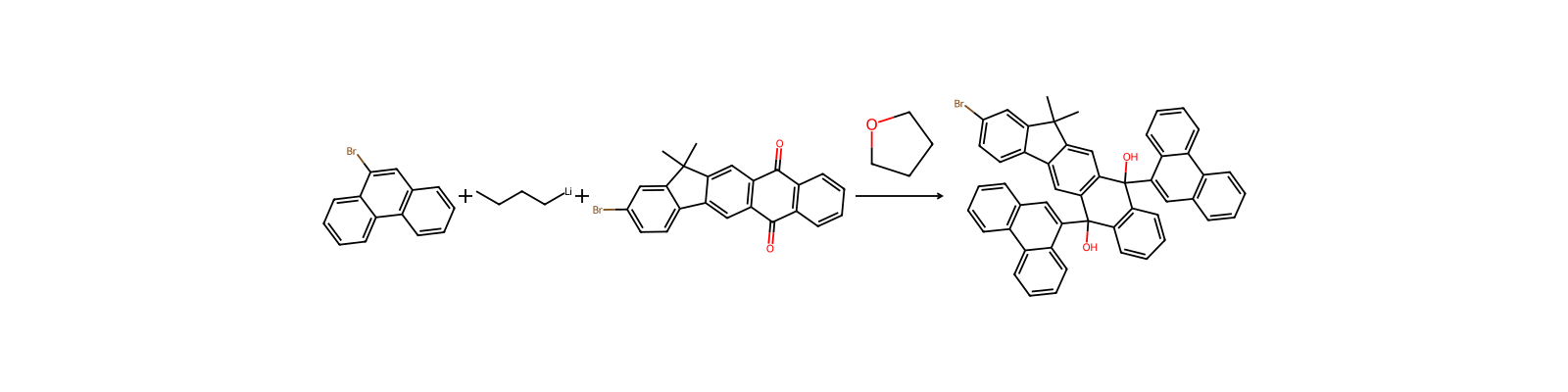
HRID 37771als Edukt
9-Bromophenanthrene
Daten werden ergänzt – lade die Seite später neu, um den aktuellen Stand zu sehen

1564-64-3Brc1cc2ccccc2c2ccccc12RSQXKVWKJVUZDG-UHFFFAOYSA-N1564-64-3、573-17-1DTXSID4049321CHEMBL3188808Sicherheitsangaben dienen nur zur Orientierung und ersetzen weder das Sicherheitsdatenblatt (SDB) des Lieferanten noch geltende Vorschriften oder eine fachliche Bewertung.
This chemical does not meet GHS hazard criteria for 50% (1 of 2) of reports.
Warning
H315 (50%): Causes skin irritation [Warning Skin corrosion/irritation]
P261, P264, P264+P265, P271, P280, P302+P352, P304+P340, P305+P351+P338, P319, P321, P332+P317, P337+P317, P362+P364, P403+P233, P405, and P501 (click each P-code to see the statement)
Aggregated GHS information provided per 2 reports by companies from 2 notifications to the ECHA C&L Inventory. Each notification may be associated with multiple companies.
Beschreibung9-Bromophenanthrene is a luminescent material that fluoresces at short wavelengths and can be used as a molecular probe to detect the presence of other compounds and the mechanism of reaction, among other things.
Verwenden9-Bromophenanthrene is used as halogenated building block. Isotope labelled 9-Bromophenanthrene (B687200), a halogenated polycyclic aromatic hydrocarbon that has been seen to have a room temperature phosphorescence that can be induced by β-cyclodextrin (β-CD) in the presence of cyclohexane; however, trace Fe(III) causes a decrease of the RTP emission.
synthetische9-Bromophenanthrene (90-94%) is produced by adding bromine to a refluxing solution of phenanthrene in carbon tetrachloride. This is the starting-point of 9-substituted phenanthrenes, e.g, when heated with cuprous cyanide at 260℃, 9-bromophenanthrene forms the corresponding cyano-compound; this may be hydrolysed to phenanthrene-9-carboxylic acid. Phenanthrene undergoes the Friedel-Crafts reaction mainly in the 3-, and to a small extent, in the 2-position. It is chloromethylated in the 9-position. When nitrated, phenanthrene gives a mixture of three mononitro-derivatives, the 3-isomer predominating. Sulphonation of phenanthrene gives a mixture of 1-, 2-, 3- and 9-phenanthrenesulphonic acids, and the ratio of these isomers depends on the temperature.