Succinimid
Succinimide

Grundinformationen
- CAS
123-56-8- Standard-SMILES
O=C1CCC(=O)N1- InChIKey
KZNICNPSHKQLFF-UHFFFAOYSA-N- Summenformel
- C4H5NO2
- Durchschnittliche Molmasse
- 99,09 g/mol
- Monoisotopische Masse
- 99,0320284
Überblick
Succinimide is a dicarboximide that is pyrrolidine which is substituted by oxo groups at positions 2 and 5. It is a dicarboximide and a pyrrolidinone.
Namen und Bezeichner
- Bevorzugter Name
- Succinimide
- IUPAC
- pyrrolidine-2,5-dione
- Lokaler Name
- Succinimid
- Englischer Name
- Succinimide
- Summenformel
- C4H5NO2
- Molmasse
- 99.09
Namen und Synonyme
SUCCINIMIDE123-56-8pyrrolidine-2,5-dione2,5-PyrrolidinedioneButanimideSuccinic acid imide2,5-Dioxopyrrolidine2,5-DiketopyrrolidineSuccinic imide3,4-Dihydropyrrole-2,5-dioneDihydro-3-pyrroline-2,5-dioneDTXSID8051629
Weitere Namen anzeigen
SILubrizol 2153succiminideOrotric
NSC-11204CHEBI:930710X90O3503DTXCID3030181RefChem:6266204-635-6679-911-6Succinimide-sauba
Datenbank-Bezeichner
- CAS
123-56-8、584-43-0- PubChem CID
- 11439
- DTXSID
DTXSID8051629- ChEMBL
CHEMBL275661- ChEBI
CHEBI:9307- UNII
- 10X90O3503
- EC Number
- 204-635-6
- Nikkaji
- J25.395B
Eigenschaften
Berechnete Struktureigenschaften
- XLogP
- -1
- Polarare Oberfläche (TPSA)
- 46,2 Ų
- H-Brücken-Donoren
- 1
- H-Brücken-Akzeptoren
- 2
- Frei drehbare Bindungen
- 0
- Schwere Atome
- 7
- Formalladung
- 0
- Komplexität
- 105
Experimentelle und physikochemische Eigenschaften
Chemical ClassesIndustrial compound
SpringerMaterials PropertiesBoiling point
Physikochemische Eigenschaften
- Schmelzpunkt
- 123 · 123-125 °C (lit.)
- Siedepunkt
- 285 · 285-290 °C (lit.)
- Dichte
- 1.41 · 1.41
- Dampfdruck
- 1 hPa · <1 hPa (50 °C)
- Brechungsindex
- 1.4166 · 1.4166 (estimate)
- Flammpunkt
- 201 °C · 201 °C
- storage temp.
- 30 °C · Store below +30°C.
- Löslichkeit
- 330 g/l · 330g/l
- pka
- 9.6 · 9.6(at 25℃)
- Aggregatzustand
- Powder or Flakes
- Farbe
- Off-white to beige to light brown
- PH
- 4 · 4-6 (200g/l, H2O)
Sicherheit und Regulatorisches
Sicherheitsangaben dienen nur zur Orientierung und ersetzen weder das Sicherheitsdatenblatt (SDB) des Lieferanten noch geltende Vorschriften oder eine fachliche Bewertung.
GHS-Klassifizierung
GHS Classification
This chemical does not meet GHS hazard criteria for 33.2% (120 of 361) of reports.
Warning
H315 (66.5%): Causes skin irritation [Warning Skin corrosion/irritation]
P261, P264, P264+P265, P271, P280, P302+P352, P304+P340, P305+P351+P338, P319, P321, P332+P317, P337+P317, P362+P364, P403+P233, P405, and P501 (click each P-code to see the statement)
Aggregated GHS information provided per 361 reports by companies from 8 notifications to the ECHA C&L Inventory. Each notification may be associated with multiple companies.
Gefahrenhinweise
Regulatory Information
Chemical: 2,5-Pyrrolidinedione
REACH registered substance: Succinimide (EC: 204-635-6)
2,5-Pyrrolidinedione: Does not have an individual approval but may be used under an appropriate group standard
Hazard Classes and CategoriesSkin Irrit. 2 (66.5%)
Sicherheitsdaten
- wgk
- 2
- tsca
- TSCA listed
- hs_code
- 29251995
- RTECS-Nr.
- WN2200000
- risk_code
- 36/37/38
- Toxizität
- LD50 orally in rats: 14 g/kg (Melon)
- hazard_code
- Xi
- safety_code
- 22-24/25-36-26-S24/25
- Speicherklasse
- 11 - Combustible Solids
Chemie und Industrie
Pharmakologische Informationen
ATC Code
G - Genito urinary system and sex hormones
QG - Genito urinary system and sex hormones
Verwendung und Herstellung
General Manufacturing Information2,5-Pyrrolidinedione: ACTIVE
Anwendungen
VerwendenSuccinimide is used in organic syntheses and in industrial silver plating processes. It is a reagent that is used in the synthesis of Lumiflavin (L473900), which is a toxic photolysis product of vitamin B2 (R415000). Further, it is used to form covalent bonds between proteins, peptides and plastics. In addition to this, it is used as an important raw material for the synthesis of heterocyclic compounds through N-acyliminium cyclizations.
Darstellung
synthetischeTo a flask equipped with a dropping funnel, mechanical stirrer, and a 40 cm long side arm of not less than 10 mm inside diameter is added 236 gm (2.0 mole) of succinic acid. The flask is cooled and 270 ml (4.0 moles) of 28% aqueous ammonia is slowly added with stirring. The flask is rapidly heated with an oil bath until 200 ml of water distils. The temperature of the bath is rapidly raised to 275°C. Succinimide starts to distil over the range 275-289°C, to afford 168 gm of crude product which solidifies on cooling. The intermediate fraction, boiling between 102° and 275°C, is redistilled to afford 10.0 gm of crude succinimide, b.p. 275-289°C. The combined product (178 gm) is added to 178 gm of hot ethanol. The solution is cooled, the crystals filtered, washed with 25 ml of cold ethanol, and dried to afford 163-164 gm (82-83%), m.p. 123-125°C. Approximately 4-5 gm of additional product may be obtained by concentrating the mother liquor. Recent Japanese patents suggested inert aprotic solvents such as cyclic amides (e.g., N-methylpyrrolidone, N-acetyl-2-pyrrolidone, DMF, or tet-ramethylurea) and azeotroping solvents (e.g., toluene, 0-xylene, hexane, or pentane) or other high-boiling solvents (e.g., chlorobenzene or chlo-rotoluene) as dehydrating agents for the formation of imides from dibasic acids (e.g., 3- and/or 4) hydroxyphthalic acid with a large variety of diamines including diaminosiloxanes such as bis (3-aminopropyl)-tetra-methylsiloxane.
Zugehörige Reaktionen
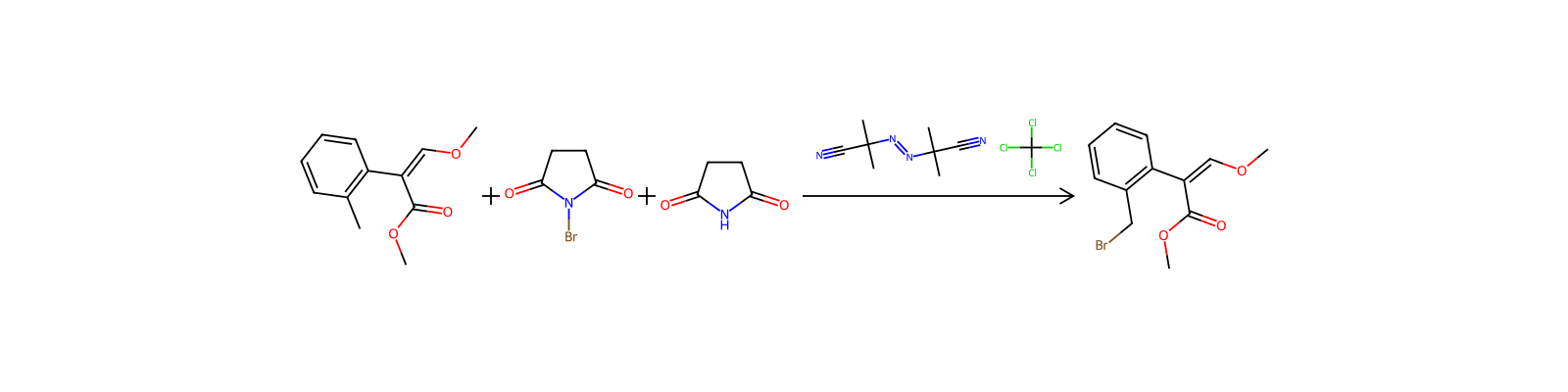
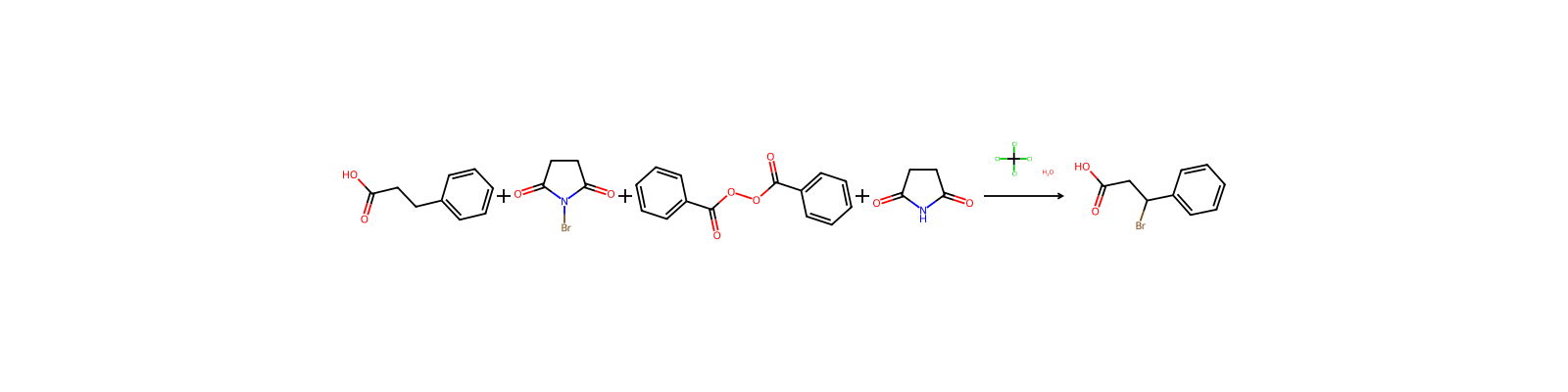
294


Notizen zur Verbindung
Wird geladen…