4-Amino-3-phenylbutyric acid hydrochloride
Daten werden ergänzt – meist innerhalb einer Minute fertig
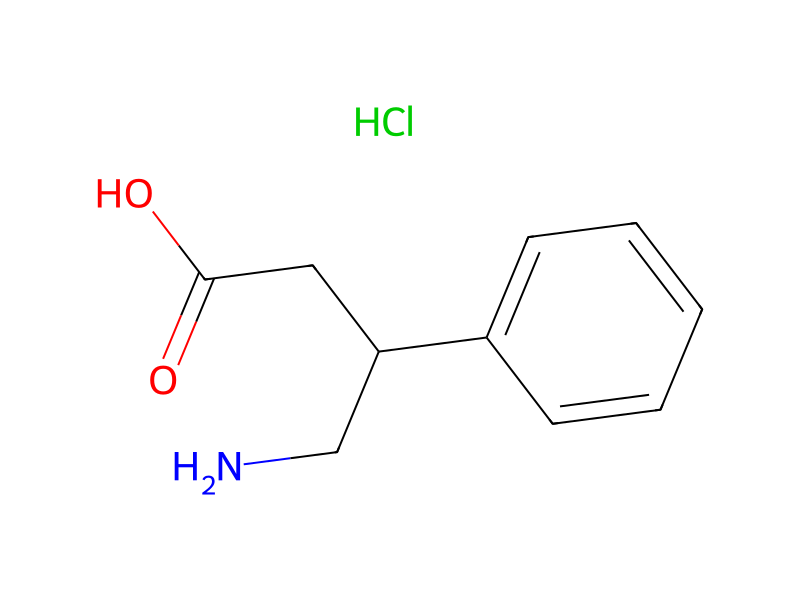
Grundinformationen
- CAS
3060-41-1- Standard-SMILES
Cl.NCC(CC(=O)O)c1ccccc1- InChIKey
XSYRYMGYPBGOPS-UHFFFAOYSA-N- Summenformel
- C10H14ClNO2
- Durchschnittliche Molmasse
- 215,67 g/mol
- Monoisotopische Masse
- 215,07130637
Namen und Bezeichner
- Bevorzugter Name
- 4-Amino-3-phenylbutyric acid hydrochloride
- IUPAC
- 4-amino-3-phenylbutanoic acid;hydrochloride
Namen und Synonyme
Weitere Namen anzeigen
Datenbank-Bezeichner
- CAS
3060-41-1- PubChem CID
- 11499499
- DTXSID
DTXSID001350159- UNII
- 625240H2LN
- EC Number
- 640-227-8
Eigenschaften
Berechnete StruktureigenschaftenWird ergänzt
- Polarare Oberfläche (TPSA)
- 63,3 Ų
- H-Brücken-Donoren
- 3
- H-Brücken-Akzeptoren
- 3
- Frei drehbare Bindungen
- 4
- Schwere Atome
- 14
- Formalladung
- 0
- Komplexität
- 164
Sicherheit und Regulatorisches
GHS-Klassifizierung
GHS Classification
Warning
H315 (96.7%): Causes skin irritation [Warning Skin corrosion/irritation]
P261, P264, P264+P265, P271, P280, P302+P352, P304+P340, P305+P351+P338, P319, P321, P332+P317, P337+P317, P362+P364, P403+P233, P405, and P501 (click each P-code to see the statement)
Aggregated GHS information provided per 30 reports by companies from 3 notifications to the ECHA C&L Inventory. Each notification may be associated with multiple companies.
Gefahrenhinweise
Chemie und Industrie
Pharmakologische Informationen
MeSH Pharmacological Classification
Drugs used to prevent SEIZURES or reduce their severity.
Substances that act in the brain stem or spinal cord to produce tonic or clonic convulsions, often by removing normal inhibitory tone. They were formerly used to stimulate respiration or as antidotes to barbiturate overdose. They are now most commonly used as experimental tools.
Drugs used to induce drowsiness or sleep or to reduce psychological excitement or anxiety.
A traditional grouping of drugs said to have a soothing or calming effect on mood, thought, or behavior. Included here are the ANTI-ANXIETY AGENTS (minor tranquilizers), ANTIMANIC AGENTS, and the ANTIPSYCHOTIC AGENTS (major tranquilizers). These drugs act by different mechanisms and are used for different therapeutic purposes.
Endogenous compounds and drugs that bind to and activate GAMMA-AMINOBUTYRIC ACID receptors (RECEPTORS, GABA).
Zugehörige Reaktionen
Keine Reaktionsaufzeichnungen unter den aktuellen Filterkriterien.
Notizen zur Verbindung
Wird geladen…