StartseiteMCPWorkbenchSkills
StartseiteWorkbenchBenachrichtigungenMein Bereich
llms.txt · MCP-AnleitungDatenschutz · Nutzungsbedingungen · Supportv1.8.0
  1. Startseite
  2. /Verbindung

Trichlormethylsulfenyl-chlorid

Trichloromethanesulfenyl chloride

HCID 11666
Neue NotizNeue ReaktionAnfrage stellen
Druckvorschau
GrundinformationenÜberblickNamen und BezeichnerEigenschaftenSicherheit und RegulatorischesChemie und IndustrieZugehörige ReaktionenNotizen zur Verbindung
TeilstruktursucheÄhnliche Strukturen suchen

Grundinformationen

CAS
594-42-3
Standard-SMILES
ClSC(Cl)(Cl)Cl
InChIKey
RYFZYYUIAZYQLC-UHFFFAOYSA-N
Summenformel
CCl4S
Durchschnittliche Molmasse
185,9 g/mol
Monoisotopische Masse
183,84748172

Überblick

Perchloromethyl mercaptan appears as a yellow oily liquid with an offensive odor. Insoluble in water. Density 1.72 g / cm3. Hence sinks in water. Nonflammable but supports combustion. Very toxic by inhalation or skin absorption.

Namen und Bezeichner

Bevorzugter Name
Trichloromethanesulfenyl chloride
IUPAC
trichloromethyl thiohypochlorite
Lokaler Name
Trichlormethylsulfenyl-chlorid
Englischer Name
Perchloromethylmercaptan
Summenformel
CCl4S
Molmasse
185.89

Namen und Synonyme

Perchloromethyl mercaptan594-42-3ClairsitTRICHLOROMETHANESULFENYL CHLORIDEPerchloromethylmercaptanMethanesulfenyl chloride, trichloro-PerchloromethanethiolTrichloromethylsulfenyl chloridePerchlormethylmerkaptan(Trichloromethane)sulfenyl chloridePerchlorinemethylmercaptanThiocarbonyl tetrachloride
Weitere Namen anzeigen
PCMPMMchlorothio-trichloro-methaneClairsit(TM)perchloromethylrcrawastenumberp118TRICHLOROMETHANETHIOL
RCRA waste number P118Trichloromethanesulphenyl chlorideTrichloromethane sulfenyl chlorideMercaptan methylique perchloreTrichlormethyl sulfur chlorideTrichloromethylsulphenyl chlorideTrichloromethyl sulfochlorideDTXSID6025854

Datenbank-Bezeichner

CAS
594-42-3

Eigenschaften

Berechnete Struktureigenschaften

XLogP
3,2
Polarare Oberfläche (TPSA)
25,3 Ų
H-Brücken-Donoren
0
H-Brücken-Akzeptoren
1
Frei drehbare Bindungen
0
Schwere Atome
6
Formalladung
0
Komplexität
37,3

Experimentelle und physikochemische Eigenschaften

Chemical ClassesToxic Gases & Vapors -> Other Toxic Gases & Vapors
SpringerMaterials PropertiesSchoenflies notation
Odor · 2 Einträge

STRONG UNPLEASANT

Unbearable, acrid odor.

Density · 6 Einträge

1.6947 at 68 °F (EPA, 1998) - Denser than water; will sink

Sp gr: 1.7 at 20 °C

Relative density (water = 1): 1.7

1.69

1.6947 @ 20°C

1.69

Color/Form · 3 Einträge

OILY, YELLOW LIQUID

YELLOW TO ORANGE-RED

Pale-yellow, oily liquid.

Solubility · 4 Einträge

less than 1 mg/mL at 70 °F (NTP, 1992)

SOL IN ETHER; INSOL IN WATER

Solubility in water: none

Insoluble

CorrosivityCORROSIVE TO MOST METALS
Boiling Point · 6 Einträge

297 to 298 °F at 760 mmHg (EPA, 1998)

Sicherheit und Regulatorisches

Sicherheitsangaben dienen nur zur Orientierung und ersetzen weder das Sicherheitsdatenblatt (SDB) des Lieferanten noch geltende Vorschriften oder eine fachliche Bewertung.

GHS-Klassifizierung

GHS Classification · 6 Einträge

Danger

H301 (100%): Toxic if swallowed [Danger Acute toxicity, oral]

P260, P261, P262, P264, P270, P271, P280, P284, P301+P316, P301+P330+P331, P302+P352, P302+P361+P354, P304+P340, P305+P354+P338, P316, P317, P319, P320, P321, P330, P361+P364, P362+P364, P363, P403+P233, P405, and P501 (click each P-code to see the statement)

Aggregated GHS information provided per 79 reports by companies from 5 notifications to the ECHA C&L Inventory. Each notification may be associated with multiple companies.

Danger

H301: Toxic if swallowed [Danger Acute toxicity, oral]

Gefahrenhinweise

Hazards IdentificationToxic/poison by inhalation (TIH/PIH)
Regulatory Information · 4 Einträge

T - indicates a substance that is the subject of a final TSCA section 4 test rule.

Status: No longer Valid Update: 24-07-2018 https://echa.europa.eu/registration-dossier/-/registered-dossier/6687

Perchloromethyl mercaptan: Does not have an individual approval but may be used as a component in a product covered by a group standard. It is not approved for use as a chemical in its own right.

The New Jersey Worker and Community Right to Know Act requires public and private employers to provide information about hazardous substances at their workplaces. (N.J.S.A. 34:5A-1 et. seq.)

DOT LabelPoison Inhalation Hazard
Fire Hazards · 3 Einträge

Very irritating vapors formed from hot material; may form phosgene gas, hydrogen chloride, and sulfur dioxide. At high temperatures this compound will decompose to carbon tetrachloride, sulfur chloride, heavy oil polymers, phosgene gas, hydrogen chloride, and sulfur dioxide. Reacts with iron or steel, evolving carbon tetrachloride. Corrosive to most metals. Reacts with water only when hot to give carbon dioxide, hydrochloric acid, and sulfur. Hazardous polymerization may not occur. (EPA, 1998)

Chemie und Industrie

Verwendung und Herstellung

Uses · 3 Einträge

Used in the production of dyes and fungicides; [ACGIH]

Used as an intermediate for the synthesis of dyes & fungicides (Captan, Folpet).

... Has tear gas properties that have been of military interest.

Methods of Manufacturing · 2 Einträge

CHLORINATION OF CARBON DISULFIDE, THIOPHOSGENE, OR METHYL THIOCYANATE.

The chlorination of carbon disulfide on a granular-charcoal column in the presence of difunctional carbonyl compounds, phosphonates, phosphorites, phosphites, phosphates or lead acetate.

Formulations/PreparationsGRADES OR PURITY: TECHNICAL: 97+%
General Manufacturing InformationMethanesulfenyl chloride, trichloro-: ACTIVE
Anwendungen · 2 Einträge

BeschreibungPerchlormethylmercaptan bildet eine ölige, hellgelbe, wasserunlösliche, extrem penetrant riechende, heftig zu Tränen reizende Flüssigkeit. Die Geruchsbelästigung ist fast unerträglicher als der Tränenreiz. Aufgrund dieser Eigenschaften wurde die Substanz im 1. Weltkrieg als chemischer Kampfstoff verwendet. Der erstmalige Einsatz erfolgte im September 1915 durch französische und russische Truppen. Heute wird Perchlormethylmercaptan zur Herstellung von Bioziden, Brennstoffadditiven und Farbstoffen verwendet.

VerwendenOrganic synthesis, dye intermediate, fumigant.

Vor- und nachgelagerte Produkte

Vorgelagerte Rohstoffe

ChlorKohlendisulfidThiocarbonyl selenide

Zugehörige Reaktionen

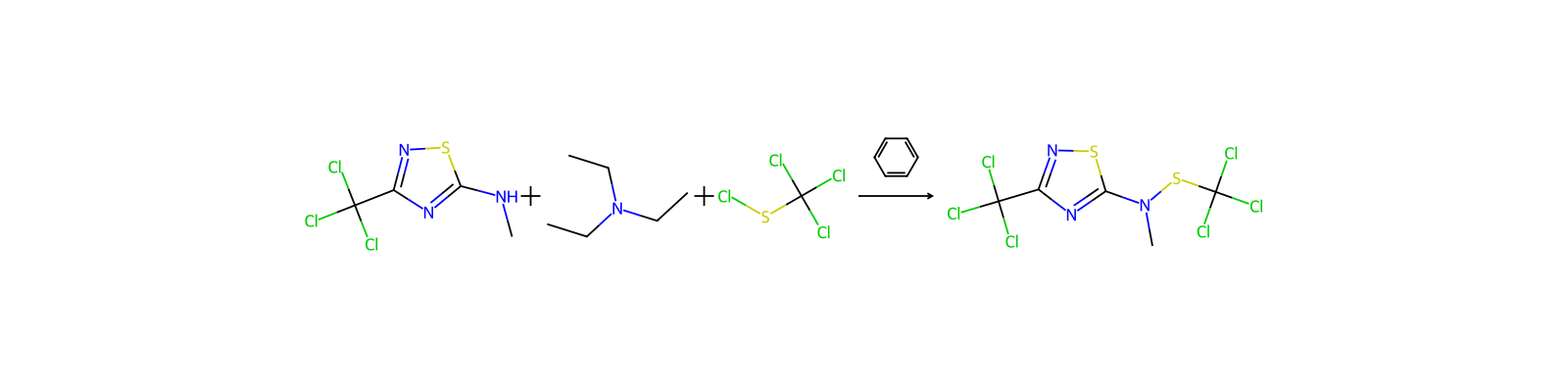
70
Reaktionsaufzeichnung erstellen
Reaktionsgleichung von HRID 70242
HRID 70242als Eduktuspto-grants-2014_09
Reaktionsgleichung von HRID 124859
HRID 124859als EduktTraining data from https://doi.org/10.1039/C8SC04228D (2/10)
Reaktionsgleichung von HRID 126973
HRID 126973als Eduktuspto-grants-1981_03
Reaktionsgleichung von HRID 126974
HRID 126974als Eduktuspto-grants-1981_03
Reaktionsgleichung von HRID 129812
HRID 129812als Eduktuspto-grants-1995_11
Reaktionsgleichung von HRID 371707
HRID 371707als Eduktuspto-grants-1978_05
Reaktionsgleichung von HRID 371708
HRID 371708als Eduktuspto-grants-1978_05
Reaktionsgleichung von HRID 371709
HRID 371709als Eduktuspto-grants-1978_05
Seite 1 von 9

Notizen zur Verbindung

Wird geladen…

Auf dieser SeiteGrundinformationenÜberblickNamen und BezeichnerEigenschaftenSicherheit und RegulatorischesChemie und IndustrieZugehörige ReaktionenNotizen zur Verbindung
Weitere Aktionen
Neue NotizNeue ReaktionAnfrage stellen
PubChem CID
11666
DTXSID
DTXSID6025854
ChEMBL
CHEMBL3188766
UNII
KK489OII9M
EC Number
209-840-4
Nikkaji
J6.775J

147-148 °C @ 760 MM HG, 51 °C @ 25 MM HG

147-148 °C

297 °F

149 °C @760 [mm Hg]

297 °F (Decomposes)

DecompositionDECOMPOSES BETWEEN 148-9 °C
Vapor Density · 4 Einträge

6.414 (EPA, 1998) - Heavier than air; will sink (Relative to Air)

6.414 (AIR= 1)

Relative vapor density (air = 1): 6.4

6.414

Odor ThresholdOdor Threshold Low: 0.001 [ppm]
Vapor Pressure · 6 Einträge

25 mmHg at 123.8 °F (EPA, 1998)

3.0 [mmHg]

Vapor pressure of 65 torr at 70 °C

3 mm Hg at 20 °C.

Vapor pressure, kPa at 20 °C: 0.4

3 mmHg

Physikochemische Eigenschaften

Siedepunkt
146 · 146-148 °C(lit.)
Dichte
1.7 g/mL · 1.7 g/mL at 25 °C(lit.)
Dampfdichte
6.41 · 6.41 (vs air)
Dampfdruck
2.02 psi · 2.02 psi ( 20 °C)
Brechungsindex
20 · n20/D 1.537(lit.)
storage temp.
-20 °C · -20°C Freezer
Löslichkeit
Chloroform, Ethyl Acetate
Aggregatzustand
Liquid
Farbe
Clear yellow
Henry's Law Constant
4.1 · 4.1×10-2 mol/(m3Pa) at 25℃, Zhang et al. (2010)
InChI
1S/CCl4S/c2-1(3,4)6-5
InChIKey
RYFZYYUIAZYQLC-UHFFFAOYSA-N
SMILES
ClSC(Cl)(Cl)Cl
CAS Datenbank
594 · 594-42-3(CAS DataBase Reference)
NIST chemische Informationen
Methanesulfenyl chloride, trichloro-(594-42-3)
EPA chemische Informationen
Perchloromethyl mercaptan (594-42-3)

· Non-combustible, substance itself does not burn but may decompose upon heating to produce corrosive and/or toxic fumes.

Not combustible. Gives off irritating or toxic fumes (or gases) in a fire.

Fire PotentialTHIS CMPD IS NEITHER FLAMMABLE NOR SERIOUS FIRE HAZARD, ALTHOUGH IT WILL SUPPORT COMBUSTION.
Health Hazards · 2 Einträge

May cause death or permanent injury after short exposure to small quantities, strong irritant to eyes and skin. Inhalation may cause severe irritation of the upper respiratory tract. It also is a strong irritant to the eyes and skin. Brief exposure to lower concentrations may produce central nervous system depression and lung, liver, and heart congestion. Severe exposures may be fatal. Exposure of eyes may lead to severe conjunctivitis or corneal damage. The liquid is irritating to the skin, and may be absorbed through the skin in quantities sufficient to cause general toxic effects. Ingestion may cause damage to mucous membranes and result in pain and burning of the mouth and throat, nausea, vomiting, cramps, and diarrhea. In severe cases, tissue ulceration and CNS depression may occur. (EPA, 1998)

· TOXIC and/or CORROSIVE; inhalation, ingestion or contact (skin, eyes) with vapors, dusts or substance may cause severe injury, burns or death.

Hazards Summary · 1 Eintrag

Exposure to high concentrations may cause pulmonary edema and death. [ACGIH] A severe skin, eye, and respiratory tract irritant; Inhalation of high concentrations can cause pulmonary edema; [ICSC] Perchloromethyl mercaptan is a lachrymator and has tear gas properties. [CHEMINFO] Liquid may cause severe corneal burns if not rinsed out promptly; [CHRIS]

DOT ID and Guide · 2 Einträge

1670 157

1670 157

Reactive GroupSulfides, Organic
UN ClassificationUN Hazard Class: 6.1; UN Pack Group: I
OSHA StandardsPermissible Exposure Limit: Table Z-1 8-hr Time Weighted Avg: 0.1 ppm (0.8 mg/cu m).
Reactivity Profile · 1 Eintrag

PERCHLOROMETHYL MERCAPTAN is incompatible with acids, diazo and azo compounds, halocarbons, isocyanates, aldehydes, alkali metals, nitrides, hydrides, and other strong reducing agents. Reactions with these materials generate heat and in many cases hydrogen gas. Reacts readily with oxidizing agents.

Sicherheit und Schutzausrüstung

Fire Fighting · 2 Einträge

Fight fire from maximum distance. Dike fire control water for later disposal; do not scatter the material. Positive pressure breathing apparatus and special protective clothing should be worn.

In case of fire in the surroundings, use appropriate extinguishing media.

First Aid Measures · 4 Einträge

Fresh air, rest. Half-upright position. Artificial respiration may be needed. Refer for medical attention.

Remove contaminated clothes. Rinse skin with plenty of water or shower. Refer for medical attention .

First rinse with plenty of water for several minutes (remove contact lenses if easily possible), then refer for medical attention.

Rinse mouth. Do NOT induce vomiting. Give one or two glasses of water to drink. Refer for medical attention .

Accidental Release Measures · 2 Einträge

· CALL 911. Then call emergency response telephone number on shipping paper. If shipping paper not available or no answer, refer to appropriate telephone number listed on the inside back cover.

· ELIMINATE all ignition sources (no smoking, flares, sparks or flames) from immediate area.

First Aid · 3 Einträge

Signs and Symptoms of Acute Perchloromethylmercaptan Exposure: Signs and symptoms of acute exposure to perchloromethylmercaptan may lead to liver, heart, and kidney damage. Respiratory effects include coughing, dyspnea (shortness of breath), painful breathing, and lung congestion. Tachycardia (rapid heart rate) is often observed. Nausea, vomiting, abdominal cramping, and diarrhea may also occur. Contact with perchloromethylmercaptan may result in severe dermatitis (red, inflamed skin), conjunctivitis (red, inflamed eyes), and burns with ulceration and severe pain.

General First Aid:

(General first aid procedures)

Safe StorageSeparated from food and feedstuffs. See Chemical Dangers. Well closed.
Exposure Control and Personal Protection · 2 Einträge

· Wear positive pressure self-contained breathing apparatus (SCBA).

TIH (Toxic Inhalation Hazard) - Term used to describe gases and volatile liquids that are toxic when inhaled. Some are TIH materials themselves, e.g., chlorine, and some release TIH gases when spilled in water, e.g., chlorosilanes. [ERG 2016].

Cleanup Methods1. VENTILATE AREA OF SPILL OR LEAK. 2. COLLECT FOR RECLAMATION OR ABSORB IN VERMICULITE, DRY SAND, EARTH, OR A SIMILAR MATERIAL.
Nonfire Spill ResponseExcerpt from ERG Guide 157 [Substances - Toxic and/or Corrosive (Non-Combustible / Water-Sensitive)]:
Disposal Methods · 1 Eintrag

1. BY ABSORBING IT IN VERMICULITE, DRY SAND, EARTH OR SIMILAR MATERIAL & DISPOSING IN SECURED SANITARY LANDFILL. 2. BY DISSOLVING IN COMBUSTIBLE SOLVENT, SUCH AS ALC, & BURNING IN SUITABLE COMBUSTION CHAMBER EQUIPPED WITH APPROPRIATE EFFLUENT GAS CLEANING DEVICE.

Spillage Disposal · 1 Eintrag

Evacuate danger area! Consult an expert! Personal protection: chemical protection suit including self-contained breathing apparatus. Collect leaking and spilled liquid in sealable containers as far as possible. Absorb remaining liquid in sand or inert absorbent. Then store and dispose of according to local regulations.

Preventive Measures · 4 Einträge

SRP: The scientific literature for the use of contact lenses in industry is conflicting. The benefit or detrimental effects of wearing contact lenses depend not only upon the substance, but also on factors including the form of the substance, characteristics and duration of the exposure, the uses of other eye protection equipment, and the hygiene of the lenses. However, there may be individual substances whose irritating or corrosive properties are such that the wearing of contact lenses would be harmful to the eye. In those specific cases, contact lenses should not be worn. In any event, the usual eye protection equipment should be worn even when contact lenses are in place.

SRP: Contaminated protective clothing should be segregated in such a manner so that there is no direct personal contact by personnel who handle, dispose, or clean the clothing. Quality assurance to ascertain the completeness of the cleaning procedures should be implemented before the decontaminated protective clothing is returned for reuse by the workers. Contaminated clothing should not be taken home at end of shift, but should remain at employee's place of work for cleaning.

The worker should immediately wash the skin when it becomes contaminated.

Work clothing that becomes wet or significantly contaminated should be removed and replaced.

Isolation and Evacuation · 4 Einträge

Excerpt from ERG Guide 157 [Substances - Toxic and/or Corrosive (Non-Combustible / Water-Sensitive)]:

Immediate precautionary measure

Small spill:

Small spill:

Toxikologische Informationen

Target OrgansEyes, skin, respiratory system, liver, kidneys
Environmental Fate · 3 Einträge

TERRESTRIAL FATE: If trichloromethanesulfenyl chloride is released to soil, it will be expected to slowly hydrolyze(1). No data were located and no estimations could be made concerning biodegradation in, adsorption to or volatilization from soil(SRC). Based upon a measured vapor pressure of 3 mm Hg at 20 °C(2), volatilization from dry near-surface soil or surfaces may be significant processes(SRC).

AQUATIC FATE: If trichloromethanesulfenyl chloride is released to water, it will be expected to slowly hydrolyze(1). No data were located and no estimations could be made concerning bioconcentration, biodegradation, volatilization, and adsorption to sediment and suspended solids(SRC).

ATMOSPHERIC FATE: If trichloromethanesulfenyl chloride is released to the atmosphere, it will be expected to exist almost entirely in the vapor phase(1) based upon a reported vapor pressure of 3 mm Hg at 20 °C(2). It will be susceptible to photooxidation via vapor phase reaction with photochemically produced hydroxyl radicals. An atmospheric half-life of 8 days at an atmospheric concentration of 5X10+5 hydroxyl radicals per cu cm has been calculated for this process based upon an estimated rate constant(3,SRC).

Adverse EffectsDermatotoxin - Skin burns.
Exposure Routes · 2 Einträge

The substance can be absorbed into the body by inhalation of its vapour, through the skin and by ingestion.

inhalation, skin absorption, ingestion, skin and/or eye contact

Signs and Symptoms · 5 Einträge

Cough. Sore throat. Laboured breathing. Nausea. Vomiting. Convulsions.

Redness. Pain.

Redness. Pain.

Abdominal cramps. Further see Inhalation.

irritation eyes, skin, nose, throat; lacrimation (discharge of tears); cough, dyspnea (breathing difficulty), deep breath pain, coarse rales; vomiting; pallor, tachycardia; acidosis; anuria; liver, kidney damage

ICSC Environmental DataEnvironmental effects from the substance have not been investigated adequately.
Soil Adsorption/MobilityDue to lack of data it is not possible to estimate a Koc for trichloroethanesulfenyl chloride. (SRC)
Human Toxicity Excerpts · 5 Einträge

MEN EXPOSED AT LOWER CONCENTRATIONS /BELOW 45 PPM/ NOTED STRONG EYE, THROAT AND CHEST IRRITATION. NAUSEA ALSO RESULTED FROM EXPOSURE.

... BRIEF EXPOSURE TO LOW CONCN MAY PRODUCE CNS DEPRESSION & LUNG, LIVER, & HEART CONGESTION.

TOXIC BY INGESTION & INHALATION, STRONG IRRITANT TO EYES & SKIN.

... /LIQ/ ... MAY BE ABSORBED THROUGH SKIN IN QUANTITIES TO PRODUCE SYSTEMIC POISONING.

Trichloromethanethiol (perchloromethyl mercaptan) is ... irritating to the respiratory tract.

Artificial Pollution Sources · 1 Eintrag

Trichloromethanesulfenyl chloride may be released to the environment as a result of its manufacture and use as an intermediate principally in the production of fungicides, including captan and folpet(1). It is also used as an intermediate in other organic syntheses including the production of dyes(2).

Environmental Biodegradation · 1 Eintrag

No data were located concerning the biodegradation of trichloromethanesulfenyl chloride either in natural systems or in laboratory studies(SRC). Since trichloromethanesulfenyl chloride slowly hydrolyzes in water(1,2), biodegradation may not be significant relative to hydrolysis(SRC).

Environmental BioconcentrationDue to a lack of data, it is not possible to estimate a BCF for trichloromethanesulfenyl chloride. (SRC)
Volatilization from Water/Soil · 1 Eintrag

Due to a lack of data, it is not possible to estimate half-lives for volatilization from water and soil for trichloromethanesulfenyl chloride(SRC). Based upon a measured vapor pressure of 3 mm Hg at 20 °C(1), volatilization of trichloromethanesulfenyl chloride from surfaces and near-surface dry soil may be significant processes(SRC).

Regulatorische Informationen

Atmospheric Standards · 1 Eintrag

This action promulgates standards of performance for equipment leaks of Volatile Organic Compounds (VOC) in the Synthetic Organic Chemical Manufacturing Industry (SOCMI). The intended effect of these standards is to require all newly constructed, modified, and reconstructed SOCMI process units to use the best demonstrated system of continuous emission reduction for equipment leaks of VOC, considering costs, non air quality health and environmental impact and energy requirements. Perchloromethyl mercaptan is produced, as an intermediate or final product, by process units covered under this subpart.

CERCLA Reportable Quantities · 2 Einträge

Persons in charge of vessels or facilities are required to notify the National Response Center (NRC) immediately, when there is a release of this designated hazardous substance, in an amount equal to or greater than its reportable quantity of 100 lb or 45.4 kg. The toll free number of the NRC is (800) 424-8802; In the Washington D.C. metropolitan area (202) 426-2675. The rule for determining when notification is required is stated in 40 CFR 302.4 (section IV. D.3.b).

Releases of CERCLA hazardous substances are subject to the release reporting requirement of CERCLA section 103, codified at 40 CFR part 302, in addition to the requirements of 40 CFR part 355. Perchloromethylmercaptan is an extremely hazardous substance (EHS) subject to reporting requirements when stored in amounts in excess of its threshold planning quantity (TPQ) of 500 lbs.

DHS Chemicals of Interest (COI) · 4 Einträge

Perchloromethylmercaptan

1.00

10,000

Toxic chemical that can be released at a facility.

Sicherheitsdaten

F
13-21
OEB
C
OEL
TWA: 0.1 ppm (0.8 mg/m3)
wgk
3
IDLA
10 ppm
tsca
TSCA listed
ridadr
UN 1670
hs_code
29309099
RTECS-Nr.
PB0370000
risk_code
23/24/25-34-26-25-21-52/53
hazard_code
T,T+,N
safety_code
26-36/37/39-45-7/9-28A-25-61
hazard_class
6.1
packing_group
I
Speicherklasse
6.1B - Non-combustible acute toxic Cat. 1 and 2very toxic hazardous materials
Giftige Stoffe Daten
594-42-3(Hazardous Substances Data)
Hazard Classifications
Acute Tox. 1 InhalationAcute Tox. 3 OralAcute Tox. 4 DermalEye Dam. 1Skin Corr. 1B
Methane, trichloro[(chloromethyl)thio]-
Methylthiocyanat
Tetrachlormethan
Dimethylsulfid
Trichlormethan
Iod

Nachgelagerte Produkte

ThiocarbonylchloridDichloromethanedisulfenyl chlorideSelentetrachlorid3-(Trifluoromethyl)phenyl isothiocyanateTetramethylorthocarbonatBenzoylchloridN-(Trichlormethylthio)phthalimid