
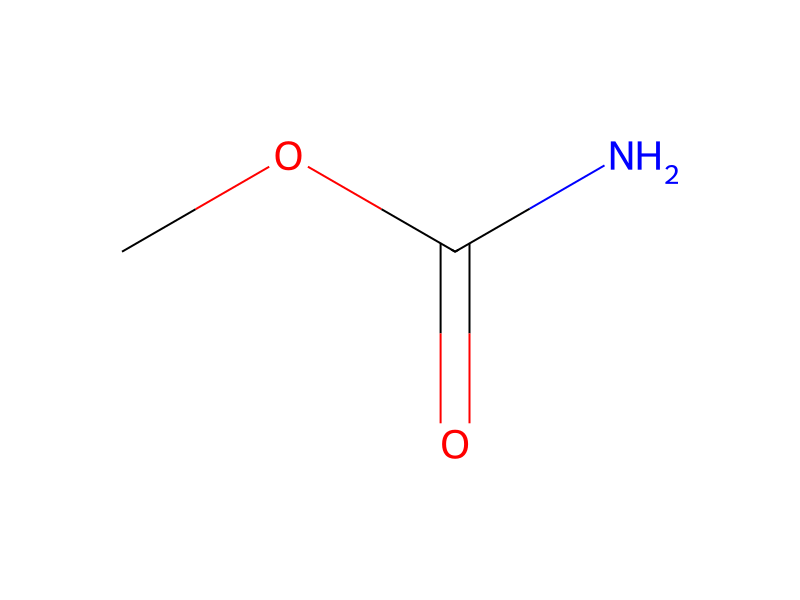
Grundinformationen
- Standard-SMILES
COC(N)=O- InChIKey
GTCAXTIRRLKXRU-UHFFFAOYSA-N- Summenformel
- C2H5NO2
- Durchschnittliche Molmasse
- 75,07 g/mol
- Monoisotopische Masse
- 75,0320284
Überblick
Methyl Carbamate can cause cancer according to The National Toxicology Program.
Namen und Bezeichner
- Bevorzugter Name
- Methyl Carbamate
- IUPAC
- methyl carbamate
- Lokaler Name
- Methylcarbamat
- Englischer Name
- Methyl carbamate
- Summenformel
- C2H5NO2
- Molmasse
- 75.07
Namen und Synonyme
METHYL CARBAMATE598-55-0UrethylaneMethylcarbamateMethylurethaneMethylurethanCarbamic acid, methyl esterCarbamic acid methyl esterMethylkarbamatNCI-C55594DTXSID80208349WFX634X2T
Weitere Namen anzeigen
MCMMECBCWS5MCMTC(?)-GCp55-gammap85-alphaurethylan
Methylester kyseliny karbaminoveDTXCID60834NSC-3054CHEBI:76606RefChem:157812209-939-2CCRIS 885HSDB 2587
Datenbank-Bezeichner
- CAS
598-55-0- PubChem CID
- 11722
- DTXSID
DTXSID8020834- ChEMBL
CHEMBL1085707- ChEBI
CHEBI:76606- UNII
- 9WFX634X2T
- EC Number
- 209-939-2
- Nikkaji
- J1.651I
Eigenschaften
Berechnete Struktureigenschaften
- XLogP
- -0,7
- Polarare Oberfläche (TPSA)
- 52,3 Ų
- H-Brücken-Donoren
- 1
- H-Brücken-Akzeptoren
- 2
- Frei drehbare Bindungen
- 1
- Schwere Atome
- 5
- Formalladung
- 0
- Komplexität
- 42,9
Experimentelle und physikochemische Eigenschaften
Chemical ClassesOther Classes -> Carbamic Acid Esters
SpringerMaterials PropertiesSchoenflies notation
LogPlog Kow = -0.66
Density
1.1361 at 133 °F (NTP, 1992) - Denser than water; will sink
1.1361 g/cu cm at 56 °C
Color/Form
WHITE CRYSTALS
NEEDLES
Solubility
greater than or equal to 100 mg/mL at 66 °F (NTP, 1992)
SOL IN WATER: 217 PARTS IN 100 @ 11 °C
SOL IN ETHANOL: 73 PARTS IN 100 @ 15 °C; SOL IN ETHER
In water, 6.91X10+5 mg/l at 15.5 °C
Boiling Point
351 °F at 760 mmHg (NTP, 1992)
177 °C
DecompositionWhen heated to decomposition it emits toxic fumes of NOx.
Melting Point
129 °F (NTP, 1992)
52-54 °C
Vapor Pressure0.56 [mmHg]
Refractive IndexINDEX OF REFRACTION: 1.4125 @ 56 °C/D
Physical Description
Methyl carbamate appears as white crystals. (NTP, 1992)
Liquid
White solid; sublimes at room temperature; [Merck Index] White crystalline solid; [MSDSonline]
Physikochemische Eigenschaften
- Schmelzpunkt
- 56 · 56-58 °C (lit.)
- Siedepunkt
- 176 · 176-177 °C (lit.)
- Dichte
- 1 · 1,14 g/cm3
- Brechungsindex
- 1.4125 · 1.4125
- Flammpunkt
- 93 °C · 93 °C
- storage temp.
- Inert atmosphere,Room Temperature
- Löslichkeit
- 700 g/L · 700 g/L (20°C)
- pka
- 13.37 · 13.37±0.50(Predicted)
- Aggregatzustand
- Adhering Crystals
- Farbe
- White
- PH
- 6 · 6-8 (50g/l, H2O, 20℃)
- Wasserlöslichkeit
- 700 g/L · 700 g/L (20 ºC)
- Merck
- 14 · 14,6036
- Specific Activity
- 11.2 · 11.2-16.8nmol/min·mg
- BRN
- 635779 · 635779
- Henry's Law Constant
- 2.5 · 2.5×102 mol/(m3Pa) at 25℃, HSDB (2015)
- InChI
- 1S/C2H5NO2/c1-5-2(3)4/h1H3,(H2,3,4)
- InChIKey
- GTCAXTIRRLKXRU-UHFFFAOYSA-N
- SMILES
- COC(N)=O
- CAS Datenbank
- 598 · 598-55-0(CAS DataBase Reference)
- NIST chemische Informationen
- Carbamic acid, methyl ester(598-55-0)
- EPA chemische Informationen
- Methyl carbamate (598-55-0)
Sicherheit und Regulatorisches
GHS-Klassifizierung
GHS Classification
This chemical does not meet GHS hazard criteria for 0.1% (1 of 758) of reports.
Warning
H315 (65.4%): Causes skin irritation [Warning Skin corrosion/irritation]
P203, P261, P264, P264+P265, P271, P280, P302+P352, P304+P340, P305+P351+P338, P318, P319, P321, P332+P317, P337+P317, P362+P364, P403+P233, P405, and P501 (click each P-code to see the statement)
Aggregated GHS information provided per 758 reports by companies from 11 notifications to the ECHA C&L Inventory. Each notification may be associated with multiple companies.
Gefahrenhinweise
Regulatory Information
Chemical: Carbamic acid, methyl ester
Hazard Traits - Carcinogenicity
Carbamic acid, methyl ester is listed on the EPA's Chemical Data Reporting (CDR) system. Manufacturers and importers of Carbamic acid, methyl ester are required to report information about their production and use of this chemical to the EPA under the Toxic Substances Control Act (TSCA). (40 eCFR Part 711)
Status: Active Update: 27-07-2021 https://echa.europa.eu/registration-dossier/-/registered-dossier/18202
Carbamic acid, methyl ester: Does not have an individual approval but may be used as a component in a product covered by a group standard. It is not approved for use as a chemical in its own right.
DOT LabelPoison
Fire HazardsFlash point data for this chemical are not available; however, it is probably combustible. (NTP, 1992)
Health HazardsSYMPTOMS: Overexposure to this compound may cause narcosis.
Hazards SummaryHigh levels of exposure may lead to narcosis; [CAMEO] An irritant; Effects in high-dose animal studies include convulsions; [MSDSonline]
Reactive GroupCarbamates
Special ReportsDHHS/NTP; Toxicology & Carcinogenesis Studies of Methyl Carbamate in F344/N Rats and B6C3F1 Mice Technical Report Series No. 328 (1987) NIH Publication No. 88-2584
Reactivity Profile
METHYL CARBAMATE is a carbamate ester. Carbamates are chemically similar to, but more reactive than amides. Like amides they form polymers such as polyurethane resins. Carbamates are incompatible with strong acids and bases, and especially incompatible with strong reducing agents such as hydrides. Flammable gaseous hydrogen is produced by the combination of active metals or nitrides with carbamates. Strongly oxidizing acids, peroxides, and hydroperoxides are incompatible with carbamates.
Air and Water ReactionsWater soluble.
Hazard Classes and CategoriesSkin Irrit. 2 (65.4%)
Hazardous Reactivities and Incompatibilities
This intermediate /N-carbomethoxymethylimino phosphoryl chloride/ (or its ethyl homolog), produced during prepn of phosphoryl dichloride isocyanate from interaction of phosphorus pentachloride & methyl (or ethyl) carbamate, is unstable. Its decomposition to the required product may be violent or explosive unless moderated by the presence of a halogenated solvent.
Sicherheit und Schutzausrüstung
Fire FightingFires involving this material can be controlled with a dry chemical, carbon dioxide or Halon extinguisher. (NTP, 1992)
First Aid
EYES: First check the victim for contact lenses and remove if present. Flush victim's eyes with water or normal saline solution for 20 to 30 minutes while simultaneously calling a hospital or poison control center. Do not put any ointments, oils, or medication in the victim's eyes without specific instructions from a physician. IMMEDIATELY transport the victim after flushing eyes to a hospital even if no symptoms (such as redness or irritation) develop.
Nonfire Spill Response
SMALL SPILLS AND LEAKAGE: If you spill this chemical, you should dampen the solid spill material with water, then transfer the dampened material to a suitable container. Use absorbent paper dampened with water to pick up any remaining material. Seal your contaminated clothing and the absorbent paper in a vapor-tight plastic bag for eventual disposal. Wash all contaminated surfaces with a soap and water solution. Do not reenter the contaminated area until the Safety Officer (or other responsible person) has verified that the area has been properly cleaned.
Disposal Methods
SRP: At the time of review, criteria for land treatment or burial (sanitary landfill) disposal practices are subject to significant revision. Prior to implementing land disposal of waste residue (including waste sludge), consult with environmental regulatory agencies for guidance on acceptable disposal practices.
Isolation and EvacuationExcerpt from ERG Guide 154 [Substances - Toxic and/or Corrosive (Non-Combustible)]:
Personal Protective Equipment (PPE)
RECOMMENDED RESPIRATOR: Where the neat test chemical is weighed and diluted, wear a NIOSH-approved half face respirator equipped with a combination filter cartridge, i.e. organic vapor/acid gas/HEPA (specific for organic vapors, HCl, acid gas, SO2 and a high efficiency particulate filter). (NTP, 1992)
Toxikologische Informationen
Interactions
Male CF-1 mice were treated with urethane (0, 0.5, 1.0, 1.5, and 2 g/kg; ip) and 18 hr later hepatic metallothionein concentrations were determined with the cadmium hemoglobin radioassay. Urethane (1 g/kg and higher) significantly increase hepatic metallothionein levels, resulting in a 14 fold increase after 2 g/kg. Time course experiments indicated that metallothionein levels were increased significantly at 6 hr after administration of urethane (1.5 g/kg) and reached a maximum between 12 and 24 hr. Gel filtration, anion exchange chromatography, and UV spectral analysis were used to characterize the protein induced by urethane. Pretreatment with actinomycin-D prevented induction of metallothionein by urethane. Administration of equimolar dosages (20 mmol/kg) of urethane, N-hydroxyurethane, and methyl carbamate indicated that urethane and N-hydroxyurethane induce metallothionein but that methyl carbamate does not. Metallothionein induction was also not observed with (pentobarbital and phenobarbital). Urethane induces hepatic metallothionein but this effect is not related to its anesthetic action, nor is it a common property of all carbamates.
Environmental Fate
TERRESTRIAL FATE: Based on a recommended classification scheme(1), an estimated Koc value of 10(SRC), determined from a measured log Kow of -0.66(2) and a recommended regression-derived equation(3), indicates that methyl carbamate is expected to have very high mobility in soil(SRC). However, methyl carbamate was determined to adsorb onto the clay mineral montmorillonite(4). Volatilization of methyl carbamate will not be important from moist soil surfaces(SRC) given an estimated Henry's Law constant of 4.0X10⁻⁸ atm-cu m/mole(SRC), using a fragment constant estimation method(5). Hydrolysis of methyl carbamate in moist soils may be catalyzed by adsorption to Na+, Mg2+, Al3+, and Cu2+ montmorillonites(4,SRC). Biodegradation of methyl carbamate in soil may be important(SRC), based on its biodegradation in river and seawater(6).
AQUATIC FATE: Based on a recommended classification scheme(1), an estimated Koc value of 10(SRC), determined from a measured log Kow of -0.66(2) and a recommended regression-derived equation(3), indicates that methyl carbamate is not expected to adsorb to suspended solids and sediment in water(SRC). Methyl carbamate is not expected to volatilize from water surfaces(3,SRC) based on an estimated Henry's Law constant of 4.0X10⁻⁸ atm-cu m/mole(SRC), developed using a fragment constant estimation method(4). According to a classification scheme(5), an estimated BCF value of 0.19(3,SRC), from a measured log Kow(2), suggests that bioconcentration in aquatic organisms is low(SRC). Methyl carbamate was degraded 19 and 18% in river and seawater, respectively, over a three day period(6). Purely aliphatic carbamates are expected to be resistant to hydrolysis under environmental conditions(7); hydrolysis half-lives of 3300 and 330 years at pH values of 7 and 8, respectively, were estimated for methyl carbamate(8,SRC).
ATMOSPHERIC FATE: According to a model of gas/particle partitioning of semivolatile organic compounds in the atmosphere(1), methyl carbamate, which has an estimated vapor pressure of 0.56 mm Hg at 25 °C(2,SRC), is expected to exist solely as a vapor in the ambient atmosphere. Vapor-phase methyl carbamate is degraded in the atmosphere by reaction with photochemically-produced hydroxyl radicals(SRC); the half-life for this reaction in air is estimated to be about 4.8 days(3,SRC).
Food Survey Values
Methyl carbamate was detected in trace amounts in red and white wines, sherry, whisky, and Armagnac(1). Methyl carbamate was detected in fruit brandy from France and Austria at an average concentration of 28 and 9 ug/kg, respectively(1). Methyl carbamate was detected in various breads, light toast, and dark toast at an average concentration of 3.0, 2.2, and 2.7 ug/kg, respectively(1). Trace levels, 1 to 4 ug/kg, of methyl carbamate were detected in various yogurt samples(1). Soy sauce samples contained minute amounts, 0.1 to 1.1 ug/kg, of methyl carbamate(1).
Adverse EffectsNeurotoxin - Other CNS neurotoxin
Ongoing Test Status
The following link will take the user to the National Toxicology Program (NTP) Test Agent Search Results page, which tabulates all of the "Standard Toxicology & Carcinogenesis Studies", "Developmental Studies", and "Genetic Toxicity Studies" performed with this chemical. Clicking on the "Testing Status" link will take the user to the status (i.e., in review, in progress, in preparation, on test, completed, etc.) and results of all the studies that the NTP has done on this chemical. [http://ntp-apps.niehs.nih.gov/ntp_tox/index.cfm?fuseaction=ntpsearch.searchresults&searchterm=598-55-0]
Soil Adsorption/Mobility
The Koc of methyl carbamate is estimated as approximately 10(SRC), using a measured log Kow of -0.66(1) and a regression-derived equation(2,SRC). According to a recommended classification scheme(3), this estimated Koc value suggests that methyl carbamate is expected to have very high mobility in soil(SRC). Methyl carbamate adsorbs on Na+, Mg2+, Al3+, and Cu2+ montmorillonites which catalyze the hydrolysis of methyl carbamate when equilibrated at room temperature and 100% relative humidity(4).
Natural Pollution SourcesMETHYL CARBAMATE HAS BEEN ISOLATED FROM 4 SALSOLA SPECIES...
Artificial Pollution SourcesMethyl carbamate's production and use as an intermediate in the manufacture of dimethylol methyl carbamate-based resins(1) may result in its release to the environment through various waste streams(SRC).
Environmental BiodegradationMethyl carbamate, present at a concentration of 100 ppm, was degraded 19 and 18% after three days cultivation in water from the Mino River and Akashi Beach, Japan, respectively(1).
Carcinogen Classification
Methyl carbamate
Group 3: Not classifiable as to its carcinogenicity to humans
Volume 12: (1976) Some Carbamates, Thiocarbamates and Carbazides
1987
1987
Methyl Carbamate
Environmental Bioconcentration
An estimated BCF value of 0.19 was calculated for methyl carbamate(SRC), using a measured log Kow of -0.66(1) and a recommended regression-derived equation(2). According to a classification scheme(3), this BCF value suggests that bioconcentration in aquatic organisms is low(SRC).
Volatilization from Water/Soil
The Henry's Law constant for methyl carbamate is estimated as 4.0X10⁻⁸ atm-cu m/mole(SRC) using a fragment constant estimation method(1). This value indicates that methyl carbamate will be essentially nonvolatile from water surfaces(2,SRC). Methyl carbamate's Henry's Law constant(1,SRC) indicates that volatilization from moist soil surfaces is not expected to occur(SRC).
Sicherheitsdaten
- wgk
- 3
- tsca
- TSCA listed
- hs_code
- 29241900
- RTECS-Nr.
- FC2450000
- risk_code
- 36-40-61
- hazard_code
- Xn,T
- safety_code
- 26-36/37-36-22-45-53
- Speicherklasse
- 11 - Combustible Solids
- Giftige Stoffe Daten
- 598-55-0(Hazardous Substances Data)
- Hazard Classifications
- Carc. 2Eye Irrit. 2
Chemie und Industrie
Pharmakologische Informationen
Absorption, Distribution and Excretion
RATS INJECTED IP WITH METHYL CARBAMATE...EXCRETED...CARBAMATE...IN URINE...
DNA BINDING OF...(14)C-METHYL CARBAMATE LABELED IN METHYL GROUP HAS BEEN INVESTIGATED IN MOUSE LIVER & KIDNEY. ... INCORP OF (3)H-METHYL CARBAMATE INTO LIVER-CELL RNA HAS BEEN EXAMINED IN MICE...
Verwendung und Herstellung
Uses
Used to make dimethylol methyl carbamate-based resins and pharmaceuticals; Also used in the textile industry as a fabric finish for polyester/cotton blends; [HSDB]
Textiles (Printing, Dyeing, or Finishing) [Category: Industry]
USED IN EUROPE AS PHARMACEUTICAL INTERMEDIATE
An intermediate in the manufacture of dimethylol methyl carbamate-based resins, which are used in the textile industry as durable-press fabric finishes for polyester/cotton blends.
U.S. Production
2023: 1,000,000 - <5,000,000 lb
(1975) PROBABLY GREATER THAN 9.1X10+5 GRAMS
Consumption PatternsPROBABLY 100% AS A CHEM INT FOR DIMETHYLOL METHYL CARBAMATE-BASED RESINS AS A DURABLE-PRESS FABRIC FINISH (1976)
Industry UsesAdhesion/cohesion promoter
Methods of Manufacturing
FROM SILVER OR MERCURICYANATE WITH H2S & METHANOL: BIRKENBACH, KOLB, BER 68, 901 (1953). FROM UREA & METHANOL: GERMAN PATENT 753,127 (1940 TO IG FARBENIND).
IT CAN...BE PREPD BY REACTION OF AMMONIA WITH METHYL CHLOROFORMATE ... & THIS METHOD IS BELIEVED TO HAVE BEEN USED COMMERCIALLY.
General Manufacturing Information
All Other Basic Organic Chemical Manufacturing
Carbamic acid, methyl ester: ACTIVE
Anwendungen
VerwendenMethyl carbamate was used in the synthesis of protected aminocyclopropanes.
Vor- und nachgelagerte Produkte
Vorgelagerte Rohstoffe
Nachgelagerte Produkte
Anbieter50 Anbieter
国药集团化学试剂有限公司86-21-63210123 · [email protected]
梯希爱(上海)化成工业发展有限公司021-67121386 · [email protected]
上海阿拉丁生化科技股份有限公司400-6206333 13167063860 · [email protected]
科瑞迪化学400-821-5857 021-64326257 · [email protected]
Syntechem Co.,Ltd[email protected]
上海迈瑞尔生化科技有限公司4006356688 18621169109 · [email protected]
武汉易泰科技有限公司上海分公司18930552037 · [email protected]
阿法埃莎(中国)化学有限公司400-6106006 · [email protected]
安耐吉化学&3A(安徽泽升科技股份有限公司)400-0056266 · [email protected]
上海瀚鸿科技股份有限公司021-54306202 13764082696 · [email protected]
上海景颜化工科技有限公司13817811078 · [email protected]
上海隆盛化工有限公司58099637 13585536065 · [email protected]
孝感深远化工有限公司15527621225; 15527621225 · [email protected]
山东西亚化学有限公司13355009207 13355009207 · [email protected]
玛雅试剂+86 (573) 82222445 (0)18006601000 452520369 · [email protected]
四川库利南科技有限公司400-1166-196 18981987031 · [email protected]
上海耐士化工科技有限公司400-188-0725 +86 21 34310725 13611771617
天津希恩思生化科技有限公司400 638 7771 · [email protected]
艾科试剂4008-755-333 18080918076 · [email protected]
上海思域化工科技有限公司86-21-34053660 · [email protected]
赛默飞世尔科技(中国)有限公司800-810-5118 · [email protected]
北京伊诺凯科技有限公司400-810-7969 010-59572699 · [email protected]
江苏艾康生物医药研发有限公司025-66113011 13913916777 · [email protected]
上海健超生物科技有限公司150-2103-5486 18017383231 · [email protected]
TCI AMERICA800-4238616 · [email protected]
TOKYO CHEMICAL INDUSTRY CO., LTD.03-36680489 · [email protected]
TCI Europe320-37350700 · [email protected]
上海贤鼎生物科技有限公司4009209199 · [email protected]
深圳振强药物研发有限公司0755-66853366 13670046396 · [email protected]
深圳康特腾科技有限公司86-0755-86635001 · [email protected]
北京环宇世纪化学科技有限公司hysj_bj.com
湖北鑫源顺医药化工有限公司13971561712, 13995564702, 027-50664929 · [email protected]
上海将来实业股份有限公司400-0066400 13621662912 · [email protected]
上海将来实业股份有限公司021-61552785 · [email protected]
天津阿尔塔科技有限公司022-65378550-8551 · [email protected]
日照力德士化工有限公司010-51268198 · [email protected]
美岚实业(上海)有限公司021-58958189 · [email protected]
上海爱蝶实业有限公司021-58957966 18930537195 · [email protected]
成都零六生物科技有限公司400-1166-196 13458535857 · [email protected]
广拓化学(上海)有限公司021-60899189-8001 18918189673 · [email protected]
上海御略医药科技有限公司021-60345187 13671753212 · [email protected]
上海麦克林生化科技股份有限公司15221275939 15221275939 · [email protected]
杭州杰恒化工有限公司0571-87396432 · [email protected]
上海嵩爰化工科技有限公司010-1234567 18521000990 · [email protected]
上海孚一生物科技有限公司+86 (21) 61124340
成都润泽本土化工有限公司13096311329 028-88469284 616445927 · [email protected]
湖北巨胜科技有限公司027-59599241 18871490274 · [email protected]
池州凯隆进出口贸易有限公司[email protected]
Sigma-Aldrich西格玛奥德里奇(上海)贸易有限公司021-61415566 800-8193336 · [email protected]
桦特昇生物科技(武汉)有限公司027-59207879 1972026995 18140587686 · [email protected]
Ergänzende Hinweise
DefinitionChEBI: Methyl carbamate is a carbamate ester resulting from the formal condensation of the carboxy group of carbamic acid with methanol.
Zugehörige Reaktionen
67



Verknüpfte Notizen
Wird geladen…