Revefenacin
HCID 11753673
Daten werden ergänzt – lade die Seite später neu, um den aktuellen Stand zu sehen
Grundinformationen
- CAS
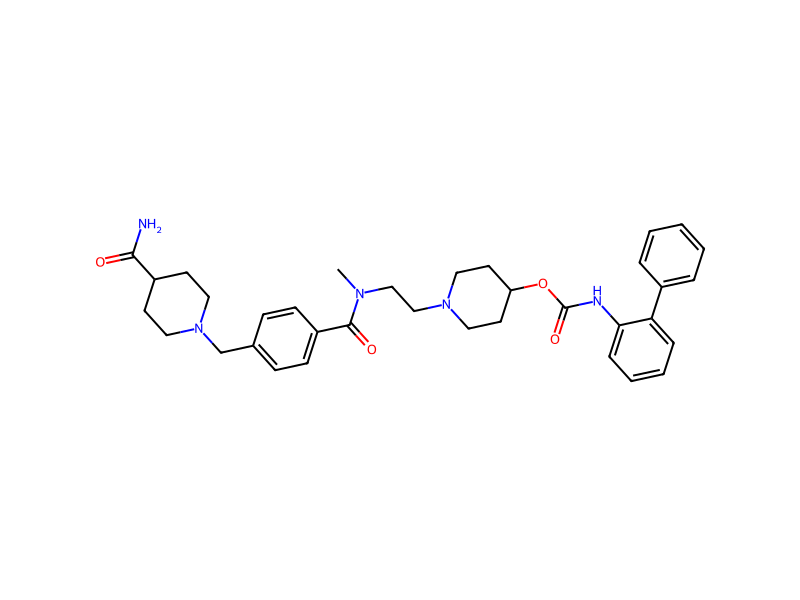
1211931-83-7- Standard-SMILES
CN(CCN1CCC(OC(=O)Nc2ccccc2-c2ccccc2)CC1)C(=O)c1ccc(CN2CCC(C(N)=O)CC2)cc1- InChIKey
FYDWDCIFZSGNBU-UHFFFAOYSA-N- Summenformel
- C35H43N5O4
- Durchschnittliche Molmasse
- 597,7 g/mol
- Monoisotopische Masse
- 597,33150486
Überblick
Revefenacin is a novel biphenyl carbamate tertiary amine agent that belongs to the family of the long-acting muscarinic antagonists (LAMA). The labile primary amide in the structure produces a "soft-drug" site that allows rapid systemic clearance and minimizing of the systemically mediated adverse reactions. The LAMA group falls into a parent category known as long-acting inhaled bronchodilators and this type of agents are recommended as a maintenance therapy for chronic obstructive pulmonary disease (COPD). From the LAMA group, revefenacin is the first once-daily nebulized LAMA treatment. It was developed by Theravance Biopharma and FDA approved on November 9, 2018.
Namen und Bezeichner
- Bevorzugter Name
- Revefenacin
- IUPAC
- [1-[2-[[4-[(4-carbamoylpiperidin-1-yl)methyl]benzoyl]-methylamino]ethyl]piperidin-4-yl] N-(2-phenylphenyl)carbamate
- Englischer Name
- TD-4208
- Summenformel
- C35H43N5O4
- Molmasse
- 597.75
Namen und Synonyme
Revefenacin864750-70-9TD-4208YupelriGSK-1160724revefenacinarevefenacineGSK1160724G2AE2VE07O[1-[2-[[4-[(4-carbamoylpiperidin-1-yl)methyl]benzoyl]-methylamino]ethyl]piperidin-4-yl] N-(2-phenylphenyl)carbamate1-(2-(4-((4-Carbamoylpiperidin-1-yl)methyl)-N-methylbenzamido)ethyl)piperidin-4-yl N-((1,1'-biphenyl)-2-yl)carbamateDTXSID701027775
Weitere Namen anzeigen
1-(2-(4-((4-carbamoylpiperidin-1-yl)methyl)-N-methylbenzamido)ethyl)piperidin-4-yl [1,1'-biphenyl]-2-ylcarbamatebiphenyl-2-ylcarbamic acid 1-(2-{[4-(4-carbamoylpiperidin-1-ylmethyl)benzoyl]methylamino}ethyl)piperidin-4-ylesterCPDD1221REVENACINRefenaxinLefennaxinRafenexine
Biphenyl-2-ylcarbamic acid, 1-(2-((4-(4-carbamoylpiperidin-1-ylmethyl)benzoyl)methylamino)ethyl)piperidin-4-yl ester1-[2-[[4-[[4-(Aminocarbonyl)-1-piperidinyl]methyl]benzoyl]methylamino]ethyl]-4-piperidinyl N-[1,1'-biphenyl]-2-ylcarbamaterevefenacinum(1-(2-((4-((4-carbamoylpiperidin-1-yl)methyl)benzoyl)-methylamino)ethyl)piperidin-4-yl) N-(2-phenylphenyl)carbamate1-(2-((4-((4-(Aminocarbonyl)-1-piperidinyl)methyl)benzoyl)methylamino)ethyl)-4-piperidinyl N-(1,1'-biphenyl)-2-ylcarbamate1-(2-(1-(4-((4-carbamoylpiperidin-1-yl)methyl)phenyl)-N-methylformamido)ethyl)piperidin-4-yl N-((1,1'-biphenyl)-2-yl)carbamate1-[2-(1-{4-[(4-carbamoylpiperidin-1-yl)methyl]phenyl}-N-methylformamido)ethyl]piperidin-4-yl N-{[1,1'-biphenyl]-2-yl}carbamateRefChem:57759
Eigenschaften
Berechnete StruktureigenschaftenWird ergänzt
- XLogP
- 4,1
- Polarare Oberfläche (TPSA)
- 108 Ų
- H-Brücken-Donoren
- 2
- H-Brücken-Akzeptoren
- 6
- Frei drehbare Bindungen
- 11
- Schwere Atome
- 44
- Formalladung
- 0
- Komplexität
- 918
Experimentelle und physikochemische Eigenschaften
DrugsPharmaceuticals -> Listed in ZINC15
Solubility< 1 mg/ml
Human Drugs
Breast Feeding; Lactation; Milk, Human; Parasympatholytics; Muscarinic Antagonists; Bronchodilator Agents
FDA approved drugs -> Active ingredient
FDA approved drugs -> Active ingredient
Physikochemische Eigenschaften
- Siedepunkt
- 777.5 · 777.5±60.0 °C(Predicted)
- Dichte
- 1.26 · 1.26±0.1 g/cm3(Predicted)
- storage temp.
- -20 °C · Store at -20°C
- Löslichkeit
- 125 mg/mL · DMSO : ≥ 125 mg/mL (209.12 mM)
- Aggregatzustand
- Solid
- pka
- 13.34 · 13.34±0.70(Predicted)
- Farbe
- White to off-white
- InChIKey
- FYDWDCIFZSGNBU-UHFFFAOYSA-N
Sicherheit und Regulatorisches
Sicherheitsangaben dienen nur zur Orientierung und ersetzen weder das Sicherheitsdatenblatt (SDB) des Lieferanten noch geltende Vorschriften oder eine fachliche Bewertung.
GHS-Klassifizierung
GHS Classification
Warning
H302 (100%): Harmful if swallowed [Warning Acute toxicity, oral]
P264, P270, P301+P317, P330, and P501 (click each P-code to see the statement)
Aggregated GHS information provided per 2 reports by companies from 1 notifications to the ECHA C&L Inventory.
Warning
H302 (100%): Harmful if swallowed [Warning Acute toxicity, oral]
Gefahrenhinweise
Hazard Classes and CategoriesAcute Tox. 4 (100%)
Toxikologische Informationen
Hepatotoxicity
Like other anticholinergic agents, revefenacin has not been linked to episodes of liver enzyme elevations or clinically apparent liver injury. Another reason for its hepatic safety may relate to its low systemic absorption when administered by inhaler.
Effects During Pregnancy and Lactation◉ Summary of Use during Lactation
Sicherheitsdaten
- Alarmwort
- Warnung
- Gefahrenhinweise
- Code Gefahrenhinweise Gefahrenklasse Abteilung Alarmwort Symbol P-Code H302
Chemie und Industrie
Pharmakologische Informationen
ATC Code
R - Respiratory system
QR - Respiratory system
Protein BindingThe protein binding of revefenacin and its active metabolite is of 71% and 42% respectively.
Pharmacodynamics
Revefenacin has been reported to produce a sustained, long-acting bronchodilation with lower anti-muscarinic-related side effects. In clinical trials, revefenacin demonstrated to be of a long duration of action and low systemic exposure in patients with COPD. Also, it was reported that a dose of 88 mcg can produce a clinically effective bronchodilation measured by through forced expiratory volume in 1s and serial spirometric assessments. In placebo-controlled trials, revefenacin showed a decrease in the use of albuterol rescue inhalers and sustained increases in the peak expiratory flow rate that reached a steady state at a maximum in day 7. As well, there was a reported superior lung selectivity index when compared with other LAMAs such as glycopyrronium and tiotropium which produced a decreased sialagogue effect.
Mechanism of Action
Revefenacin is an inhaled bronchodilator muscarinic antagonist with a long-acting bronchodilation activity. It has been shown to present a high affinity and behaved as a competitive antagonist of the five muscarinic cholinergic receptors. Studies have indicated that revefenacin dissociates significantly slower from the muscarinic receptor M3 (hM3) when compared to the receptor M2 (hM2) which indicates a kinetic selectivity for this subtype. This competitive antagonism produces a suppressive action of the acetylcholine-evoked calcium mobilization and contractile responses in the airway tissue. Lastly, due to the duration of the bronchodilation, revefenacin is considered a long-acting muscarinic antagonist which allows it to be dosed once daily. This response is very important for the therapy of COPD as the main goal is the reduce the frequency and severity of exacerbations which are normally driven by the presence of elevated cholinergic bronchoconstrictor tone mediated by muscarinic receptors on parasympathetic ganglia and airway smooth muscle. Hence, the activity of revefenacin produces a potent and long-lasting protection against the bronchoconstrictor response to acetylcholine or methacholine.
Zugehörige Reaktionen
0
Noch keine zugehörigen Reaktionen