StartseiteMCPWorkbenchSkills
StartseiteWorkbenchBenachrichtigungenMein Bereich
llms.txt · MCP-AnleitungDatenschutz · Nutzungsbedingungen · Supportv1.8.0
  1. Startseite
  2. /Verbindung

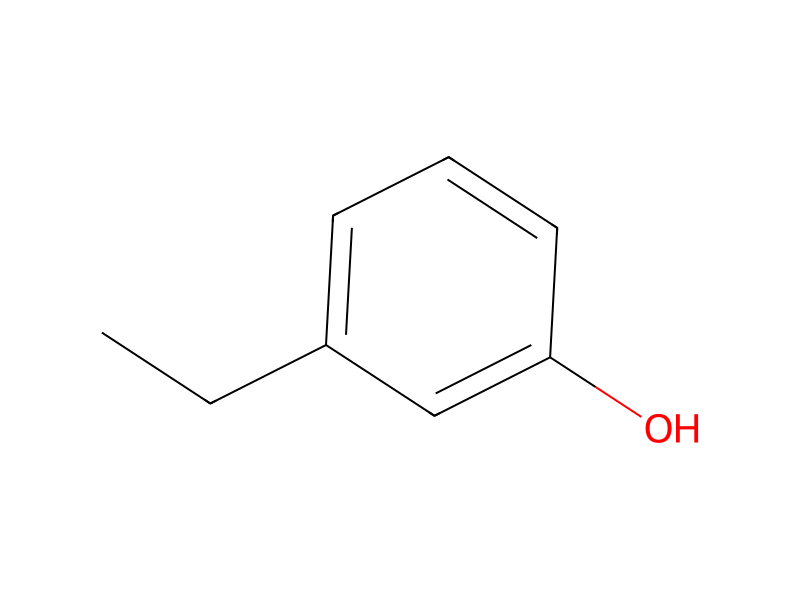
3-Ethylphenol

HCID 12101
Neue NotizNeue ReaktionAnfrage stellen
Druckvorschau
GrundinformationenÜberblickNamen und BezeichnerEigenschaftenSicherheit und RegulatorischesChemie und IndustrieZugehörige ReaktionenNotizen zur Verbindung
TeilstruktursucheÄhnliche Strukturen suchen

Grundinformationen

CAS
620-17-7
Standard-SMILES
CCc1cccc(O)c1
InChIKey
HMNKTRSOROOSPP-UHFFFAOYSA-N
Summenformel
C8H10O
Durchschnittliche Molmasse
122,16 g/mol
Monoisotopische Masse
122,07316494

Überblick

3-Ethylphenol is a member of phenols.

Namen und Bezeichner

Bevorzugter Name
3-Ethylphenol
IUPAC
3-ethylphenol
Lokaler Name
3-Ethylphenol
Englischer Name
3-Ethylphenol
Summenformel
C8H10O
Molmasse
122.16

Namen und Synonyme

3-ETHYLPHENOL620-17-7Phenol, 3-ethyl-Phenol, m-ethyl-meta-Ethylphenol1-Ethyl-3-hydroxybenzeneBenzene, 1-ethyl-3-hydroxy-DTXSID00224800G9ZK222JXNSC-8873DTXCID402480RefChem:93864
Weitere Namen anzeigen
m-ethyl-pheno3-ethyl-phenoM-ElhylPhenolPhenol,3-ethyl-3-Ethylphenol>3-ETHYLPHENOL 95+%
210-627-3m-Ethylphenol1-Hydroxy-3-ethylbenzene3-Ethyl-phenolMFCD000023113-Ethylphenol 100 microg/mL in MethanolCAS-620-17-7HSDB 5720

Datenbank-Bezeichner

CAS
620-17-7
PubChem CID
12101
DTXSID
DTXSID0022480
ChEMBL
CHEMBL58052
ChEBI
CHEBI:34332
UNII
0G9ZK222JX
EC Number
210-627-3
Nikkaji
J2.086I

Eigenschaften

Berechnete Struktureigenschaften

XLogP
2,4
Polarare Oberfläche (TPSA)
20,2 Ų
H-Brücken-Donoren
1
H-Brücken-Akzeptoren
1
Frei drehbare Bindungen
1
Schwere Atome
9
Formalladung
0
Komplexität
80,6

Experimentelle und physikochemische Eigenschaften

Chemical ClassesOther Classes -> Phenols
SpringerMaterials PropertiesBoiling point
FragrancesFragrance Ingredient (3-Ethylphenol) -> IFRA transparency List
LogP · 2 Einträge

Log Kow = 2.40

2.4

Density1.0283 @ 20 °C/4 °C
Flavoring AgentsEU Flavoring substances
Color/FormCOLORLESS LIQUID
SolubilitySLIGHTLY SOLUBLE IN WATER, CHLOROFORM; VERY SOLUBLE IN ALCOHOL, ETHER
Boiling Point218.4 °C @ 760 MM HG
Melting Point-4 °C
Vapor Pressure · 2 Einträge

Sicherheit und Regulatorisches

Sicherheitsangaben dienen nur zur Orientierung und ersetzen weder das Sicherheitsdatenblatt (SDB) des Lieferanten noch geltende Vorschriften oder eine fachliche Bewertung.

GHS-Klassifizierung

GHS Classification · 6 Einträge

Danger

H301 (39%): Toxic if swallowed [Danger Acute toxicity, oral]

P260, P261, P262, P264, P264+P265, P270, P271, P280, P301+P316, P301+P317, P301+P330+P331, P302+P352, P302+P361+P354, P304+P340, P305+P351+P338, P305+P354+P338, P316, P317, P319, P321, P330, P332+P317, P337+P317, P361+P364, P362+P364, P363, P403+P233, P405, and P501 (click each P-code to see the statement)

Aggregated GHS information provided per 200 reports by companies from 11 notifications to the ECHA C&L Inventory. Each notification may be associated with multiple companies.

Warning

H302: Harmful if swallowed [Warning Acute toxicity, oral]

Gefahrenhinweise

Regulatory Information · 4 Einträge

Chemical: Phenol, 3-ethyl-

Commission Regulation (EC) No 1565/2000 (Repealed by Com. Implementing Reg. (EU) No 872/2012)

Phenol, 3-ethyl- is listed on the EPA's Chemical Data Reporting (CDR) system. Manufacturers and importers of Phenol, 3-ethyl- are required to report information about their production and use of this chemical to the EPA under the Toxic Substances Control Act (TSCA). (40 eCFR Part 711)

Phenol, 3-ethyl-: Does not have an individual approval but may be used under an appropriate group standard

Other Safety InformationIMAP assessments - Ethylphenols: Human health tier II assessment
Hazards SummaryAn irritant; [MSDSonline] See Phenol.
Hazard Classes and Categories · 3 Einträge

Acute Tox. 3 (39%)

Acute toxicity - category 4

Acute toxicity (Oral) - Category 4

Sicherheit und Schutzausrüstung

Chemie und Industrie

Pharmakologische Informationen

Metabolism/Metabolites3-ethylphenol has known human metabolites that include 3-Ethylphenyl sulfate.
Cellular LocationsMembrane

Verwendung und Herstellung

Uses · 3 Einträge

Used as a starting material for photochemicals; [HSDB]

Pure 3-ethylphenol is a starting material for photochemicals.

3-Ethylphenol and .... are contained in the xylenol fraction boiling between ca. 205 and 225 °C obtained from tar phenols, which is used, for example, for the production of phenolic resins.

U.S. Imports(1982) 1.12X10+8 GRAMS (PRINCPL CUSTMS DISTS)
U.S. Production · 2 Einträge

2023: 3,255,915 lb

(1977) AT LEAST 4.54X10+5 GRAMS

Consumer UsesCleaning agent
Industry UsesCleaning agent
Methods of Manufacturing · 1 Eintrag

3-Ethylphenol is produced by sulfonation of ethylbenzene and subsequent alkali melt of the 3-ethylbenzenesulfonic acid obtained. By sulfonation under severe conditions, the 4-ethylbenzenesulfonic acid formed initially isomerizes to form a mixture of 2-,3-, and 4-ethylbenzenesulfonic acids in a ratio of 2:58:40. The 2- and 4-ethylbenzenesulfonic acids are selectively hydrolyzed back to ethylbenzene and sulfuric acid by blowing steam through the mixture at 150-170 °C. 3-Ethylphenol is then obtained by alkali melt of the remaining 3-ethylbenzenesulfonic acid at 330-340 °C in up to 98% purity.

Use ClassificationFragrance Ingredients
General Manufacturing Information

Zugehörige Reaktionen

54
Reaktionsaufzeichnung erstellen
Reaktionsgleichung von HRID 95918
HRID 95918als EduktTraining data from https://doi.org/10.1039/C8SC04228D (2/10)
Reaktionsgleichung von HRID 114662
HRID 114662als EduktTraining data from https://doi.org/10.1039/C8SC04228D (2/10)
Reaktionsgleichung von HRID 119379
HRID 119379als EduktTraining data from https://doi.org/10.1039/C8SC04228D (2/10)
Reaktionsgleichung von HRID 231668
HRID 231668als Produktuspto-grants-1989_07
Reaktionsgleichung von HRID 323095
HRID 323095als Eduktuspto-grants-2001_04
Reaktionsgleichung von HRID 343281
HRID 343281als Eduktuspto-grants-1999_01
Reaktionsgleichung von HRID 364766
HRID 364766als Eduktuspto-grants-1986_08
Reaktionsgleichung von HRID 369005
HRID 369005als Eduktuspto-grants-2000_10
Seite 1 von 7

Notizen zur Verbindung

Wird geladen…

Auf dieser SeiteGrundinformationenÜberblickNamen und BezeichnerEigenschaftenSicherheit und RegulatorischesChemie und IndustrieZugehörige ReaktionenNotizen zur Verbindung
Weitere Aktionen
Neue NotizNeue ReaktionAnfrage stellen

0.05 [mmHg]

0.05 mm Hg at 25 °C

Food Contact SubstancesFCS -> FDA Inventory of Food Contact Substances Listed in 21 CFR

Physikochemische Eigenschaften

Schmelzpunkt
4.5 °C · −4.5 °C (23.9 °F; 268.6 K)
Siedepunkt
218 °C · 218 °C
Dichte
1.0076 g/cm3 · 1.0076 g/cm3
Brechungsindex
1.53 · 1.53
Flammpunkt
115 °C · 115 °C
storage temp.
Inert atmosphere,Room Temperature
pka
1 · pK1:10.07 (25°C)
Aggregatzustand
liquid
Farbe
colorless
Geruch (Odor)
musty
Geruchsart
musty
Wasserlöslichkeit
Slightly soluble in water.
BRN
1857002 · 1857002
Henry's Law Constant
4.9 · 4.9×100 mol/(m3Pa) at 25℃, Karl et al. (2003)
Kosmetik-Inhaltsstoffe Funktionen
PERFUMING
InChI
1S/C8H10O/c1-2-7-4-3-5-8(9)6-7/h3-6,9H,2H2,1H3
InChIKey
HMNKTRSOROOSPP-UHFFFAOYSA-N
SMILES
CCc1cccc(O)c1
LogP
2.4 · 2.400
CAS Datenbank
620 · 620-17-7(CAS DataBase Reference)
NIST chemische Informationen
3 · 3-Ethylphenol(620-17-7)
EPA chemische Informationen
m-Ethylphenol (620-17-7)
Disposal Methods · 1 Eintrag

SRP: At the time of review, criteria for land treatment or burial (sanitary landfill) disposal practices are subject to significant revision. Prior to implementing land disposal of waste residue (including waste sludge), consult with environmental regulatory agencies for guidance on acceptable disposal practices.

Toxikologische Informationen

Environmental Fate · 3 Einträge

TERRESTRIAL FATE: Based on a recommended classification scheme(1), an estimated Koc value of 480(SRC), determined from a measured log Kow(2) and a recommended regression-derived equation(3), indicates that 3-ethylphenol will have moderate mobility in soil(SRC). Based on limited data, biodegradation of this compound is likely. A system where water was passed through contaminated soil (initial 3-ethylphenol concn = 73 ug/L) and then through a upflow aerated column was capable of 93% removal in 37 days(4). 3-Ethylphenol's measured and estimated values for vapor pressure(5) and Henry's Law constant(6,SRC), respectively, indicate that volatilization from dry and moist soil surfaces is possible, but will not be a major fate process for this compound(SRC).

AQUATIC FATE: Based on a recommended classification scheme(1), an estimated Koc value of 480(SRC), determined from a measured log Kow(2) and a recommended regression-derived equation(3), indicates that 3-ethylphenol may adsorb to suspended solids and sediment(SRC) in the water. Based on limited data, biodegradation of this compound is likely. A system where water was passed through contaminated soil (initial 3-ethylphenol concn = 73 ug/L) and then through a upflow aerated column was capable of 93% removal in 37 days(4). 3-Ethylphenol should volatilize from water surfaces based on an estimated Henry's Law constant of 1.1X10⁻⁶ atm-cu m/mole(SRC), developed using a fragment constant estimation method(5). Estimated half-lives for a model river and model lake are 37 and 274 days, respectively(3,SRC). An estimated BCF value of 40(3,SRC), from an experimental log Kow(2), suggests that 3-ethylphenol may bioconcentrate in aquatic organisms(SRC) according to a recommended classification scheme(6).

ATMOSPHERIC FATE: According to a suggested classification scheme(1), a measured vapor pressure of 0.05 mm Hg at 25 °C(2) indicates that 3-ethylphenol will mainly exist in the vapor phase in the ambient atmosphere. Vapor-phase 3-ethylphenol is degraded in the atmosphere by reaction with photochemically produced hydroxyl radicals(SRC); the half-life for this reaction in air is estimated to be about 5 hours(3,SRC).

Effluent Concentrations · 1 Eintrag

Final effluent collected from the Los Angeles County wastewater treatment plant contained 3-ethylphenol at an average concentration of 15 ug/L(1). 3-Ethylphenol was detected at unreported concentrations in a groundwater plume emanating from the Hipps Road Landfill, Florida(2). 3-Ethylphenol was detected in industrial wastewater from the following industries: petroleum refining (1 of 21 extracts), organic chemicals (1 of 31 extracts), and publicly-owned treatment works (1 in 44 extracts)(3). 3- and 4-ethylphenol (mixed) were detected in cigarette smoke at 1.2-2.8 mg/100 cigarettes(4). 3-Ethylphenol was detected in wastewater from the gasification of Indian Head lignite coal(5).

Soil Adsorption/Mobility · 1 Eintrag

The Koc of 3-ethylphenol is estimated as approximately 480(SRC), using a measured log Kow of 2.40(1) and a regression-derived equation(2,SRC). According to a recommended classification scheme(3), this estimated Koc value suggests that 3-ethylphenol has moderate mobility in soil(SRC).

Natural Pollution Sources · 2 Einträge

A xylenol fraction boiling between 216 and 218 °C containing predominantly 3- and 4-ethylphenol is obtained from brown coal low-temperature tar and used in the varnish industry.

Volcanic ash from Mount St. Helens, following th May 18, 1980 eruption, contained 3-ethylphenol(1).

Artificial Pollution Sources · 1 Eintrag

3-Ethylphenol's production and use in the manufacture of photochemicals and varnishes(1), may result in its release to the environment through various waste streams(SRC). 3-Ethylphenol is also released in effluent streams from coal gasification plants(3) and from cigarette smoke(2).

Environmental Biodegradation · 1 Eintrag

A lab-scale, upflow aerated column receiving water that had first passed through a soil sample, obtained from a former asphalt production plant, (3-ethylphenol influent initially at 73 ug/L) was capable of 93% removal of this compound within 37 days(1). An on-site (at the production plant) upflow aerated column and trickling filter, after 38 days of operation, removed 86% and 22% of the initial concentration of p-ethylphenol, respectively(1). Differences between lab scale and on-site reactors were due to differences in the hydraulic load(1). Pseudomonas strain FH23, isolated by enrichment culture with 4-hydroxybiphenyl, had a oxygen uptake rate of 9 nmol/min/mg protein when grown with 3-ethylphenol as the sole carbon source(2).

Carcinogen ClassificationNo indication of carcinogenicity to humans (not listed by IARC).
Environmental Bioconcentration · 1 Eintrag

An estimated BCF value of 40 was calculated for 3-ethylphenol(SRC), using a measured log Kow of 2.40(1) and a recommended regression-derived equation(2). According to a recommended classification scheme(3), this BCF value suggests that bioconcentration in aquatic organisms may be an important fate process(SRC).

Volatilization from Water/Soil · 1 Eintrag

The Henry's Law constant for 3-ethylphenol is estimated as 1.1X10⁻⁶ atm-cu m/mole(SRC) using a fragment constant estimation method(1). This value indicates that 3-ethylphenol will volatilize from water surfaces(2,SRC). Based on this Henry's Law constant, the volatilization half-life from a model river (1 m deep, flowing 1 m/sec, wind velocity of 3 m/sec) is estimated as approximately 37 days(2,SRC). The volatilization half-life from a model lake (1 m deep, flowing 0.05 m/sec, wind velocity of 0.5 m/sec) is estimated as approximately 274 days(2,SRC). 3-Ethylphenol's values for vapor pressure(4) and Henry's Law constant(1,SRC) indicate that volatilization from dry and moist soil surfaces is possible, but not likely to be a major fate process for this compound(SRC).

Environmental Abiotic Degradation · 1 Eintrag

The rate constant for the vapor-phase reaction of 3-ethylphenol with photochemically produced hydroxyl radicals has been estimated as 8.4X10⁻¹¹ cu cm/molecule-sec at 25 °C(SRC) using a structure estimation method(1,SRC). This corresponds to an atmospheric half-life of about 5 hours at an atmospheric concentration of 5X10+5 hydroxyl radicals per cu cm(1,SRC). 3-Ethylphenol has a measured pKa of 9.9, indicating that under most environmental conditions this compound will exist mainly as the non-dissociated form(2).

Probable Routes of Human ExposureThe general population may be exposed to 3-ethylphenol by inhalation of cigarette smoke or dermal contact with products containing this compound. (SRC)
Environmental Water ConcentrationsGROUNDWATER: 3-Ethylphenol was detected in a leachate sample from Southington landfill, Connecticut at 0.2 mg/L(1).

Sicherheitsdaten

wgk
3
tsca
TSCA listed
ridadr
UN 3145 8/PG 3
hs_code
2907199090
risk_code
20/21/22-36/37/38-34
hazard_code
Xn,C
safety_code
26-37/39-36/37-45-36/37/39
hazard_class
8
packing_group
III
Speicherklasse
10 - Combustible liquids
Giftige Stoffe Daten
620-17-7(Hazardous Substances Data)
Hazard Classifications
Acute Tox. 4 DermalAcute Tox. 4 InhalationAcute Tox. 4 OralEye Irrit. 2Skin Irrit. 2STOT SE 3
· 2 Einträge

Paint and Coating Manufacturing

Phenol, 3-ethyl-: ACTIVE

Anwendungen

VerwendenIt is used as a photographic chemical intermediate and an intermediate for the cyan coupler of photographic paper. It has a wide application in fragrance industry.

Vor- und nachgelagerte Produkte

Vorgelagerte Rohstoffe

3-Hydroxyphenylacetylene3-Ethylanilin3'-Hydroxyacetophenon3-Ethylbenzenesulfonic acidEthylbenzol

Nachgelagerte Produkte

2-Ethylphenol(3-Ethyl-phenoxy)-acetic acid1-(2-Bromoethoxy)-3-ethylbenzeneβ-D-Glucopyranoside, 3-ethylphenyl(3aS,4S,5S,6R,7aS)-4-(ethoxycarbonyl)-6-ethyl-1-oxooctahydro-1H-indene-5-carboxylic acidBenzaldehyde, 2-ethyl-4-methoxy-