
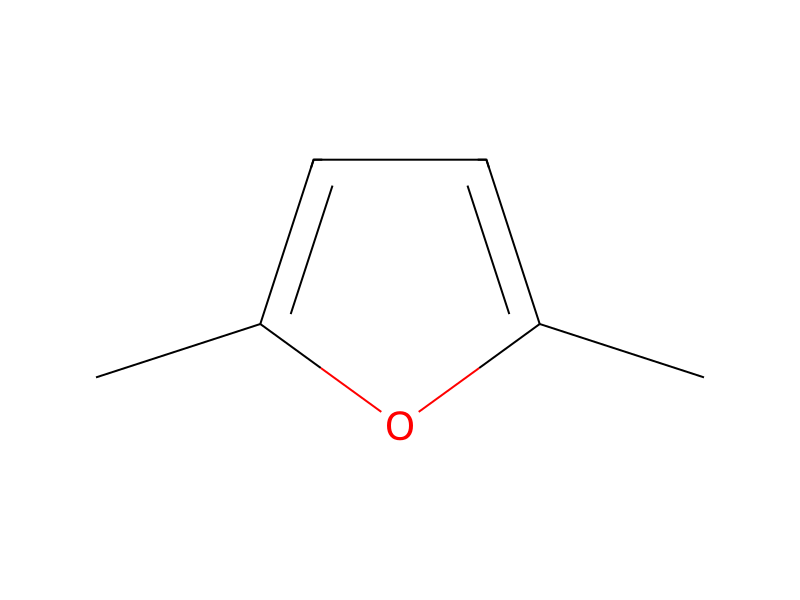
Grundinformationen
- Standard-SMILES
Cc1ccc(C)o1- InChIKey
GSNUFIFRDBKVIE-UHFFFAOYSA-N- Summenformel
- C6H8O
- Durchschnittliche Molmasse
- 96,13 g/mol
- Monoisotopische Masse
- 96,05751488
Überblick
2,5-dimethylfuran is a clear yellow oily liquid. Aromatic caustic odor. (NTP, 1992)
Namen und Bezeichner
- Bevorzugter Name
- 2,5-Dimethylfuran
- IUPAC
- 2,5-dimethylfuran
- Lokaler Name
- 2,5-Dimethylfuran
- Englischer Name
- 2,5-Dimethylfuran
- Summenformel
- C6H8O
- Molmasse
- 96.13
Namen und Synonyme
2,5-DIMETHYLFURAN625-86-5Furan, 2,5-dimethyl-2,5-Dimethylfurane2,5-dimethyl-furanDTXSID7022093DR5HL9OJ7YNSC-6220DTXCID102093FEMA NO. 4106CHEBI:89052RefChem:444578
Weitere Namen anzeigen
DIMETHYL FURANFEMA 41062,5diMethylturan2,5-dimethyl-fura2,5- twoMethyl furan2,5-Dimethylfuran >2,5-Dimethylfuran,98%
210-914-32,5-Dimethyl furanNSC 6220MFCD000032502,5-Dimethyl furaneCCRIS 3158EINECS 210-914-3UNII-DR5HL9OJ7Y
Datenbank-Bezeichner
- CAS
625-86-5- PubChem CID
- 12266
- DTXSID
DTXSID7022093- ChEMBL
CHEMBL1416448- ChEBI
CHEBI:89052- UNII
- DR5HL9OJ7Y
- EC Number
- 210-914-3
- Nikkaji
- J45.569E
Eigenschaften
Berechnete Struktureigenschaften
- XLogP
- 2,2
- Polarare Oberfläche (TPSA)
- 13,1 Ų
- H-Brücken-Donoren
- 0
- H-Brücken-Akzeptoren
- 1
- Frei drehbare Bindungen
- 0
- Schwere Atome
- 7
- Formalladung
- 0
- Komplexität
- 53,2
Experimentelle und physikochemische Eigenschaften
Chemical Classes
Other Classes -> Ethers, Other
Flammable agents - 3rd degree
SpringerMaterials PropertiesChemical diffusion
LogP
2.24
2.24
Food AdditivesFLAVORING AGENT OR ADJUVANT -> FDA Substance added to food
Density
0.8883 at 68 °F (NTP, 1992) - Less dense than water; will float
0.892-0.898
Flavoring AgentsEU Flavoring substances
Solubility
less than 1 mg/mL at 72.5 °F (NTP, 1992)
Slightly soluble in water
Soluble (in ethanol)
Flash Point30.2 °F (NTP, 1992)
Boiling Point
198 to 201 °F at 760 mmHg (NTP, 1992)
92.00 to 94.00 °C. @ 760.00 mm Hg
93 °C
Melting Point
-81 °F (NTP, 1992)
-63 °C
Vapor Density3.31 (NTP, 1992) - Heavier than air; will sink (Relative to Air)
Vapor Pressure
53 mmHg at 72 °F ; 174 mmHg at 124 °F; 404 mmHg at 167 °F (NTP, 1992)
25.9 [mmHg]
Physikochemische Eigenschaften
- Schmelzpunkt
- -62 °C · -62 °C
- Siedepunkt
- 92 · 92-94 °C(lit.)
- Dichte
- 0.905 g/mL · 0.905 g/mL at 20 °C
- Dampfdichte
- 3.31 · 3.31 (vs air)
- Brechungsindex
- 20 · n20/D 1.441(lit.)
- FEMA
- 4106 · 4106 | 2,5-DIMETHYLFURAN
- Flammpunkt
- 29 °F · 29 °F
- storage temp.
- Flammables area
- Löslichkeit
- Chloroform (Slightly), Ethyl Acetate (Slightly), Methanol (Slightly)
- Aggregatzustand
- Liquid
- Farbe
- Clear colorless to amber
- Wichte
- 0.903 · 0.903
- Geruch (Odor)
- 10 % · at 10.00 % in propylene glycol. chemical ethereal meaty gravy roast beef bacon
- Geruchsart
- meaty
- Wasserlöslichkeit
- Slightly miscible with water. Miscible with ethanol and fats.
- JECFA Number
- 1488 · 1488
- BRN
- 106449 · 106449
- Stabilität
- Light Sensitive, Volatile
- InChI
- 1S/C6H8O/c1-5-3-4-6(2)7-5/h3-4H,1-2H3
- InChIKey
- GSNUFIFRDBKVIE-UHFFFAOYSA-N
- SMILES
- Cc1ccc(C)o1
- LogP
- 2.24 · 2.24
- Oberflächenspannung
- 25.42 mN/m · 25.42mN/m at 293.15K
- CAS Datenbank
- 625 · 625-86-5(CAS DataBase Reference)
- NIST chemische Informationen
- 2 · Furan, 2,5-dimethyl-(625-86-5)
- EPA chemische Informationen
- 2 · 2,5-Dimethylfuran (625-86-5)
Sicherheit und Regulatorisches
GHS-Klassifizierung
GHS Classification
This chemical does not meet GHS hazard criteria for 62.8% (91 of 145) of all reports.
Danger
H225 (37.2%): Highly Flammable liquid and vapor [Danger Flammable liquids]
P210, P233, P240, P241, P242, P243, P264, P270, P280, P301+P317, P303+P361+P353, P330, P370+P378, P403+P235, and P501 (click each P-code to see the statement)
Aggregated GHS information provided per 145 reports by companies from 11 notifications to the ECHA C&L Inventory. Each notification may be associated with multiple companies.
Gefahrenhinweise
Regulatory Information
Chemical: Furan, 2,5-dimethyl-
Commission Regulation (EC) No 1565/2000 (Repealed by Com. Implementing Reg. (EU) No 872/2012)
Furan, 2,5-dimethyl- is listed on the EPA's Chemical Data Reporting (CDR) system. Manufacturers and importers of Furan, 2,5-dimethyl- are required to report information about their production and use of this chemical to the EPA under the Toxic Substances Control Act (TSCA). (40 eCFR Part 711)
Furan, 2,5-dimethyl-: Does not have an individual approval but may be used under an appropriate group standard
The New Jersey Worker and Community Right to Know Act requires public and private employers to provide information about hazardous substances at their workplaces. (N.J.S.A. 34:5A-1 et. seq.)
DOT LabelFlammable Liquid
Fire HazardsThis chemical is flammable. (NTP, 1992)
Health Hazards
SYMPTOMS: Exposure to this compound may cause skin, eye and mucous membrane irritation. Other symptoms of exposure include conjunctivitis, corneal damage, nausea, vomiting, abdominal pain, headache, dizziness, cyanosis, dermatitis, collapse, respiratory distress, convulsions, blistering and ulceration of skin, gangrene, erythema, vertigo, lowered body temperature, chronic lung disease, kidney and liver damage, and coma.
Hazards SummaryNot mutagenic in vitro; [ToxPlanet: CDC] May cause irritation; Harmful by ingestion; [Alfa Aesar MSDS] See Furan.
Reactive GroupEthers
Reactivity AlertsHighly Flammable
Reactivity Profile2,5-DIMETHYLFURAN can react vigorously with oxidizing materials. It is also incompatible with strong acids and strong bases. (NTP, 1992)
Air and Water ReactionsHighly flammable. This chemical may be sensitive to exposure to air(not vigorous). Insoluble in water.
Peroxide Forming Chemical
2,5-Dimethylfuran
B*: Compounds that form peroxides on concentration (distillation/evaporation)
Fábos et al.
Hazard Classes and Categories
Flam. Liq. 2 (37.2%)
Flammable agents - 3rd degree
Sicherheit und Schutzausrüstung
Fire FightingFires involving this material can be controlled with a dry chemical, carbon dioxide or Halon extinguisher. (NTP, 1992)
First Aid
EYES: First check the victim for contact lenses and remove if present. Flush victim's eyes with water or normal saline solution for 20 to 30 minutes while simultaneously calling a hospital or poison control center. Do not put any ointments, oils, or medication in the victim's eyes without specific instructions from a physician. IMMEDIATELY transport the victim after flushing eyes to a hospital even if no symptoms (such as redness or irritation) develop.
Nonfire Spill Response
SMALL SPILLS AND LEAKAGE: If you spill this chemical, FIRST REMOVE ALL SOURCES OF IGNITION. Then, use absorbent paper to pick up all liquid spill material. Your contaminated clothing and absorbent paper should be sealed in a vapor-tight plastic bag for eventual disposal. Solvent wash all contaminated surfaces with 60-70% ethanol followed by washing with a soap and water solution. Do not reenter the contaminated area until the Safety Officer (or other responsible person) has verified that the area has been properly cleaned.
Isolation and EvacuationExcerpt from ERG Guide 128 [Flammable Liquids (Water-Immiscible)]:
Personal Protective Equipment (PPE)
RECOMMENDED RESPIRATOR: When working with this chemical, wear a NIOSH-approved full face chemical cartridge respirator equipped with the appropriate organic vapor cartridges. If that is not available, a half face respirator similarly equipped plus airtight goggles can be substituted. However, please note that half face respirators provide a substantially lower level of protection than do full face respirators. (NTP, 1992)
Toxikologische Informationen
Adverse EffectsNeurotoxin - Acute solvent syndrome
Toxicity Summary2,5-Dimethylfuran plays a role in the mechanism for the neurotoxicity of hexane in humans. Together with hexane-2,5-dione and 4,5-dihydroxy-2-hexanone, it is one of the main metabolites of hexane. (Wikipedia)
Carcinogen ClassificationNo indication of carcinogenicity to humans (not listed by IARC).
Toxicity DataLCLo (rat) = 500 ppm/4hr
Sicherheitsdaten
- F
- 8
- wgk
- 3
- tsca
- TSCA listed
- ridadr
- UN 1993 3/PG 2
- hs_code
- 29321900
- RTECS-Nr.
- LU0875000
- risk_code
- 11-22-2017/11/22
- hazard_code
- F,Xn
- hazard_note
- Harmful/Flammable
- safety_code
- 16
- hazard_class
- 3
- packing_group
- II
- Speicherklasse
- 3 - Flammable liquids
- Hazard Classifications
- Acute Tox. 4 OralEye Irrit. 2Flam. Liq. 2Skin Irrit. 2Skin Sens. 1STOT SE 3
Chemie und Industrie
Pharmakologische Informationen
Cellular LocationsCytoplasm
Verwendung und Herstellung
Uses
A volatile constituent of tobacco smoke and roasted coffee aroma; Also a human metabolite of n-hexane; [CDC] Used as flavoring agent or adjuvant; [FDA]
Its blood concentration can be used as a biomarker for smoking. While it may be abbreviated DMF, it should not be confused with dimethylformamide.
U.S. Production2023: 50,000 - <250,000 lb
Industry UsesIntermediate
Use Classification
Flavouring Agent -> FLAVOURING_AGENT -> JECFA Functional Classes
Flavoring Agents -> JECFA Flavorings Index
General Manufacturing Information
All Other Basic Organic Chemical Manufacturing
Furan, 2,5-dimethyl-: ACTIVE
Anwendungen
OccurrenceReported found in beef, chicken, cocoa, coffee, egg, malt, rice, and rum.
Verwenden2,5-Dimethylfuran is a major metabolite of hexane with singlet oxygen scavenging ability. It is used as biofuel, biomaker for smoking, pharmaceutical intermediate and in organic synthesis. It is also used to analyze samples for the derivatization of carbonyl-containing compounds to their oximes.
Vor- und nachgelagerte Produkte
Vorgelagerte Rohstoffe
Nachgelagerte Produkte
Anbieter50 Anbieter
国药集团化学试剂有限公司86-21-63210123 · [email protected]
梯希爱(上海)化成工业发展有限公司021-67121386 · [email protected]
上海阿拉丁生化科技股份有限公司400-6206333 13167063860 · [email protected]
武汉欣扬瑞和化学科技有限公司153-07155313 15307155313 · [email protected]
河北创海生物科技有限公司+86-86-13131129325 · [email protected]
T&W GROUP021-61551611 13296011611 · [email protected]
爱斯特(成都)生物制药股份有限公司+86-28-85122536 85324413 · [email protected]
Baoji Guokang Healthchem co.,ltd+8615604608665 15604608665 · [email protected]
Dayang Chem (Hangzhou) Co.,Ltd.+86-0571-88938639 17705817739 · [email protected]
科瑞迪化学400-821-5857 021-64326257 · [email protected]
Syntechem Co.,Ltd[email protected]
上海迈瑞尔生化科技有限公司4006356688 18621169109 · [email protected]
阿法埃莎(中国)化学有限公司400-6106006 · [email protected]
安耐吉化学&3A(安徽泽升科技股份有限公司)400-0056266 · [email protected]
武汉卡诺斯科技有限公司027-83238443 15327105076 · [email protected]
上海瀚鸿科技股份有限公司021-54306202 13764082696 · [email protected]
石家庄利达化学品有限公司+86 (311) 8573-7996 · [email protected]
天津万象恒远科技有限公司15722085254 · [email protected]
吉良化学21-62165282 · [email protected]
上海隆盛化工有限公司58099637 13585536065 · [email protected]
郑州研德生物科技有限公司0371-63682289 15538176268 · [email protected]
合肥天健化工有限公司551-65418679 15856988503;15837135945 · [email protected]
苏州启航生物科技有限公司18662190603;18151111370 · [email protected]
山东西亚化学有限公司13355009207 13355009207 · [email protected]
玛雅试剂+86 (573) 82222445 (0)18006601000 452520369 · [email protected]
四川库利南科技有限公司400-1166-196 18981987031 · [email protected]
天津希恩思生化科技有限公司400 638 7771 · [email protected]
Xiamen AmoyChem Co., Ltd+86-86-5926051114 · [email protected]
艾科试剂4008-755-333 18080918076 · [email protected]
青岛保税区鲁联国际贸易有限公司0532-83893697 18561902820 · [email protected]
上海思域化工科技有限公司86-21-34053660 · [email protected]
赛默飞世尔科技(中国)有限公司800-810-5118 · [email protected]
北京伊诺凯科技有限公司400-810-7969 010-59572699 · [email protected]
TCI AMERICA800-4238616 · [email protected]
TOKYO CHEMICAL INDUSTRY CO., LTD.03-36680489 · [email protected]
TCI Europe320-37350700 · [email protected]
上海贤鼎生物科技有限公司4009209199 · [email protected]
深圳康特腾科技有限公司86-0755-86635001 · [email protected]
越林试剂021-62960152 · [email protected]
北京环宇世纪化学科技有限公司hysj_bj.com
上海将来实业股份有限公司021-61552785 · [email protected]
HBCChem, Inc.+1-510-219-6317 · [email protected]
成都零六生物科技有限公司400-1166-196 13458535857 · [email protected]
雷丁试剂0510-85629785 18013409632 · [email protected]
上海麦克林生化科技股份有限公司15221275939 15221275939 · [email protected]
杭州杰恒化工有限公司0571-87396432 · [email protected]
上海有朋化工有限公司021-69005955 13701776567 · [email protected]
上海凯赛化工有限公司021-33516722 13701817765 · [email protected]
上海彤源化工有限公司021-021-69182866 13701855675 · [email protected]
成都润泽本土化工有限公司13096311329 028-88469284 616445927 · [email protected]
Zugehörige Reaktionen
14


Verknüpfte Notizen
Wird geladen…