NEUROPEPTIDE FF
Daten werden ergänzt – lade die Seite später neu, um den aktuellen Stand zu sehen
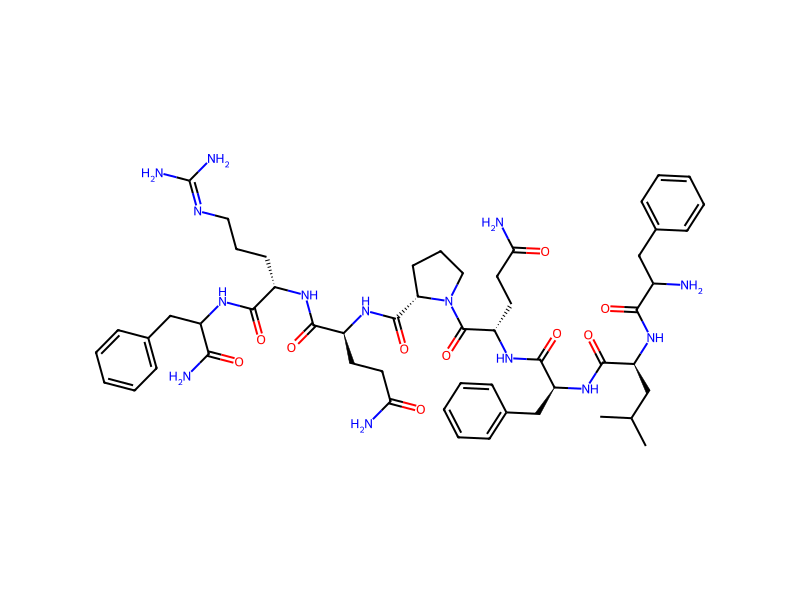
Grundinformationen
- CAS
99566-27-5- Standard-SMILES
CC(C)C[C@H](NC(=O)C(N)Cc1ccccc1)C(=O)N[C@@H](Cc1ccccc1)C(=O)N[C@@H](CCC(N)=O)C(=O)N1CCC[C@H]1C(=O)N[C@@H](CCC(N)=O)C(=O)N[C@@H](CCCN=C(N)N)C(=O)NC(Cc1ccccc1)C(N)=O- InChIKey
HWYCFZUSOBOBIN-AQJXLSMYSA-N- Summenformel
- C54H76N14O10
- Durchschnittliche Molmasse
- 1.081,27 g/mol
Namen und Bezeichner
- Bevorzugter Name
- NEUROPEPTIDE FF
- Englischer Name
- NEUROPEPTIDE FF
- Summenformel
- C54H76N14O10
- Molmasse
- 1081.27
Namen und Synonyme
NPFFNPAFninamideF-8-F-NH2FLFQPQRF-NH2NEUROPEPTIDE FFNeuropeptide FF TFANeuropeptide FF (cattle)Neuropeptide FF F-8-F-NH2NEUROPEPTIDE FF USP/EP/BP
Datenbank-Bezeichner
- CAS
99566-27-5- PubChem CID
- 123797
Eigenschaften
Physikochemische Eigenschaften
- storage temp.
- 20 °C · −20°C
- Löslichkeit
- 1 mg/ml · Water: 1 mg/ml
- Aggregatzustand
- Solid
- Farbe
- White to off-white
- Wasserlöslichkeit
- 0.5 mg/ml · Soluble to 0.50 mg/ml in water.
Sicherheit und Regulatorisches
Sicherheitsangaben dienen nur zur Orientierung und ersetzen weder das Sicherheitsdatenblatt (SDB) des Lieferanten noch geltende Vorschriften oder eine fachliche Bewertung.
Sicherheitsdaten
- wgk
- 3
Chemie und Industrie
Anwendungen
BeschreibungNeuropeptide FF (NPFF) is a peptide expressed in the brain and spinal cord that shares a precursor protein with neuropeptide AF. NPFF is expressed primarily in the posterior pituitary, hypothalamus, and medulla. It is an agonist at NPFF1 and NPFF2 receptors (Kis = 2.82 and 0.21 nM, respectively, for human recombinant receptors) that inhibits forskolin-induced cAMP production in CHO cells (EC50s = 236 and 2.3 nM, respectively). NPFF activates parvocellular neurons in the paraventricular nucleus (PVN) of the hypothalamus to stimulate oxytocin release from their projections in the brain stem, thereby regulating baroreflex control of heart rate. However, it inhibits magnocellular PVN neurons by enhancing GABAergic input. It is also found in plasma and exogenous administration briefly increases mean arterial pressure (MAP) by 40 mm Hg in rats, an effect that is only partially blocked by the norepinephrine competitor guanethidine and the α1-adrenergic receptor antagonist prazosin . NPFF has anti-opioid effects in rodent models, inhibiting morphine-induced analgesia and inducing abstinence in morphine-tolerant rats. It also inhibits acquisition of conditioned place preference to cocaine in rats when administered at doses of 10 and 20 nmol.
VerwendenEndogenous antiopioid peptide and agonist at NPFF1 and NPFF2 receptors (Ki values are 2.82 and 0.21 nM respectively). Exhibits anorexigenic effects.
Anbieter67 Anbieter
上海麦克林生化科技股份有限公司021-50706066 15221275939 · [email protected]
成都彼样生物科技有限公司18108052721 · [email protected]
上海优宁维生物科技股份有限公司15921930842 15921930842 · [email protected]
Hangzhou Go Top Peptide Biotech0571-88211921 · [email protected]
南京昱盛康生物科技有限公司13327808530 · [email protected]
Zugehörige Reaktionen
0
Keine Reaktionsaufzeichnungen unter den aktuellen Filterkriterien.
Notizen zur Verbindung
Wird geladen…