
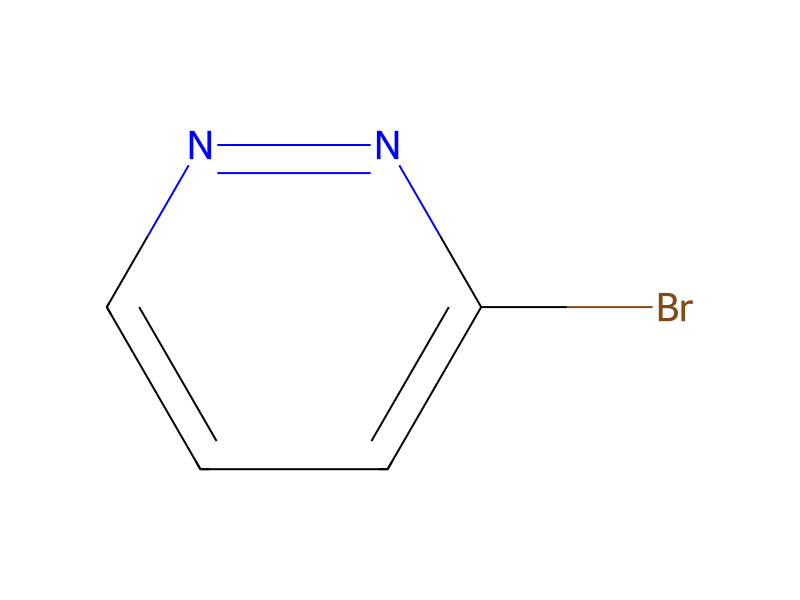
Grundinformationen
- Standard-SMILES
Brc1cccnn1- InChIKey
ILYSUJOMLYXAOC-UHFFFAOYSA-N- Summenformel
- C4H3BrN2
- Durchschnittliche Molmasse
- 158,98 g/mol
- Monoisotopische Masse
- 157,94796
Namen und Bezeichner
- Bevorzugter Name
- 3-Bromopyridazine
- IUPAC
- 3-bromopyridazine
- Englischer Name
- Pyridazine, 3-bromo- (9CI)
- Summenformel
- C4H3BrN2
- Molmasse
- 158.98
Namen und Synonyme
3-bromopyridazine88491-61-6DTXSID10520082RefChem:277796DTXCID80470888811-583-33-Bromo-pyridazineMFCD10688587Pyridazine, 3-bromo-SCHEMBL180986SCHEMBL209412SCHEMBL18938588
Weitere Namen anzeigen
3-bromo- (9CI)3-Bromopyridazine ,97%Pyridazine, 3-bromo- (9CI)3-broMopyridazine hydrobroMidePyridazine, 3-bromo- (9CI) ISO 9001:2015 REACH
SCHEMBL30828602ILYSUJOMLYXAOC-UHFFFAOYSA-NAKOS009548430CS-W004020FB72022GS-4388MB08580AC-25814
Datenbank-Bezeichner
- CAS
88491-61-6- PubChem CID
- 13126699
- DTXSID
DTXSID10520082- EC Number
- 811-583-3
- Nikkaji
- J1.002.398J
Eigenschaften
Berechnete Struktureigenschaften
- XLogP
- 0,2
- Polarare Oberfläche (TPSA)
- 25,8 Ų
- H-Brücken-Donoren
- 0
- H-Brücken-Akzeptoren
- 2
- Frei drehbare Bindungen
- 0
- Schwere Atome
- 7
- Formalladung
- 0
- Komplexität
- 57
Physikochemische Eigenschaften
- Schmelzpunkt
- 73 · 73-74 °C
- Siedepunkt
- 270 · 270.0±13.0 °C(Predicted)
- Dichte
- 1.726 · 1.726±0.06 g/cm3(Predicted)
- storage temp.
- -20 °C · Inert atmosphere,Store in freezer, under -20°C
- Aggregatzustand
- solid
- pka
- 0.99 · 0.99±0.10(Predicted)
- Farbe
- Yellow to reddish brown
- InChI
- 1S/C4H3BrN2/c5-4-2-1-3-6-7-4/h1-3H
- InChIKey
- ILYSUJOMLYXAOC-UHFFFAOYSA-N
- SMILES
- BrC1=CC=CN=N1
- CAS Datenbank
- 88491 · 88491-61-6
Sicherheit und Regulatorisches
GHS-Klassifizierung
GHS Classification
Danger
H301+H311+H331 (16.7%): Toxic if swallowed, in contact with skin or if inhaled [Danger Acute toxicity, oral; acute toxicity, dermal; acute toxicity, inhalation];H302 (83.3%): Harmful if swallowed [Warning Acute toxicity, oral];H315 (66.7%): Causes skin irritation [Warning Skin corrosion/irritation];H318 (33.3%): Causes serious eye damage [Danger Serious eye damage/eye irritation];H319 (33.3%): Causes serious eye irritation [Warning Serious eye damage/eye irritation];H332 (50%): Harmful if inhaled [Warning Acute toxicity, inhalation];H335 (66.7%): May cause respiratory irritation [Warning Specific target organ toxicity, single exposure; Respiratory tract irritation]
P261, P262, P264, P264+P265, P270, P271, P280, P301+P316, P301+P317, P302+P352, P304+P340, P305+P351+P338, P305+P354+P338, P316, P317, P319, P321, P330, P332+P317, P337+P317, P361+P364, P362+P364, P403+P233, P405, and P501 (click each P-code to see the statement)
Aggregated GHS information provided per 6 reports by companies from 4 notifications to the ECHA C&L Inventory. Each notification may be associated with multiple companies.;Information may vary between notifications depending on impurities, additives, and other factors. The percentage value in parenthesis indicates the notified classification ratio from companies that provide hazard codes. Only hazard codes with percentage values above 10% are shown. For more detailed information, please visit ECHA C&L website.
Gefahrenhinweise
Hazard Classes and CategoriesAcute Tox. 4 (83.3%);Skin Irrit. 2 (66.7%);Eye Dam. 1 (33.3%);Eye Irrit. 2A (33.3%);Acute Tox. 4 (50%);STOT SE 3 (66.7%)
Sicherheitsdaten
- hs_code
- 2933998090
- Speicherklasse
- 11 - Combustible Solids
- Hazard Classifications
- Acute Tox. 4 Oral
Chemie und Industrie
Vor- und nachgelagerte Produkte
Vorgelagerte Rohstoffe
Anbieter50 Anbieter
郑州阿尔法化工有限公司+86-18530059196 · [email protected]
苏州道澜生物医药科技有限公司15952404857 · [email protected]
上海凌富药物研究有限公司+86(21)5895 0110 19945755304 · [email protected]
武汉英诺医药科技有限公司+86-027-59232304 15387063101 · [email protected]
毕佳索(上海毕得医药科技股份有限公司)400-6005915 · [email protected]
上海麦克林生化科技股份有限公司021-50706066 15221275939 · [email protected]
咸宁深蓝生物医药研发有限公司18171815831 · [email protected]
常州市阿尔捷化工商贸有限公司13813686894 · [email protected]
陕西缔都新材料有限公司029-63373950 17392216152 · [email protected]
宁波季诺化学品有限公司0574-87314919 057487319282 · [email protected]
爱斯特(成都)生物制药股份有限公司+86-28-85122536 85324413 · [email protected]
Dayang Chem (Hangzhou) Co.,Ltd.+86-0571-88938639 17705817739 · [email protected]
郑州鸿晟医药科技有限公司0371-55695890 15637198702 · [email protected]
韶远科技(上海)有限公司021-50795510 4000665055 · [email protected]
Jinan Liheng Biotechnology Co., Ltd.15865262812 · [email protected]
北京索莱宝科技有限公司010-50973130 17801761073 · [email protected]
南部县诚信科技有限公司0838-5675166 15883665058 · [email protected]
安耐吉化学&3A(安徽泽升科技有限公司)021-58432009 400-005-6266 · [email protected]
上海德默医药科技有限公司400-021-7337 2355568890 · [email protected]
安耐吉化学&3A(安徽泽升科技股份有限公司)400-0056266 · [email protected]
梯希爱(上海)化工贸易有限公司021-61109150 · [email protected]
常州科化生物科技有限公司0519-68985668 13685222090 · [email protected]
上海瀚鸿科技股份有限公司021-54306202 13764082696 · [email protected]
上海相辉医药科技有限公司13761987713 · [email protected]
上海景颜化工科技有限公司13817811078 · [email protected]
嘉兴市艾森化工有限公司0573-85285100 18627885956 · [email protected]
郑州研德生物科技有限公司0371-63682289 15538176268 · [email protected]
上海攀鸿化工科技有限公司021-56491756 13512199871 · [email protected]
济南精合医药科技有限公司0531-88811783 · [email protected]
苏州启航生物科技有限公司18151111370
成都海品信医药科技有限公司85114309 18982182443 · [email protected]
上海健超生物科技有限公司150-2103-5486 18017383231 · [email protected]
上海贤鼎生物科技有限公司4009209199 · [email protected]
台州南峰药物研究所[email protected] 18616377689 · [email protected]
上海仁曲医药科技有限公司18171398856 2968382473 · [email protected]
越林试剂021-62960152 · [email protected]
无锡中坤生化科技有限公司+86 0510-85629785
凯诺医药技术有限公司+86-18921203887 · [email protected]
上海湄水化工科技有限公司021-60549325 18616193163
HBCChem, Inc.+1-510-219-6317 · [email protected]
上海毕得医药科技股份有限公司400-164-7117 18317119277 · [email protected]
雷丁试剂0510-85629785 18013409632 · [email protected]
天津安浩生物科技有限公司[email protected]
杭州杰恒化工有限公司0571-87396432 · [email protected]
上海永叶生物科技有限公司86-021-61559134 15921386130 · [email protected]
上海嵩爰化工科技有限公司010-1234567 18521000990 · [email protected]
江苏艾康生物医药研发有限公司025-66028182 17714375163 · [email protected]
南京益冉生物医药科技有限公司13770809694 · [email protected]
南京伶亚生物医药科技有限公司18068075658 · [email protected]
四川美大康华康药业有限公司0838-3216983 18942895460 · [email protected]
Zugehörige Reaktionen
2

Verknüpfte Notizen
Wird geladen…