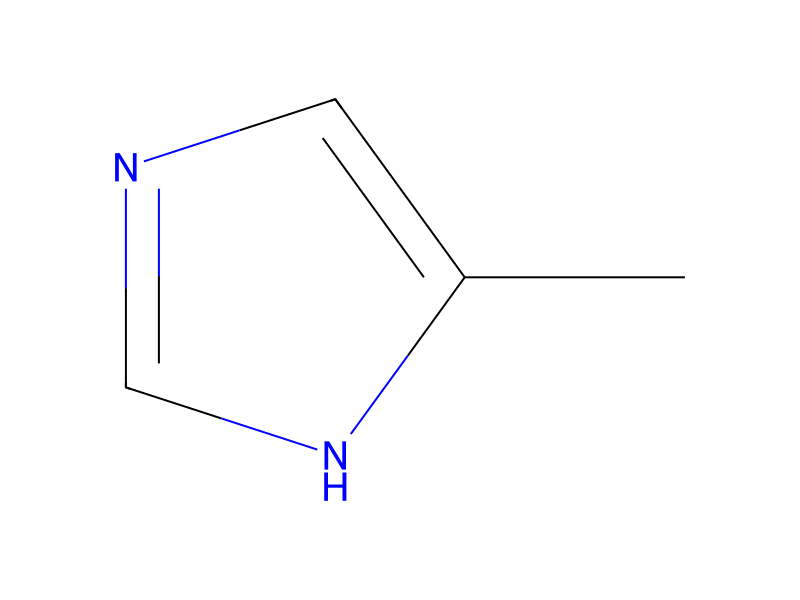
822-36-6Cc1cnc[nH]1XLSZMDLNRCVEIJ-UHFFFAOYSA-N4-Methylimidazole can cause cancer according to The National Toxicology Program.
822-36-6DTXSID9025617CHEMBL1230309CHEBI:40035log Kow = 0.23
0.23
263 °C
263 °C @760 [mm Hg]
Danger
H350: May cause cancer [Danger Carcinogenicity]
P203, P280, P318, P405, and P501 (click each P-code to see the statement)
This chemical does not meet GHS hazard criteria for 2.4% (7 of 286) of reports.
Danger
H302 (86%): Harmful if swallowed [Warning Acute toxicity, oral]
Chemical: 1H-Imidazole, 4-methyl-
Hazard Traits - Carcinogenicity; Reproductive Toxicity
Regulation (EC) No 1333/2008 (amended)
REACH registered substance: 4-methylimidazole (EC: 212-497-3)
1H-Imidazole, 4-methyl-: Does not have an individual approval but may be used as a component in a product covered by a group standard. It is not approved for use as a chemical in its own right.
No histopathological changes observed in 15-day oral studies of rats and mice; 14-week oral studies produced tremors, ataxia, anemia, hepatocytic vacuolization, and testicular degeneration in rats and anemia, liver cytoplasmic vacuolization, and renal degeneration in mice; Histopathological liver changes also observed in 106-week oral study of rats; [HSDB] Causes neurological effects including hyperexcitability, convulsions, and seizures in livestock and experimental animals; Reproductive organ toxicity and decreased fertility observed in male rats; Evidence of carcinogenicity: none in male rats; equivocal in female rats; clear evidence in male and female mice; [NTP] Irritating or corrosive to skin and irritating to eyes in rabbits; [IUCLID] Causes burns; Inhalation may cause corrosive injuries to upper respiratory tract and lungs; Harmful by ingestion; [Sigma-Aldrich MSDS] See 2-Methylimidazole.
The toxicokinetics and metabolism of 4-methylimidazole (4-MZ) have been studied in the male F344 rat using 14C radiolabelled compound ... Elimination of 4-MZ after an iv dose of 5 mg/kg can be described by a two-compartment process with an estimated half-life of 1.8 hr ...
4-methylimidazole (4-MI) was given orally to a cow in increased dosages to determine if it could be detected in her milk and be present at a concn high enough to affect her nursing calf. 4-MI was found in the milk, but the calf remained clinically normal throughout the experiment. The cow died after the fourth dose of 20 g 4-MI. Four groups of 10 mice each were given oral doses of water, normal milk, cow's milk after low doses of 4-MI, or cow's milk after high doses of 4-MI. All mice remained healthy after a 2-wk feeding trial. Six 3-day-old calves were given 4-MI directly in their bottles of milk up to 2 times the highest level found in toxic feed with only mild depression noted in one calf. Two pregnant cows were given 4-MI pre-partum to determine if it would get into the colostrum at higher levels. Both cows received 4-MI 3 days before they calved and for 2 wk afterward. Cow A exhibited trembling, excessive salivation and incoordination after the initial dose. Cow B and the newborn calves were never affected throughout the experiment. Each time the dose of 4-MI reached 1.5 g or more, Cow A would exhibit the previously described signs. 4-MI was detected in the colostrum but not in higher concentrations than in the other milk samples.
The toxicokinetics and metabolism of 4-methylimidazole (4-MZ) have been studied in the male F344 rat using 14C radiolabelled compound. Radioactivity in plasma and urine was profiled by HPLC. After gavage administration of 50 mg/kg, about 85% of the administered radioactivity was recovered in urine within 48 hr. The majority of the radioactivity in urine or plasma was associated with the parent compound and only one minor hydrophilic metabolite was present in urine and in plasma. Elimination of radioactivity via fecal, biliary or respiration was negligible. Elimination of 4-MZ after an iv dose of 5 mg/kg can be described by a two-compartment process with an estimated half-life of 1.8 hr and an estimated apparent volume of distribution of 2.3 L/kg. After gavage at doses of 5, 50 and 150 mg/kg, 4-MZ was readily absorbed with a estimated bioavailability of 60-70%. Urinary excretion data indicated that renal clearance of 4-MZ accounted for about 80% of total body plasma clearance. Based on the estimated AUC of metabolite and the estimated renal clearance of 4-MZ, the formation of metabolite and the renal clearance of 4-MZ appeared to be a saturable process.
Keine Reaktionsaufzeichnungen unter den aktuellen Filterkriterien.
Wird geladen…
56 °C
56 °C
Department of Health & Human Services/National Institute of Environmental Health Sciences, National Toxicology Program; Toxicology and Carcinogenesis Studies of 4-Methylimidazole (CAS No. 822-36-6) in F344/N Rats and B6C3F1 Mice (Feed Studies), NTP TR-535 (January 2007).
European Chemicals Bureau; IUCLID Dataset, 4-Methylimidazole (822-36-6) (2000 CD-ROM edition) contains information on use, toxicology, and environmental effects of this chemical as supplied to the European Union by industry.[Available from, as of July 15, 2009: http://esis.jrc.ec.europa.eu/]
Acute Tox. 4 (86%)
Acute toxicity - category 4
Carcinogenicity - Category 1B
Acute toxicity (Oral) - Category 3
Carc. 1B
Suitable extinguishing media: Use water spray, alcohol-resistant foam, dry chemical or carbon dioxide.
Special protective equipment for fire-fighters: Wear self contained breathing apparatus for fire fighting if necessary.
SRP: Wastewater from contaminant suppression, cleaning of protective clothing/equipment, or contaminated sites should be contained and evaluated for subject chemical or decomposition product concentrations. Concentrations shall be lower than applicable environmental discharge or disposal criteria. Alternatively, pretreatment and/or discharge to a POTW is acceptable only after review by the governing authority. Due consideration shall be given to remediation worker exposure (inhalation, dermal and ingestion) as well as fate during treatment, transfer and disposal. If it is not practicable to manage the chemical in this fashion, it must meet Hazardous Material Criteria for disposal.
Personal precautions: Use personal protective equipment. Avoid dust formation. Avoid breathing dust. Ensure adequate ventilation. Evacuate personnel to safe areas.
Environmental precautions: Do not let product enter drains.
Methods for cleaning up: Pick up and arrange disposal without creating dust. Keep in suitable, closed containers for disposal.
SRP: The most favorable course of action is to use an alternative chemical product with less inherent propensity for occupational exposure or environmental contamination. Recycle any unused portion of the material for its approved use or return it to the manufacturer or supplier. Ultimate disposal of the chemical must consider: the material's impact on air quality; potential migration in soil or water; effects on animal, aquatic, and plant life; and conformance with environmental and public health regulations.
Dissolve or mix the material with a combustible solvent and burn in a chemical incinerator equipped with an afterburner and scrubber. Observe all federal, state, and local environmental regulations. Contact a licensed professional waste disposal service to dispose of this material.
SRP: The scientific literature for the use of contact lenses in industry is conflicting. The benefit or detrimental effects of wearing contact lenses depend not only upon the substance, but also on factors including the form of the substance, characteristics and duration of the exposure, the uses of other eye protection equipment, and the hygiene of the lenses. However, there may be individual substances whose irritating or corrosive properties are such that the wearing of contact lenses would be harmful to the eye. In those specific cases, contact lenses should not be worn. In any event, the usual eye protection equipment should be worn even when contact lenses are in place.
Handling: Avoid contact with skin and eyes. Avoid formation of dust and aerosols.
In case of skin contact: Take off contaminated clothing and shoes immediately. Wash off with soap and plenty of water. Consult a physician.
In case of eye contact: Continue rinsing eyes during transport to hospital. Rinse thoroughly with plenty of water for at least 15 minutes and consult a physician.
Hygiene measures: Handle in accordance with good industrial hygiene and safety practice. Wash hands before breaks and at the end of workday.
2.3 [mg/m3]
25 [mg/m3]
150 [mg/m3]
Respiratory protection: Where risk assessment shows air-purifying respirators are appropriate use a full-face particle respirator type N100 (US) or type P3 (EN 143) respirator cartridges as a backup to engineering controls. If the respirator is the sole means of protection, use a full-face supplied air respirator. Use respirators and components tested and approved under appropriate government standards such as NIOSH (US) or CEN (EU).
Hand protection: Handle with gloves.
Eye protection: Safety glasses.
Skin and body protection: Choose body protection according to the amount and concentration of the dangerous substance at the work place.
Provide appropriate exhaust ventilation at places where dust is formed. Normal measures for preventive fire protection.
TERRESTRIAL FATE: Based on a classification scheme(1), an estimated Koc value of 33(SRC), determined from a log Kow of 0.23(2) and a structure estimation method(3), indicates that 4-methylimidazole is expected to have very high mobility in soil(SRC). The estimated pKa of 4-methylimidazole is 7.51(4), indicating that this compound will partially exist in cation form in the environment, and cations generally adsorb more strongly to soils containing organic carbon and clay than their neutral counterparts(5). Volatilization of 4-methylimidazole from moist soil surfaces may be an important fate process(SRC) given an estimated Henry's Law constant of 4.1X10⁻⁶ atm-cu m/mole(SRC), using a fragment constant estimation method(6). However, volatilization from moist soil may be attenuated because the base compound exists as a cation and cations do not volatilize. 4-Methylimidazole is not expected to volatilize from dry soil surfaces(SRC) based upon an estimated vapor pressure of 0.007 mm Hg at 25 °C(SRC), determined from a fragment constant method(7). Biodegradation data were not available(SRC, 2009).
AQUATIC FATE: Based on a classification scheme(1), an estimated Koc value of 32(SRC), determined from a log Kow of 0.23(2) and a structure estimation method(3), indicates that 4-methylimidazole is not expected to adsorb to suspended solids and sediment(SRC). Volatilization from water surfaces may be expected(4) based upon an estimated Henry's Law constant of 4.1X10⁻⁶ atm-cu m/mole(SRC). Using this Henry's Law constant and an estimation method(4), volatilization half-lives for a model river and model lake are 195 hours and 62 days, respectively(SRC). According to a classification scheme(5), an estimated BCF of 3.2(SRC), from its log Kow(2) and a regression-derived equation(6), suggests the potential for bioconcentration in aquatic organisms is low(SRC). Biodegradation data were not available(SRC, 2009).
ATMOSPHERIC FATE: According to a model of gas/particle partitioning of semivolatile organic compounds in the atmosphere(1), 4-methylimidazole, which has an estimated vapor pressure of 0.007 mm Hg at 25 °C(SRC), determined from a fragment constant method(2), is expected to exist solely as a vapor in the ambient atmosphere. Vapor-phase 4-methylimidazole is degraded in the atmosphere by reaction with photochemically-produced hydroxyl radicals(SRC); the half-life for this reaction in air is estimated to be 4.1 hours(SRC), calculated from its rate constant of 9.4X10⁻¹¹ cu cm/molecule-sec at 25 °C(3), determined using a structure estimation method(3). 4-Methylimidazole does not contain chromophores that absorb at wavelengths >290 nm(4) and therefore is not expected to be susceptible to direct photolysis by sunlight(SRC).
The Koc of 4-methylimidazole is estimated as 33(SRC), using a log Kow of 0.23(1) and a structure estimation method(2). According to a classification scheme(3), this estimated Koc value suggests that 4-methylimidazole is expected to have very high mobility in soil. The estimated pKa of 4-methylimidazole is 7.51(4), indicating that this compound will partially exist in cation form in the environment and cations generally adsorb more strongly to soils containing organic carbon and clay than their neutral counterparts(5).
/SIGNS AND SYMPTOMS/ Irritating /to skin and eyes/.
/SIGNS AND SYMPTOMS/ May be harmful if inhaled. Material is extremely destructive to the tissue of the mucous membranes and upper respiratory tract. ...May be harmful if absorbed through skin. Causes skin burns. ...Causes eye burns. ...Harmful if swallowed. Causes burns.
4-Methylimidazole
Group 2B: Possibly carcinogenic to humans
Volume 101: (2012) Some Chemicals Present in Industrial and Consumer Products, Food and Drinking-water
2013
2011
4-Methylimidazole
An estimated BCF of 3.2 was calculated in fish for 4-methylimidazole(SRC), using a log Kow of 0.23(1) and a regression-derived equation(2). According to a classification scheme(3), this BCF suggests the potential for bioconcentration in aquatic organisms is low(SRC).
The Henry's Law constant for 4-methylimidazole is estimated as 4.1X10⁻⁶ atm-cu m/mole(SRC) using a fragment constant estimation method(1). This Henry's Law constant indicates that 4-methylimidazole may be expected to volatilize from water surfaces(2). Based on this Henry's Law constant, the volatilization half-life from a model river (1 m deep, flowing 1 m/sec, wind velocity of 3 m/sec)(2) is estimated as 195 hours(SRC). The volatilization half-life from a model lake (1 m deep, flowing 0.05 m/sec, wind velocity of 0.5 m/sec)(2) is estimated as 62 days(SRC). 4-Methylimidazole's Henry's Law constant indicates that volatilization from moist soil surfaces may occur(SRC). 4-Methylimidazole is not expected to volatilize from dry soil surfaces(SRC) based upon an estimated vapor pressure of 0.007 mm Hg(SRC), determined from a fragment constant method(3).
/LABORATORY ANIMALS: Acute Exposure/ Clinical signs, gross and histologic necropsy findings and dose response curves of 4-methylimidazole (4-MI) were determined in young Holstein calves. Three-day-old Holstein bull calves were given an oral dose of 0,25,50,100,200 or 400 mg 4-MI/kg bw. Acute clinical signs were hypersalivation, mouth chomping, diarrhea, muscle fasciculations, tremors, hyperexcitability, convulsions, coma and death. Death occurred within 3 hr for calves given the highest dose of 400 mg/kg. Two of 3 calves dosed at 200 mg/kg died within 8 and 3/4 hr of dosing. Only 1 of 3 calves showed mild signs at the 100 mg/kg dose level and no effects were observed at the 50 or 25 mg/kg dose level. Signs due to 4-MI in this experiment were similar to signs observed in calves whose dams were consuming ammoniated hay. No pathological lesions attributable to 4-MI toxicosis were found during gross or microscopic necropsy examination. Blood chemistry values from calves treated with 4-MI were within normal ranges except for potassium, phosphorus and glucose which were elevated (P less than .05) at the time of death for those calves dosed at 400 mg/kg.
/LABORATORY ANIMALS: Acute Exposure/ /4-Methylimidazole was determined to be/ irritating ... /and/ corrosive (causes burns) /to the skin and irritating to the eyes according to the Draize test on rabbits/.
/LABORATORY ANIMALS: Subchronic or Prechronic Exposure/ Fifteen-day and 14-week studies of ... 4-methylimidazole (4MI) were conducted ... Groups of five male and five female Fischer rats and B6C3F1 mice were administered ... 4MI at 0, 300, 800, or 2,500 ppm for 15 days, and groups of 10 male and 10 female Fischer rats and B6C3F1 mice were administered ... 4MI at 0, 625, 1,250, 2,500, 5,000 or 10,000 ppm for 14 weeks. In the 15-day studies, ... 4MI induced no histopathological changes in rats and mice. In the 14-week studies, ... in rats, 4MI induced tremors and ataxia in the high-dose groups. Serum T(3), T(4), and TSH levels were not altered, and no thyroid lesions occurred. Anemia, hepatocytic vacuolation, testicular degeneration, and prostatic atrophy were observed. In mice, anemia, liver cytoplasmic vacuolization, and renal degeneration and dilation occurred ...
/LABORATORY ANIMALS: Subchronic or Prechronic Exposure/ /Cats were dosed intraperitoneally with 0.43 mg/kg bw 4-methylimidazole at intervals of 3 days for 70 days. Liver hypertrophy was observed in some animals. The weight increases were not changed compared with the controls. Also, the biochemical values (bilirubin ... blood values, etc.) showed no deviations from the nominal values or from those of the control group ...
For more Non-Human Toxicity Excerpts (Complete) data for 4-Methylimidazole (8 total), please visit the HSDB record page.
The rate constant for the vapor-phase reaction of 4-methylimidazole with photochemically-produced hydroxyl radicals has been estimated as 9.4X10⁻¹¹ cu cm/molecule-sec at 25 °C(SRC) using a structure estimation method(1). This corresponds to an atmospheric half-life of about 4.1 hours at an atmospheric concentration of 5X10+5 hydroxyl radicals per cu cm(1). 4-Methylimidazole is not expected to undergo hydrolysis in the environment due to the lack of functional groups that hydrolyze under environmental conditions(2). 4-Methylimidazole does not contain chromophores that absorb at wavelengths >290 nm(2) and therefore is not expected to be susceptible to direct photolysis by sunlight(SRC).
Occupational exposure to 4-methylimidazole may occur through inhalation and dermal contact with this compound at workplaces where 4-methylimidazole is produced or used. Use data indicate that limited exposure to the general population may occur via ingestion and dermal contact with products containing this compound. (SRC)
Used to make pharmaceuticals, antiseptic agents, and photo developing solutions; [HSDB] Present in caramel coloring, tobacco smoke, wine, soy sauce, and other foods; Also formed when ammonia is added to livestock feed to increase nutritional value; Used to make pharmaceuticals, photographic and photothermographic chemicals, dyes, pigments, agricultural chemicals, rubber, and inks; Also used in oven cleaners, as a crosslinking agent for epoxy resin hardeners, corrosion inhibitor for cooling water, and in absorbents that remove acid gases from hydrocarbon or synthesis gas; [NTP]
Plastic Composites Manufacturing [Category: Industry]
Has been reported as one of several compounds resulting from interaction of reducing sugars with ammonia; Major pharmaceutical intermediate; Starting material for drug used for ulcer therapy and other drugs, antiseptic agents; Photo developing solution.
In the generally applicable Radziszewski reaction, a 1,2-dicarbonyl compound is condensed with an aldehyde and ammonia (R1 = H) in a molar ratio of 1:1:2, respectively. Replacement of a molar equivalent of ammonia with a primary amine (R1 = alkyl or aryl) leads to the corresponding 1-substituted imidazoles. The reaction is usually carried out in water or a water-alcohol mixture at 50 - 100 °C. Work-up may involve the usual processes (e.g., distillation, extraction, and crystallization). Distillation leads to imidazole with a purity > 99%. The yield is generally 60 - 85 %. ... Compounds used to prepare simple imidazoles by the Radziszewski reaction: Imidazole: 4(5)-methylimidazole; Dicarbonyl compound: methylglyoxal; Aldehyde: formaldehyde; Amine: ammonia.
Verwenden4-Methylimidazole is a monomethylated imidazole that can be used as a building block in the preparation of a wide range of biologically active compounds. 4-Methylimidazole is a product which results f rom the interaction of reducing sugars with ammonia. 4-Methylimidazole showed convulsant activity in animals and is listed as a possible carcinogen.
synthetische4-Methylimidazole is synthesized by the reaction of glyoxal, acetaldehyde and ammonia. Another method to synthesize the compound is by catalytic dehydrogenation of imidazoline derivatives. 4-Methylimidazole may be synthesized from propanol and formamide, by catalytic cyclization of bisformamidipropane or by photolysis of alkenyltetrazole derived from alkenes by sequential epoxidation, ring opening and dehydration (NTP, 2007).
DefinitionChEBI: 4-methylimidazole is imidazole substituted at position 4 by a methyl group. It has a role as a carcinogenic agent and a reaction intermediate.