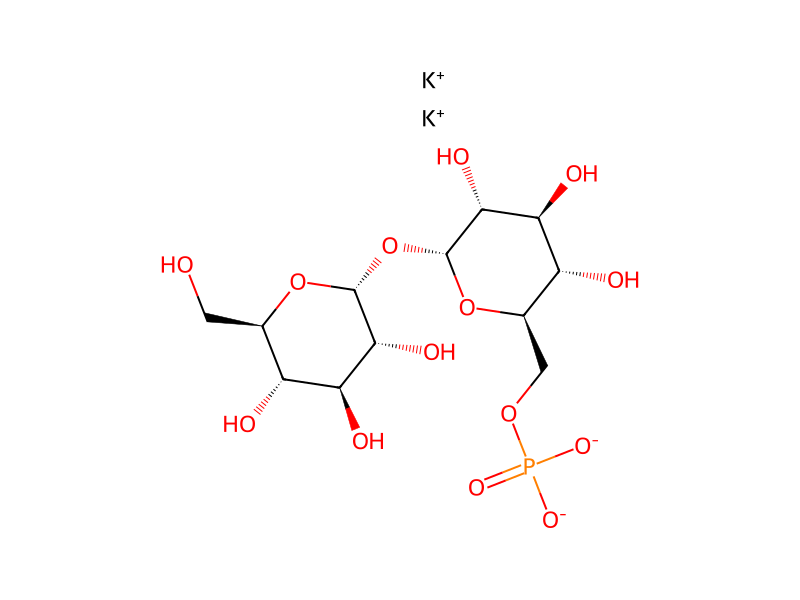
trehalose 6-phosphate dipotassium salt
HCID 132285186
Daten werden ergänzt – lade die Seite später neu, um den aktuellen Stand zu sehen
Grundinformationen
- CAS
136632-28-5- Standard-SMILES
O=P([O-])([O-])OC[C@H]1O[C@H](O[C@H]2O[C@H](CO)[C@@H](O)[C@H](O)[C@H]2O)[C@H](O)[C@@H](O)[C@@H]1O.[K+].[K+]- InChIKey
YKCUKYNZTFYPHM-PVXXTIHASA-L- Summenformel
- C12H21K2O14P
- Durchschnittliche Molmasse
- 498,46 g/mol
- Monoisotopische Masse
- 497,9943053
Namen und Bezeichner
- Bevorzugter Name
- trehalose 6-phosphate dipotassium salt
- IUPAC
- dipotassium;[(2R,3S,4S,5R,6R)-3,4,5-trihydroxy-6-[(2R,3R,4S,5S,6R)-3,4,5-trihydroxy-6-(hydroxymethyl)oxan-2-yl]oxyoxan-2-yl]methyl phosphate
- Englischer Name
- TREHALOSE 6-PHOSPHATE DIPOTASSIUM SALT
- Summenformel
- C12H21K2O14P
- Molmasse
- 498.46
Namen und Synonyme
Trehalose 6-phosphate dipotassium salt136632-28-5RefChem:898938635-058-1Tre6P (potassium)orb1694057orb2278598DTXSID501377340TREHALOSE6-PHOSPHATEDIPOTASSIUMSALTalpha,alpha-Trehalose 6-phosphate potassiumG77958T36081
Weitere Namen anzeigen
YKCUKYNZTFYPHM-CTDSUHBFSA-Ltrehalose-6-phosphate dipotassiumTrehalose 6-phosphate diammonium saltTrehalose 6-phosphate (potassium salt)Α-D-GLUCOPYRANOSYL Α-D-GLUCOPYRANOSIDE 6-(DIHYDROGEN PHOSPHATE)α-D-glucopyranosyl α-D-glucopyranoside 6-(dihydrogen phosphate)TREHALOSE 6-PHOSPHATE DIPOTASSIUM SALT(SALTDATA: dipotassium salt)Α-D-GLUCOPYRANOSYL Α-D-GLUCOPYRANOSIDE 6-(DIHYDROGEN PHOSPHATE)DIPOTASSIUM SALT[(2S,3R,4S,5S,6S)-3,4,5-trihydroxy-6-[(2S,3S,4S,5R,6S)-3,4,5-trihydroxy-6-(hydroxymethyl)tetrahydropyran-2-yl]oxy-tetrahydropyran-2-yl]methyl dihydrogen phosphate
T78471I+/--D-Glucopyranoside, I+/--D-glucopyranosyl, 6-(dihydrogen phosphate), potassium salt (1:2)
Eigenschaften
Berechnete StruktureigenschaftenWird ergänzt
- Polarare Oberfläche (TPSA)
- 242 Ų
- H-Brücken-Donoren
- 7
- H-Brücken-Akzeptoren
- 14
- Frei drehbare Bindungen
- 5
- Schwere Atome
- 29
- Formalladung
- 0
- Komplexität
- 517
Physikochemische Eigenschaften
- Schmelzpunkt
- 140 °C · >140°C (dec.)
- storage temp.
- 20 °C · −20°C
- Löslichkeit
- Water (Slightly, Sonicated)
- Aggregatzustand
- Solid
- Farbe
- White to Pale Brown
- Stabilität
- Hygroscopic
- Major Application
- agriculture
- InChIKey
- KSPIKJRSOAXHOT-PVXXTIHASA-N
- SMILES
- [K].[H][C@@]1(O[C@H](CO)[C@@H](O)[C@H](O)[C@H]1O)O[C@H]2O[C@H](COP(O)(O)=O)[C@@H](O)[C@H](O)[C@H]2O
Sicherheit und Regulatorisches
Sicherheitsangaben dienen nur zur Orientierung und ersetzen weder das Sicherheitsdatenblatt (SDB) des Lieferanten noch geltende Vorschriften oder eine fachliche Bewertung.
GHS-Klassifizierung
GHS Classification
Warning
H302 (100%): Harmful if swallowed [Warning Acute toxicity, oral]
P261, P264, P270, P271, P280, P301+P317, P302+P352, P304+P340, P317, P321, P330, P362+P364, and P501 (click each P-code to see the statement)
Aggregated GHS information provided per 39 reports by companies from 2 notifications to the ECHA C&L Inventory. Each notification may be associated with multiple companies.
Gefahrenhinweise
Hazard Classes and CategoriesAcute Tox. 4 (100%)
Sicherheitsdaten
- wgk
- 3
- risk_code
- 20/21/22-68/20/21/22-39/23/24/25-11
- hazard_code
- Xn,T,F
- safety_code
- 36/37
- Speicherklasse
- 6.1C - Combustible acute toxic Cat.3toxic compounds or compounds which causing chronic effects
- Hazard Classifications
- Acute Tox. 3 DermalAcute Tox. 4 InhalationAcute Tox. 4 OralSTOT SE 1
Chemie und Industrie
Anwendungen
VerwendenTrehalose is a natural non-reducing disaccharide found in plants, invertebrates, fungi, and bacteria. In addition to roles as an energy source and stress protectant, trehalose can function as a signaling molecule. Trehalose 6-phosphate is an intermediate in the biosynthesis of trehalose. It is generated from UDP-glucose and glucose 6-phosphate by trehalose 6-phosphate synthase (TPS or otsA). In plants, changes in trehalose 6-phosphate levels positively correlate with diurnal changes in sucrose and may regulate diverse processes, including starch degradation and flowering.
Zugehörige Reaktionen
0
Noch keine zugehörigen Reaktionen