
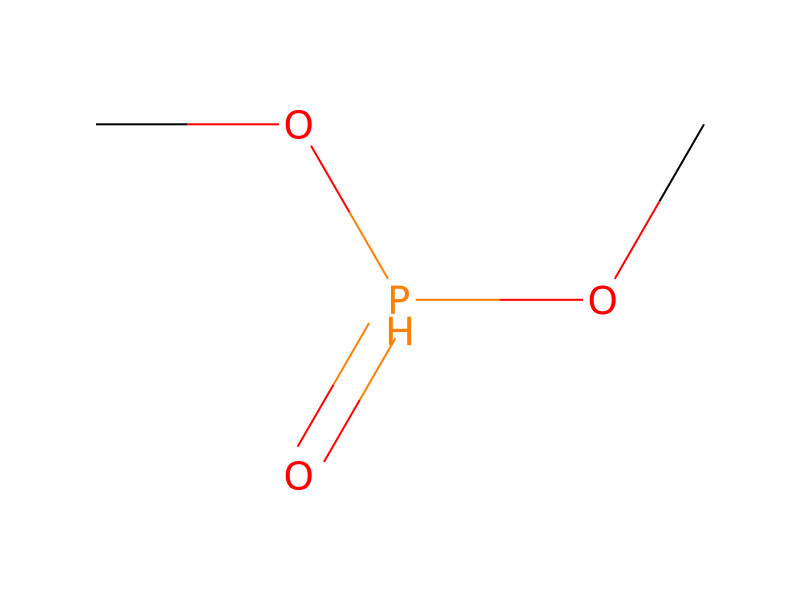
Grundinformationen
- Standard-SMILES
CO[PH](=O)OC- InChIKey
HZCDANOFLILNSA-UHFFFAOYSA-N- Summenformel
- C2H7O3P
- Durchschnittliche Molmasse
- 110,05 g/mol
- Monoisotopische Masse
- 110,01328071
Überblick
Dimethyl hydrogen phosphite is a colorless liquid. (USCG, 1999)
Namen und Bezeichner
- Bevorzugter Name
- Phosphonic acid, dimethyl ester
- IUPAC
- methoxyphosphonoyloxymethane
Namen und Synonyme
RefChem:929181DTXCID20164557212-783-8868-85-9Bis(hydroxymethyl)phosphine oxideDimethoxyphosphine oxideDimethyl acid phosphiteDimethyl hydrogen phosphiteDimethyl hydrogen phosphonateDimethyl phosphiteDimethyl phosphonateDimethylester kyselini fosforite
Weitere Namen anzeigen
Dimethylester kyseliny fosforiteDimethylfosfitDimethylfosfonatDimethylhydrogenphosphiteDimethylphosphonateDTXCID10493DTXSID20242066DTXSID5020493
Datenbank-Bezeichner
- CAS
868-85-9、96-36-6- PubChem CID
- 13361
- DTXSID
DTXSID5020493- EC Number
- 212-783-8
Eigenschaften
Berechnete Struktureigenschaften
- XLogP
- -0,5
- Polarare Oberfläche (TPSA)
- 35,5 Ų
- H-Brücken-Donoren
- 0
- H-Brücken-Akzeptoren
- 3
- Frei drehbare Bindungen
- 2
- Schwere Atome
- 6
- Formalladung
- 0
- Komplexität
- 46,8
Experimentelle und physikochemische Eigenschaften
Chemical ClassesOther Classes -> Phosphite Compounds
LogP-1.2
OdorMild odor
Density
1.2 (USCG, 1999) - Denser than water; will sink
1.2002 g/cu cm at 20 °C
Relative density (water = 1): 1.2
1.2 @25 °C
Viscosity1.06 centistokes at 25 °C
Color/FormMobile, colorless liquid
Solubility
greater than or equal to 100 mg/mL at 67.1 °F (NTP, 1992)
Soluble in water; miscible with most organic solvents
In water, >10 g/100 mL at 20 °C
Solubility in water, g/100ml at 20 °C: >10
Flash Point
85 °F (NTP, 1992)
70 °C
70 °C (Closed cup)
70 °C c.c.
Boiling Point
338 to 340 °F at 760 mmHg (NTP, 1992)
170.5
171 °C
DecompositionWhen heated to decomposition it emits toxic fumes of /phosphorous oxides/.
Melting Point29 °C
Vapor Density7.9 (Air = 1)
Sicherheit und Regulatorisches
GHS-Klassifizierung
GHS Classification
Danger
H226 (71.8%): Flammable liquid and vapor [Warning Flammable liquids]
P203, P210, P233, P240, P241, P242, P243, P261, P262, P264, P264+P265, P270, P272, P273, P280, P302+P352, P303+P361+P353, P305+P351+P338, P316, P318, P321, P332+P317, P333+P317, P337+P317, P361+P364, P362+P364, P370+P378, P403+P235, P405, and P501 (click each P-code to see the statement)
Aggregated GHS information provided per 627 reports by companies from 11 notifications to the ECHA C&L Inventory. Each notification may be associated with multiple companies.
Danger
H227: Combustible liquid [Warning Flammable liquids]
Gefahrenhinweise
Regulatory Information
Chemical: Phosphonic acid, dimethyl ester
Hazard Traits - Carcinogenicity
Phosphonic acid, dimethyl ester is listed on the EPA's Chemical Data Reporting (CDR) system. Manufacturers and importers of Phosphonic acid, dimethyl ester are required to report information about their production and use of this chemical to the EPA under the Toxic Substances Control Act (TSCA). (40 eCFR Part 711)
Status: Active Update: 16-12-2019 https://echa.europa.eu/registration-dossier/-/registered-dossier/30190
Phosphonic acid, dimethyl ester: Does not have an individual approval but may be used under an appropriate group standard
Other Safety InformationIMAP assessments - Phosphonic acid, dimethyl ester: Human health tier I assessment
DOT LabelPoison
Fire Hazards
Special Hazards of Combustion Products: Emits toxic fumes under fire conditions. (USCG, 1999)
Combustible. Above 70 °C explosive vapour/air mixtures may be formed.
Health HazardsHarmful if swallowed, inhaled or absorbed through skin. Exposure can cause nausea, headache and vomiting. Vapor irritating to eyes, mucous membrane and upper respiratory tract. (USCG, 1999)
Hazards Summary
A skin, eye, mucous membrane, and respiratory tract irritant; [CAMEO] A skin and eye irritant; The substance may have effects on the eyes, resulting in cataract. [ICSC] An irritant; Can be absorbed through skin; Effects in high-dose animal studies include injury to the liver, kidney, cornea, and bone structure; [MSDSonline]
Reactive GroupSulfonates, Phosphonates, and Thiophosphonates, Organic
Special Reports
DHHS/NTP; Toxicology & Carcinogenesis Studies of Dimethyl Hydrogen Phosphite in F344/N Rats and B6C3F1 Mice (Gavage Studies) Technical Report Series No. 287 (1985) NIH Publication No. 86-2543
Organization for the Prohibition of Chemical Weapons; Convention on the Prohibition of the Development, Production, Stockpiling and Use of Chemical Weapons and Their Destruction. Available from http://www.opcw.org/docs/cwc_eng.pdf as of May 1, 2007. The Chemical Weapons Convention (CWC) is an international treaty which bans the development, production, stockpiling, and transfer or use of chemical weapons. The Convention mandates the destruction and prohibition of chemical weapons and related facilities and provides for restrictions on international trade in toxic chemicals and precursors.
Reactivity AlertsHighly Flammable
Reactivity ProfileDIMETHYL HYDROGEN PHOSPHITE may form highly toxic and flammable phosphine gas in the presence of strong reducing agents such as hydrides. Partial oxidation by oxidizing agents may result in the release of toxic phosphorus oxides.
Chemical Dangers
Decomposes rapidly on heating. This produces toxic fumes including phosphorus oxides and phosphine. Decomposes on contact with moist air above 220 °C. This produces phosphoric acid and methanol. The solution in water is a strong acid. It reacts violently with bases and is corrosive. Reacts violently with acids and oxidants.
Physical DangersThe vapour is heavier than air.
Sicherheit und Schutzausrüstung
Fire Fighting
Fire Extinguishing Agents Not to Be Used: Water may be ineffective.
Use foam, alcohol-resistant foam, carbon dioxide. In case of fire: keep drums, etc., cool by spraying with water. NO direct contact with water. Combat fire from a sheltered position.
First Aid Measures
Fresh air, rest. Refer for medical attention.
First rinse with plenty of water for at least 15 minutes, then remove contaminated clothes and rinse again.
First rinse with plenty of water for several minutes (remove contact lenses if easily possible), then refer for medical attention.
Rinse mouth. Do NOT induce vomiting. Refer for medical attention .
First Aid
EYES: First check the victim for contact lenses and remove if present. Flush victim's eyes with water or normal saline solution for 20 to 30 minutes while simultaneously calling a hospital or poison control center. Do not put any ointments, oils, or medication in the victim's eyes without specific instructions from a physician. IMMEDIATELY transport the victim after flushing eyes to a hospital even if no symptoms (such as redness or irritation) develop.
Safe StorageDry. Store in an area without drain or sewer access. Separated from food and feedstuffs. See Chemical Dangers.
Nonfire Spill ResponseNeutralizing Agents for Acids and Caustics: Dry lime, soda ash (USCG, 1999)
Disposal Methods
SRP: The most favorable course of action is to use an alternative chemical product with less inherent propensity for occupational exposure or environmental contamination. Recycle any unused portion of the material for its approved use or return it to the manufacturer or supplier. Ultimate disposal of the chemical must consider: the material's impact on air quality; potential migration in soil or water; effects on animal, aquatic, and plant life; and conformance with environmental and public health regulations.
Spillage Disposal
Personal protection: chemical protection suit and filter respirator for acid gases and vapours adapted to the airborne concentration of the substance. Do NOT let this chemical enter the environment. Cover the spilled material with inert absorbent. Collect leaking and spilled liquid in sealable containers as far as possible.
Isolation and EvacuationExcerpt from ERG Guide 151 [Substances - Toxic (Non-Combustible)]:
Eye PreventionWear safety goggles.
Fire PreventionNO open flames, NO sparks and NO smoking. Above 70 °C use a closed system and ventilation.
Inhalation RiskA harmful contamination of the air will be reached slowly on evaporation of this substance at 20 °C; on spraying or dispersing, however, much faster.
Skin PreventionProtective clothing. Protective gloves.
Toxikologische Informationen
Ecotoxicity ValuesLC50; Species: Pimephales promelas (Fathead minnow); Conditions: freshwater; static; Concentration: 225000 ug/L for 4 days/formulated product/
Environmental Fate
TERRESTRIAL FATE: Adsorption to soil, volatilization from moist soil surfaces, and biodegradation are not expected to be important fate processes due to the hydrolysis of dimethyl hydrogen phosphite(SRC). Hydrolysis occurs under both acidic and basic conditions(1). Final hydrolysis products include methanol and phosphorous acid or its salts(1). In neutral water, dimethyl hydrogen phosphite was reported to hydrolyze completely within 144 hours; the half-life is in the range of 50 to 70 hours(2). Hydrolysis half-lives of 10 days at 25 °C and 19 days at 20 °C have also been reported for dimethyl hydrogen phosphite(3). Basic conditions speed the hydrolysis(4). Dimethyl hydrogen phosphite may leach, possibly reaching groundwater where it will hydrolyze completely(SRC). Dimethyl hydrogen phosphite is expected to volatilize from dry soil surfaces(SRC) based upon a vapor pressure of 1.5 mm Hg(1).
AQUATIC FATE: Hydrolysis occurs under both acidic and basic conditions(1). Final hydrolysis products include methanol and phosphorous acid or its salts(1). In neutral water dimethyl hydrogen phosphite was reported to hydrolyze completely within 144 hours; the half-life is in the range of 50 to 70 hours(2). Hydrolysis half-lives of 10 days at 25 °C and 19 days at 20 °C have also been reported for dimethyl hydrogen phosphite(3). Basic conditions speed the hydrolysis(4). Adsorption to suspended solids and sediment, volatilization from water surfaces, bioconcentration, and biodegradation are not expected to be important fate processes due to the rapid hydrolysis of dimethyl hydrogen phosphite(SRC). The ethyl homologue of dimethyl hydrogen phosphite has been reported to photolyze in water(5) indicating that dimethyl hydrogen phosphite may also photolyze(SRC).
ATMOSPHERIC FATE: According to a model of gas/particle partitioning of semivolatile organic compounds in the atmosphere(1), dimethyl hydrogen phosphite, which has a vapor pressure of 1.5 mm Hg at 20 °C(2), is expected to exist solely as a vapor in the ambient atmosphere. Vapor-phase dimethyl hydrogen phosphite is degraded in the atmosphere by reaction with photochemically-produced hydroxyl radicals(SRC); the half-life for this reaction in air is estimated to be 3.2 days(SRC), calculated from its rate constant of 5.08X10⁻¹² cu cm/molecule-sec at 25 °C(3). Dimethyl hydrogen phosphite does not absorb at wavelengths >290 nm(4) and therefore is not expected to be susceptible to direct photolysis by sunlight(5).
Adverse EffectsOccupational hepatotoxin - Secondary hepatotoxins: the potential for toxic effect in the occupational setting is based on cases of poisoning by human ingestion or animal experimentation.
Exposure RoutesThe substance can be absorbed into the body by inhalation, through the skin and by ingestion.
Signs and Symptoms
Cough. Nausea. Sore throat.
MAY BE ABSORBED! Redness. Pain.
Redness. Pain.
Diarrhoea. Nausea. Vomiting.
Ongoing Test Status
The following link will take the user to the National Toxicology Program (NTP) Test Agent Search Results page, which tabulates all of the "Standard Toxicology & Carcinogenesis Studies", "Developmental Studies", and "Genetic Toxicity Studies" performed with this chemical. Clicking on the "Testing Status" link will take the user to the status (i.e., in review, in progress, in preparation, on test, completed, etc.) and results of all the studies that the NTP has done on this chemical. [http://ntp-apps.niehs.nih.gov/ntp_tox/index.cfm?fuseaction=ntpsearch.searchresults&searchterm=868-85-9]
ICSC Environmental DataThe substance is harmful to aquatic organisms.
Soil Adsorption/MobilityAdsorption to soils or suspended solids is not expected to be an important fate process(SRC) due to the hydrolysis of dimethyl hydrogen phosphite(1-4).
TSCA Test Submissions
The mutagenicity of dimethyl hydrogen phosphite was evaluated in Salmonella tester strains TA98, TA100, TA1535, TA1537 and TA1538 (Ames Test), and in Saccharomyces cerevisiae strain D4, both in the presence and absence of added metabolic activation by Aroclor-induced rat liver S9 fraction. Based on preliminary toxicity determinations, dimethyl hydrogen phosphite, diluted in DMSO, was tested at concentrations up to 5ul/plate using the plate incorporation technique. Dimethyl hydrogen phosphite did not cause a positive response in any tester strain with or without metabolic activation.
The mutagenicity of dimethyl hydrogen phosphite was evaluated in Salmonella tester strains TA98, TA100, TA1535, TA1537 and TA1538 (Ames Test), both in the presence and absence of added metabolic activation by Aroclor-induced rat liver S9 fraction. Based on preliminary toxicity determinations, dimethyl hydrogen phosphite, diluted in DMSO, was tested at concentrations up to 15ul/plate using the preincubation method. Dimethyl hydrogen phosphite did not cause a positive response in any tester strain with or without metabolic activation.
The ability of dimethyl hydrogen phosphite to induce specific locus mutations at the TK locus of cultured L5178Y mouse lymphoma cells (Mouse Lymphoma Mutagenicity Assay) was evaluated in the presence and absence of Aroclor-induced rat liver S9 metabolic activation. Based on preliminary toxicity determinations, nonactivated cultures were treated with 1.3, 1.0, 0.75, 0.56, 0.42, 0.32, 0.24, 0.18 and 0.13ul/ml, producing a range of 13 - 107% total growth. S9 activated cultures treated with 1.8, 1.3, 1.0, 0.75, 0.56, 0.42, 0.32, 0.24, 0.18 and 0.13ul/ml produced a range of 8 - 61% total growth. The nonactivated culture at highest dose level produced a mutant frequency which was two fold of the solvent control (DMSO). Activated cultures at the four highest concentrations produced mutant frequencies significantly greater than the solvent control, and a dose-response relationship was observed.
The mutagenic potential of dimethyl hydrogen phosphite was evaluated in the germ cells of Drosophila melanogaster males employing the following: somatic reversion of white-ivory test, Y chromosome loss test, Dominant lethal test and Bithorax test, sex-linked lethal test and timing of crosses test. Male flies were exposed to 0.07ml of test article delivered as an aerosol in an 25ml flask, after 5 minutes of exposure flies experienced a 20% mortality with about 20% of the survivors being sterile. Dimethyl hydrogen phosphite did cause a significant increase in the mutant frequencies in male Drosophila germ cells employing the dominant lethal and sex-linked lethal assays. All other tests were negative.
The effect of dimethyl hydrogen phosphite (DMHP) was evaluated in the bacterial DNA repair assay using E. coli tester strains WP2uvrA+recA+ and WP100uvrA-recA- and Salmonella tester strains TA1978uvrB+ and TA1538uvrB-, both with and without metabolic activation by Aroclor-induced rat liver S9 fraction. (strains designated with a "+" are repair proficient and strains designated with a "-" are repair deficient). DMHP was tested at a concentrations of 0, 0.3, 3.0, 30.0 or 50.0 ug/plate. DMHP caused significant preferential killing of the repair deficient strain WP100, at 30.0 mg/plate with activation and at 50.0 ug/plate without activation (survival indices = , 0.01 and 0.38, respectively). DMHP caused significant preferential killing of the repair deficient strain TA1538, at 30.0 and 50.0 mg/plate without activation (survival indices = < 0.01). A clear dose-response was not observed in any of the tests. DMHP did not cause significant preferential killing of the repair deficient strain TA1538 with activation.
Artificial Pollution SourcesDimethyl hydrogen phosphite's production and use in lubricants and as an adhesive and chemical intermediate(1) may result in its release to the environment through various waste streams(SRC).
Environmental Biodegradation
AEROBIC: Dimethyl hydrogen phosphite, present at 100 mg/L, reached 48% of its theoretical BOD in 4 weeks using an activated sludge inoculum at 30 mg/L and the Japanese MITI test(1). However, biodegradation is not expected to be an important fate process(SRC) due to the hydrolysis of dimethyl hydrogen phosphite(2-5).
Carcinogen Classification
Dimethyl hydrogen phosphite
Group 2B: Possibly carcinogenic to humans
Volume 48: (1990) Some Flame Retardants and Textile Chemicals, and Exposures in the Textile Manufacturing Industry
2024 online
2023
Dimethyl hydrogen phosphite
Chemie und Industrie
Pharmakologische Informationen
Metabolism/Metabolites
In vitro, DMHP was metabolized to formaldehyde by the microsomal fractions of liver, lungs, kidneys, forestomach, and glandular stomach. In vivo, DMHP was metabolized to the product of demethylation, monomethyl hydrogen phosphite (MMHP), which was excreted in urine. Results of this study indicate that the NTP carcinogenicity study with DMHP was carried out within the dose range in which the absorption, metabolism, and disposition of DMHP are linear in both species.
Absorption, Distribution and Excretion
A study of dimethyl hydrogen phosphite (DMHP) by the National Toxicology Program (NTP) indicated that chronic administration by oral gavage resulted in an increased incidence of neoplastic lesions in the lungs and forestomachs of Fischer 344 rats but not in B6C3F1 mice. The current study was designed to evaluate the metabolic basis, if any, of this species selectivity by studying the metabolism and disposition of carbon-14-DMHP in the respective strains of rats and mice. Results of this study indicate that DMHP administered at a range of dose of 10-200 mg/kg was readily and near completely absorbed from the gastrointestinal tracts of rats and mice. DMHP-derived radioactivity was eliminated primarily as CO2 in the expired air, 44-57%, and urine, 28-49%, and very little was collected in feces, 1-2%, or as volatile organics, 2-3%. DMHP-derived radioactivity was widely distributed in tissues of rats and mice, with the highest concentrations observed in the liver, kidneys, spleen, lungs, and forestomach, and the lowest in brain, skeletal muscle, and adipose tissue. The disappearance of radioactivity from mouse tissues was approximately twice as rapid as from rat tissues. In vitro, DMHP was metabolized to formaldehyde by the microsomal fractions of liver, lungs, kidneys, forestomach, and glandular stomach. In vivo, DMHP was metabolized to the product of demethylation, monomethyl hydrogen phosphite (MMHP), which was excreted in urine. Results of this study indicate that the NTP carcinogenicity study with DMHP was carried out within the dose range in which the absorption, metabolism, and disposition of DMHP are linear in both species. Apparent species-dependent differences in the metabolism and disposition of DMHP are limited to the more rapid metabolism and elimination by the mouse. Therefore, the species-dependent variations in the carcinogenicity of DMHP are most likely attributable to factors other than metabolism and disposition.
Verwendung und Herstellung
Uses
Used to make insecticides and herbicides; [ChemIDplus] Used as a lubricant additive, an adhesive, a flame retardant for fabrics, a stabilizer in oil and plaster, and as a steel corrosion inhibitor in combination with pyrocatechol; [HSDB] Used to make water treatment chemicals, flame retardants, and pharmaceuticals; [eChemPortal: SIDSUNEP]
Steel Producing [Category: Industry]
Lubricant additives; intermediate; adhesive
Dimethyl hydrogen phosphite is used as a flame retardant on Nylon 6 fibers and, in combination with guanidine and formaldehyde, to impart flame and crease resistance to cotton textiles. The compound is also used to increase fire resistance to cellulosic textiles, acrolein-grafted polyamide fibers and gamma-irradiated polyethylene. It is used as a lubricant additive, as a chemical intermediate in the production of organophosphorous pesticides and as an adhesive. Dimethyl hydrogen phosphite has also been used as a stabilizer in oil and plaster and, in combination with pyrocatechol, as a corrosion inhibitor on steel.
Feedstock for chemical synthesis.
Scheduled 3B precursor to DMMP.
U.S. Production
2023: 1,000,000 - <5,000,000 lb
This chemical is listed as a High Production Volume (HPV) (65FR81686). Chemicals listed as HPV were produced in or imported into the U.S. in >1 million pounds in 1990 and/or 1994. The HPV list is based on the 1990 Inventory Update Rule. (IUR) (40 CFR part 710 subpart B; 51FR21438).
(1972) PROBABLY GREATER THAN 4.54X10+5 GRAMS
(1975) PROBABLY GREATER THAN 4.5X10+5 GRAMS
Production volumes for non-confidential chemicals reported under the Inventory Update Rule. [Table#4072]
Consumer UsesCatalyst
Industry UsesCatalyst
Methods of Manufacturing
Dimethyl hydrogen phosphite is manufactured by the reaction of phosphorous trichloride with methanol or with sodium methoxide.
Reaction of phosphorus trichloride and methanol or sodium methoxide
Synthesis: Phosphorous trichloride and methanol. Catalyst: Methyl chloride.
General Manufacturing Information
All Other Basic Organic Chemical Manufacturing
Phosphonic acid, dimethyl ester: ACTIVE
Dimethyl hydrogen phosphite is a Scheduled 3B precursor.
Zugehörige Reaktionen
22


Verknüpfte Notizen
Wird geladen…