StartseiteMCPWorkbenchSkills
StartseiteWorkbenchBenachrichtigungenMein Bereich
llms.txt · MCP-AnleitungDatenschutz · Nutzungsbedingungen · Supportv1.8.0
  1. Startseite
  2. /Verbindung

3-(Triethoxysilyl)-propylamin

(3-Aminopropyl)triethoxysilane
HCID 13521
Neue NotizNeue ReaktionAnfrage stellen
Druckvorschau
GrundinformationenÜberblickNamen und BezeichnerEigenschaftenSicherheit und RegulatorischesChemie und IndustrieZugehörige ReaktionenNotizen zur Verbindung
TeilstruktursucheÄhnliche Strukturen suchen

Grundinformationen

CAS
919-30-2
Standard-SMILES
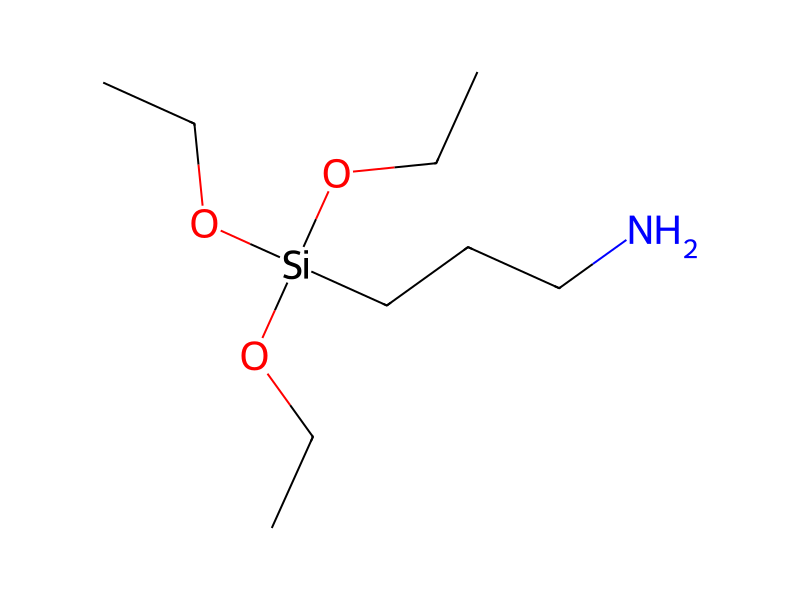
CCO[Si](CCCN)(OCC)OCC
InChIKey
WYTZZXDRDKSJID-UHFFFAOYSA-N
Summenformel
C9H23NO3Si
Durchschnittliche Molmasse
221,37 g/mol
Monoisotopische Masse
221,14472013

Überblick

a coating surface compound

Namen und Bezeichner

Bevorzugter Name
(3-Aminopropyl)triethoxysilane
IUPAC
3-triethoxysilylpropan-1-amine
Lokaler Name
3-(Triethoxysilyl)-propylamin
Englischer Name
3-Aminopropyltriethoxysilane
Summenformel
C9H23NO3Si
Molmasse
221.37

Namen und Synonyme

3-Aminopropyltriethoxysilane919-30-2(3-Aminopropyl)triethoxysilane3-(TRIETHOXYSILYL)PROPYLAMINEAPTESSilicone A-11001-Propanamine, 3-(triethoxysilyl)-Silane amg-9Propylamine, 3-(triethoxysilyl)-Nuca 1100Silane 1100Aminopropyltriethoxysilane
Weitere Namen anzeigen
3-(triethoxysilyl)propan-1-amineAMEOa1100γ-Aminopropyltriethoxysilane3-TRIETHOXYSILYLPROPYLAMINEAktisil AMDynasylan AMEOy-Aminopropyltriethoxysilane
Triethoxy(3-aminopropyl)silanegamma-Aminopropyltriethoxysilane3-(Triethoxysilyl)-1-propanamine(gamma-Aminopropyl)triethoxysilaneUc-A 1100Silane, (3-aminopropyl)triethoxy-aminopropyl triethoxysilane(aminopropyl)triethoxysilane

Datenbank-Bezeichner

CAS
919-30-2、96726-79-3
PubChem CID

Eigenschaften

Berechnete Struktureigenschaften

Polarare Oberfläche (TPSA)
53,7 Ų
H-Brücken-Donoren
1
H-Brücken-Akzeptoren
4
Frei drehbare Bindungen
9
Schwere Atome
14
Formalladung
0
Komplexität
118

Experimentelle und physikochemische Eigenschaften

Chemical ClassesToxic Gases & Vapors -> Other Toxic Gases & Vapors
Density · 3 Einträge

0.94 at 25 °C

Density = 0.9506 g/cu m at 20 °C

1.01 @25 °C

Color/FormLiquid
Flash Point98 °C (closed cup)
Boiling Point · 2 Einträge

217 °C

217 °C @760 [mm Hg]

DecompositionWhen heated to decomposition it emits toxic fumes of /nitrogen oxides/.
Melting Point-70 °C
Vapor Pressure · 3 Einträge

0.01 [mmHg]

3.3 kPa at 121 °C extrapolated to 2 Pa at 20 °C (0.015 mm Hg)

0.05 [mm Hg] @20 °C

Food Contact Substances · 2 Einträge

FCS -> FDA Inventory of Food Contact Substances Listed in 21 CFR

FCS -> FDA Inventory of Effective Food Contact Substance (FCS) Notifications

Sicherheit und Regulatorisches

Sicherheitsangaben dienen nur zur Orientierung und ersetzen weder das Sicherheitsdatenblatt (SDB) des Lieferanten noch geltende Vorschriften oder eine fachliche Bewertung.

GHS-Klassifizierung

GHS Classification · 6 Einträge

Danger

H302: Harmful if swallowed [Warning Acute toxicity, oral]

P260, P264, P270, P280, P301+P317, P301+P330+P331, P302+P361+P354, P304+P340, P305+P354+P338, P316, P321, P330, P363, P405, and P501 (click each P-code to see the statement)

Danger

H302 (100%): Harmful if swallowed [Warning Acute toxicity, oral]

P260, P261, P264, P264+P265, P270, P272, P280, P301+P317, P301+P330+P331, P302+P352, P302+P361+P354, P304+P340, P305+P354+P338, P316, P317, P321, P330, P333+P317, P362+P364, P363, P405, and P501 (click each P-code to see the statement)

Gefahrenhinweise

Regulatory Information · 5 Einträge

Chemical: 1-Propanamine, 3-(triethoxysilyl)-

Council Directive (EEC) No 109/1989 (Repealed by Reg. EC No 1935/2004 (amended))

1-Propanamine, 3-(triethoxysilyl)- is listed on the EPA's Chemical Data Reporting (CDR) system. Manufacturers and importers of 1-Propanamine, 3-(triethoxysilyl)- are required to report information about their production and use of this chemical to the EPA under the Toxic Substances Control Act (TSCA). (40 eCFR Part 711)

REACH registered substance: 3-aminopropyltriethoxysilane (EC: 213-048-4)

3-(Triethoxysilyl) propylamine: Does not have an individual approval but may be used under an appropriate group standard

Other Safety InformationEvaluation - Chemicals that are unlikely to require further regulation to manage risks to environment
Hazards Summary · 1 Eintrag

The kidney is the target organ after oral and dermal exposure of animals; Inhalation exposures for 6 hours to saturated vapor did not kill any rats tested; Skin sensitization testing of guinea pigs was positive; [OECD SIDS: 3-Aminopropyltriethoxysilane - 2003] Reacts with water or moisture producing flammable and toxic chemicals; [CHEMINFO] A severe skin and eye irritant that can cause corrosive injuries; [eChemPortal: SIDSUNEP] Corrosive to skin and eyes; [eChemPortal: ERMA] Can cause burns; [eChemPortal: ESIS] A corrosive substance that can cause injury to the skin, eyes, and respiratory tract; Inhalation may cause chemical pneumonitis and pulmonary edema; Targets nerves, liver, and kidneys; [MSDSonline]

Chemie und Industrie

Verwendung und Herstellung

Uses · 6 Einträge

Used to size glass fibers for making laminates and to make non-thrombogenic dental and orthopedic materials; [HSDB] Used as coupling agent and adhesion promoter in fiberglass, adhesives, sealants, foundry resins, and coatings; [eChemPortal: SIDSUNEP]

Molding and Core Making [Category: Foundry]

Sizing of glass fibers for making laminates

In preparation of nonthrombogenic dental and orthopedic materials

Used as coupling agents and adhesion promoters, aminosilanes are intentionally converted by hydrolysis to the trisilanols, which then bond molecularly to inorganic substrates /Aminosilanes/

The commercial uses of this material are numerous and include various applications as coupling agents and adhesion promoters in fiberglass, adhesives and sealants, foundry resins, and in pre-treatment for coatings. A small percentage of this material may be found in sealants and coatings.[Organization for Economic Cooperation and Development; Screening Information Data Set for 3-Aminopropyltriethoxysilane

ImpuritiesEthyl alcohol (0-1%), 2-butanone (0-2%), dibenzoyl peroxide (0-1%) (purity 98% - 100%)[Organization for Economic Cooperation and Development; Screening Information Data Set for 3-Aminopropyltriethoxysilane
U.S. Production · 4 Einträge

2023: 5,500,000 - <7,000,000 lb

1-Propanamine, 3-(triethoxysilyl)- is listed as a High Production Volume (HPV) chemical (65FR81686). Chemicals listed as HPV were produced in or imported into the U.S. in >1 million pounds in 1990 and/or 1994. The HPV list is based on the 1990 Inventory Update Rule. (IUR) (40 CFR part 710 subpart B; 51FR21438).

Production volumes for non-confidential chemicals reported under the Inventory Update Rule. [Table#5534]

Production volume for non-confidential chemicals reported under the 2006 Inventory Update Rule. Chemical: 1-Propanamine, 3-(triethoxysilyl)-. Aggreated National Production Volume: 1 to < 10 million lbs.

Consumer UsesBinder
Industry UsesAdhesion/cohesion promoter
Methods of Manufacturing

Zugehörige Reaktionen

99
Reaktionsaufzeichnung erstellen
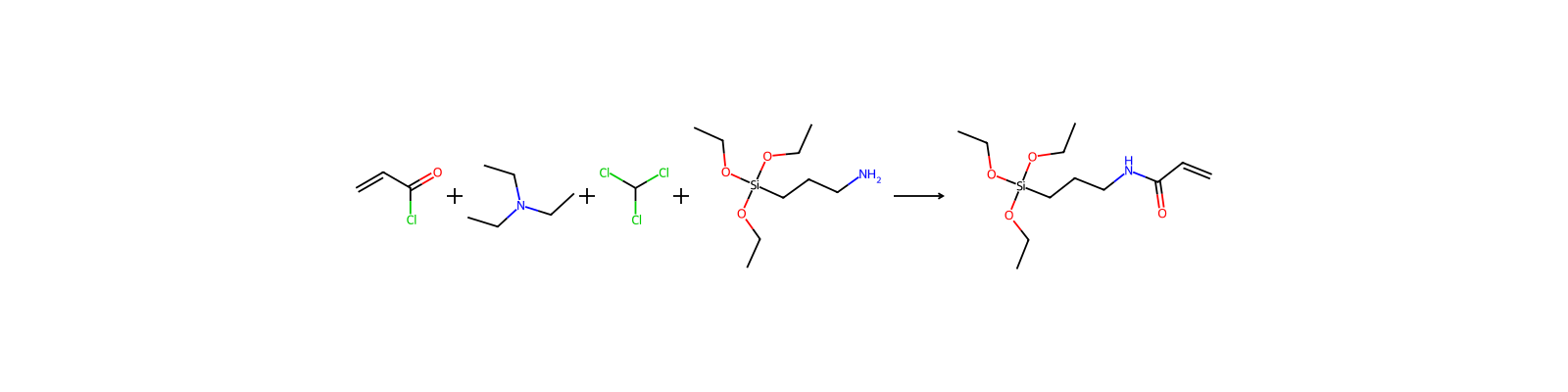
Reaktionsgleichung von HRID 22063
HRID 22063als Eduktuspto-grants-1995_06
Reaktionsgleichung von HRID 32856
HRID 32856als Eduktuspto-grants-2008_09
Reaktionsgleichung von HRID 54885
HRID 54885als Eduktuspto-grants-1997_04
Reaktionsgleichung von HRID 127002
HRID 127002als Eduktuspto-grants-1981_03
Reaktionsgleichung von HRID 142511
HRID 142511als ProduktTraining data from https://doi.org/10.1039/C8SC04228D (9/10)
Reaktionsgleichung von HRID 148317
HRID 148317als EduktTraining data from https://doi.org/10.1039/C8SC04228D (9/10)
Reaktionsgleichung von HRID 224739
HRID 224739als Produktuspto-grants-1980_11
Reaktionsgleichung von HRID 236632
HRID 236632als Eduktuspto-grants-1987_02
Seite 1 von 13

Notizen zur Verbindung

Wird geladen…

Auf dieser SeiteGrundinformationenÜberblickNamen und BezeichnerEigenschaftenSicherheit und RegulatorischesChemie und IndustrieZugehörige ReaktionenNotizen zur Verbindung
Weitere Aktionen
Neue NotizNeue ReaktionAnfrage stellen
13521
DTXSID
DTXSID2027333
ChEMBL
CHEMBL1542365
UNII
L8S6UBW552
EC Number
213-048-4、619-243-4
Nikkaji
J14.168B
Refractive IndexIndex of refraction = 1.4225 at 20 °C
Physical Description · 2 Einträge

Liquid; Dry Powder; Liquid

Liquid; [HSDB] Colorless or light yellow liquid with a fishy odor; [CHEMINFO] Clear colorless liquid; [MSDSonline]

Physikochemische Eigenschaften

Schmelzpunkt
-70 °C · -70 °C
Siedepunkt
217 °C · 217 °C(lit.)
Dichte
0.946 g/mL · 0.946 g/mL at 25 °C(lit.)
Dampfdruck
0 · 0-7910Pa at 25℃
Brechungsindex
20 · n20/D 1.422
Flammpunkt
205 °F · 205 °F
storage temp.
room temp
Löslichkeit
Miscible with toluene, acetone, chloroform and ethanol.
Aggregatzustand
Liquid
pka
10.37 · 10.37±0.10(Predicted)
Wichte
0.942 · 0.942
Farbe
25 · APHA: ≤25
PH
11 · 11 (20g/l, H2O, 20℃)
Geruch (Odor)
Fishy odor
Explosionsgrenze
0.8 · 0.8-4.5%(V)
Wasserlöslichkeit
REACTS
BRN
1754988 · 1754988
Henry's Law Constant
1.2 · 1.2×102 mol/(m3Pa) at 25℃, Ebert et al. (2023)
Stabilität
Stable. Incompatible with acids, strong oxidizing agents. May decompose on exposure to moisture.
Kosmetik-Inhaltsstoffe Funktionen
SURFACTANT - CLEANSING
InChI
1S/C9H23NO3Si/c1-4-11-14(12-5-2,13-6-3)9-7-8-10/h4-10H2,1-3H3
InChIKey
WYTZZXDRDKSJID-UHFFFAOYSA-N
SMILES
CCO[Si](CCCN)(OCC)OCC
LogP
-4 · -4--0.3 at 20℃
CAS Datenbank
919 · 919-30-2(CAS DataBase Reference)
NIST chemische Informationen
1 · 1-Propanamine, 3-(triethoxysilyl)-(919-30-2)
EPA chemische Informationen
3 · 3-Aminopropyltriethoxysilane (919-30-2)
Special Reports · 1 Eintrag

Organization for Economic Cooperation and Development; Screening Information Data Set for 3-Aminopropyltriethoxysilane [APTES], CAS #919-30-2 p.7 (November, 2003). This OECD Initial Assessment of HPV Chemicals is part of a series of OECD SIDS documents published by UNEP Chemicals to facilitate the access to information needed for health and environmental risk assessments of chemicals.[Available from, as of October 7, 2009: http://www.chem.unep.ch/irptc/sids/OECDSIDS/sidspub.html]

Other Hazardous Reactions · 1 Eintrag

Since APTES is sensitive to hydrolysis, which may occur during testing, observed toxicity is likely due to the hydrolysis products ethanol and trisilanols.[Organization for Economic Cooperation and Development; Screening Information Data Set for 3-Aminopropyltriethoxysilane

Toxic Combustion ProductsHazardous decomposition products formed under fire conditions: Carbon oxides, nitrogen oxides (NOx), silicon oxides.
Hazard Classes and Categories · 4 Einträge

Acute Tox. 4 (100%)

Acute toxicity - category 4

Acute toxicity (Oral) - Category 4

Acute Tox. 4 *

Skin, Eye, and Respiratory Irritations · 2 Einträge

APTES is severely irritating to the skin and eyes.[Organization for Economic Cooperation and Development; Screening Information Data Set for 3-Aminopropyltriethoxysilane

A skin and eye irritant.

Hazardous Reactivities and IncompatibilitiesMaterials to avoid: Strong oxidizing agents, acids.

Sicherheit und Schutzausrüstung

Fire Fighting Procedures · 2 Einträge

Suitable extinguishing media: Use water spray, alcohol-resistant foam, dry chemical or carbon dioxide.

Special protective equipment for fire-fighters: Wear self contained breathing apparatus for fire fighting if necessary.

Storage ConditionsStore in cool place. Keep container tightly closed in a dry and well-ventilated place. Containers which are opened must be carefully resealed and kept upright to prevent leakage. Moisture sensitive. Store under inert gas.
Cleanup Methods · 3 Einträge

Methods for cleaning up Soak up with inert absorbent material and dispose of as hazardous waste. Keep in suitable, closed containers for disposal. Personal precautions: Use personal protective equipment. Avoid breathing vapors, mist or gas. Ensure adequate ventilation. Evacuate personnel to safe areas.

Environmental precautions: Do not let product enter drains.

SRP: Wastewater from contaminant suppression, cleaning of protective clothing/equipment, or contaminated sites should be contained and evaluated for subject chemical or decomposition product concentrations. Concentrations shall be lower than applicable environmental discharge or disposal criteria. Alternatively, pretreatment and/or discharge to a permitted wastewater treatment facility is acceptable only after review by the governing authority and assurance that "pass through" violations will not occur. Due consideration shall be given to remediation worker exposure (inhalation, dermal and ingestion) as well as fate during treatment, transfer and disposal. If it is not practicable to manage the chemical in this fashion, it must be evaluated in accordance with EPA 40 CFR Part 261, specifically Subpart B, in order to determine the appropriate local, state and federal requirements for disposal.

Disposal Methods · 2 Einträge

Dissolve or mix the material with a conbustible solvent and burn in a chemical incinerator equipped with an afterburner and scrubber. Observe all federal, state, and local environmental regulations. Contact a licensed professional waste disposal service to dispose of this material.

SRP: The most favorable course of action is to use an alternative chemical product with less inherent propensity for occupational harm/injury/toxicity or environmental contamination. Recycle any unused portion of the material for its approved use or return it to the manufacturer or supplier. Ultimate disposal of the chemical must consider: the material's impact on air quality; potential migration in soil or water; effects on animal and plant life; and conformance with environmental and public health regulations.

Preventive Measures · 5 Einträge

In production, this material is mostly handled in closed systems. Necessary engineering controls during production include proper ventilation, containment, safety equipment and actual hardware designed to minimize exposure through splashing, or exposure to the air. Transfer of this material is in closed pipes rather than in open systems to minimize loss of this material (hydrolysis) although some customers do transfer the material in open systems.[Organization for Economic Cooperation and Development; Screening Information Data Set for 3-Aminopropyltriethoxysilane

In case of skin contact: Take off contaminated clothing and shoes immediately. Wash off with soap and plenty of water. Consult a physician.

In case of eye contact: Rinse thoroughly with plenty of water for at least 15 minutes and consult a physician.

Hygiene measures: Handle in accordance with good industrial hygiene and safety practice. Wash hands before breaks and at the end of workday.

For more Preventive Measures (Complete) data for 3-(Triethoxysilyl)propylamine (6 total), please visit the HSDB record page.

Protective Action Criteria (PAC) · 3 Einträge

5.3 [mg/m3]

59 [mg/m3]

350 [mg/m3]

Personal Protective Equipment (PPE) · 4 Einträge

Respiratory protection: Where risk assessment shows air-purifying respirators are appropriate use a full-face respirator with multipurpose combination (US) or type ABEK (EN 14387) respirator cartridges as a backup to engineering controls. If the respirator is the sole means of protection, use a full-face supplied air respirator. Use respirators and components tested and approved under appropriate government standards such as NIOSH (US) or CEN (EU).

Hand protection: The selected protective gloves have to satisfy the specifications of EU Directive 89/686/EEC and the standard EN 374 derived from it. Handle with gloves.

Eye protection: Safety glasses

Skin and body protection: Choose body protection according to the amount and concentration of the dangerous substance at the work place.

Toxikologische Informationen

Ecotoxicity Values · 4 Einträge

EC50; Species: Daphnia magna (water flea); Concentration: 331 mg/L 48 hr; Conditions: static; End point: immobilization.[Organization for Economic Cooperation and Development; Screening Information Data Set for 3-Aminopropyltriethoxysilane

LC50; Species: Brachydanio rerio (freshwater fish); Concentration: > or = 934 mg/L 96 hr /Conditions of bioassay not specified in source/[Organization for Economic Cooperation and Development; Screening Information Data Set for 3-Aminopropyltriethoxysilane

EC50; Species: Daphnia magna/Straus clone 5 (Water flea); Conditions: Static (OECD Guideline 202, Part 1, 1984); Concentration: 592 mg/L 24 hr (95% confidence limits: 349-1003 mg/L); Effect: immobilization

EC50; Species: Daphnia magna/Straus clone 5 (Water flea); Conditions: static (OECD Guideline 202, Part 1, 1984); Concentration: 331 mg/L 48 hr (95% confidence limits: 249-441 mg/L); Effect: immobilization

Environmental Fate · 3 Einträge

TERRESTRIAL FATE: Adsorption to soil will not be an important environmental fate process(SRC) due to (3-aminopropyl)triethoxysilane's rapid hydrolysis; its half-life is 0.15 hours at pH 9 and 24.7 °C(1). (3-Aminopropyl)triethoxysilane is not expected to volatilize from dry soil based on its vapor pressure of 0.015 mm Hg at 20 °C(2). The observed biodegradation of (3-aminopropyl)triethoxysilane, a 67% loss in 28 days indicated by a DOC die-away test using domestic sewage innoculum, is of the hydrolysis products (ethanol and trisilanols)(1); therefore, biodegradation is not an important environmental fate process in soil(SRC).

AQUATIC FATE: Hydrolysis of (3-aminopropyl)triethoxysilane occurs rapidly via cleavage of the ethoxy groups in the presence of water; at pH 9.0, hydrolysis occurred most rapidly, with a half lives at 10, 24.7, and 37 °C of 0.78, 0.15, and 0.043 hours, respectively(1). Due to (3-aminopropyl)triethoxysilane's rapid hydrolysis, adsorption to suspended solids and sediment, and bioconcentration in aquatic organisms will not be important environmental fate processes(SRC). (3-Aminopropyl)triethoxysilane is not readily biodegradable as indicated by a DOC die-away test using domestic sewage innoculum; the observed degradation was attributed primarily to hydrolysis and further degradation of resulting products (ethanol and trisilanols)(1). Therefore, biodegradation is not an important environmental fate process in water(SRC).

ATMOSPHERIC FATE: According to a model of gas/particle partitioning of semivolatile organic compounds in the atmosphere(1), (3-aminopropyl)triethoxysilane, which has a vapor pressure of 0.015 mm Hg at 20 °C(2), is expected to exist solely as a vapor in the ambient atmosphere. Vapor-phase (3-aminopropyl)triethoxysilane is degraded in the atmosphere by reaction with photochemically-produced hydroxyl radicals(SRC); the half-life for this reaction in air is estimated to be 7.2 hours(SRC), calculated from its rate constant of 5.3X10⁻¹¹ cu cm/molecule-sec at 25 °C(SRC) that was derived using a structure estimation method(3). However, because of the rapid hydrolysis of this material with moisture in the atmosphere, photolysis in the atmosphere is not predicted to be a significant mode of removal, and should be considered secondary to hydrolysis(4). Hydrolysis occurs rapidly via cleavage of the ethoxy groups in the presence of water; at pH 9.0, hydrolysis of (3-aminopropyl)triethoxysilane occurred most rapidly, with a half lives at 10, 24.7, and 37 °C of 0.78, 0.15, and 0.043 hours, respectively(4). (3-Aminopropyl)triethoxysilane does not contain chromophores that absorb at wavelengths >290 nm(5) and therefore is not expected to be susceptible to direct photolysis by sunlight(SRC).

Adverse EffectsOccupational hepatotoxin - Secondary hepatotoxins: the potential for toxic effect in the occupational setting is based on cases of poisoning by human ingestion or animal experimentation.
Toxicity Summary · 1 Eintrag

Exposure: The commercial uses of this material are numerous and include various applications as coupling agents and adhesion promoters in fiberglass, adhesives and sealants, foundry resins, and in pre-treatment for coatings. ... Human Health: 3-Aminopropyltriethoxysilane (APTES) has been tested for acute toxicity by the oral, dermal, and inhalation routes of exposure. Acute oral LD50s in rats range from 1570 to 3650 mg/kg bw. The dermal LD50 is 4.29 g/kg bw and the 4-hour inhalation LC50 of the hydrolysate is greater than 7.35 mg/L. Six hours of exposure to substantially saturated vapor of APTES did not kill any of the 5 male or female rats (LT50 > 6 hours). The kidney is a target organ for toxicity for oral and dermal exposures. APTES is severely irritating to the skin and eyes. In a Buehler study in guinea pigs, 7/30 animals showed a skin sensitization response. The hydrolysis products of this material do not elicit a sensitization response in a guinea pig maximization test. Repeated inhalation exposure of rats to 147 mg/cu m of APTES hydrolysate respirable aerosol for four weeks produced squamous metaplasia and foci of minimal granulomatous laryngitis. No systemic toxicity was observed in rabbits after 9 repeated dermal doses of 17 or 84 mg/kg bw/day or three repeated dermal doses of 126 mg/kg bw/day of APTES; the site of contact NOAEL is less than 17 mg/kg bw/day. The no-observed-adverse-effect level (NOAEL) of APTES in a 90-day oral (gavage) study with rats was 200 mg/kg bw/day. APTES has been tested in several bacterial reverse mutation/Ames assays, in vitro V79 hamster lung cell and Chinese hamster fibroblast chromosome aberration assays, two Chinese hamster ovary cell HGPRT gene mutation assays, and an in vivo mouse micronucleus assay. In vivo and in vitro screening assays have not revealed any evidence of genotoxic potential. At the highest dose-level (600 mg/kg/day) in a 90 day oral gavage study in rats, no effects were seen on parameters of oestrus cycle and spermatogenesis or reproductive organs. The NOAEL for developmental effects has been identified for APTES following exposure via oral (gavage) in rats, with a value of 100 mg/kg bw/day, the NOAEL for maternal toxicity based on deaths and ulceration of the GI tract is <0.5 mL/kg. Environment: The estimated partition coefficient Log Kow is 0.31 and the estimated water solubility is 7.6 x 10+5 mg/L; these values may not be applicable because the material is hydrolytically unstable... Photodegradation modeling indicates the halflife in the atmosphere due to the reaction with photochemically induced OH radicals to be approximately 2.4 hours. However, photodegradation as a mode of removal is unlikely and not expected to be a significant degradation process because APTES is hydrolytically unstable. In spill conditions, the concentration of the parent silane is very high. The silanols concentration could also be high; however, the silanol rapidly self-condenses to form water insoluble, resinous oligomers and polymers. The molecular weight of the resulting oligomers and polymers is predicted to be over 1000. Anecdotal evidence suggests the molecular weight of the polymers resulting from spills is 5000 - 10000. As the parent silane and the resulting silanol are diluted, it is predicted that the polymers resulting from condensation will be of lower molecular weight. At sufficiently low silanol concentrations, low molecular weight oligomers are favored. It is calculated that at 1000 ppm of a related trialkoxysilane, the equilibrium concentration will be 86% silanol monomer and 14% silanol dimer. At still lower concentrations, the silanol will exist as the uncondensed monomer. These polymers will not be bioavailable. However, such materials are likely to cause toxicity in aquatic species due to physical effects (encapsulation, blockage of gills). The APTES 96-hr LC50 is > 934 mg/L for freshwater fish (Brachydanio rerio). The 48-hr EC50 for APTES is = 331 mg/L for the water flea (Daphnia magna). The 72-hr EbC50 for freshwater green algae (Scenedesmus subspicatus) is 603 mg/L. On the basis of cell growth, a 10% suppression of cell growth for the freshwater green algae (Scenedesmus subspicatus)was achieved at 72 hour EbC10 = 38 mg/L; on the basis of growth rate, a 10% suppression of cell growth in the same species was achieved at (0-72 hour) ErC10 = 321 mg/L. Since APTES is sensitive to hydrolysis, which may occur during preparation of the dosing solutions and/or during the testing, the observed toxicity is likely due to the hydrolysis products ethanol and trisilanols.[Organization for Economic Cooperation and Development; Screening Information Data Set for 3-Aminopropyltriethoxysilane

Soil Adsorption/MobilityAdsorption to soil will not be an important environmental fate process due to (3-aminopropyl)triethoxysilane's rapid hydrolysis(SRC); its half-life is 0.15 hours at pH 9 and 24.7 °C(1).
Human Toxicity Excerpts/SIGNS AND SYMPTOMS/ May be harmful if inhaled. Material is extremely destructive to the tissue of the mucous membranes and upper respiratory tract. May be harmful if absorbed through skin. Causes skin burns. Causes eye burns.
Artificial Pollution Sources(3-Aminopropyl)triethoxysilane's production and use as a chemical coupling agent for ligands to glass and silica surfaces(1) may result in its release to the environment through various waste streams(SRC).
Environmental Biodegradation · 1 Eintrag

AEROBIC: (3-Aminopropyl)triethoxysilane was found to be not readily biodegradable when inoculated with domestic sewage and analyzed for biodegradation using the DOC die away test. The results indicated that after 28 days, 67 percent of (3-aminopropyl)triethoxysilane had degraded. This degradation was primarily attributed to hydrolysis. Hydrolysis of (3-aminopropyl)triethoxysilane occurs rapidly, and consequently biodegradation of the hydrolysis products (ethanol and trisilanols) is the primary fate pathway(1).

Environmental Bioconcentration · 1 Eintrag

Bioconcentration is not anticipated since this material is hydrolytically unstable; rapid hydrolysis of this material produces ethanol and trisilanols. (3-Aminopropyl)triethoxysilane's hydrolysis half-life is 0.15 hours at pH 9 and 24.7 °C(1).

Volatilization from Water/Soil · 1 Eintrag

The reactive nature of (3-aminopropyl)triethoxysilane destroys the parent material in any moisture-containing environment, thus limiting environmental exposure to the silane. The parent material is hydrolyzed in a spill situation; the rapid hydrolysis means that the parent silane is unlikely to be found in the environment(1). The hydrolysis half-life of (3-aminopropyl)triethoxysilane is 0.15 hours at pH 9 and 24.7 °C(1). (3-Aminopropyl)triethoxysilane is not expected to volatilize from dry soil surfaces(SRC) based upon a vapor pressure of 0.015 mm Hg(2).

Non-Human Toxicity Excerpts · 5 Einträge

/LABORATORY ANIMALS: Acute Exposure/ Five rats were exposed for four hr to 7.35 mg/L of a 60% solution of APTES (hydrolyzed APTES). The animals were observed during the following 14 day post exposure period. After exposure, slow righting reflex, labored breathing, hypoactivity, ataxia and discharge from the mouth, nose and eyes were apparent. At 3 days, the animals were fully recovered. All animals gained weight during the study period. There were no other clinical signs.[Organization for Economic Cooperation and Development; Screening Information Data Set for 3-Aminopropyltriethoxysilane

/LABORATORY ANIMALS: Acute Exposure/ Five rats per group were exposed to 5 or 16 ppm undiluted APTES as a vapor for 6 hr. There were no signs of toxicity during or following exposure. There were no remarkable gross pathologic findings. The vapor of this material shows very low acute inhalation toxicity in the rat. Six hr of exposure to substantially saturated vapor generated from APTES did not kill any of the 5 male or 5 female rats.[Organization for Economic Cooperation and Development; Screening Information Data Set for 3-Aminopropyltriethoxysilane

/LABORATORY ANIMALS: Acute Exposure/ Male and female rabbits were dosed by occlusive dermal route of exposure with 8, 4, 2, and 1 g/kg of APTES for a period of twenty-four hr ... The kidney was identified as a target organ in this acute study. Severe local cutaneous effects were observed. The LD50 is 4.29 g/kg bw, indicating the toxicity of this material is very low by the dermal route. A follow-up study was conducted to assess the percutaneous toxicity and nephrotoxic potential of the test article. Single occlusive, cutaneous doses of the test article were given to groups of 6 male rabbits at 3 dose levels (2.0, 4.0, and 6.0 mL/kg) for a period of 24 hr. Single cutaneous applications of 2.0 mL/kg or more of the test article to rabbit skin resulted in kidney and urinary bladder injury. At 2 mL/kg, four animals had no systemic signs of toxicity. Two animals dosed with 2 mL/kg had blood-stained periurogenital discharge, and renal tubular epithelial cell degeneration was observed (1 animal on day 1). On day 2, the one animal sacrificed had microscopic evidence of tubular epithelial cell degeneration and proteinosis involving the kidneys, and one or more lesions involving the bladder. At day 14, there was no evidence of microscopic lesions. These effects appear to develop within one or 2 days after contact and subside thereafter, possibly indicating a capacity for renal repair[Organization for Economic Cooperation and Development; Screening Information Data Set for 3-Aminopropyltriethoxysilane

/LABORATORY ANIMALS: Acute Exposure/ APTES was administered by gavage at doses of 4, 2, and 1 g/kg in 5 male rats/group and 2, 1.41 and 1 g/kg in 5 female rats/group. Signs of toxicity included sluggishness, lacrimation, kyphosis, an unkempt appearance, piloerection, staining on the fur, closed eyelids, emaciation, and diarrhea. Survivors recovered at 2 to 9 days.[Organization for Economic Cooperation and Development; Screening Information Data Set for 3-Aminopropyltriethoxysilane

Environmental Abiotic Degradation · 3 Einträge

The rate constant for the vapor-phase reaction of (3-aminopropyl)triethoxysilane with photochemically-produced hydroxyl radicals has been estimated as 5.3X10⁻¹¹ cu cm/molecule-sec at 25 °C(SRC) using a structure estimation method(1). This corresponds to an atmospheric half-life of about 7.2 hours at an atmospheric concentration of 5X10+5 hydroxyl radicals per cu cm(1). However, hydrolysis of (3-aminopropyl)triethoxysilane is expected to be the primary route of abiotic degradation under environmental conditions; hydrolysis occurs rapidly via cleavage of the ethoxy groups in the presence of water to produce ethanol and trisilanols(2). The Si-C is hydrolytically stable. (3-Aminopropyl)triethoxysilane was shown to hydrolyze over a range of pH and temperature conditions; at pH 9.0 hydrolysis of (3-aminopropyl)triethoxysilane occurred most rapidly, with a half lives at 10, 24.7, and 37 °C of 0.78, 0.15, and 0.043 hours respectively(2). (3-Aminopropyl)triethoxysilane does not contain chromophores that absorb at wavelengths >290 nm(3) and therefore is not expected to be susceptible to direct photolysis by sunlight(SRC).

(3-Aminopropyl)triethoxysilane hydrolysis at envrionmentally relevant temperature and pH(1).

Only the ethoxy groups will be hydrolyzed from (3-aminopropyl)triethoxysilane. The transient silanol groups will condense with other silanols to yield R-Si(OR')3 type resins, where R = CH2CH2CH2NH2 and R' = either H or Si(R)(OR'). As a result, aminopropyl-functional resins are generated. If the silane is slowly released such that the concentration of the resulting aminopropyl-functional silanetriol is not high enough to result in polymerization, the trisilanol will exist largely as the monomer. The monomer is known to be water soluble by virtue of the three hydroxy groups on the silicon(1).

Sicherheitsdaten

F
10-34
wgk
1
tsca
TSCA listed
ridadr
UN 2735 8/PG 2
hs_code
29310095
RTECS-Nr.
TX2100000
risk_code
22-34-43
Toxizität
LD50 orally in Rabbit: 1780 mg/kg LD50 dermal Rabbit 3800 mg/kg
hazard_code
C,Xn
safety_code
26-36/37/39-45
hazard_class
8
packing_group
III
Speicherklasse
8A - Combustible corrosive hazardous materials
Giftige Stoffe Daten
919-30-2(Hazardous Substances Data)
Hazard Classifications
Acute Tox. 4 OralEye Dam. 1Skin Corr. 1BSkin Sens. 1
Selbstentzündungstemperatur
300 °C
· 3 Einträge

... /In/ the acrylonitrile process ... cyanoethylsilane ... is ethoxylated and then hydrogenated over Raney nickel at high hydrogen pressure.

The ammonia substitution process starts from chloropropyltriethoxysilane, and requires a large excess and high pressure of NH3. With a 75-fold molar quantity of NH3 with respect to the chloro component, selectivities for the primary amine of up to 8% have been reported. The correspondingly low space-time yields can only be improved if increased proportions of di- and even trisubstituted downstream products of the initially formed aminopropylsilane are acceptable.

Catalyzed hydrogenation of the corresponding nitrile (2-cyanoethyltriethoxysilane) to produce the primary amino-functional silane as follows: (EtO)3-Si-CH2CH2-CN + 2H2 + [catalyst]--> (EtO)3-SiCH2CH2CH2-NH2. Vacuum distillation provides the highest quality version.

Household ProductsInformation on 6 consumer products that contain 3-Aminopropyltriethoxysilane in the following categories is provided:
General Manufacturing Information · 4 Einträge

Miscellaneous Manufacturing

1-Propanamine, 3-(triethoxysilyl)-: ACTIVE

APTES is transported from the production site as the parent silane to processors/formulators. Generally, APTES is used by the processor/formulator as an adhesion promoter with use levels <1%. In some applications, APTES is used as a crosslinker; these use levels are higher and can approach 3 to 5 %. Once APTES is added to a consumer or industrial product, the parent silane reacts with the components of the formulation and is generally present as the parent silane at 0.1-0.2% until after curing (use). After curing the parent silane is consumed into the polymer matrix and no longer exists and greatly reduces potential for consumer or worker exposure. APTES polymerizes during use.[Organization for Economic Cooperation and Development; Screening Information Data Set for 3-Aminopropyltriethoxysilane

Attaches a primary amine functional group to a surface; used to chemically couple ligands to glass and silica surfaces such as glass slides. The silane is used to couple to the glass and the amine functional group is used to couple to compounds of interest. Coats some plastics noncovalently to create a reactive film.

Anwendungen

VerwendenForms aminopropyl derivative of glass, an adsorbent for affinity chromatography. Used to prepare positively charged slides suitable for use with various immunohistochemical and in situ hybridization procedures.

Vor- und nachgelagerte Produkte

Vorgelagerte Rohstoffe

Trichlorsilan

Nachgelagerte Produkte

Triethoxy(3-isocyanatopropyl)silanBis([3-triethoxysilyl)propyl]urea3-isothiocyanatopropyltriethoxysilane4-Oxo-4-[[3-(triethoxysilyl)propyl]amino]-2-butensure

For more Non-Human Toxicity Excerpts (Complete) data for 3-(Triethoxysilyl)propylamine (21 total), please visit the HSDB record page.