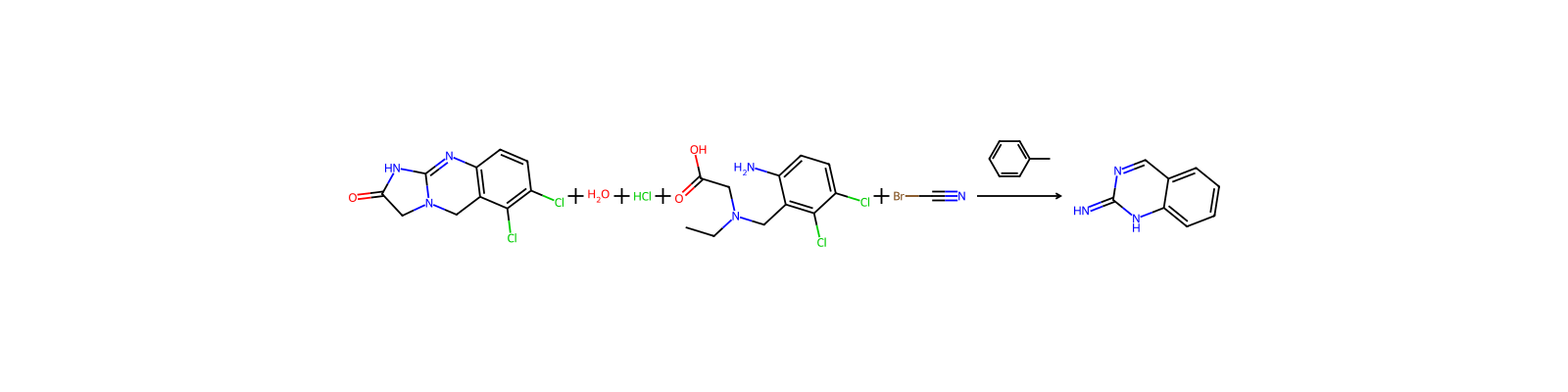
Anagrelide
Daten werden ergänzt – meist innerhalb einer Minute fertig

Grundinformationen
- CAS
68475-42-3- Standard-SMILES
O=C1CN2Cc3c(ccc(Cl)c3Cl)N=C2N1- InChIKey
OTBXOEAOVRKTNQ-UHFFFAOYSA-N- Summenformel
- C10H7Cl2N3O
- Durchschnittliche Molmasse
- 256,08 g/mol
Überblick
Anagrelide is a 1,5-dihydroimidazo[2,1-]quinazoline having an oxo substituent at the 2-position and chloro substituents at the 6- and 7-positions. It has a role as a cardiovascular drug, an antifibrinolytic drug, an anticoagulant and a platelet aggregation inhibitor.
Namen und Bezeichner
- Bevorzugter Name
- Anagrelide
- IUPAC
- 6,7-dichloro-3,5-dihydro-1H-imidazo[2,1-b]quinazolin-2-one
Namen und Synonyme
anagrelide68475-42-3AnagrelidaAnagrelidumK9X45X0051CHEBI:142290L01XX356,7-dichloro-1H,2H,3H,5H-imidazolidino[2,1-b]quinazolin-2-one6,7-dichloro-3H,5H-imidazo(2,1-b)quinazolin-2-ol6,7-dichloro-3H,5H-imidazo[2,1-b]quinazolin-2-ol6,7-dichloro-1H,2H,3H,5H-imidazolidino(2,1-b)quinazolin-2-oneRefChem:59015
Weitere Namen anzeigen
DTXCID6028280DTXSID40483056,7-Dichloro-5,10-dihydroimidazo[2,1-b]quinazolin-2(3H)-oneAnagrelidum [INN-Latin]Xagrid6,7-dichloro-5,10-dihydro-3H-imidazo[2,1-b]quinazolin-2-oneAnagrelide (INN/BAN)HSDB 7325
Datenbank-Bezeichner
- CAS
68475-42-3- PubChem CID
- 135409400
- ChEMBL
CHEMBL760- ChEBI
CHEBI:142290- UNII
- K9X45X0051
- EC Number
- 864-866-9
- Nikkaji
- J18.596E
Eigenschaften
Berechnete StruktureigenschaftenWird ergänzt
- XLogP
- 1,6
- Polarare Oberfläche (TPSA)
- 44,7 Ų
- H-Brücken-Donoren
- 1
- H-Brücken-Akzeptoren
- 2
- Frei drehbare Bindungen
- 0
- Schwere Atome
- 16
- Formalladung
- 0
- Komplexität
- 360
Experimentelle und physikochemische Eigenschaften
DrugsPharmaceuticals -> Listed in ZINC15
LogP
log Kow = -0.1 /Estimated/
2.4
1.86
Solubility
Very slightly soluble
In water, 1,300 mg/L at 25 °C /Estimated/
2.79e-01 g/L
Human Drugs
Breast Feeding; Lactation; Fibrinolytic Agents; Platelet Aggregation Inhibitors
EMA approved medicines: Human medicine
EMA approved medicines: Human medicine
Melting Point280 °C
Vapor Pressure6.8X10-10 mm Hg at 25 °C /Estimated/
Henry's Law ConstantHenry's Law constant= 2.7X10⁻¹³ atm-cu m/mole at 25 °C /Estimated/
Physical DescriptionSolid
Collision Cross Section147.01 Ų [M+H]+ [CCS Type: TW; Method: calibrated with polyalanine and drug standards]
Other Experimental Properties
Hydroxyl radical reaction rate constant = 2.5X10⁻¹¹ cu cm/molec-sec at 25 °C /Estimated/
Off white powder, mp >280 °C. Very slightly soluble in water; sparingly soluble in DMSO, DMF. Also prepared as the hemihydrate; crystals from ethanolic HCl. /Anagrelide hydrochloride monohydrate/
Sicherheit und Regulatorisches
GHS-Klassifizierung
GHS Classification
Danger
H302 (100%): Harmful if swallowed [Warning Acute toxicity, oral]
P203, P261, P264, P264+P265, P270, P271, P280, P301+P317, P302+P352, P304+P340, P305+P351+P338, P318, P319, P321, P330, P332+P317, P337+P317, P362+P364, P403+P233, P405, and P501 (click each P-code to see the statement)
The GHS information provided by 1 company from 1 notification to the ECHA C&L Inventory.
Gefahrenhinweise
FDA Requirements
The Approved Drug Products with Therapeutic Equivalence Evaluations List identifies currently marketed prescription drug products, incl anagrelide hydrochloride, approved on the basis of safety and effectiveness by FDA under sections 505 of the Federal Food, Drug, and Cosmetic Act. /Anagrelide Hydrochloride/
Hazard Classes and CategoriesAcute Tox. 4 (100%)
Sicherheit und Schutzausrüstung
Storage ConditionsStore at 25 °C (77 °F) excursions permitted to 15 - 30 °C (56 - 86 °F), in air tight, resistant container.
Disposal Methods
SRP: The most favorable course of action is to use an alternative chemical product with less inherent propensity for occupational exposure or environmental contamination. Recycle any unused portion of the material for its approved use or return it to the manufacturer or supplier. Ultimate disposal of the chemical must consider: the material's impact on air quality; potential migration in soil or water; effects on animal, aquatic, and plant life; and conformance with environmental and public health regulations.
Toxikologische Informationen
Interactions
Bioavailability studies evaluating possible interactions between anagrelide and other drugs have not been conducted. The most common medications used concomitantly with anagrelide have been aspirin, acetaminophen, furosemide, iron, ranitidine, hydroxyurea, and allopurinol. The most frequently used concomitant cardiac medication has been digoxin. Although drug-to-drug interaction studies have not been conducted, there is no clinical evidence to suggest that anagrelide interacts with any of these compounds.
A case report has suggested that sucralfate may interfere with anagrelide absorption.
Hepatotoxicity
In preregistration studies, anagrelide was not associated with serum enzyme elevations or with episodes of clinically apparent liver injury. Since its approval, there has been a single published abstract reporting progressive, ultimately fatal cholestasis after liver transplantation and use of anagrelide, but there have been no other published reports of anagrelide hepatotoxicity in the literature. In large, long term follow up studies there have been occasional instances of transient serum enzyme elevations without jaundice or symptoms. The product label for anagrelide mentions abnormal enzymes as an adverse event but not clinically apparent liver injury, hepatitis or jaundice. However, the general clinical experience with anagrelide has been limited.
Environmental Fate
TERRESTRIAL FATE: Based on a classification scheme(1), an estimated Koc value of 2,400(SRC), determined from a structure estimation method(2), indicates that anagrelide is expected to have slight mobility in soil(SRC). Volatilization of anagrelide from moist soil surfaces is not expected to be an important fate process(SRC) given an estimated Henry's Law constant of 2.7X10⁻¹³ atm-cu m/mole(SRC), using a fragment constant estimation method(3). Anagrelide is not expected to volatilize from dry soil surfaces(SRC) based upon an estimated vapor pressure of 6.8X10⁻¹⁰ mm Hg(SRC), determined from a fragment constant method(4). Biodegradation data were not available(SRC, 2005).
AQUATIC FATE: Based on a classification scheme(1), an estimated Koc value of 2400(SRC), determined from a structure estimation method(2), indicates that anagrelide is expected to adsorb to suspended solids and sediment(SRC). Volatilization from water surfaces is not expected(3) based upon an estimated Henry's Law constant of 2.7X10⁻¹³ atm-cu m/mole(SRC), developed using a fragment constant estimation method(4). According to a classification scheme(5), an estimated BCF of 3.2(SRC), from an estimated log Kow of -0.1(6) and a regression derived equation(7) suggests the potential for bioconcentration in aquatic organisms is low(SRC). Biodegradation data were not available(SRC, 2005).
ATMOSPHERIC FATE: According to a model of gas/particle partitioning of semivolatile organic compounds in the atmosphere(1), anagrelide, which has an estimated vapor pressure of 6.8X10⁻¹⁰ mm Hg at 25 °C(SRC), determined from a fragment constant method(2), is expected to exist solely in the particulate phase in the ambient atmosphere. Particulate-phase anagrelide may be removed from the air by wet and dry deposition(SRC). Anagrelide contains chromophores that may absorb light at wavelengths >290 nm and therefore may be susceptible to direct photolysis by sunlight; however, the rate of this reaction is not known(SRC).
Soil Adsorption/Mobility
Using a structure estimation method based on molecular connectivity indices(1), the Koc for anagrelide can be estimated to be 2,400(SRC). According to a classification scheme(2), this estimated Koc value suggests that anagrelide is expected to have slight mobility in soil.
Human Toxicity Excerpts
/CASE REPORTS/ A 60-year-old white woman with chronic myeloid leukemia who had been treated with hydroxyurea for 7 years was offered anagrelide to control thrombocytosis. She developed severe hypersensitivity pneumonitis soon after the drug was initiated and required intubation and mechanical ventilation. A high-resolution computed tomography scan of the chest demonstrated extensive multifocal ground glass attenuation and patchy alveolar consolidation involving both lungs. Bronchoalveolar lavage revealed a preponderance of lymphocytes, suggesting hypersensitivity phenomenon, but was otherwise negative for malignancy and other causes of interstitial pneumonitis. An objective causality assessment revealed that an adverse drug event was probable. Discontinuation of anagrelide and hydroxyurea, and institution of corticosteroid therapy resulted in dramatic improvement. To our knowledge, this is the first case report of severe hypersensitivity pneumonitis closely related to anagrelide therapy.
/SIGNS AND SYMPTOMS/ There are no reports of overdosage with anagrelide hydrochloride. Platelet reduction from anagrelide therapy is dose-related; therefore, thrombocytopenia, which can potentially cause bleeding, is expected from overdosage. Should overdosage occur, cardiac and central nervous system toxicity can also be expected.
Artificial Pollution SourcesAnagrelide's production and use as an antithrombocythemic(1), may result in its release to the environment through various waste streams(SRC).
Environmental Bioconcentration
An estimated BCF of 3.2 was calculated for anagrelide(SRC), using an estimated log Kow of -0.1(1) and a regression-derived equation(2). According to a classification scheme(3), this BCF suggests the potential for bioconcentration in aquatic organisms is low(SRC), provided the compound is not altered physically or chemically once released into the environment(SRP).
Volatilization from Water/Soil
The Henry's Law constant for anagrelide is estimated as 2.7X10⁻¹³ atm-cu m/mole(SRC) using a fragment constant estimation method(1). This Henry's Law constant indicates that anagrelide is expected to be essentially nonvolatile from water surfaces(2). Anagrelide's Henry's Law constant indicates that volatilization from moist soil surfaces will not occur(SRC). Anagrelide is not expected to volatilize from dry soil surfaces(SRC) based upon an estimated vapor pressure of 6.8X10⁻¹⁰ mm Hg(SRC), determined from a fragment constant method(3).
Non-Human Toxicity Excerpts
/LABORATORY ANIMALS: Acute Exposure/ Single oral doses of anagrelide hydrochloride at 2,500, 1,500 and 200 mg/kg in mice, rats and monkeys, respectively, were not lethal. Symptoms of acute toxicity were: decreased motor activity in mice and rats and softened stools and decreased appetite in monkeys.
/LABORATORY ANIMALS: Developmental or Reproductive Toxicity/ Anagrelide hydrochloride at oral doses up to 240 mg/kg/day was found to have no effect on fertility and reproductive performance of male rats. However, in female rats, at oral doses of 60 mg/kg/day or higher, it disrupted implantation when administered in early pregnancy and retarded or blocked parturition when administered in late pregnancy. /Anagrelide hydrochloride/
/LABORATORY ANIMALS: Developmental or Reproductive Toxicity/ Teratology studies have been performed in pregnant rats at oral doses up to 900 mg/kg/day and in pregnant rabbits at oral doses up to 20 mg/kg/day and have revealed no evidence of impaired fertility or harm to the fetus due to anagrelide hydrochloride. /Anagrelide hydrochloride/
/LABORATORY ANIMALS: Developmental or Reproductive Toxicity/ A perinatal and postnatal study performed in female rats revealed that anagrelide hydrochloride at oral doses of 60 mg/kg/day or higher produced delay or blockage of parturition, deaths of nondelivering pregnant dams and their fully developed fetuses, and increased mortality in the pups born. /Anagrelide hydrochloride/
/GENOTOXICITY/ Anagrelide hydrochloride was not genotoxic in the Ames test, the mouse lymphoma cell (L5178Y, TK+/-) forward mutation test, the human lymphocyte chromosome aberration test, or the mouse micronucleus test. /Anagrelide hydrochloride/
Environmental Abiotic Degradation
Anagrelide is not expected to undergo hydrolysis in the environment due to the lack of hydrolyzable functional groups(1). Anagrelide contains chromophores that may absorb light at wavelengths >290 nm and therefore may be susceptible to direct photolysis by sunlight; however, the rate of this reaction is not known(SRC).
Probable Routes of Human Exposure
Occupational exposure to anagrelide may occur through inhalation and dermal contact with this compound at workplaces where anagrelide is produced or used. Exposure to the drug among the general population exposure may be limited to those being administered anagrelide, an antithrombocythemic. (SRC)
Environmental Fate/Exposure Summary
Anagrelide's production and use as an antithrombocythemic may result in its release to the environment through various waste streams. If released to air, an estimated vapor pressure of 6.8X10⁻¹⁰ mm Hg at 25 °C indicates anagrelide will exist solely in the particulate phase in the ambient atmosphere. Particulate-phase anagrelide will be removed from the atmosphere by wet and dry deposition. Anagrelide contains chromophores that may absorb light at wavelengths >290 nm and therefore may be susceptible to direct photolysis by sunlight; however, the rate of this reaction is not known. If released to soil, anagrelide is expected to have slight mobility based upon an estimated Koc of 2400. Volatilization from moist soil surfaces is not expected to be an important fate process based upon an estimated Henry's Law constant of 2.7X10⁻¹³ atm-cu m/mole. Anagrelide is not expected to volatilize from dry soil surfaces based upon its vapor pressure. If released into water, anagrelide is expected to adsorb to suspended solids and sediment based upon the estimated Koc. Volatilization from water surfaces is not expected to be an important fate process based upon this compound's estimated Henry's Law constant. An estimated BCF of 3.2 suggests the potential for bioconcentration in aquatic organisms is low. Hydrolysis is not expected to be an important environmental fate process since this compound lacks functional groups that hydrolyze under environmental conditions. Occupational exposure to anagrelide may occur through inhalation and dermal contact with this compound at workplaces where anagrelide is produced or used. Exposure to the drug among the general population exposure may be limited to those being administered anagrelide, an antithrombocythemic. (SRC)
Regulatorische Informationen
FDA Requirements
The Approved Drug Products with Therapeutic Equivalence Evaluations List identifies currently marketed prescription drug products, incl anagrelide hydrochloride, approved on the basis of safety and effectiveness by FDA under sections 505 of the Federal Food, Drug, and Cosmetic Act. /Anagrelide Hydrochloride/
Chemie und Industrie
Pharmakologische Informationen
ATC Code
L - Antineoplastic and immunomodulating agents
QL - Antineoplastic and immunomodulating agents
Pharmacodynamics
Anagrelide decreases platelet counts by suppressing transcription factors necessary for the synthesis and maturation of platelet-producing cells. The drug itself appears to have a relatively short residence time in the body necessitating twice or four times daily dosing. However, given that the pharmacological effect of anagrelide therapy is reliant on a gradual suppression of platelet-producing cells, it may take 7 to 14 days for its administration to be reflected in reduced platelet counts - for this reason any changes to anagrelide doses should not exceed 0.5 mg/day in any one week. Evidence from animal studies suggests anagrelide may impair female fertility. Female patients of reproductive age should be advised of the potential for adverse effects on fertility prior to initiating therapy.
Mechanism of Action
The exact mechanism by which anagrelide lowers platelet count is unclear. Evidence from human trials suggests a dose-related suppression of megakaryocyte maturation, the cells responsible for platelet production - blood drawn from patients receiving anagrelide showed a disruption to the post-mitotic phase of megakaryocyte development and a subsequent reduction in their size and ploidy. This may be achieved via indirect suppression of certain transcription factors required for megakaryocytopoeisis, including GATA-1 and FOG-1. Anagrelide is a known inhibitor of phosphodiesterase 3A (PDE3A), although its platelet-lowering effects appear unrelated to this inhibition. While PDE3 inhibitors, as a class, can inhibit platelet aggregation, this effect is only seen at higher anagrelide doses (i.e. greater than those required to reduce platelet count). Modulation of PDE3A has been implicated in causing cell cycle arrest and apoptosis in cancer cells expressing both PDE3A and SLFN12, and may be of value in the treatment of gastrointestinal stromal tumours.
The mechanism by which anagrelide reduces blood platelet count is under investigation. Studies support a hypothesis of dose-related reduction in platelet production resulting from a decrease in megakaryocyte hypermaturation. In blood withdrawn from healthy volunteers treated with anagrelide, a disruption was found in the postmitotic phase of megakaryocyte development and a reduction in megakaryocyte size and ploidy. At therapeutic doses, anagrelide dose not produce significant changes in white cell counts or coagulation parameters and may have a small but clinically insignificant effect on red cell parameters. Platelet aggregation is inhibited in people at doses higher than those required to reduce platelet count. Anagrelide inhibits cyclic AMP phosphodiesterase and ADP- and collagen-induced platelet aggregation.
Biological Half-Life
The t<sub>1/2</sub> of anagrelide and its active metabolite, 3-hydroxy anagrelide, are approximately 1.5 hours and 2.5 hours, respectively.
At fasting and at a dose of 0.5 mg, the plasma half-life is 1.3 hours ... .
Elimination: Plasma 1.3 hours (at a dose of 0.5 mg while fasting). Note: Plasma half life was found to be increased (to 1.8 hours) when anagrelide was taken after food. Steady state plasma concentration measurements show no accumulation of anagrelide in plasma with repeated administration.
Metabolism/Metabolites
Anagrelide is extensively metabolized, primarily in the liver by cytochrome P450 1A2 (CYP1A2), into two major metabolites: 6,7-dichloro-3-hydroxy-1,5 dihydro-imidazo[2,1-b]quinazolin-2-one (3-hydroxy anagrelide) and 2-amino-5,6-dichloro-3,4,-dihydroquinazoline (RL603). The 3-hydroxy metabolite is considered pharmacologically active and carries a similar potency and efficacy in regards to its platelet-lowering effects, but inhibits PDE3 with a potency 40x greater than that of the parent drug.
Anagrelide is extensively metabolized; less than 1% is recovered unchanged in the urine.
FDA Pharmacological Classification
K9X45X0051
ANAGRELIDE
Physiologic Effects [PE] - Decreased Platelet Production
Established Pharmacologic Class [EPC] - Platelet-reducing Agent
Mechanisms of Action [MoA] - Phosphodiesterase 3 Inhibitors
Anagrelide is a Platelet-reducing Agent. The mechanism of action of anagrelide is as a Phosphodiesterase 3 Inhibitor. The physiologic effect of anagrelide is by means of Decreased Platelet Production.
MeSH Pharmacological Classification
Fibrinolysin or agents that convert plasminogen to FIBRINOLYSIN.
Drugs or agents which antagonize or impair any mechanism leading to blood platelet aggregation, whether during the phases of activation and shape change or following the dense-granule release reaction and stimulation of the prostaglandin-thromboxane system.
Absorption, Distribution and Excretion
Following oral administration, the bioavailability of anagrelide is approximately 70%. Given on an empty stomach, the Cmax is reached within 1 hour (Tmax) of administration. Co-administration with food slightly lowers the Cmax and increases the AUC, but not to a clinically significant extent.
Following metabolism, urinary excretion of metabolites appears to be the primary means of anagrelide elimination. Less than 1% of an administered dose is recovered in the urine as unchanged parent drug, while approximately 3% and 16-20% of the administered dose is recovered as 3-hydroxy anagrelide and RL603, respectively.
Following oral administration of 14C-anagrelide in people, more than 70% of radioactivity was recovered in urine. The available plasma concentration time data at steady state in patients showed that anagrelide does not accumulate in plasma after repeated administration.
The volume of distribution (VolD) is 12 L/kg of body weight.
Limited data indicate probable dose linearly between doses of 500 mg (0.5 mg) and 2 mg. Bioavailability was found to be modestly reduced by an average of 13.8% when anagrelide was administered after food.
The peak plasma level was lowered by an average of 45% and delayed by 2 hours ... when a 0.5 mg dose of anagrelide was taken after food ...
Cellular LocationsMembrane
Verwendung und Herstellung
Uses
MEDICATION: Antithrombocythemic
Reduces blood platelet count ... for the treatment of myeloproliferative disorders /Hydrochloride/
Methods of ManufacturingPreparation: W. N. Beverung, A. Partyka, US 3932407; US RE 31617; T. A. Jenks et al., US 4146781 (1976,1984, 1979 all to Bristol-Myers)
Formulations/PreparationsAgrylin (Roberts); Capsules: 0.5 mg, 1 mg.
General Manufacturing Information
Information available in 2005 indicated that Anagrelide hydrochloride was used in the manufacture of pharmaceutical preparations in the following countries: Australia, Austria, Canada, Israel, South Africa, Switzerland, United States (1,2) /Anagrelide Hydrochloride/
Zugehörige Reaktionen
12




Notizen zur Verbindung
Wird geladen…