StartseiteMCPWorkbenchSkills
StartseiteWorkbenchBenachrichtigungenMein Bereich
llms.txt · MCP-AnleitungDatenschutz · Nutzungsbedingungen · Supportv1.8.3
  1. Startseite
  2. /Verbindung

2-Imino-1-methylimidazolidin-4-on

2-Imino-1-methyl-4-imidazolidinone

HCID 137319715
Neue Reaktion
Drucken
GrundinformationenÜberblickNamen und BezeichnerEigenschaftenSicherheit und RegulatorischesChemie und IndustrieZugehörige ReaktionenNotizen zur Verbindung
TeilstruktursucheÄhnliche Strukturen suchen

Grundinformationen

CAS
60-27-5
Standard-SMILES
CN1CC(=O)NC1=N
InChIKey
DDRJAANPRJIHGJ-UHFFFAOYSA-N
Summenformel
C4H7N3O
Durchschnittliche Molmasse
113,12 g/mol
Monoisotopische Masse
113,05891184

Überblick

Creatinine has been used in trials studying the treatment of Amyotrophic Lateral Sclerosis.

Namen und Bezeichner

Bevorzugter Name
2-Imino-1-methyl-4-imidazolidinone
IUPAC
2-imino-1-methylimidazolidin-4-one
Lokaler Name
2-Imino-1-methylimidazolidin-4-on
Englischer Name
Creatinine
Summenformel
C4H7N3O
Molmasse
113.12

Namen und Synonyme

MFCD000597302-amino-1-methyl-4,5-dihydro-1H-imidazol-4-oneMethylguanidineacetic acidDTXCID6025987CAS-60-27-5imidazolidine, 2-imino-1-methyl-4-oxo-2-Amino-1-methyl-2-imidazolin-4-one; 2-Imino-1-methylimidazolidin-4-one; 2-Imino-N-methylhydantoin82016-55-5krebiozencreatinine tautomerCreatinine (VAN)2-imino-1-methyl-4-imidazolidinone
Weitere Namen anzeigen
DADADiisopropylamine dichloroacetate1-METHYLHYDANTOIN-2-IMIDECREATININ2-IMINO-1-METHYLIMIDAZOLIDIN-4-ONE2-AMINO-1-METHYL-1,5-DIHYDRO-4H-IMIDAZOL-4-ONECubisolb-AnoxineatinineKREATININ
Creatinine (Standard)UNII-AYI8EX34EUSCHEMBL16295SCHEMBL288512orb1224507orb1310556SCHEMBL6453667SCHEMBL23777915

Datenbank-Bezeichner

Eigenschaften

Berechnete Struktureigenschaften

XLogP
-0,8
Polarare Oberfläche (TPSA)
56,2 Ų
H-Brücken-Donoren
2
H-Brücken-Akzeptoren
2
Frei drehbare Bindungen
0
Schwere Atome
8
Formalladung
0
Komplexität
142

Experimentelle und physikochemische Eigenschaften

DrugsPharmaceuticals -> Listed in ZINC15
LogP · 2 Einträge

-1.76

-1.76

Solubility80.1 mg/mL at 16 °C
Melting Point303 °C (decomposes)
Physical DescriptionSolid
Collision Cross Section · 6 Einträge

120.2 Ų [M+H]+ [CCS Type: TW; Method: calibrated with polyalanine and drug standards]

123.2 Ų [M+H]+ [CCS Type: DT; Method: single field calibrated with ESI Low Concentration Tuning Mix (Agilent)]

132.99 Ų [M+Na]+ [CCS Type: DT; Method: stepped-field]

122.99 Ų [M+Na]+ [CCS Type: TW; Method: calibrated with polyalanine and drug standards]

123.4 Ų [M+H]+ [CCS Type: DT; Method: single field calibrated with Agilent tune mix (Agilent)]

120.65 Ų [M-H]- [CCS Type: DT; Method: stepped-field]

Physikochemische Eigenschaften

Schmelzpunkt

Sicherheit und Regulatorisches

Sicherheitsangaben dienen nur zur Orientierung und ersetzen weder das Sicherheitsdatenblatt (SDB) des Lieferanten noch geltende Vorschriften oder eine fachliche Bewertung.

Sicherheitsdaten

F
9-23
wgk
3
tsca
TSCA listed
ridadr
UN 1789 8/PG 3
hs_code
29332990
risk_code
34-36/37/38-20/21/22
Toxizität
A degradation product of creatine. Serum creatinine is elevated after eating meat. High serum creatinine may also be indicative of renal failure.
hazard_code
Xi,Xn
safety_code
26-36/37/39-45-24/25-36
Speicherklasse
13 - Non Combustible Solids

Chemie und Industrie

Pharmakologische Informationen

Tissue LocationsAdipose Tissue
Cellular LocationsCytoplasm
Anwendungen · 2 Einträge

BeschreibungCreatinine is together with urea, the most widely known "uremic toxin", and is usually assessed when- ever a reduction in kidney function is suspected. This is mainly because creatinine evaluation is cheap, widely accessible and relatively well reflects the renal function. It also forms the basis for estimation of estimated glomerular filtration rate (eGFR) and thus is a major component of all principal eGFR equations.Creatinine, which is nonenzymatically produced from the creatine pool in skeletal muscle, but is also to some extent generated from exogenous creatine present in meat, is the major guanidine compound retained in patients with diminished glomerular filtration rate. Creatinine is routinely determined in plasma or serum as a measure of impairment of renal function and it might be expected that a variety of uremic symptoms correlate with the plasma creatinine level; this does not, however, necessarily imply a causal relationship. In fact, high serum creatinine levels correlate with low mortality in HD patients, presumably because the creatinine generation rate reflects the size of the muscle mass. Creatinine seems to be relatively nontoxic. Large amounts of creatinine have been fed to healthy subjects without any adverse effects and animals also tolerate large doses.

VerwendenCreatinine is the end product of creatine catabolism. Creatinine is a normal constituent of urine. Also found together with creatine in muscle tissues and blood. Creatinine is found in all soils and i n grain seeds and other vegetable matter as well as in certain fish and in crab meat extract.

Vor- und nachgelagerte Produkte

Vorgelagerte Rohstoffe

N-AmidinosarkosinDichloroacetic acid methyl ester

Zugehörige Reaktionen

10
Reaktionsaufzeichnung erstellen
Reaktionsgleichung von HRID 120013
HRID 120013als Edukt
Reaktionsgleichung von HRID 155826
HRID 155826als Edukt
Reaktionsgleichung von HRID 293106
HRID 293106als Edukt
Reaktionsgleichung von HRID 675775
HRID 675775als Edukt
Reaktionsgleichung von HRID 683584
HRID 683584als Edukt
Reaktionsgleichung von HRID 821248
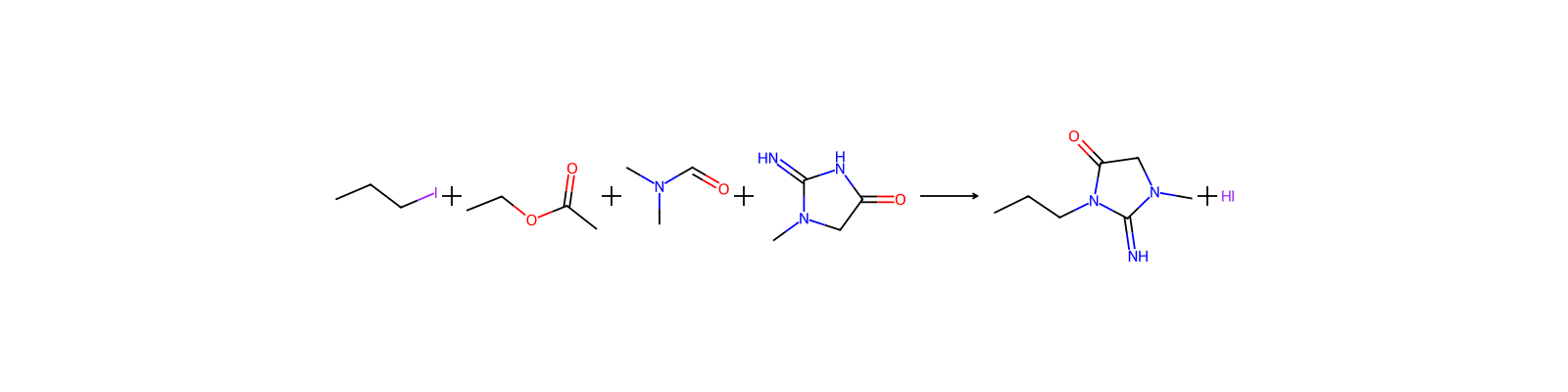
HRID 821248als Produkt
Reaktionsgleichung von HRID 1120016
HRID 1120016als Edukt
Reaktionsgleichung von HRID 1237285
HRID 1237285als Edukt
ZurückSeite 1 von 2

Notizen zur Verbindung

Auf dieser SeiteGrundinformationenÜberblickNamen und BezeichnerEigenschaftenSicherheit und RegulatorischesChemie und IndustrieZugehörige ReaktionenNotizen zur Verbindung
CAS
60-27-5
PubChem CID
137319715
DTXSID
DTXSID8045987
Nikkaji
J1.397H
295 °C · 295 °C (dec.) (lit.)
Siedepunkt
211.83 °C · 211.83°C (rough estimate)
Dichte
1.2526 · 1.2526 (rough estimate)
Brechungsindex
1.57 · 1.5700 (estimate)
Flammpunkt
290 °C · 290 °C
storage temp.
Sealed in dry,Room Temperature
Löslichkeit
1 M · 1 M HCl: 0.1 g/mL at 20 °C, clear
pka
4.83 · 4.83(at 25℃)
Aggregatzustand
Crystalline Powder
Farbe
White
PH
7 · 7.0-9.0 (20°C, 50g/L in H2O)
Wasserlöslichkeit
SOLUBLE
Merck
14 · 14,2569
BRN
112061 · 112061
Stabilität
Stable. Incompatible with strong oxidizing agents.
Kosmetik-Inhaltsstoffe Funktionen
SKIN CONDITIONING
InChI
1S/C4H7N3O/c1-7-2-3(8)6-4(7)5/h2H2,1H3,(H2,5,6,8)
InChIKey
DDRJAANPRJIHGJ-UHFFFAOYSA-N
SMILES
CN1CC(=O)N=C1N
LogP
-1.76 · -1.760
CAS Datenbank
60 · 60-27-5(CAS DataBase Reference)
NIST chemische Informationen
Creatinine(60-27-5)
EPA chemische Informationen
4 H-Imidazol-4-one, · 4H-Imidazol-4-one, 2-amino-1,5-dihydro-1-methyl- (60-27-5)
Di-iso-Propylamin
Acetic acid-diisopropylamide

Nachgelagerte Produkte

Phenylcarbamat2-Amino-5,5-bis-hydroxymethyl-1-methyl-1,5-dihydro-imidazol-4-one

Ergänzende Hinweise

DefinitionChEBI: A lactam obtained by formal cyclocondensation of creatine. It is a metabolite of creatine.