StartseiteMCPWorkbenchSkills
StartseiteWorkbenchBenachrichtigungenMein Bereich
llms.txt · MCP-AnleitungDatenschutz · Nutzungsbedingungen · Supportv1.8.0
  1. Startseite
  2. /Verbindung

Triethoxysilan

Triethoxysilane

HCID 13830
Neue NotizNeue ReaktionAnfrage stellen
Druckvorschau

Daten werden ergänzt – lade die Seite später neu, um den aktuellen Stand zu sehen
GrundinformationenÜberblickNamen und BezeichnerEigenschaftenSicherheit und RegulatorischesChemie und IndustrieZugehörige ReaktionenNotizen zur Verbindung
TeilstruktursucheÄhnliche Strukturen suchen

Grundinformationen

CAS
998-30-1
Standard-SMILES
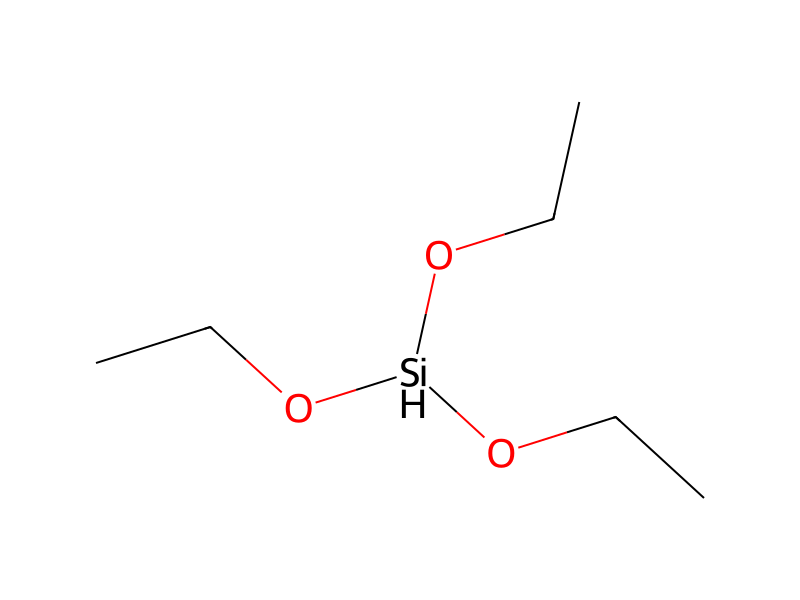
CCO[SiH](OCC)OCC
InChIKey
QQQSFSZALRVCSZ-UHFFFAOYSA-N
Summenformel
C6H16O3Si
Durchschnittliche Molmasse
164,27 g/mol
Monoisotopische Masse
164,0868709

Überblick

Triethoxysilane is a liquid. Used as a reducing agent.

Namen und Bezeichner

Bevorzugter Name
Triethoxysilane
IUPAC
triethoxysilane
Lokaler Name
Triethoxysilan
Englischer Name
Triethoxysilane
Summenformel
C6H16O3Si
Molmasse
164.27

Namen und Synonyme

RefChem:899464DTXCID7031240213-650-78T460WDH89998-30-1DTXSID6052667NSC-124134Silane, triethoxy-SIT 8185TriethoxysilanehydridotriethoxysilaneHSi(OEt)3
Weitere Namen anzeigen
TEStriethoxy-silanDK967CT2500DKSI078HSi(OC2H5)3DKFELEX0259
Si(OEt)3HTriethoxisilanetriethoxy silanetriethoxy-silaneTRIESTriethoxysilane, 95%(EtO)3SiHSCHEMBL35885

Datenbank-Bezeichner

CAS
998-30-1
PubChem CID
13830
DTXSID
DTXSID6052667
EC Number
213-650-7

Eigenschaften

Berechnete StruktureigenschaftenWird ergänzt

Polarare Oberfläche (TPSA)
27,7 Ų
H-Brücken-Donoren
0
H-Brücken-Akzeptoren
3
Frei drehbare Bindungen
6
Schwere Atome
10
Formalladung
0
Komplexität
55,7

Experimentelle und physikochemische Eigenschaften

Chemical Classes · 2 Einträge

Metals -> Metalloid Compounds (Silicon)

Flammable agents - 3rd degree

SpringerMaterials PropertiesChemical shift
Density · 4 Einträge

0.8745 at 68 °F (EPA, 1998) - Less dense than water; will float

0.8745 at 20 °C

0.87 g/cm³

0.8745 @ 20°C

Flash Point · 3 Einträge

26 °C

80 °F (26 °C) (Closed cup)

26 °C c.c.

Boiling Point · 4 Einträge

270 to 275 °F at 760 mmHg (EPA, 1998)

133.5 °C

133.5 °C

133.5 °C @760 [mm Hg]

Decomposition · 3 Einträge

When heated to decomposition, it emits acrid smoke and irritating fumes.

The silanes decomp at elevated temp to liberate hydrogen and deposit a high purity silicon, which leads to some of the principal uses of silanes. /Silanes/

Hazardous decomposition products: Reacts with water to form ethanol.

Melting Point · 3 Einträge

Sicherheit und Regulatorisches

Sicherheitsangaben dienen nur zur Orientierung und ersetzen weder das Sicherheitsdatenblatt (SDB) des Lieferanten noch geltende Vorschriften oder eine fachliche Bewertung.

GHS-Klassifizierung

GHS Classification · 5 Einträge

This chemical does not meet GHS hazard criteria for 6.9% (8 of 116) of reports.

Danger

H226 (86.2%): Flammable liquid and vapor [Warning Flammable liquids]

P210, P223, P231+P232, P233, P235, P240, P241, P242, P243, P260, P264, P264+P265, P270, P271, P280, P284, P301+P317, P301+P330+P331, P302+P335+P334, P302+P352, P302+P361+P354, P303+P361+P353, P304+P340, P305+P354+P338, P316, P317, P320, P321, P330, P332+P317, P362+P364, P363, P370+P378, P402+P404, P403+P233, P403+P235, P405, P407, P410, P413, P420, and P501 (click each P-code to see the statement)

Aggregated GHS information provided per 116 reports by companies from 10 notifications to the ECHA C&L Inventory. Each notification may be associated with multiple companies.

Gefahrenhinweise

Regulatory Information · 5 Einträge

Chemical: Silane, triethoxy-

Silane, triethoxy- is listed on the EPA's Chemical Data Reporting (CDR) system. Manufacturers and importers of Silane, triethoxy- are required to report information about their production and use of this chemical to the EPA under the Toxic Substances Control Act (TSCA). (40 eCFR Part 711)

Status: Active Update: 14-01-2021 https://echa.europa.eu/registration-dossier/-/registered-dossier/5339

Silane, triethoxy-: Does not have an individual approval but may be used as a component in a product covered by a group standard. It is not approved for use as a chemical in its own right.

The New Jersey Worker and Community Right to Know Act requires public and private employers to provide information about hazardous substances at their workplaces. (N.J.S.A. 34:5A-1 et. seq.)

Other Safety InformationEvaluation - Chemicals that are unlikely to require further regulation to manage risks to environment
DOT LabelPoison Inhalation Hazard Flammable Liquid

Chemie und Industrie

Verwendung und Herstellung

Uses · 3 Einträge

Used to make organic coupling agents and low-temperature-vulcanizing (LTV) silicone rubbers and elastomers; [HSDB]

Is of commercial importance in the silane and silicone industry for the production of organofunctional coupling agents, low-temperature-vulcanizing (LTV) silicone rubbers and elastomers, and specialty monomers.

... Used to prepare a number of organic coupling agents utilized by the plastics industry as adhesion promoters.

U.S. Production · 3 Einträge

2023: 50,000 - <250,000 lb

Production volumes for non-confidential chemicals reported under the Inventory Update Rule. [Table#5876]

Production volume for non-confidential chemicals reported under the 2006 Inventory Update Rule. Chemical: Silane, triethoxy-. Aggreated National Production Volume: <500,000 lbs.

Industry UsesIntermediate
Methods of ManufacturingReaction of silicon with ethanol ... produces triethoxysilane ... with cuprous chloride as the catalyst ... .
General Manufacturing Information · 2 Einträge

All Other Basic Organic Chemical Manufacturing

Silane, triethoxy-: ACTIVE

Anwendungen · 2 Einträge

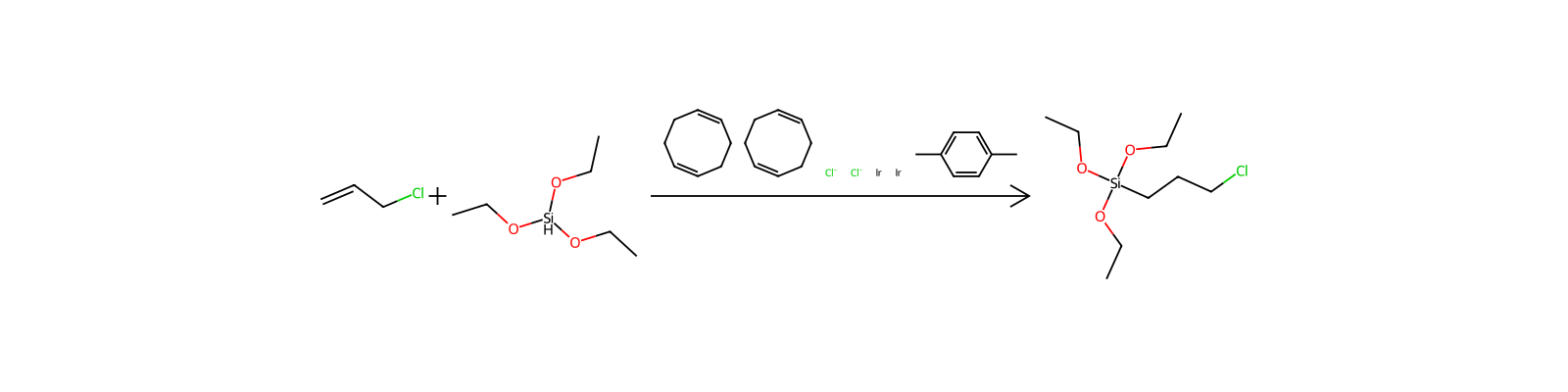
BeschreibungTriethoxysilane is an organosilicon compound with the formula HSi(OC2H5)3. It is a colourless liquid used in precious metal-catalysed hydrosilylation reactions. The resulting triethoxysilyl groups are often valued for attachment to silica surfaces.Compared to most compounds with Si-H bonds, triethoxysilane exhibits relatively low reactivity. Like most silyl ethers, triethoxysilane is susceptible to hydrolysis. As reducing agent, triethoxysilane can for example be used in reduction of amides, reduction of carbonyl compounds in the presence of cobalt(II) chloride as catalyst, Cu-catalyzed reductive hydroxymethylation of styrenes, and Rh-catalyzed hydrodediazoniation.

Zugehörige Reaktionen

160
Reaktionsaufzeichnung erstellen
Reaktionsgleichung von HRID 18661
HRID 18661als Eduktuspto-grants-2010_06
Reaktionsgleichung von HRID 52682
HRID 52682als Eduktuspto-grants-1997_04
Reaktionsgleichung von HRID 52683
HRID 52683als Eduktuspto-grants-1997_04
Reaktionsgleichung von HRID 52685
HRID 52685als Eduktuspto-grants-1997_04
Reaktionsgleichung von HRID 93023
HRID 93023als EduktTraining data from https://doi.org/10.1039/C8SC04228D (2/10)
Reaktionsgleichung von HRID 94374
HRID 94374als EduktTraining data from https://doi.org/10.1039/C8SC04228D (2/10)
Reaktionsgleichung von HRID 99056
HRID 99056als EduktTraining data from https://doi.org/10.1039/C8SC04228D (2/10)
Reaktionsgleichung von HRID 122855
HRID 122855als EduktTraining data from https://doi.org/10.1039/C8SC04228D (2/10)
Seite 1 von 20

Notizen zur Verbindung

Wird geladen…

Auf dieser SeiteGrundinformationenÜberblickNamen und BezeichnerEigenschaftenSicherheit und RegulatorischesChemie und IndustrieZugehörige ReaktionenNotizen zur Verbindung
Weitere Aktionen
Neue NotizNeue ReaktionAnfrage stellen

-170 °C

-170 °C

-170 °C

Vapor Density · 2 Einträge

Relative vapor density (Air = 1): 5.7

Relative vapor density (air = 1): 5.7

Vapor Pressure · 2 Einträge

20.25 [mmHg]

8.5 [mm Hg] @25 °C

Refractive IndexIndex of refraction: 1.337 at 20 °C
Physical Description · 4 Einträge

Triethoxysilane is a liquid. Used as a reducing agent.

Liquid

Colorless to yellow liquid with a sweetish odor; [AIHA]

COLOURLESS LIQUID.

Other Experimental Properties · 4 Einträge

Moisture-sensitive

Organosilanes containing one or more Si--H bonds have excellent reducing capabilities. /Organosilanes/

Organo-functional silanes are noted for their ability to bond organic polymer systems to inorganic substrates. /Silane cmpd/

The reaction of organosilanes with halogens and halogen cmpd usually proceeds in good yield through cleavage of the Si--H bond and formation of the silicon-halogen bond. Reaction with fluorine, however, does not proceed satisfactorily because of cleavage of not only the Si--H but also C--Si and C--H bonds. Direct halogenation with chlorination, bromine, and iodine proceeds smoothly, however. /Organosilanes/

Physikochemische Eigenschaften

Schmelzpunkt
-170 °C · -170°C
Siedepunkt
134 · 134-135 °C(lit.)
Dichte
0.89 g/mL · 0.89 g/mL at 25 °C(lit.)
Dampfdruck
9.21 hPa · 9.21hPa at 20℃
Brechungsindex
20 · n20/D 1.377(lit.)
Flammpunkt
80 °F · 80 °F
storage temp.
0 · Store at 0-5°C
Löslichkeit
sol diethyl ether, THF, alkanes, aromatic and chlorinated solvents.
Aggregatzustand
A liquid
Wichte
0.8753 · 0.8753
Wasserlöslichkeit
Insoluble in water. Soluble in organic solvents.
BRN
1738989 · 1738989
Stabilität
Stable, but moisture sensitive. Flammable. Incompatible with strong oxidizing agents, strong acids, strong bases.
InChIKey
QQQSFSZALRVCSZ-UHFFFAOYSA-N
CAS Datenbank
998 · 998-30-1(CAS DataBase Reference)
NIST chemische Informationen
Silane, triethoxy-(998-30-1)
EPA chemische Informationen
Triethoxysilane (998-30-1)
Fire Hazards · 2 Einträge

When heated to decomposition, it emits acrid smoke and fumes. (EPA, 1998)

Flammable. Above 26 °C explosive vapour/air mixtures may be formed.

Fire Potential · 2 Einträge

Flammable liquid

... Trichlorosilane is highly flammable. /Trichlorosilane/

Health HazardsToxicity is similar to silanes. Silanes are moderately irritating to skin, eyes, and mucous membranes. Silane compounds are toxic. (EPA, 1998)
Hazards Summary · 1 Eintrag

A skin, eye, and respiratory tract irritant; [ICSC] Silanes form explosive mixtures with air; [HSDB] A corrosive substance that can cause injury to the skin, eyes, and respiratory tract; Inhalation may cause chemical pneumonitis and pulmonary edema; Can be absorbed through skin; Effects in high-dose animal studies include acute tubular necrosis, acute pulmonary edema, and abnormal liver function tests; [MSDSonline] See Trimethoxysilane.

Reactive GroupMetal Hydrides, Metal Alkyls, Metal Aryls, and Silanes
UN ClassificationUN Hazard Class: 6.1; UN Subsidiary Risks: 3; UN Pack Group: I
Special ReportsUSEPA; Chemical Profile: Triethoxysilane (1985). Aspects covered in this data sheet: exposure limitations; personal protective equipment; fire hazards; fire fighting; disposal; first aid; spills.
Reactivity AlertsStrong Reducing Agent
Reactivity ProfileTRIETHOXYSILANE has been involved in cases where it has disproportionated, generating silane (SiH4) which has a history of being pyrophoric.

Sicherheit und Schutzausrüstung

Fire Fighting · 2 Einträge

(Non-Specific -- Poisonous Liquid, n.o.s.) Keep unnecessary people away; isolate hazard area and deny entry. Stay upwind; keep out of low areas. Ventilate closed spaces before entering them. Wear positive pressure breathing apparatus and special protective clothing. Remove and isolate contaminated clothing at the site. Move container from fire area if you can do so without risk. Fight fire from maximum distance. Dike fire control water for later disposal; do not scatter the material.

Use water spray, powder, foam, carbon dioxide. In case of fire: keep drums, etc., cool by spraying with water.

First Aid Measures · 4 Einträge

Fresh air, rest. Refer for medical attention.

Remove contaminated clothes. Rinse and then wash skin with water and soap.

First rinse with plenty of water for several minutes (remove contact lenses if easily possible), then refer for medical attention.

Rinse mouth.

First Aid · 1 Eintrag

Signs and Symptoms of Triethoxysilane Exposure: Signs and symptoms of acute exposure to triethoxysilane may include irritation of the eyes, skin, mucous membranes, and respiratory tract. Also, severe ocular burns, headache, and anesthetic effects may be noted.

Safe StorageFireproof. Separated from strong oxidants, strong acids and strong bases.
Fire Fighting Procedures · 4 Einträge

Powder, water spray, foam, carbon dioxide.

In case of fire: keep drums, etc., cool by spraying with water.

Suitable extinguishing media: For small (incipient) fires, use media such as "alcohol" foam, dry chemical, or carbon dioxide. For large fires, apply water from as far as possible. Use very large quantities (flooding) of water applied as a mist or spray; solid streams of water may be ineffective. Cool all affected containers with flooding quantities of water. ... Use water spray to cool unopened containers.

Special protective equipment for fire-fighters: Wear self contained breathing apparatus for fire fighting if necessary.

Storage Conditions · 2 Einträge

Store in cool place. Keep container tightly closed in a dry and well-ventilated place. Containers which are opened must be carefully resealed and kept upright to prevent leakage. Moisture sensitive.

Fireproof. Separated from strong oxidants, strong acids and strong bases.

Cleanup Methods · 3 Einträge

Methods for cleaning up: Contain spillage, and then collect with non-combustible absorbent material, (e.g. sand, earth, diatomaceous earth, vermiculite) and place in container for disposal according to local / national regulations. Keep in suitable, closed containers for disposal. Personal precautions: Wear respiratory protection. Avoid breathing vapors, mist or gas. Ensure adequate ventilation. Remove all sources of ignition. Evacuate personnel to safe areas. Beware of vapors accumulating to form explosive concentrations. Vapors can accumulate in low areas.

Environmental precautions: Prevent further leakage or spillage if safe to do so. Do not let product enter drains.

SRP: Wastewater from contaminant suppression, cleaning of protective clothing/equipment, or contaminated sites should be contained and evaluated for subject chemical or decomposition product concentrations. Concentrations shall be lower than applicable environmental discharge or disposal criteria. Alternatively, pretreatment and/or discharge to a permitted wastewater treatment facility is acceptable only after review by the governing authority and assurance that "pass through" violations will not occur. Due consideration shall be given to remediation worker exposure (inhalation, dermal and ingestion) as well as fate during treatment, transfer and disposal. If it is not practicable to manage the chemical in this fashion, it must be evaluated in accordance with EPA 40 CFR Part 261, specifically Subpart B, in order to determine the appropriate local, state and federal requirements for disposal.

Nonfire Spill Response · 1 Eintrag

(Non-Specific -- Poisonous Liquid, n.o.s.) Keep unnecessary people away; isolate hazard area and deny entry. Stay upwind; keep out of low areas. Ventilate closed spaces before entering them. Remove and isolate contaminated clothing at the site. Do not touch spilled material; stop leak if you can do so without risk. Use water spray to reduce vapors.

Disposal Methods · 3 Einträge

SRP: The most favorable course of action is to use an alternative chemical product with less inherent propensity for occupational harm/injury/toxicity or environmental contamination. Recycle any unused portion of the material for its approved use or return it to the manufacturer or supplier. Ultimate disposal of the chemical must consider: the material's impact on air quality; potential migration in soil or water; effects on animal and plant life; and conformance with environmental and public health regulations.

Remove all ignition sources. Collect leaking and spilled liquid in sealable containers as far as possible. Do NOT wash away into sewer.

Burn in a chemical incinerator equipped with an afterburner and scrubber but exert extra care in igniting as this material is highly flammable. This combustible material may be burned in a chemical incinerator equipped with an afterburner and scrubber. Observe all federal, state, and local environmental regulations. Contact a licensed professional waste disposal service to dispose of this material.

Spillage Disposal · 1 Eintrag

Personal protection: filter respirator for organic gases and vapours adapted to the airborne concentration of the substance. Remove all ignition sources. Collect leaking and spilled liquid in sealable containers as far as possible. Do NOT wash away into sewer.

Preventive Measures · 5 Einträge

In case of skin contact: Take off contaminated clothing and shoes immediately. Wash off with soap and plenty of water. Consult a physician.

In case of eye contact: Rinse thoroughly with plenty of water for at least 15 minutes and consult a physician.

Hygiene measures: Avoid contact with skin, eyes and clothing. Wash hands before breaks and immediately after handling the product.

Caution: Silanes are toxic. Avoid contact with skin and eyes. Use effective fume removal device. /Silanes/

For more Preventive Measures (Complete) data for Triethoxysilane (6 total), please visit the HSDB record page.

Isolation and EvacuationExcerpt from ERG Guide 131 [Flammable Liquids - Toxic]:

Toxikologische Informationen

Environmental Fate · 3 Einträge

TERRESTRIAL FATE: Triethoxysilane is expected to undergo hydrolysis in the environment similar to most alkoxysilanes(1); a similar compound, trimethoxysilane, is reported to hydrolyze in aqueous conditions(2). The rapid hydrolysis indicates that absorption to soil and volatilization from moist soil will not be important environmental fate processes(SRC). Triethoxysilane is expected to volatilize from dry soil surfaces(SRC) based upon a vapor pressure of 8.5 mm Hg at 25 °C(SRC) determined from a fragment constant method(3). Biodegradation data were not available(SRC, 2009).

AQUATIC FATE: Triethoxysilane is expected to undergo hydrolysis in the environment similar to most alkoxysilanes(1); a similar compound, trimethoxysilane, is reported to hydrolyze in aqueous conditions(2). The hydrolytic half-life of trimethoxysilane in water is 0.3 minutes at 2 °C and pH 7.0(3). The rapid hydrolysis indicates that absorption to suspended soils and sediments, volatilization from water and moist soil surfaces, and bioconcentration in aquatic organisms will not be important environmental fate processes(SRC). Biodegradation data were not available(SRC, 2009).

ATMOSPHERIC FATE: According to a model of gas/particle partitioning of semivolatile organic compounds in the atmosphere(1), triethoxysilane, which has an estimated vapor pressure of 8.5 mm Hg at 25 °C(SRC), determined from a fragment constant method(2) is expected to exist solely as a vapor in the ambient atmosphere. Vapor-phase triethoxysilane is degraded in the atmosphere by reaction with photochemically-produced hydroxyl radicals(SRC); the half-life for this reaction in air is estimated to be 21 hours(SRC), calculated from its rate constant of 1.9X10⁻¹¹ cu cm/molecule-sec at 25 °C(SRC) that was derived using a structure estimation method(3). However, due to the hydrolysis of this compound with moisture in the atmosphere, photolysis in the atmosphere is not predicted to be an important mode of removal, and should be considered secondary to hydrolysis(SRC). Triethoxysilane does not contain chromophores that absorb at wavelengths >290 nm(4) and therefore is not expected to be susceptible to direct photolysis by sunlight(SRC).

Adverse EffectsOccupational hepatotoxin - Secondary hepatotoxins: the potential for toxic effect in the occupational setting is based on cases of poisoning by human ingestion or animal experimentation.
Exposure RoutesThe substance can be absorbed into the body by inhalation of its vapour.
Signs and Symptoms · 3 Einträge

Cough. Sore throat.

Redness.

Redness. Pain.

Soil Adsorption/Mobility · 1 Eintrag

Triethoxysilane is expected to undergo hydrolysis in the environment similar to most alkoxysilanes(1); a similar compound, trimethoxysilane, is reported to hydrolyze in aqueous conditions(2). The rapid hydrolysis indicates that adsorption to soil is not expected(SRC).

Human Toxicity Excerpts/SIGNS AND SYMPTOMS/ May be fatal if inhaled. Material is extremely destructive to the tissue of the mucous membranes and upper respiratory tract. May be harmful if absorbed through skin. Causes skin burns. Causes eye burns.
Artificial Pollution SourcesTriethoxysilane's production and use as a reagent for the preparation of organic coupling agents in the plastics industry(1) may result in its release to the environment through various waste streams(SRC).
Environmental Bioconcentration · 1 Eintrag

Triethoxysilane is expected to undergo hydrolysis in the environment similar to most alkoxysilanes(1); a similar compound, trimethoxysilane, is reported to hydrolyze in aqueous conditions(2). The rapid hydrolysis indicates that bioconcentration in aquatic organisms will not be an important environmental fate process(SRC).

Volatilization from Water/Soil · 1 Eintrag

Triethoxysilane is expected to undergo hydrolysis in the environment similar to most alkoxysilanes(1); a similar compound, trimethoxysilane, is reported to hydrolyze in aqueous conditions(2). The rapid hydrolysis indicates that volatilization from water surfaces and moist soil will not be important environmental fate processes(SRC). Triethoxysilane is expected to volatilize from dry soil surfaces(SRC) based upon an estimated vapor pressure of 8.5 mm Hg(SRC), determined from a fragment constant method(3).

Non-Human Toxicity Excerpts/LABORATORY ANIMALS: Acute Exposure/ Methyl triethoxysilane has been tested by application of 0.02 mL to rabbit eyes and found to cause immediate irritation but no corneal damage. The eyes were normal within 24 hrs. /Methyl triethoxysilane/
Environmental Abiotic Degradation · 1 Eintrag

The rate constant for the vapor-phase reaction of triethoxysilane with photochemically-produced hydroxyl radicals has been estimated as 1.9X10⁻¹¹ cu cm/molecule-sec at 25 °C(SRC) using a structure estimation method(1). This corresponds to an atmospheric half-life of about 21 hours at an atmospheric concentration of 5X10+5 hydroxyl radicals per cu cm(1). However, due to the hydrolysis of this compound with moisture in the atmosphere, photolysis in the atmosphere is not predicted to be an important mode of removal, and should be considered secondary to hydrolysis(SRC). Triethoxysilane is expected to undergo hydrolysis in the environment similar to most alkoxysilanes(2); a similar compound, trimethoxysilane, is reported to hydrolyze in aqueous conditions(3). Triethoxysilane does not contain chromophores that absorb at wavelengths >290 nm(4) and therefore is not expected to be susceptible to direct photolysis by sunlight(SRC).

Probable Routes of Human Exposure · 1 Eintrag

Occupational exposure to triethoxysilane may occur through inhalation and dermal contact with this compound at workplaces where it is produced or used. It is unlikely that the general population would be exposed to triethoxysilane as it is primarily used in a manufacturing setting. (SRC)

Regulatorische Informationen

CERCLA Reportable Quantities · 1 Eintrag

Releases of CERCLA hazardous substances are subject to the release reporting requirement of CERCLA section 103, codified at 40 CFR part 302, in addition to the requirements of 40 CFR part 355. Triethoxysilane is an extremely hazardous substance (EHS) subject to reporting requirements when stored in amounts in excess of its threshold planning quantity (TPQ) of 500 lbs.

Sicherheitsdaten

F
10-21
wgk
3
tsca
TSCA listed
ridadr
UN 3384 6.1/PG 1
hs_code
29209090
RTECS-Nr.
VV6682000
risk_code
10-26-34-23/24/25
hazard_code
T+,C,T
safety_code
26-28-36/37/39-45
hazard_class
6.1
packing_group
II
Giftige Stoffe Daten
998-30-1(Hazardous Substances Data)

VerwendenTriethoxysilane is useful reagent for the hydrosilylation of carbon–carbon multiple bonds; reducing agent for carbonyl groups

Vor- und nachgelagerte Produkte

Nachgelagerte Produkte

1H,1H,2H,2H-Perfluorodecyltriethoxysilane4-Aminobutyltriethoxysilane1,1-Diethoxybutan1,1-Diethoxy-2-methylpropanEthylpropyletherBenzyltriethoxysilanPhenylpropylether2,8,9-Trioxa-5-aza-1-silabicyclo[3.3.3]undecanDodecyltriethoxysilanDodecanePropanoicacid,3-(triethoxysilyl)-,ethylester