
1-Methylimidazol
1-Methylimidazole
Daten werden ergänzt – lade die Seite später neu, um den aktuellen Stand zu sehen
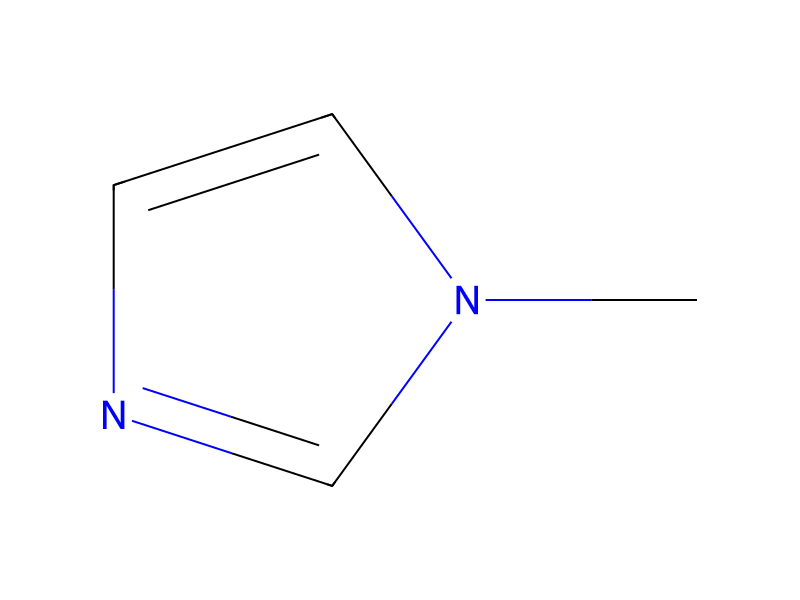
Grundinformationen
- CAS
616-47-7- Standard-SMILES
Cn1ccnc1- InChIKey
MCTWTZJPVLRJOU-UHFFFAOYSA-N- Summenformel
- C4H6N2
- Durchschnittliche Molmasse
- 82,1 g/mol
- Monoisotopische Masse
- 82,0530982
Überblick
1-methyl-1H-imidazole is a 1H-imidazole having a methyl substituent at the N-1 position.
Namen und Bezeichner
- Bevorzugter Name
- 1-Methylimidazole
- IUPAC
- 1-methylimidazole
- Lokaler Name
- 1-Methylimidazol
- Englischer Name
- 1-Methylimidazole
- Summenformel
- C4H6N2
- Molmasse
- 82.1
Namen und Synonyme
1-methylimidazole1-Methyl-1H-imidazole616-47-7N-Methylimidazole1H-Imidazole, 1-methyl-IMIDAZOLE, 1-METHYL-DTXSID60522911-methyl-1H-imidazol-3-iumP4617QS63YNSC-88064DTXCID6030863CHEBI:113454
Weitere Namen anzeigen
MIMMeImmethyl imidazoleN-methylimidazole (1-methylimidazole)N-methyl midazoleN-methyl glyoxaline
RefChem:76394210-484-7N-methylimidazol1-methylimidazol1-methylimdazolen-methyl imidazoleN1-MethylimidazoleMFCD00005292
Datenbank-Bezeichner
- CAS
616-47-7- PubChem CID
- 1390
- DTXSID
DTXSID6052291- ChEMBL
CHEMBL543- ChEBI
CHEBI:113454- UNII
- P4617QS63Y
- EC Number
- 210-484-7
- Nikkaji
- J1.664K
Eigenschaften
Berechnete StruktureigenschaftenWird ergänzt
- XLogP
- -0,1
- Polarare Oberfläche (TPSA)
- 17,8 Ų
- H-Brücken-Donoren
- 0
- H-Brücken-Akzeptoren
- 1
- Frei drehbare Bindungen
- 0
- Schwere Atome
- 6
- Formalladung
- 0
- Komplexität
- 44,8
Experimentelle und physikochemische Eigenschaften
Chemical ClassesNitrogen Compounds -> Imidazoles
DrugsPharmaceuticals -> Listed in ZINC15
SpringerMaterials PropertiesDensity
LogP-0.06
Density1.0325 @25 °C
Boiling Point196 °C @760 [mm Hg]
Melting Point-6 °C
Vapor Pressure0.47 [mmHg]
Physical Description
Liquid
Colorless to yellow hygroscopic liquid; [Alfa Aesar MSDS]
Dissociation Constants6.95 (at 25 °C)
Physikochemische Eigenschaften
Sicherheit und Regulatorisches
Sicherheitsangaben dienen nur zur Orientierung und ersetzen weder das Sicherheitsdatenblatt (SDB) des Lieferanten noch geltende Vorschriften oder eine fachliche Bewertung.
GHS-Klassifizierung
GHS Classification
Danger
H302: Harmful if swallowed [Warning Acute toxicity, oral]
P260, P264, P270, P280, P301+P317, P301+P330+P331, P302+P352, P302+P361+P354, P304+P340, P305+P354+P338, P316, P317, P321, P330, P362+P364, P363, P405, and P501 (click each P-code to see the statement)
This chemical does not meet GHS hazard criteria for 0.1% (1 of 797) of reports.
Danger
H302 (96.9%): Harmful if swallowed [Warning Acute toxicity, oral]
Gefahrenhinweise
Regulatory Information
Chemical: 1H-Imidazole, 1-methyl-
1H-Imidazole, 1-methyl- is listed on the EPA's Chemical Data Reporting (CDR) system. Manufacturers and importers of 1H-Imidazole, 1-methyl- are required to report information about their production and use of this chemical to the EPA under the Toxic Substances Control Act (TSCA). (40 eCFR Part 711)
REACH registered substance: 1-methylimidazole (EC: 210-484-7)
1-Methylimidazole: Does not have an individual approval but may be used under an appropriate group standard
Other Safety InformationEvaluation - 1H-Imidazole, 1-methyl-
Hazards Summary
Causes convulsions in oral and intraperitoneal lethal-dose studies of mice; [RTECS] Dermal LD50 (rabbit) = 400-640 mg/kg; Causes burns; Inhalation may cause corrosive injuries to upper respiratory tract and lungs; Harmful by ingestion and skin absorption; [Alfa Aesar MSDS] See Imidazole.
Hazard Classes and Categories
Acute Tox. 4 (96.9%)
Acute toxicity (ingestion) - category 4
Acute Tox. 4 *
Sicherheit und Schutzausrüstung
Chemie und Industrie
Verwendung und Herstellung
U.S. Production2023: 50,000 - <75,000 lb
Industry UsesProcessing aids not otherwise specified
General Manufacturing Information
All Other Basic Organic Chemical Manufacturing
1H-Imidazole, 1-methyl-: ACTIVE
Anwendungen
Verwenden1-Methylimidazole is an aprotic solvent. It is a derivative of imidazole used in the production of pharmaceuticals, pesticides, ion exchange resins, dye intermediates, textile auxiliaries, photographic chemicals, and corrosion inhibitors. It can also be used as a catalyst for the manufacture of polyurethane and a curing agent for epoxy resins. For example, when 1-methylimidazole is added to an aqueous diethylenetriamine (DETA) solution, high CO2 loading can be achieved through phase separation of the absorbent during CO2 absorption[1].
Darstellung
synthetische1-Methylimidazole is prepared mainly by two routes industrially. The main one is acid-catalysed methylation of imidazole by methanol. The second method involves the Radziszewski reaction from glyoxal, formaldehyde, and a mixture of ammonia and methylamine. (CHO)2 + CH2O + CH3NH2 + NH3 → H2C2N(NCH3)CH + 3 H2O The compound can be synthesized on a laboratory scale by methylation of imidazole at the pyridine-like nitrogen and subsequent deprotonation. Similarly, 1-methylimidazole may be synthesized by first deprotonating imidazole to form a sodium salt followed by methylation. H2C2N(NH)CH + CH3I → [H2C2(NH)(NCH3)CH]I [H2C2(NH)(NCH3)CH]I + NaOH → H2C2N(NCH3)CH + H2O + NaI
Vor- und nachgelagerte Produkte
Vorgelagerte Rohstoffe
Zugehörige Reaktionen
1.660


Notizen zur Verbindung
Wird geladen…