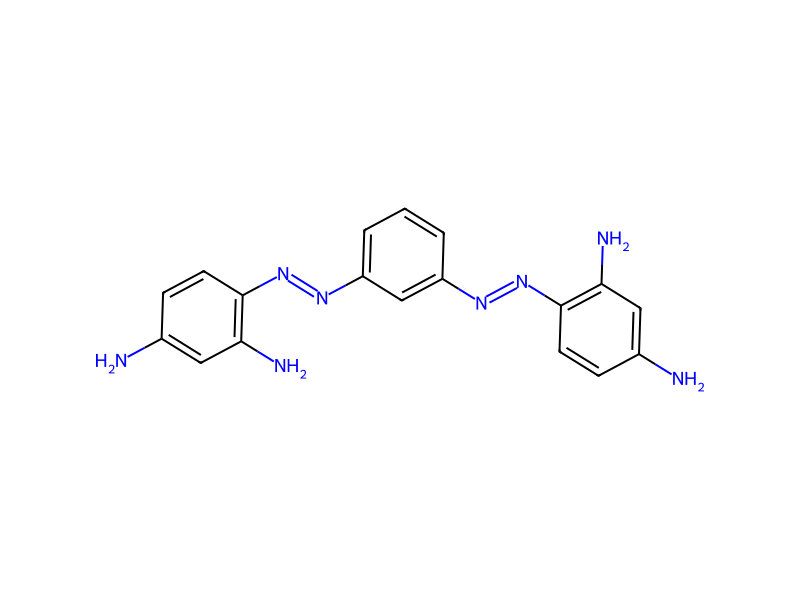
Grundinformationen
- Standard-SMILES
Nc1ccc(N=Nc2cccc(N=Nc3ccc(N)cc3N)c2)c(N)c1- InChIKey
BDFZFGDTHFGWRQ-UHFFFAOYSA-N- Summenformel
- C18H18N8
- Durchschnittliche Molmasse
- 346,4 g/mol
- Monoisotopische Masse
- 346,16544258
Überblick
C.i. basic brown 1 is an odorless dark purple to blackish-brown powder. (NTP, 1992)
Namen und Bezeichner
- Bevorzugter Name
- C.I. Basic Brown 1
- IUPAC
- 4-[[3-[(2,4-diaminophenyl)diazenyl]phenyl]diazenyl]benzene-1,3-diamine
- Englischer Name
- BismarkbrownG
- Summenformel
- C18H18N8
- Molmasse
- 346.38912
Namen und Synonyme
Weitere Namen anzeigen
Datenbank-Bezeichner
- CAS
10114-58-6、1052-38-6、8005-77-4- PubChem CID
- 13981
- DTXSID
DTXSID6043753- ChEBI
CHEBI:87654- UNII
- 911CR7FM6S
- EC Number
- 213-888-1、616-873-1
- Nikkaji
- J217.165A
Eigenschaften
Berechnete Struktureigenschaften
- XLogP
- 2,8
- Polarare Oberfläche (TPSA)
- 154 Ų
- H-Brücken-Donoren
- 4
- H-Brücken-Akzeptoren
- 8
- Frei drehbare Bindungen
- 4
- Schwere Atome
- 26
- Formalladung
- 0
- Komplexität
- 454
Experimentelle und physikochemische Eigenschaften
Physical Description
C.i. basic brown 1 is an odorless dark purple to blackish-brown powder. (NTP, 1992)
Wet Solid; Liquid
Physikochemische Eigenschaften
- EPA chemische Informationen
- 1 · C.I. Basic Brown 1 (8005-77-4)
Sicherheit und Regulatorisches
GHS-Klassifizierung
GHS Classification
This chemical does not meet GHS hazard criteria for 2.4% (3 of 123) of reports.
H413 (88.6%): May cause long lasting harmful effects to aquatic life [Hazardous to the aquatic environment, long-term hazard]
P273, and P501 (click each P-code to see the statement)
Aggregated GHS information provided per 123 reports by companies from 9 notifications to the ECHA C&L Inventory.
Gefahrenhinweise
Regulatory Information
Chemical: 1,3-Benzenediamine, 4,4'-[1,3-phenylenebis(azo)]bis-
1,3-Benzenediamine, 4,4'-[1,3-phenylenebis(2,1-diazenediyl)]bis- is listed on the EPA's Chemical Data Reporting (CDR) system. Manufacturers and importers of 1,3-Benzenediamine, 4,4'-[1,3-phenylenebis(2,1-diazenediyl)]bis- are required to report information about their production and use of this chemical to the EPA under the Toxic Substances Control Act (TSCA). (40 eCFR Part 711)
REACH registered substance: 4,4'-[1,3-phenylenebis(azo)]bisbenzene-1,3-diamine (EC: 213-888-1)
Bismarck brown Y: Does not have an individual approval but may be used under an appropriate group standard
1,3-Benzenediamine, 4,4'-[1,3-phenylenebis(azo)]bis-: Does not have an individual approval but may be used as a component in a product covered by a group standard. It is not approved for use as a chemical in its own right.
Reactivity Profile
C.I. BASIC BROWN 1 is an azo compound. Toxic gases are formed by mixing compounds containing azo groups with acids, aldehydes, amides, carbamates, cyanides, inorganic fluorides, halogenated organics, isocyanates, ketones, metals, nitrides, peroxides, phenols, epoxides, acyl halides, and strong oxidizing or reducing agents. Flammable gases are formed by mixing materials in this group with alkali metals. Explosive combination can occur with strong oxidizing agents, metal salts, peroxides, and sulfides. This chemical is incompatible with oxidizing and reducing agents. (NTP, 1992)
Sicherheit und Schutzausrüstung
First Aid
EYES: First check the victim for contact lenses and remove if present. Flush victim's eyes with water or normal saline solution for 20 to 30 minutes while simultaneously calling a hospital or poison control center. Do not put any ointments, oils, or medication in the victim's eyes without specific instructions from a physician. IMMEDIATELY transport the victim after flushing eyes to a hospital even if no symptoms (such as redness or irritation) develop.
Nonfire Spill Response
SMALL SPILLS AND LEAKAGE: If you spill this chemical, you should dampen the solid spill material with water, then transfer the dampened material to a suitable container. Use absorbent paper dampened with water to pick up any remaining material. Seal your contaminated clothing and the absorbent paper in a vapor-tight plastic bag for eventual disposal. Wash all contaminated surfaces with a soap and water solution. Do not reenter the contaminated area until the Safety Officer (or other responsible person) has verified that the area has been properly cleaned.
Personal Protective Equipment (PPE)
RECOMMENDED RESPIRATOR: Where the neat test chemical is stored, weighed and diluted, wear an approved half face respirator equipped with an organic vapor/acid gas cartridge (specific for organic vapors, HCl, acid gas and SO2) with a dust/mist filter. (NTP, 1992)
Chemie und Industrie
Verwendung und Herstellung
General Manufacturing Information
Synthetic Dye and Pigment Manufacturing
1,3-Benzenediamine, 4,4'-[1,3-phenylenebis(2,1-diazenediyl)]bis-: ACTIVE
Vor- und nachgelagerte Produkte
Vorgelagerte Rohstoffe
Anbieter17 Anbieter
Zugehörige Reaktionen
Keine Reaktionsaufzeichnungen unter den aktuellen Filterkriterien.
Verknüpfte Notizen
Wird geladen…