
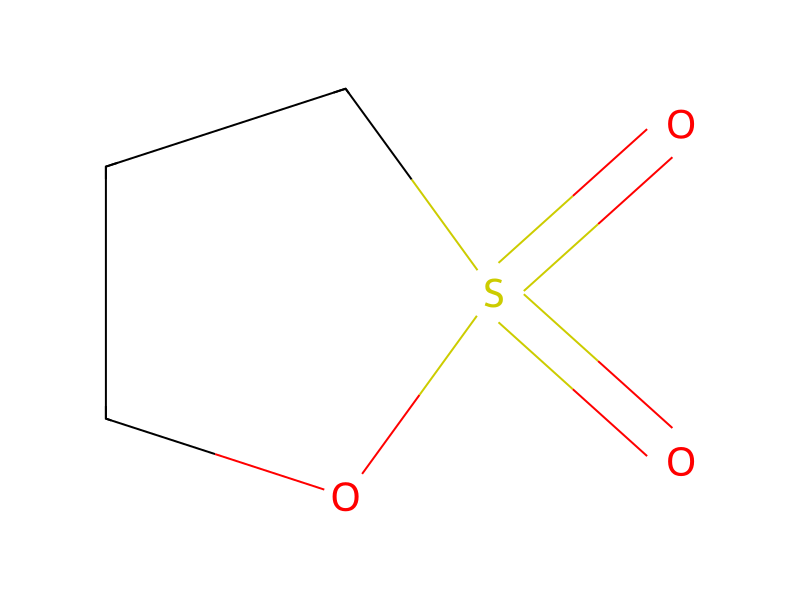
Grundinformationen
- Standard-SMILES
O=S1(=O)CCCO1- InChIKey
FSSPGSAQUIYDCN-UHFFFAOYSA-N- Summenformel
- C3H6O3S
- Durchschnittliche Molmasse
- 122,15 g/mol
- Monoisotopische Masse
- 122,00376505
Überblick
1,3-Propane Sultone can cause cancer according to an independent committee of scientific and health experts.
Namen und Bezeichner
- Bevorzugter Name
- Propane sultone
- IUPAC
- oxathiolane 2,2-dioxide
- Lokaler Name
- 1,3-Propansulton
- Englischer Name
- 1,3-Propanesultone
- Summenformel
- C3H6O3S
- Molmasse
- 122.14
Namen und Synonyme
1120-71-41,3-PROPANE SULTONEPropane sultone1,2-oxathiolane 2,2-dioxidePropanesultone1,2-Oxathiolane, 2,2-dioxideRCRA waste number U193DTXSID80211953-Hydroxy-1-propanesulfonic acid gamma-sultone1,2-Oxathrolane 2,2-dioxide3-Hydroxy-1-propanesulphonic acid sultoneL6NTK7VJX9
Weitere Namen anzeigen
1,3-PS1,3-PROPANESULTONE1,3-propanesulfonic acid lactone1,3-Propanesulfone1,3-propyl sultoneoxathiolane 2,2-dioxidetonePropyl Sultone
3-HYDROXY-1-PROPANESULFONIC ACID SULTONENSC-423861-Propanesulfonic acid, 3-hydroxy-, gamma-sultoneDTXCID001195NSC42386gamma-Propane sultoneRefChem:729061-Propanesulfonic acid-3-hydroxy-gamma-sultone
Datenbank-Bezeichner
- CAS
1120-71-4- PubChem CID
- 14264
- DTXSID
DTXSID8021195- ChEMBL
CHEMBL3185243- ChEBI
CHEBI:82370- UNII
- L6NTK7VJX9
- EC Number
- 214-317-9
- Nikkaji
- J4.528D
Eigenschaften
Berechnete Struktureigenschaften
- XLogP
- -0,2
- Polarare Oberfläche (TPSA)
- 51,8 Ų
- H-Brücken-Donoren
- 0
- H-Brücken-Akzeptoren
- 3
- Frei drehbare Bindungen
- 0
- Schwere Atome
- 7
- Formalladung
- 0
- Komplexität
- 140
Experimentelle und physikochemische Eigenschaften
Chemical Classes
Hazardous Air Pollutants (HAPs)
Other Classes -> Sulfur Compounds
Carcinogens
SpringerMaterials PropertiesDielectric constant
Odor
Foul odor above 31.11 °C.
Releases a fould odor as it melts.
Density
1.39 (NIOSH, 2024) - Denser than water; will sink
SPECIFIC GRAVITY: 1.393 @ 40 °C/4 °C
Density (at 25 °C): 1.392 g/cm³
1.393 @ 40°C
1.39
Color/Form
COLORLESS LIQ OR WHITE CRYSTALS
White, crystalline solid or a colorless liquid (above 86 degrees F).
Solubility
10 % (NIOSH, 2024)
READILY SOL IN KETONES, ESTERS & AROMATIC HYDROCARBONS
INSOL IN ALIPHATIC HYDROCARBONS
SOL IN WATER (100 G/L)
Solubility in water, g/100ml: 10 (moderate)
10%
Flash Point
greater than 235 °F (NIOSH, 2024)
Flash point > 235 °F
>110 °C
>235 °F
Boiling Point180 °C at 0.039 atm.
Melting Point
86 °F (NIOSH, 2024)
31 °C
31 °C
31 °C
86 °F
Vapor Pressure0.27 [mmHg]
Refractive IndexINDEX OF REFRACTION: 1.450 @ 40 °C/D
Physical Description
Propane sultone appears as white crystalline solid or a colorless liquid (above 86 °F). Releases a foul odor when melting. (NIOSH, 2024)
Liquid
White, crystalline solid or a colorless liquid (above 86 degrees F). [Note: Releases a foul odor as it melts.]; [NIOSH]
WHITE CRYSTALS OR COLOURLESS LIQUID WITH CHARACTERISTIC ODOUR.
White, crystalline solid or a colorless liquid (above 86 °F). [Note: Releases a foul odor as it melts.]
Physikochemische Eigenschaften
- Schmelzpunkt
- 30 · 30-33 °C (lit.)
- Siedepunkt
- 180 °C/30 · 180 °C/30 mmHg (lit.)
- Dichte
- 1.392 g/mL · 1.392 g/mL at 25 °C (lit.)
- Dampfdruck
- 0.001 · 0.001-0.48Pa at 20-25℃
- Brechungsindex
- 1.4332 · 1.4332 (estimate)
- Flammpunkt
- 230 °F · >230 °F
- storage temp.
- Inert atmosphere,Room Temperature
- Löslichkeit
- Chloroform (Slightly), Methanol (Slightly)
- Aggregatzustand
- powder
- Farbe
- White or Colorless to Light yellow
- Wasserlöslichkeit
- Slightly soluble
- BRN
- 109782 · 109782
- Henry's Law Constant
- 1.6 · 1.6×103 mol/(m3Pa) at 25℃, Ebert et al. (2023)
- Stabilität
- Stable, but moisture sensitive. Incompatible with strong oxidizing agents, strong acids, strong bases.
- InChI
- 1S/C3H6O3S/c4-7(5)3-1-2-6-7/h1-3H2
- InChIKey
- FSSPGSAQUIYDCN-UHFFFAOYSA-N
- SMILES
- O=S1(OCCC1)=O
- LogP
- -2.86 · -2.86--0.28 at 20℃
- CAS Datenbank
- 1120 · 1120-71-4(CAS DataBase Reference)
- NIST chemische Informationen
- 1 · 1,2-Oxathiolane, 2,2-dioxide(1120-71-4)
- EPA chemische Informationen
- 1 · 1,3-Propane sultone (1120-71-4)
Sicherheit und Regulatorisches
GHS-Klassifizierung
GHS Classification
Danger
H302: Harmful if swallowed [Warning Acute toxicity, oral]
P203, P264, P270, P280, P301+P317, P302+P352, P317, P318, P321, P330, P362+P364, P405, and P501 (click each P-code to see the statement)
Danger
H301+H311 (21.2%): Toxic if swallowed or in contact with skin [Danger Acute toxicity, oral; acute toxicity, dermal]
P203, P261, P262, P264, P264+P265, P270, P271, P273, P280, P301+P316, P301+P317, P302+P352, P304+P340, P305+P351+P338, P305+P354+P338, P316, P317, P318, P321, P330, P332+P317, P337+P317, P361+P364, P362+P364, P405, and P501 (click each P-code to see the statement)
Gefahrenhinweise
Regulatory Information
Chemical: 1,2-Oxathiolane, 2,2-dioxide
Hazard Traits - Carcinogenicity
1,2-Oxathiolane, 2,2-dioxide is listed on the EPA's Chemical Data Reporting (CDR) system. Manufacturers and importers of 1,2-Oxathiolane, 2,2-dioxide are required to report information about their production and use of this chemical to the EPA under the Toxic Substances Control Act (TSCA). (40 eCFR Part 711)
Status: Active Update: 07-10-2022 https://echa.europa.eu/registration-dossier/-/registered-dossier/13407
Substance: 1,3-propanesultone
1,3-Propane sultone: Does not have an individual approval but may be used under an appropriate group standard
Other Safety InformationIMAP assessments - 1,2-Oxathiolane, 2,2-dioxide: Human health tier II assessment
DOT LabelPoison
Fire Hazards
Excerpt from ERG Guide 153 [Substances - Toxic and/or Corrosive (Combustible)]:
Gives off irritating or toxic fumes (or gases) in a fire.
Health HazardsExcerpt from NIOSH Pocket Guide for Propane sultone:
Hazards Summary
1,3-Propane sultone is used as a chemical intermediate. No information is available on the acute (short- term), chronic (long-term), reproductive, developmental, and carcinogenic effects of 1,3-propane sultone in humans. In rodents exposed to 1,3-propane sultone via gavage (experimentally placing the chemical in the stomach) and intravenous injection, tumors of the brain and other central nervous system (CNS) tissues have been observed. Leukemia, and tumors of the ear duct, small intestine, kidneys, lung, mammary gland, uterus, and skin have been reported in rodents exposed via gavage, injection, or dermal contact. The International Agency for Research on Cancer (IARC) has classified 1,3-propane sultone as a Group 2B, possible human carcinogen.
A carcinogen in animal testing; [HSDB]
Reactive GroupAcids, Strong Oxidizing
EC ClassificationSymbol: T; R: 45-21/22; S: 53-45; Note: E
UN ClassificationUN Hazard Class: 6.1; UN Pack Group: III
Special Reports
National Toxicology Program. Eleventh Report on Carcinogens (2005). The Report on Carcinogens is an informational scientific and public health document that identifies and discusses substances (including agents, mixtures, or exposure circumstances) that may pose a carcinogenic hazard to human health. 1,3-Propane Sultone (1120-71-4) is listed as reasonably anticipated to be a human carcinogen.[Available from, as of July 31, 2009: http://ntp.niehs.nih.gov/ntp/roc/eleventh/profiles/s153prop.pdf]
RCRA Requirements
As stipulated in 40 CFR 261.33, when 1,3-propane sultone, as a commercial chemical product or manufacturing chemical intermediate or an off-specification commercial chemical product or a manufacturing chemical intermediate, becomes a waste, it must be managed according to Federal and/or State hazardous waste regulations. Also defined as a hazardous waste is any residue, contaminated soil, water, or other debris resulting from the cleanup of a spill, into water or on dry land, of this waste. Generators of small quantities of this waste may qualify for partial exclusion from hazardous waste regulations (40 CFR 261.5).
Reactivity AlertsWater-Reactive
Sicherheit und Schutzausrüstung
Fire Fighting
Excerpt from ERG Guide 153 [Substances - Toxic and/or Corrosive (Combustible)]:
In case of fire in the surroundings, use appropriate extinguishing media.
First Aid Measures
Fresh air, rest.
Wear protective gloves when administering first aid. Remove contaminated clothes. Rinse and then wash skin with water and soap. Refer for medical attention if skin irritation occurs.
Rinse with plenty of water for several minutes (remove contact lenses if easily possible). Refer for medical attention.
Rinse mouth. Seek medical attention if you feel unwell.
First Aid
Excerpt from NIOSH Pocket Guide for Propane sultone:
(General first aid procedures)
Safe StorageDry. Well closed. Separated from food and feedstuffs.
Storage Conditions
PRECAUTIONS FOR "CARCINOGENS": Storage site should be as close as practical to lab in which carcinogens are to be used, so that only small quantities required for ... expt need to be carried. Carcinogens should be kept in only one section of cupboard, an explosion-proof refrigerator or freezer (depending on chemicophysical properties ...) that bears appropriate label. An inventory ... should be kept, showing quantity of carcinogen & date it was acquired ... Facilities for dispensing ... should be contiguous to storage area. /Chemical Carcinogens/
Cleanup Methods
PRECAUTIONS FOR "CARCINOGENS": A high-efficiency particulate arrestor (HEPA) or charcoal filters can be used to minimize amt of carcinogen in exhausted air ventilated safety cabinets, lab hoods, glove boxes or animal rooms ... Filter housing that is designed so that used filters can be transferred into plastic bag without contaminating maintenance staff is avail commercially. Filters should be placed in plastic bags immediately after removal ... The plastic bag should be sealed immediately ... The sealed bag should be labelled properly ... Waste liquids ... should be placed or collected in proper containers for disposal. The lid should be secured & the bottles properly labelled. Once filled, bottles should be placed in plastic bag, so that outer surface ... is not contaminated ... The plastic bag should also be sealed & labelled. ... Broken glassware ... should be decontaminated by solvent extraction, by chemical destruction, or in specially designed incinerators. /Chemical Carcinogens/
Nonfire Spill ResponseExcerpt from ERG Guide 153 [Substances - Toxic and/or Corrosive (Combustible)]:
Disposal Methods
Generators of waste (equal to or greater than 100 kg/mo) containing this contaminant, EPA hazardous waste number U193, must conform with USEPA regulations in storage, transportation, treatment and disposal of waste.
A potential candidate for rotary kiln incineration at a temperature range of 820 to 1,600 °C and residence times of seconds for liquids and gases, and hours for solids. A potential candidate for fluidized bed incineration at a temperature range of 450 to 980 °C and residence times of seconds for liquids and gases, and longer for solids.
Dissolve or mix propane sultone with a combustible solvent and burn in a chemical incinerator equipped with an afterburner and scrubber.
PRECAUTIONS FOR "CARCINOGENS": There is no universal method of disposal that has been proved satisfactory for all carcinogenic compounds & specific methods of chem destruction ... published have not been tested on all kinds of carcinogen-containing waste. ... summary of avail methods & recommendations ... /given/ must be treated as guide only. /Chemical Carcinogens/
For more Disposal Methods (Complete) data for 1,3-PROPANE SULTONE (8 total), please visit the HSDB record page.
Spillage Disposal
Personal protection: particulate filter respirator adapted to the airborne concentration of the substance. Vacuum with specialist equipment or carefully sweep into sealable containers. If appropriate, moisten first to prevent dusting. If liquid: collect leaking liquid in sealable containers as far as possible. Carefully collect remainder. Then store and dispose of according to local regulations.
Preventive Measures
PRECAUTIONS FOR "CARCINOGENS": Smoking, drinking, eating, storage of food or of food & beverage containers or utensils, & the application of cosmetics should be prohibited in any laboratory. All personnel should remove gloves, if worn, after completion of procedures in which carcinogens have been used. They should ... wash ... hands, preferably using dispensers of liq detergent, & rinse ... thoroughly. Consideration should be given to appropriate methods for cleaning the skin, depending on nature of the contaminant. No standard procedure can be recommended, but the use of organic solvents should be avoided. Safety pipettes should be used for all pipetting. /Chemical Carcinogens/
PRECAUTIONS FOR "CARCINOGENS": In animal laboratory, personnel should remove their outdoor clothes & wear protective suits (preferably disposable, one-piece & close-fitting at ankles & wrists), gloves, hair covering & overshoes. ... clothing should be changed daily but ... discarded immediately if obvious contamination occurs ... /also,/ workers should shower immediately. In chemical laboratory, gloves & gowns should always be worn ... however, gloves should not be assumed to provide full protection. Carefully fitted masks or respirators may be necessary when working with particulates or gases, & disposable plastic aprons might provide addnl protection. If gowns are of distinctive color, this is a reminder that they should not be worn outside of lab. /Chemical Carcinogens/
PRECAUTIONS FOR "CARCINOGENS": ... Operations connected with synth & purification ... should be carried out under well-ventilated hood. Analytical procedures ... should be carried out with care & vapors evolved during ... procedures should be removed. ... Expert advice should be obtained before existing fume cupboards are used ... & when new fume cupboards are installed. It is desirable that there be means for decreasing the rate of air extraction, so that carcinogenic powders can be handled without ... powder being blown around the hood. Glove boxes should be kept under negative air pressure. Air changes should be adequate, so that concn of vapors of volatile carcinogens will not occur. /Chemical Carcinogens/
PRECAUTIONS FOR "CARCINOGENS": Vertical laminar-flow biological safety cabinets may be used for containment of in vitro procedures ... provided that the exhaust air flow is sufficient to provide an inward air flow at the face opening of the cabinet, & contaminated air plenums that are under positive pressure are leak-tight. Horizontal laminar-flow hoods or safety cabinets, where filtered air is blown across the working area towards the operator, should never be used ... Each cabinet or fume cupboard to be used ... should be tested before work is begun (eg, with fume bomb) & label fixed to it, giving date of test & avg air-flow measured. This test should be repeated periodically & after any structural changes. /Chemical Carcinogens/
For more Preventive Measures (Complete) data for 1,3-PROPANE SULTONE (13 total), please visit the HSDB record page.
Isolation and EvacuationExcerpt from ERG Guide 153 [Substances - Toxic and/or Corrosive (Combustible)]:
Eye PreventionWear face shield or eye protection in combination with breathing protection.
Toxikologische Informationen
Cancer Sites[in animals: skin tumors, leukemia, gliomas]
Interactions
1,3-PROPANE SULTONE-INDUCED SEEDLING GROWTH & ROOT GROWTH INJURY, M1 SPIKE STERILITY & M2 MUTATION FREQUENCY OF BARLEY INCR UNDER ACIDIC CONDITIONS OF PH IN CITRATE PHOSPHATE OR PHTHALAN SOLN.
GROWTH REGULATORS GIBBERELLIC ACID AND 3-INDOLEACETIC ACID EFFECTIVELY BLOCKED SEEDLING GROWTH INJURY AND MITOTIC CHROMOSOME ABERRATION INDUCTION BY THE ALKYLATING AGENT 1,3-PROPANE SULTONE IN BARLEY.
SODIUM AZIDE-INDUCED MUTATION OF BARLEY WAS SIGNIFICANTLY ENHANCED BY PRIOR TREATMENT WITH 1,3-PROPANE SULTONE, WHEREAS NO SUCH INTERACTION WAS OBSERVED WHEN SODIUM AZIDE-PRETREATED SEEDS WERE EXPOSED TO 1,3-PROPANE SULTONE.
The effects of 3 phenolic antioxidants, butylated hydroxyanisole, butylated hydroxytoluene, and propyl gallate on the mutagenic activity of propane sultone were studied using barley (Hordeum vulgare) as the test system. The antioxidants produced seedling injury marginally but did not produce any chromosomal aberrations. When administered either prior to propane sultone treatment or in a mixture with it, the seedling injury, chromosomal aberrations, mutation per 100 ml spikes as well as M2 chlorophyll mutation frequency, were enhanced. Post treatments reduced M1 spike sterility, mutations per 100 ml spikes and M2 chlorophyll mutation frequency.
In Chinese hamster (K1) cells and human lymphocytes treated with anticancer antibiotics and propane sultone, hyperthermia increased the potential of these compounds to induce chromosome aberrations when applied at temperature higher than 37 °C, irrespective of cell cycle phase.
Target OrgansEyes, skin, respiratory system
Environmental Fate
TERRESTRIAL FATE: If 1,3-propane sultone is released to soil, it will be expected to rapidly hydrolyze if the soil is moist, based upon the rapid hydrolysis observed in aqueous solution(1,2,SRC). Since it rapidly hydrolyzes, adsorption to and volatilization from moist soil are not expected to be significant processes, although no data specifically regarding the fate of 1,3-propane sultone in soil were located(SRC).
AQUATIC FATE: If 1,3-propane sultone is released to water, it will be expected to rapidly hydrolyze, based upon a measured rate constant of 8.2X10⁻² hr-1 for hydrolysis in aqueous solution at 25 °C(1) which corresponds to a half-life of 8.5 hr(SRC). The product of hydrolysis is 3-hydroxy-1-propanesulphonic acid(2). Since it rapidly hydrolyzes, bioconcentration, volatilization, and adsorption to sediment and suspended solids are not expected to be significant processes((SRC). No data were located concerning biodegradation, but 1,3-propane sultone will probably abiotically hydrolyze significantly faster than biodegradation(SRC).
ATMOSPHERIC FATE: If 1,3-propane sultone is released to the atmosphere, it will be susceptible to photooxidation via vapor phase reaction with photochemically produced hydroxyl radicals. An atmospheric half-life of 8 days at an atmospheric concentration of 5X10+5 hydroxyl radicals per cu cm has been calculated for this process based upon an estimated rate constant(1,SRC).
Adverse EffectsIARC Carcinogen - Class 3: Chemicals are not classifiable by the International Agency for Research on Cancer.
Exposure Routes
The substance can be absorbed into the body by inhalation, through the skin and by ingestion.
inhalation, skin absorption, ingestion, skin and/or eye contact
Signs and Symptoms
MAY BE ABSORBED! Redness. Pain. Burning sensation. Symptoms may be delayed.
Redness. Pain.
irritation eyes, skin, respiratory system; [potential occupational carcinogen]
ICSC Environmental DataEnvironmental effects from the substance have not been investigated adequately.
Medical Surveillance
PRECAUTIONS FOR "CARCINOGENS": Whenever medical surveillance is indicated, in particular when exposure to a carcinogen has occurred, ad hoc decisions should be taken concerning ... /cytogenetic and/or other/ tests that might become useful or mandatory. /Chemical Carcinogens/
Soil Adsorption/MobilitySince 1,3-propane sultone hydrolyzes rapidly in water(1,2), and presumably in moist soil(SRC), adsorption to soil is not expected to be a significant process(SRC).
Natural Pollution SourcesThere are no known natural sources of 1,3-propane sultone(1).
Human Toxicity Excerpts
INDUCTION OF ANCHORAGE-INDEPENDENT GROWTH IN HUMAN FIBROBLASTS BY PROPANE SULTONE.
. HUMAN FORESKIN EPITHELIAL CELLS WERE TRANSFORMED TO AN ANCHORAGE-INDEPENDENT STATE OF GROWTH (IN SOFT AGAR) AND NEOPLASIA (INVASION OF CHICK EMBRYONIC SKIN IN VITRO).
Genotoxicological investgation of 1,3-propane sultone was undertaken using human lymphocyte cultures as the test system. Concentrations greater than 1mM induced appreciable chromosomal aberrations, which increased proportionally to the dose or the duration of treatment. It was lso observed that treatment administred t 45 degrees C produced almost 3 times more abnormal cells than at 37 degrees C. The chemical also produced a significantly higher frequency of sister chromatid exchanges.
Regulatorische Informationen
RCRA Requirements
As stipulated in 40 CFR 261.33, when 1,3-propane sultone, as a commercial chemical product or manufacturing chemical intermediate or an off-specification commercial chemical product or a manufacturing chemical intermediate, becomes a waste, it must be managed according to Federal and/or State hazardous waste regulations. Also defined as a hazardous waste is any residue, contaminated soil, water, or other debris resulting from the cleanup of a spill, into water or on dry land, of this waste. Generators of small quantities of this waste may qualify for partial exclusion from hazardous waste regulations (40 CFR 261.5).
Atmospheric Standards
Listed as a hazardous air pollutant (HAP) generally known or suspected to cause serious health problems. The Clean Air Act, as amended in 1990, directs EPA to set standards requiring major sources to sharply reduce routine emissions of toxic pollutants. EPA is required to establish and phase in specific performance based standards for all air emission sources that emit one or more of the listed pollutants. 1,3-Propane sultone is included on this list.
CERCLA Reportable Quantities
Persons in charge of vessels or facilities are required to notify the National Response Center (NRC) immediately, when there is a release of this designated hazardous substance, in an amount equal to or greater than its reportable quantity of 10 lb or 4.54 kg. The toll free number of the NRC is (800) 424-8802; In the Washington D.C. metropolitan area (202) 426-2675. The rule for determining when notification is required is stated in 40 CFR 302.4 (section IV. D.3.b).
Sicherheitsdaten
- F
- 21
- wgk
- 3
- tsca
- TSCA listed
- ridadr
- UN 2810 6.1/PG 3
- hs_code
- 29349990
- RTECS-Nr.
- RP5425000
- risk_code
- 45-21/22
- Toxizität
- mouse,LD50,intraperitoneal,100mg/kg (100mg/kg),SKIN AND APPENDAGES (SKIN): HAIR: OTHERSENSE ORGANS AND SPECIAL SENSES: OTHER: EYEBEHAVIORAL: SOMNOLENCE (GENERAL DEPRESSED ACTIVITY),National Technical Information Service. Vol. OTS0555330,
- hazard_code
- T
- safety_code
- 53-45-99
- hazard_class
- 6.1
- packing_group
- III
- Speicherklasse
- 6.1C - Combustible acute toxic Cat.3toxic compounds or compounds which causing chronic effects
- Giftige Stoffe Daten
- 1120-71-4(Hazardous Substances Data)
- Hazard Classifications
- Acute Tox. 3 OralAcute Tox. 4 DermalCarc. 1BEye Dam. 1Skin Irrit. 2
Chemie und Industrie
Pharmakologische Informationen
Mechanism of Action
The reaction of propane sultone with guanosine and DNA at pH 6-7.5 gave an N7-alkylguanosine as the main products (>90%). Similar evidence suggested that 2 of the minor adducts were N1-and 6-alkyl derivatives, accounting for approx 1.6% and 0.5% of the total adduct,/respectively/. N7- and N1-alkylguanine were also detected in the DNA reacted with propane sultone.
Biological Half-LifeHALF-LIFE IS 110 MIN AT 37 °C IN PHOSPHATE BUFFER.
Verwendung und Herstellung
Uses
1,3-Propane sultone is used as a chemical intermediate to introduce sulfopropyl groups into molecules and to confer water solubility and anionic character.
Used as a chemical intermediate in the production of organic chemicals; [HSDB]
1,3-PROPANE SULTONE IS USED AS CHEMICAL INTERMEDIATE TO INTRODUCE SULFOPROPYL GROUP ... INTO MOLECULES, & TO CONFER WATER SOLUBILITY & ANIONIC CHARACTER.
CHEM INT, EG, A SULFOALKYLATING AGENT (FORMER USE)
U.S. Production2023: 100,000 - <250,000 lb
Consumer UsesIon exchange agent
Industry UsesIon exchange agent
Methods of ManufacturingPREPN: 1,3-PROPANE SULTONE IS PRODUCED COMMERCIALLY BY DEHYDRATING GAMMA-HYDROXY-PROPANESULFONIC ACID, WHICH IS PREPARED FROM SODIUM HYDROXYPROPANESULFONATE. THIS SODIUM SALT IS PREPARED BY ADDITION OF SODIUM BISULFITE TO ALLYL ALCOHOL.
Formulations/PreparationsCommercial grade contains 99% active ingredient, 0.2% water and 0.8% acid (as 3-hydroxy-1-propanesulphonic acid)
General Manufacturing Information
All Other Chemical Product and Preparation Manufacturing
1,2-Oxathiolane, 2,2-dioxide: ACTIVE
Anwendungen
BeschreibungPropane sultone also known as 1,3-propane sultone was first produced in the United States in 1963. Propane sultone exists at room temperature as a colorless liquid with a foul odor or as a white crystalline solid.
Verwenden1,3-Propane sultone is used as a chemical intermediate to introduce the sulfopropyl group into molecules and to confer water solubility and an anionic character to the molecules. It is used as a chemical intermediate in the production of fungicides, insecticides, cation-exchange resins, dyes, vulcanization accelerators, detergents, lathering agents, bacteriostats, and a variety of other chemicals and as a corrosion inhibitor for mild (untempered) steel.
Darstellung
synthetische1,3-propane sultone is produced commercially by dehydrating gamma-hydroxy-propanesulfonic acid, which is prepared from sodium hydroxypropanesulfonate. this sodium salt is prepared by addition of sodium bisulfite to allyl alcohol.
Vor- und nachgelagerte Produkte
Vorgelagerte Rohstoffe
Nachgelagerte Produkte
Anbieter50 Anbieter
国药集团化学试剂有限公司86-21-63210123 · [email protected]
北京华美互利生物化工010-56205725 · [email protected]
梯希爱(上海)化成工业发展有限公司021-67121386 · [email protected]
衢州润东化工有限公司0570-8789886 18892685668 · [email protected]
上海阿拉丁生化科技股份有限公司400-6206333 13167063860 · [email protected]
T&W GROUP021-61551611 13296011611 · [email protected]
爱斯特(成都)生物制药股份有限公司+86-28-85122536 85324413 · [email protected]
武汉博莱特化工有限公司+86-027-85583407 +86-13554014698 · [email protected]
武汉松石科技股份有限公司27-85615902 15827493093
科瑞迪化学400-821-5857 021-64326257 · [email protected]
上海迈瑞尔生化科技有限公司4006356688 18621169109 · [email protected]
武汉易泰科技有限公司上海分公司18930552037 · [email protected]
大连美仑生物技术有限公司0411-62910999 13889544652 · [email protected]
阿法埃莎(中国)化学有限公司400-6106006 · [email protected]
安耐吉化学&3A(安徽泽升科技股份有限公司)400-0056266 · [email protected]
上海瀚鸿科技股份有限公司021-54306202 13764082696 · [email protected]
上海相辉医药科技有限公司13761987713 · [email protected]
上海景颜化工科技有限公司13817811078 · [email protected]
嘉兴市艾森化工有限公司0573-85285100 18627885956 · [email protected]
池州捷峰生物科技有限公司0566-8928158 · [email protected]
武汉吉和昌新材料股份有限公司18602737196 18602737196
上海隆盛化工有限公司58099637 13585536065 · [email protected]
合肥天健化工有限公司551-65418679 15856988503;15837135945 · [email protected]
武汉丰泰威远科技有限公司027-87465837 19945049750 · [email protected]
孝感深远化工有限公司15527621225; 15527621225 · [email protected]
Beckmann-Kenko GmbH+49 4241 9308 88 · [email protected]
唐山默内德贸易有限公司0315-8309571 15633399667 · [email protected]
玛雅试剂+86 (573) 82222445 (0)18006601000 452520369 · [email protected]
四川库利南科技有限公司400-1166-196 18981987031 · [email protected]
天津希恩思生化科技有限公司400 638 7771 · [email protected]
武汉科美沃化工有限公司027-85736489 · [email protected]
艾科试剂4008-755-333 18080918076 · [email protected]
上海思域化工科技有限公司86-21-34053660 · [email protected]
南京诺利斯医药科技有限公司13901585132 · [email protected]
TCI AMERICA800-4238616 · [email protected]
TOKYO CHEMICAL INDUSTRY CO., LTD.03-36680489 · [email protected]
TCI Europe320-37350700 · [email protected]
上海贤鼎生物科技有限公司4009209199 · [email protected]
深圳振强药物研发有限公司0755-66853366 13670046396 · [email protected]
上海卓锐化工有限公司021-69180038
越林试剂021-62960152 · [email protected]
武汉市罗氏科技发展有限公司18986168071; 18986168071 · [email protected]
无锡中坤生化科技有限公司+86 0510-85629785
武汉五方伟业药化有限公司027-85838075
北京环宇世纪化学科技有限公司hysj_bj.com
上海将来实业股份有限公司400-0066400 13621662912 · [email protected]
上海将来实业股份有限公司021-61552785 · [email protected]
安徽科迪达化工有限公司0554-2106669 · [email protected]
HBCChem, Inc.+1-510-219-6317 · [email protected]
上海笛柏生物科技有限公司400-008-9730,021-54359730 400-008-9730 · [email protected]
Ergänzende Hinweise
Definition1,3-Propane sultone is a sultone. It is used as a chemical intermediate. When heated to decomposition, it emits toxic fumes of sulfur oxides. Humans are potentially exposed to residues of 1,3-propane sultone when using products manufactured from this compound. The primary routes of potential human exposure to 1,3-propane sultone are ingestion and inhalation. Contact with this chemical can cause mild irritation of the eyes and skin. It is reasonably anticipated to be a human carcinogen.
Zugehörige Reaktionen
198


Verknüpfte Notizen
Wird geladen…