Metakieselsure
HYDRATED SILICA · PRECIPITATED SILICA · bio-sil · Silicic · SILICA ACID · Kieselsre · metasilicic · kieselsaure
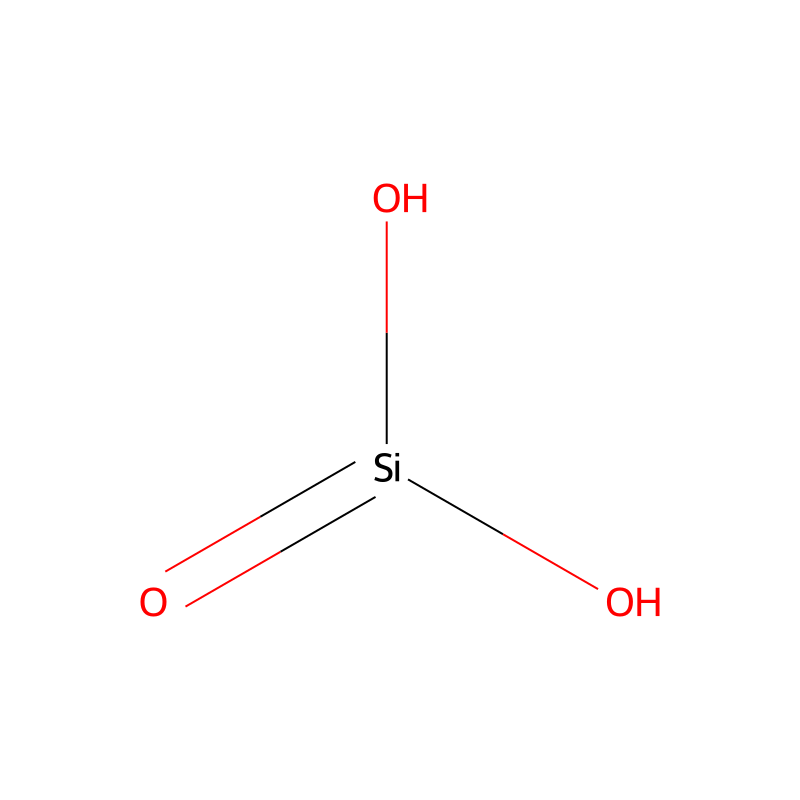
Identifikatoren & physikalische Daten
| CAS No. | 1343-98-2 |
|---|---|
| Summenformel | H2O3Si |
| Durchschnittliche Molmasse | 78,099 g/mol |
| Monoisotopische Masse | 77,97732045 g/mol |
| SMILES | O=[Si](O)O |
| InChIKey | IJKVHSBPTUYDLN-UHFFFAOYSA-N |
| PubChem CID | 14768 |
| EC No. | 231-716-3 |
| DTXSID | DTXSID30872499 |
| Lokaler Name | Metakieselsure |
Chemische & physikalische Eigenschaften
| Polarare Oberfläche (TPSA) | 57,5 |
|---|---|
| H-Brücken-Donoren | 2 |
| H-Brücken-Akzeptoren | 3 |
| Frei drehbare Bindungen | 0 |
| Schwere Atome | 4 |
| Formalladung | 0 |
| Komplexität | 26,3 |
| Schmelzpunkt | 1704℃ |
| Löslichkeit | insoluble in H2Osoluble in HF |
| Aggregatzustand | powder |
| Farbe | White |
| pH | pKa1= 9.65, pKa2 = 13.09(25℃) |
| Dielektrizitätskonstante | 2.0(Ambient) |
| InChI | 1S/H2O3Si/c1-4(2)3/h1-2H |
| InChIKey | IJKVHSBPTUYDLN-UHFFFAOYSA-N |
| SMILES | O[Si](O)=O |
| CAS Datenbank | 7699-41-4(CAS DataBase Reference) |
| EPA chemische Informationen | Silicic acid (H2SiO3) (7699-41-4) |
Sicherheit & Vorschriften
| GHS-Einstufung | This chemical does not meet GHS hazard criteria for 4.8% (5 of 105) of reports.WarningH319 (90.5%): Causes serious eye irritation [Warning Serious eye damage/eye irritation]P261, P264+P265, P271, P280, P304+P340, P305+P351+P338, P319, P337+P317, P403+P233, P405, and P501 (click each P-code to see the statement)Aggregated GHS information provided per 105 reports by companies from 7 notifications to the ECHA C&L Inventory. Each notification may be associated with multiple companies. |
|---|---|
| Regulatorische Informationen | Chemical: Silicic acid (H2SiO3)Silicic acid (H2SiO3): Does not have an individual approval but may be used as a component in a product covered by a group standard. It is not approved for use as a chemical in its own right. |
| Weitere Sicherheitsinformationen | IMAP assessments - Silicic acid (H2SiO3): Human health tier I assessment |
| Hazard Classes and Categories | Eye Irrit. 2 (90.5%) |
| Berufliche Expositionsstufe (OEB) | B |
| Arbeitsplatzgrenzwert (OEL) | TWA: 6.0 mg/m3 |
| Wassergefährdungsklasse (WGK) | 3 |
| TSCA-Inventar-Status | TSCA listed |
| RTECS-Nr. | VV8853000 |
| R-Sätze (R) | 36/37 |
| Gefahrensymbole | Xi |
| Sicherheitshinweise (S) | 22-26-36 |
| Lagerklasse | 11 - Combustible Solids |
| Gefahrenklasse | Eye Irrit. 2STOT SE 3 |
Anwendungen & Verwendung
Beschreibung
Silicic acid is the general name that refers to the group of chemical compounds of the element hydrogen, silicon, and oxygen with the formula [SiOx(OH)4-2x]n. H4SiO4 is the most predominant form. Silicic acid is a hydrated form of silicon dioxide. It belongs to the family of Miscellaneous Silicates. These are inorganic compounds in which the largest metallic oxoanion is silicate, to which either no atom or a non metal atom is bonded. Silicic acid is contained in many foods, such as grain, fruit and vegetables (borage). It is commonly used in the manufacture of toothpastes and as a stationary phase for chromatography.It is utilized for the manufacture catalyst and catalyst carrier. It is involved in tungsten filament production as chemical reagent and flux. Further, it is used for oil and wax decoloring.
Verwenden
Silicic acid is used in protein chromatography. Silicic acid has been used in a study to demonstrate the anti-biofilm potential of a glycolipid surfactant produced by a tropical marine strain of Serratia marcescens. Silicic acid has also been used to study the antioxidant activity of fresh and processed Jalapeno and Serrano peppers.