StartseiteMCPWorkbenchSkills
StartseiteWorkbenchBenachrichtigungenMein Bereich
llms.txt · MCP-AnleitungDatenschutz · Nutzungsbedingungen · Supportv1.8.0
  1. Startseite
  2. /Verbindung

Strontiumcarbonat

Strontium carbonate

HCID 15407
Neue NotizNeue ReaktionAnfrage stellen
Druckvorschau

Daten werden ergänzt – lade die Seite später neu, um den aktuellen Stand zu sehen
GrundinformationenÜberblickNamen und BezeichnerEigenschaftenSicherheit und RegulatorischesChemie und IndustrieZugehörige ReaktionenNotizen zur Verbindung
TeilstruktursucheÄhnliche Strukturen suchen

Grundinformationen

CAS
1633-05-2
Standard-SMILES
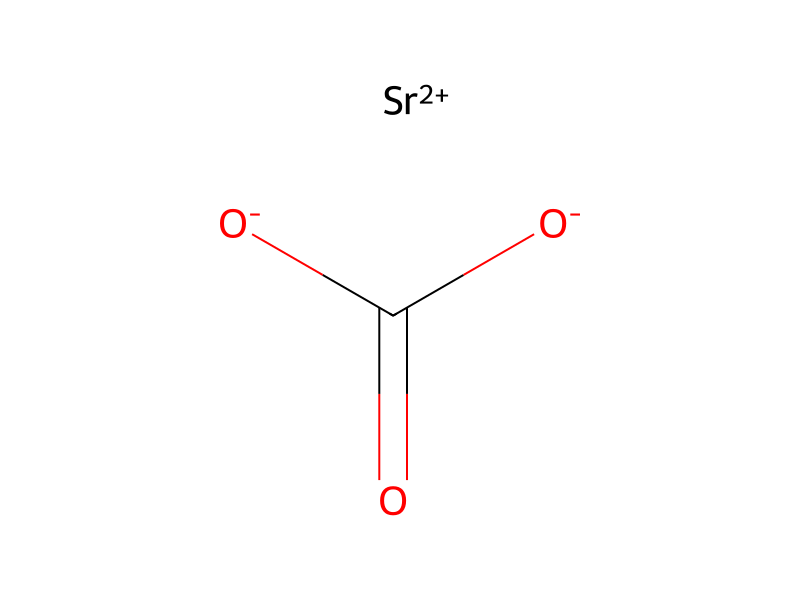
O=C([O-])[O-].[Sr+2]
InChIKey
LEDMRZGFZIAGGB-UHFFFAOYSA-L
Summenformel
SrCO3
Durchschnittliche Molmasse
147,63 g/mol
Monoisotopische Masse
147,89035611

Überblick

Strontianite is a mineral with formula of SrCO3 or Sr(CO3). The IMA symbol is Str.

Namen und Bezeichner

Bevorzugter Name
Strontium carbonate
IUPAC
strontium carbonate
Lokaler Name
Strontiumcarbonat
Englischer Name
Strontium carbonate
Summenformel
CO3Sr
Molmasse
147.63

Namen und Synonyme

STRONTIUM CARBONATE1633-05-2StrontianiteCarbonic acid, strontium salt (1:1)Strontium carbonate (SrCO3)CI 77837Carbonic acid strontium salt (1:1)DTXSID302965141YPU4MMCASTRONTIUM CARBONICUMC.I. 77837DTXCID009651
Weitere Namen anzeigen
Sulfuryl caprylateSTRONTIUM CARBONATE POWDERSrCOci77837Nsc112224StrontiumcarbonatStrontuM carbonateSTRONTIUM CARBONAEStorntiumCarbonate
NSC-112224RefChem:58367216-643-7strontium;carbonateCO3SrSrCO3CCRIS 3203STRONTIUM CARBONAS

Datenbank-Bezeichner

CAS
1633-05-2
PubChem CID
15407
DTXSID
DTXSID3029651
ChEMBL
CHEMBL3188467
UNII
41YPU4MMCA
EC Number
216-643-7
Nikkaji
J44.008F

Eigenschaften

Berechnete StruktureigenschaftenWird ergänzt

Polarare Oberfläche (TPSA)
63,2 Ų
H-Brücken-Donoren
0
H-Brücken-Akzeptoren
3
Frei drehbare Bindungen
0
Schwere Atome
5
Formalladung
0
Komplexität
18,8

Experimentelle und physikochemische Eigenschaften

Chemical ClassesMetals -> Metals, Inorganic Compounds
OdorODORLESS
TasteTASTELESS
Density · 3 Einträge

3.5 g/cu-cm

3.5 g/cm³

3.5 @25 °C

Color/Form · 4 Einträge

WHITE POWDER

Colorless or white rhombic crystalline solid transforming to hexagonal above 926 °C

White orthorhombic crystals

White crystalline powder

Solubility · 6 Einträge

11 MG/L OF WATER AT 18 °C; 650 MG/L OF WATER AT 100 °C

Sol in ammonium salts

Sol in dilute acids

SOL IN 100,000 PARTS WATER; IN ABOUT 1000 PARTS WATER SATURATED WITH CARBON DIOXIDE.

Soluble in acids, carbonated water, and solutions of ammonium salts

Solubility in water, g/100ml at 18 °C: 0.011 (very poor)

DecompositionDECOMPOSES AT 1100 °C INTO STRONTIUM OXIDE AND CARBON DIOXIDE
Melting Point · 2 Einträge

Sicherheit und Regulatorisches

Sicherheitsangaben dienen nur zur Orientierung und ersetzen weder das Sicherheitsdatenblatt (SDB) des Lieferanten noch geltende Vorschriften oder eine fachliche Bewertung.

GHS-Klassifizierung

GHS Classification · 3 Einträge

This chemical does not meet GHS hazard criteria for 99.3% (398 of 401) of all reports.

Not Classified

Aggregated GHS information provided per 401 reports by companies from 5 notifications to the ECHA C&L Inventory.

Gefahrenhinweise

Regulatory Information · 4 Einträge

Chemical: Carbonic acid, strontium salt (1:1)

Carbonic acid, strontium salt (1:1) is listed on the EPA's Chemical Data Reporting (CDR) system. Manufacturers and importers of Carbonic acid, strontium salt (1:1) are required to report information about their production and use of this chemical to the EPA under the Toxic Substances Control Act (TSCA). (40 eCFR Part 711)

REACH registered substance: Strontium carbonate (EC: 216-643-7)

Strontium carbonate: Does not have an individual approval but may be used under an appropriate group standard

Other Safety InformationIMAP assessments - Carbonic acid, strontium salt (1:1): Human health tier I assessment
Fire HazardsNot combustible.
Hazards Summary · 1 Eintrag

An irritant to the eyes and the respiratory tract; Strontium ion has effects on the calcium content of the bones and teeth, but data concerning harmful doses of strontium carbonate are inadequate. [ICSC] May cause irritation; [MSDSonline] See Strontium.

Chemical DangersReacts with acids.
Hazard Classes and CategoriesNot Classified
State Drinking Water Standards

Chemie und Industrie

Verwendung und Herstellung

Uses · 6 Einträge

Naturally found as the mineral strontianite; [Merck Index] Used in pyrotechnics, signals, ceramic ferrites, phosphors, iridescent glass, glass for color television tubes, oxide coatings, and fluxes for producing high-grade steels; Also used in refining sugar and as a lead scavenger in zinc production; [HSDB] Used in the electrical/electronic engineering industry; [IUCLID]

Steel Producing [Category: Industry]

IN PYROTECHNICS; MANUFACTURING IRIDESCENT GLASS; REFINING SUGAR

As a catalyst; in radiation-resistant glass for color television tubes, ceramic ferrites, pyrotechnics.

AS A FLUX IN THE PRODUCTION OF HIGH-GRADE ALLOY STEELS

Manufacture of glass faceplates for color television tubes (x-ray absorber)

U.S. Imports · 2 Einträge

(1986) 3.97X10+4 lb /Strontium carbonate not precipitated incl strontianite/

(1986) 1.20X10+7 lb /Strontium carbonate not precipitated incl strontianite/

U.S. Production2023: 1,000,000 - <5,000,000 lb
Consumption PatternsX-RAY ABSORBER IN FACEPLATES FOR COLOR TELEVISION TUBES, 77%; COMPONENT OF FERRITE MAGNETS, 16%; COMPONENT OF CERAMIC GLAZES, 2%; MISCELLANEOUS, 5% (1982)
Consumer UsesFiller
Industry UsesFiller
Methods of Manufacturing · 2 Einträge

CELESTITE IS BOILED WITH A SOLUTION OF AMMONIUM CARBONATE OR IS FUSED WITH SODIUM CARBONATE.

... Celestite ore is crushed, ground, & stored in bins before it is fed to rotary kilns. As ground ore is being conveyed to the kilns, it is mixed with ground coke. In the kilns, the celestite is reduced to strontium sulfide, which is known as black ash. ... The product ... from the kilns is collected in storage bins. Black ash ... is fine-ground in a ball mill & fed to a leacher circuit ... where it is dissolved in water & the muds are separated by counter current decantation. ... The filered product, a saturated soln containing 12-13% strontium sulfide, is sent to an agitation tank where soda ash is added to cause precipitation of strontium carbonate crystals ... After precipitation is complete, slurry is pumped to vacuum drum filters where nearly complete liq-solids separation is accomplished. The liq is dilute sodium sulfide soln, which is concentrated by evaporation. ... The filter cake is 60% strontium carbonate solid. ... Strontium carbonate also precipitates from strontium sulfide soln with carbon dioxide.

Zugehörige Reaktionen

28
Reaktionsaufzeichnung erstellen
Reaktionsgleichung von HRID 324911
HRID 324911als Eduktuspto-grants-2001_04
Reaktionsgleichung von HRID 387422
HRID 387422als Eduktuspto-grants-2013_02
Reaktionsgleichung von HRID 389328
HRID 389328als Eduktuspto-grants-2013_02
Reaktionsgleichung von HRID 421521
HRID 421521als Eduktuspto-grants-2012_01
Reaktionsgleichung von HRID 905004
HRID 905004als Produktuspto-grants-1983_12
Reaktionsgleichung von HRID 978972
HRID 978972als Produktuspto-grants-1987_05
Reaktionsgleichung von HRID 978973
HRID 978973als Produktuspto-grants-1987_05
Reaktionsgleichung von HRID 978974
HRID 978974als Produktuspto-grants-1987_05
Seite 1 von 4

Notizen zur Verbindung

Wird geladen…

Auf dieser SeiteGrundinformationenÜberblickNamen und BezeichnerEigenschaftenSicherheit und RegulatorischesChemie und IndustrieZugehörige ReaktionenNotizen zur Verbindung
Weitere Aktionen
Neue NotizNeue ReaktionAnfrage stellen

1494 °C

1494 °C

Refractive IndexIndex of refraction (alpha, beta, gamma): 1.518, 1.666, 1.668
Physical Description · 3 Einträge

Dry Powder

White odorless solid; [Merck Index] Colorless or white odorless hygroscopic solid; [HSDB] White odorless powder; [MSDSonline]

WHITE ODOURLESS POWDER.

Other Experimental Properties · 5 Einträge

DECOMPOSES AT 1100 °C INTO STRONTIUM OXIDE AND CARBON DIOXIDE

Liberates carbon dioxide at 1340 °C; impalpable

Enthalpy of formation (crystal): -1220.1 KJ/mol @ 25 °C; Gibbs Energy of formation (crystal): -1140.1 KJ/mol @ 25 °C; Entropy of formation (crystal): 97.1 J/mol-K @ 25 °C; Heat capacity @ constant pressure (crystal): 81.4 J/mol-K @ 25 °C

Hygroscopic

For more Other Experimental Properties (Complete) data for STRONTIUM CARBONATE (6 total), please visit the HSDB record page.

Physikochemische Eigenschaften

Schmelzpunkt
1494 °C · 1494 °C (lit.)
Dichte
3.7 g/mL · 3.7 g/mL at 25 °C (lit.)
Brechungsindex
1.518 · 1.518
storage temp.
Inert atmosphere,Room Temperature
Löslichkeit
dilute aqueous acid: slightly soluble(lit.)
Aggregatzustand
Powder
Wichte
3.7 · 3.7
Farbe
white
PH
7 · 7-8 (20°C, 0.01g/L in H2O)
Geruch (Odor)
Odorless
Wasserlöslichkeit
Soluble in ammonium chloride. Slightly soluble in ammonia and water.
Spezifische Wärmekapazität
0.55 J/ · Cp(crystal): 0.55 J/(g·K), at 25℃
Merck
14 · 14,8838
Stabilität
Stable. Incompatible with strong acids.
InChI
1S/CH2O3.Sr/c2-1(3)4;/h(H2,2,3,4);/q;+2/p-2
InChIKey
LEDMRZGFZIAGGB-UHFFFAOYSA-L
SMILES
[Sr++].[O-]C([O-])=O
LogP
-0.809 · -0.809 (est)
CAS Datenbank
1633 · 1633-05-2(CAS DataBase Reference)
EPA chemische Informationen
Carbonic acid, strontium salt (1:1) (1633-05-2)
· 5 Einträge

(AL) ALABAMA 8 pCi/l /Strontium 90/

(CA) CALIFORNIA 8 pCi/l /Strontium 90/

(CT) CONNECTICUT 8 pCi/l /Strontium 90/

(IL) ILLINOIS 8 pCi/l /Strontium 90/

For more State Drinking Water Standards (Complete) data for STRONTIUM CARBONATE (6 total), please visit the HSDB record page.

State Drinking Water Guidelines · 2 Einträge

(FL) FLORIDA 4,200 ug/l /Strontium/

(ME) MAINE 4200 ug/l /Strontium/

Federal Drinking Water GuidelinesEPA 4000 ug/l

Sicherheit und Schutzausrüstung

Fire FightingIn case of fire in the surroundings, use appropriate extinguishing media.
First Aid Measures · 4 Einträge

Fresh air, rest.

Rinse and then wash skin with water and soap.

Rinse with plenty of water for several minutes (remove contact lenses if easily possible).

Rinse mouth. Give one or two glasses of water to drink.

Safe StorageSeparated from acids.
Disposal Methods · 1 Eintrag

SRP: At the time of review, criteria for land treatment or burial (sanitary landfill) disposal practices are subject to significant revision. Prior to implementing land disposal of waste residue (including waste sludge), consult with environmental regulatory agencies for guidance on acceptable disposal practices.

Spillage DisposalPersonal protection: particulate filter respirator adapted to the airborne concentration of the substance. Sweep spilled substance into covered containers. If appropriate, moisten first to prevent dusting.
Eye PreventionWear safety goggles.
Inhalation RiskA nuisance-causing concentration of airborne particles can be reached quickly.
Skin PreventionProtective gloves.
Exposure PreventionPREVENT DISPERSION OF DUST!
Ingestion PreventionDo not eat, drink, or smoke during work.
Inhalation PreventionAvoid inhalation of dust.
Effects of Short Term ExposureMay cause mechanical irritation to the eyes and respiratory tract.

Toxikologische Informationen

Signs and Symptoms · 2 Einträge

Cough.

Redness.

Natural Pollution Sources · 2 Einträge

Strontium forms 0.02-0.03% of the earth's crust and is present in igneous rocks in amounts averaging 375 ppm(1). Of the naturally occurring strontium compounds, only the minerals strontianite (strontium carbonate) and celestite (strontium sulfate) are of economic importance(2).

OCCURS IN NATURE AS THE MINERAL STRONTIANITE.

Human Toxicity Excerpts... Inorganic salts of strontium /such/ as the chloride, sulfate, carbonate ... are remarkably benign. ... In large oral doses they presumably exert local osmotic effects & so tend to induce vomiting & diarrhea.
Artificial Pollution Sources · 1 Eintrag

More than 80% of all strontium consumed in 1995 was used in ceramic and glass manufacture, primarily in televison faceplate glass (strontium carbonate/oxide)(1). In addition, strontium (strontium carbonate) is used to remove lead impurities during the electrolytic production of zinc(1). The production and use of these strontium compounds may result in its release to the environment through various waste streams(SRC).

Non-Human Toxicity Excerpts · 4 Einträge

Major signs of chronic toxicity, which involve the skeleton, have been labeled as "strontium rickets". ... Rickets /have been produced/ in laboratory rats by feeding them strontium carbonate at 2% strontium in diet.

THE SKELETAL MALFORMATIONS INDUCED IN RATS OF WISTAR STRAIN BY STRONTIUM CARBONATE WERE STUDIED WITH SKELETAL PREPARATIONS (DAWSON'S & NOVAK'S METHODS) & FETUSES WITH MARKED CONGENITAL KYPHOSIS WERE EXAMINED HISTOLOGICALLY. STRONTIUM CARBONATE (200 MG/100 G BODY WT) MIXED WITH A PELLET (ORIENTAL KOBO LTD 15 G/DAY) OR A ROUTINE DIET WAS ADMINISTERED DURING PREGNANCY. THE VERTEBRAL COLUMN SHOWED KYPHOSIS AROUND THE JUNCTION OF THORACIC & LUMBAR VERTEBRAE, & DISARRANGEMENT OF VERTEBRAE WERE SOMETIMES SHOWN AT THE OTHER PARTS. THE VERTEBRAL BODY AT THE CURVED VERTEBRAL COLUMN WAS TRAPEZOID IN FIGURE. SKELETAL MALFORMATIONS OF A ROUTINE DIET GROUP WERE MORE FREQUENT & MORE MARKED THAN A PELLET GROUP.

A SINGLE INTRATRACHEAL INSTILLATION OF 50 MG STRONTIUM CARBONATE/RAT RESULTED IN HYPERVOLEMIA OF PULMONARY BLOOD VESSELS & HYPERPLASIA OF THE LYMPHOID FOLLICLES IN THE BRONCHIAL SUBMUCOSA AFTER 1 MONTH. AFTER 9 & 12 MONTHS, SCLEROSIS OF THE WALLS OF BLOOD VESSELS & BRONCHI WAS FOUND. THE BRONCHIAL EPITHELIUM WAS REGENERATED.

Adult white leghorn hens were fed a standard diet containing 2.93% calcium, 0.79% phosphorus & 17% protein & water ad libitum for a 4-wk period. The dietary calcium was fed at a constant level of 2.93% for all dietary treatments. Strontium carbonate was added to the diets of 10 birds to supply levels of 0, 1.5 & 3.0% strontium. These levels produced zero hatchability of fertile eggs & ash content of egg shells was increased as the dietary strontium level was increased. Embryo ash, calcium & phosphorus contents were reduced with incr dietary strontium level. Skeletal calcification in chick embryos appeared to be inhibited by retained transferred strontium.

Regulatorische Informationen

State Drinking Water Standards · 5 Einträge

(AL) ALABAMA 8 pCi/l /Strontium 90/

(CA) CALIFORNIA 8 pCi/l /Strontium 90/

(CT) CONNECTICUT 8 pCi/l /Strontium 90/

(IL) ILLINOIS 8 pCi/l /Strontium 90/

For more State Drinking Water Standards (Complete) data for STRONTIUM CARBONATE (6 total), please visit the HSDB record page.

State Drinking Water Guidelines · 2 Einträge

(FL) FLORIDA 4,200 ug/l /Strontium/

(ME) MAINE 4200 ug/l /Strontium/

Federal Drinking Water GuidelinesEPA 4000 ug/l

Sicherheitsdaten

wgk
-
tsca
TSCA listed
hs_code
2836920000
Speicherklasse
13 - Non Combustible Solids
Giftige Stoffe Daten
1633-05-2(Hazardous Substances Data)
Formulations/PreparationsGRADES: PRECIPITATED; TECHNICAL; NATURAL; REAGENT.
General Manufacturing Information · 2 Einträge

Paint and Coating Manufacturing

Carbonic acid, strontium salt (1:1): ACTIVE

Anwendungen · 3 Einträge

BeschreibungStrontium carbonate has the formula of SrCO3 and the molecular weight of 147.6326 g/mol. Strontium carbonate occurs in nature as the mineral “strontianite”. The name strontianite comes from a famous location for the mineral, Strontian, Scotland. Strontianite is strontium carbonate as found naturally. It occurs as white or slightly gray orthorhombic crystals with a refractive index of 1.518. The unit-cell parameters are: a = 5.107 , b = 8.414 , c = 6.029 , Z = 4; V = 259.07 3, Den(Calc) = 3.78. The crystal system is orthorhombic with space group Pmcn and point group 2/m, 2/m, 2/m. Strontium carbonate has only one stable form (aragonite-type structure) and temperature of precipitation has no effect on crystal form, unlike that of calcium or magnesium carbonates.

OccurrenceStrontium carbonate occurs in nature as mineral strontianite. The compound is used in pyrotechnics and ceramic ferrites. It also is used in making iridescent glass for color television tubes. Other uses are in refining sugar and preparing other strontium salts.

VerwendenStrontium carbonate (SrCO3) is used to make radiation-resistant glass and TV picture tubes, as well as pyrotechnics.

Darstellung · 1 Eintrag

synthetischeStrontium carbonate occurs in nature as strontianite and can be mined from its deposit. It is, however, usually made commercially from the mineral “celestite”. Celestite is fused with sodium carbonate at elevated temperatures or boiled with a solution of ammonium carbonate.Strontium carbonate is insoluble in water. It precipitates from the product mixture in the second reaction. If fused with sodium carbonate, the product mixture is leached with water. Insoluble carbonate separates from the water-soluble sodium sulfate.

Vor- und nachgelagerte Produkte

Vorgelagerte Rohstoffe

SODIUM SULFATE DECAHYDRATENatriumsulfatStrontiumnitratKohlenstoffdioxidStrontiumchloridStrontiumsulfatMineral powderKoks (Kohle)AmmoniumhydrogencarbonatDiammoniumcarbonatNatriumcarbonat

Nachgelagerte Produkte

Strontiumnitrat(Strontium-Calcium) Chrome YellowStrontiumchloridStrontiumfluoridSTRONTIUM HYDROXIDE OCTAHYDRATEIsodecanalStrontiumoxidStrontiumhydroxid

Ergänzende Hinweise

Definitionstrontianite: A mineral form ofstrontium carbonate, SrCO3.