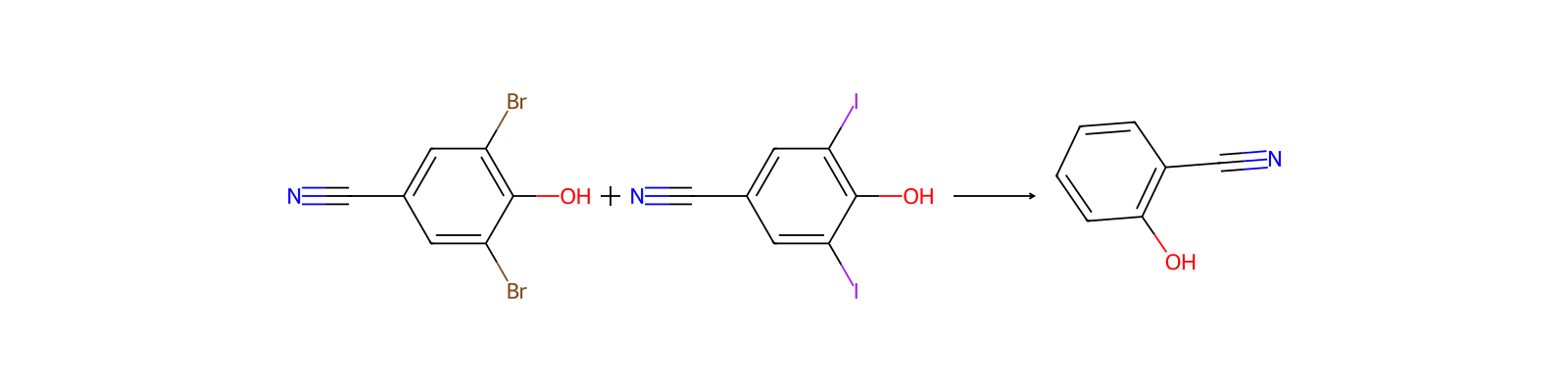

Grundinformationen
- Standard-SMILES
N#Cc1cc(I)c(O)c(I)c1- InChIKey
NRXQIUSYPAHGNM-UHFFFAOYSA-N- Summenformel
- C7H3I2NO
- Durchschnittliche Molmasse
- 370,91 g/mol
- Monoisotopische Masse
- 370,83041
Namen und Bezeichner
- Bevorzugter Name
- Ioxynil
- IUPAC
- 4-hydroxy-3,5-diiodobenzonitrile
- Lokaler Name
- Ioxynil (ISO)
- Englischer Name
- Ioxynil
- Summenformel
- C7H3I2NO
- Molmasse
- 370.91
Namen und Synonyme
Ioxynil4-Hydroxy-3,5-diiodobenzonitrile1689-83-4ActrilBentrol3,5-Diiodo-4-hydroxybenzonitrileTrevespanCertrolActrilawnCipotrilJoxynilLoxynil
Weitere Namen anzeigen
IOTRILMyloneTOTRILCertolMEXTROL
IotoxBenzonitrile, 4-hydroxy-3,5-diiodo-2,6-Diiodo-4-cyanophenolBANTROL4-Cyano-2,6-diiodophenolDTXSID80221614-Cyano-2,6-dijodphenolM&B 8873
Datenbank-Bezeichner
- CAS
1689-83-4- PubChem CID
- 15530
- DTXSID
DTXSID8022161- ChEMBL
CHEMBL509523- ChEBI
CHEBI:81821- UNII
- 8Y734M4V9E
- EC Number
- 216-881-1
- Nikkaji
- J3.375H
Eigenschaften
Berechnete Struktureigenschaften
- XLogP
- 2
- Polarare Oberfläche (TPSA)
- 44 Ų
- H-Brücken-Donoren
- 1
- H-Brücken-Akzeptoren
- 2
- Frei drehbare Bindungen
- 0
- Schwere Atome
- 11
- Formalladung
- 0
- Komplexität
- 176
Experimentelle und physikochemische Eigenschaften
LogP
Log Kow = 0.90 at pH 6.5
3.51
Odor
Faint phenolic /tech grade/
Odorless when pure
Color/FormColorless crystalline solid
Solubility
SOLUBILITY IN WATER @ 20-25 °C: 22% /LITHIUM SALT/; 14% /SODIUM SALT/; 10.7% /POTASSIUM SALT/
SOLUBILITY IN WATER: 0.005% @ 20 °C; IN CYCLOHEXANONE: 14%; IN DIMETHYLFORMAMIDE: 74%
SLIGHTLY SOL IN CHLOROFORM; SOL IN ETHER
AT 25 °C: IN ACETONE MORE THAN 10 G/100 ML; IN BENZENE 1.1 G/100 ML; IN CARBON TETRACHLORIDE 0.14 G/100 ML; IN METHANOL 3.3 G/100 ML; IN WATER 130 PPM
In water 50 mg/l (25 °C). In acetone 70, ethanol, methanol 20, cyclohexanone 140, tetrahydrofuran 340, dimethylformamide 740, chloroform 10, carbon tetrachloride <1 (all in g/l, 25 °C)
Solubility in water: none
CorrosivityNon-corrosive
Boiling PointSublimes at circa 140 °C/0.1 mm Hg
DecompositionWhen heated to decomposition ... emits toxic fumes of /hydrogen iodide and hydrogen chloride/.
Melting Point
212-213 °C
CREAM POWDER; FAINT PHENOLIC ODOR; MELTING POINT: 200 °C /TECHNICAL PRODUCT/
212-213 °C
Vapor Pressure
0.00000014 [mmHg]
Vapor pressure: 2.77X10⁻⁵ mm Hg at 105 °C /Octanoate/
Less than 1 mPa at 20 °C
Vapor pressure, Pa at 20 °C:
Physical Description
Colorless odorless solid; [ICSC] Technical product is cream solid; Decomposed by sunlight and ultraviolet light; [HSDB] Powder; [MSDSonline]
ODOURLESS COLOURLESS CRYSTALS.
Stability/Shelf Life
PRACTICALLY NON-VOLATILE
NO DETERIORATION IN LESS THAN 2 YEARS OF STORAGE
Very stable to acids and bases. Decomposed by sunlight and UV light.
Dissociation ConstantsPK: 3.96
Physikochemische Eigenschaften
- Schmelzpunkt
- 200 °C · 200 °C
- Siedepunkt
- 282.6 · 282.6±40.0 °C(Predicted)
- Dichte
- 2.4947 · 2.4947 (estimate)
- storage temp.
- Keep in dark place,Sealed in dry,Room Temperature
- pka
- 4.95 · 4.95±0.23(Predicted)
- Wasserlöslichkeit
- Insoluble
- BRN
- 2364041 · 2364041
- Henry's Law Constant
- 1.3 · 1.3×102 mol/(m3Pa) at 25℃, Mackay et al. (2006)
- CAS Datenbank
- 1689 · 1689-83-4(CAS DataBase Reference)
- NIST chemische Informationen
- 4 · Benzonitrile, 4-hydroxy-3,5-diiodo-(1689-83-4)
- EPA chemische Informationen
- Ioxynil (1689-83-4)
Sicherheit und Regulatorisches
GHS-Klassifizierung
GHS Classification
Danger
H301: Toxic if swallowed [Danger Acute toxicity, oral];H312: Harmful in contact with skin [Warning Acute toxicity, dermal];H319: Causes serious eye irritation [Warning Serious eye damage/eye irritation];H331: Toxic if inhaled [Danger Acute toxicity, inhalation];H361d ***: Suspected of damaging the unborn child [Warning Reproductive toxicity];H373 **: May causes damage to organs through prolonged or repeated exposure [Warning Specific target organ toxicity, repeated exposure];H400: Very toxic to aquatic life [Warning Hazardous to the aquatic environment, acute hazard];H410: Very toxic to aquatic life with long lasting effects [Warning Hazardous to the aquatic environment, long-term hazard]
P203, P260, P261, P264, P264+P265, P270, P271, P273, P280, P301+P316, P302+P352, P304+P340, P305+P351+P338, P316, P317, P318, P319, P321, P330, P337+P317, P362+P364, P391, P403+P233, P405, and P501 (click each P-code to see the statement)
Danger
Gefahrenhinweise
Regulatory Information
04/58/EC, Reg. (EU) 2022/801, Reg. (EU) No 540/2011
Ioxynil: Does not have an individual approval but may be used under an appropriate group standard
Fire HazardsCombustible. Liquid formulations containing organic solvents may be flammable. Gives off irritating or toxic fumes (or gases) in a fire. Finely dispersed particles form explosive mixtures in air.
Hazards Summary
A mild skin and eye irritant; Can be absorbed through skin; May be a developmental toxin, based on animal studies; [ICSC] In acute poisoning, workers had vomiting, increase in body temperature, excessive perspiration, elevated thiocyanate in urine, and abnormal liver enzymes; No adverse effects were observed in 90-day 111 ppm oral study with rats; Inhibited oxidative phosphorylation in rat liver mitochondria; [HSDB] See Benzonitrile.
EC ClassificationSymbol: T, N; R: 21-23/25-36-48/22-63-50/53; S: (1/2)-36/37-45-60-61-63
UN ClassificationUN Hazard Class: 6.1; UN Pack Group: III
Chemical DangersDecomposes on burning. This produces toxic fumes including nitrogen oxides, iodine and cyanide compounds.
Physical DangersDust explosion possible if in powder or granular form, mixed with air.
Packaging and LabellingDo not transport with food and feedstuffs. Marine pollutant.
DOT Hazard Classification
Ioxynil
Marine pollutant
Hazard Classes and Categories
Acute Tox. 3 (100%);Acute Tox. 4 (100%);Eye Irrit. 2 (100%);Acute Tox. 3 (100%);Repr. 2 (61.3%);Repr. 2 (38.7%);STOT RE 2 (100%);Aquatic Acute 1 (100%);Aquatic Chronic 1 (100%)
Reproductive toxicity - category 2;Acute toxicity - category 3;Acute toxicity - category 3;Acute toxicity - category 4;Eye irritation - category 2;Hazardous to the aquatic environment (acute) - category 1;Hazardous to the aquatic environment (chronic) - category 1;Specific target organ toxicity (repeated exposure) - category 2
Repr. 2;Acute Tox. 3 *;Acute Tox. 3 *;Acute Tox. 4 *;STOT RE 2 *;Eye Irrit. 2;Aquatic Acute 1;Aquatic Chronic 1
Skin, Eye, and Respiratory IrritationsAvoid skin and eye contact and inhalation of spray fumes. Prevent drifting.
Sicherheit und Schutzausrüstung
Fire FightingUse water spray, powder, foam, carbon dioxide.
First Aid Measures
Fresh air, rest. Refer for medical attention.
Remove contaminated clothes. Rinse and then wash skin with water and soap. Refer for medical attention .
First rinse with plenty of water for several minutes (remove contact lenses if easily possible), then refer for medical attention.
Induce vomiting (ONLY IN CONSCIOUS PERSONS!). Refer for medical attention .
Safe StorageProvision to contain effluent from fire extinguishing. Separated from strong oxidants and food and feedstuffs.
Exposure Control and Personal Protection2.0 [mg/m3], inhalable fraction, as CN[German Research Foundation (DFG)]
Disposal Methods
SRP: At the time of review, criteria for land treatment or burial (sanitary landfill) disposal practices are subject to significant revision. Prior to implementing land disposal of waste residue (including waste sludge), consult with environmental regulatory agencies for guidance on acceptable disposal practices.
Spillage Disposal
Personal protection: particulate filter respirator adapted to the airborne concentration of the substance. Do NOT let this chemical enter the environment. Sweep spilled substance into covered sealable containers. If appropriate, moisten first to prevent dusting. Carefully collect remainder. Then store and dispose of according to local regulations.
Eye PreventionWear safety goggles or face shield.
Fire PreventionNO open flames. Closed system, dust explosion-proof electrical equipment and lighting. Prevent deposition of dust.
Inhalation RiskNo indication can be given about the rate at which a harmful concentration of this substance in the air is reached on evaporation at 20 °C.
Skin PreventionProtective gloves. Protective clothing.
Exposure PreventionSTRICT HYGIENE! AVOID ALL CONTACT! AVOID EXPOSURE OF ADOLESCENTS AND CHILDREN! IN ALL CASES CONSULT A DOCTOR!
Ingestion PreventionDo not eat, drink, or smoke during work. Wash hands before eating.
Toxikologische Informationen
InteractionsDIFFERENTIAL FOLIAR...UPTAKE MAY...BE AFFECTED BY THE PRESENCE OR ABSENCE OF A SURFACTANT IN THE HERBICIDE FORMULATION.
Ecotoxicity Values
LD50 MALLARD ORAL 1200 MG/KG /TECHNICAL IOXYNIL OCTANOATE/
LD50 PHEASANT ORAL 1000 MG/KG /TECHNICAL IOXYNIL OCTANOATE/
LC50 HARLEQUIN FISH 3.3 PPM/48 HR /SODIUM SALT/
Environmental Fate
TERRERSTRIAL FATE: IOXYNIL IS LOOSELY BOUND, PROBABLY TO THE COLLOIDAL FRACTION OF SOILS. DISAPPEARANCE IS LESS RAPID IN STERILE SOILS INDICATING THAT SOIL MICROBES AID BREAKDOWN. ... RESULTANT AVG PERSISTENCE: VIRTUALLY NO PREEMERGENCE EFFECT FROM NORMAL APPLICATION RATES @ ANY PERIOD AFTER SPRAYING.
TERRESTRIAL FATE: Based on a recommended classification scheme(1), an estimated Koc value of 75(SRC), determined from a measured log Kow(2) and a recommended regression-derived equation(3), indicates that Bantrol will have high mobility in soil(SRC). Bantrol is expected to rapidly biodegrade in soil under aerobic conditions with a measured half-life of 9-10 days(4). Some degradation in anaerobic environments is possible; cyano-labelled Bantrol under anaerobic conditions released a small amount of 14CO2(5). Metabolites from the aerobic biodegradation of Bantrol were 3,5-diiodo-4-hydroxybenzamide and 3,5-diiodo-4-hydroxybenzoic acid(5). Volatilization of Bantrol should not be important from moist soil surfaces(SRC) given an estimated Henry's Law constant of 5.5X10⁻¹⁰ atm-cu m/mole(SRC), using a recommended regression equation(6). Volatilization from dry soil surfaces is not expected(SRC) based on an estimated vapor pressure of 1.4X10⁻⁷ mm Hg(SRC), from a fragment constant method(7).
AQUATIC FATE: Based on a recommended classification scheme(1), an estimated Koc value of 75(SRC), determined from a measured log Kow(2) and a recommended regression-derived equation(1), suggests that Bantrol will not adsorb to suspended solids and sediment in water(SRC). Based on soil studies, Bantrol is expected to biodegrade under aerobic conditions; some biodegradation may be seen in anaerobic environments(SRC). An aerobic biodegradation half-life of 9-10 days was measured in a clay loam soil with high organic matter content(3). Metabolites from the aerobic biodegradation of Bantrol were 3,5-diiodo-4-hydroxybenzamide and 3,5-diiodo-4-hydroxybenzoic acid(4). Bantrol should not volatilize from water surfaces based on an estimated Henry's Law constant of 5.5X10⁻¹⁰ atm-cu m/mole(SRC), developed using a fragment constant estimation method(5). According to a classification scheme(6), an estimated BCF value of 3(1,SRC), from a measured log Kow(2), suggests that bioconcentration in aquatic organisms is low(SRC). Bantrol was stable for several weeks in natural water exposed to UV light; 10% degradation required greater than 1 month(7).
ATMOSPHERIC FATE: According to a model of gas/particle partitioning of semivolatile organic compounds in the atmosphere(1), Bantrol, which has an estimated vapor pressure of 1.4X10⁻⁷ mm Hg at 25 °C(2), will exist in both the vapor and particulate phases in the ambient atmosphere. Vapor-phase Bantrol is degraded in the atmosphere by reaction with photochemically produced hydroxyl radicals(SRC); the half-life for this reaction in air is estimated to be about 75 days(3,SRC). Particulate-phase Bantrol may be physically removed from the air by wet and dry deposition(SRC).
Adverse Effects
Occupational hepatotoxin - Secondary hepatotoxins: the potential for toxic effect in the occupational setting is based on cases of poisoning by human ingestion or animal experimentation.;Nephrotoxin - The chemical is potentially toxic to the kidneys in the occupational setting.;Other Poison - Uncoupler
Exposure RoutesThe substance can be absorbed into the body by inhalation of its aerosol, through the skin and by ingestion.
Signs and Symptoms
Dizziness. Headache. Sweating. Vomiting. Weakness. Fever.
MAY BE ABSORBED! Pain. Redness.
Pain. Redness.
See Inhalation.
ICSC Environmental DataThe substance is toxic to aquatic organisms. Avoid release to the environment in circumstances different to normal use.
Soil Adsorption/Mobility
The Koc of Bantrol is estimated as approximately 75(SRC), using a measured log Kow of 0.90(1) and a regression-derived equation(2,SRC). According to a recommended classification scheme(3), this estimated Koc value suggests that Bantrol has high mobility in soil(SRC). Alkaline soils adsorbed small amounts of Bantrol on soil particles(4).
Atmospheric ConcentrationsURBAN AIR: Bantrol was not detected in air collected from Kitakyushu, Japan, in either July 1991 or April 1992 (detection limit=0.4 ng/cu m)(1).
Human Toxicity Excerpts
SYMPTOMS OF POISONING: INCREASED BODY TEMPERATURE, SWEATING & INCR RESPIRATION.
FOUR WORKERS INVOLVED IN PRODUCTION OF IOXYNIL SUDDENLY DEVELOPED SUBACUTE POISONING. SYMPTOMS: WT LOSS DUE TO EXCESSIVE PERSPIRATION, FEVER, EMESIS. ELEVATED THIOCYANATE LEVELS IN URINE AND ENZYMES SGOT, CREATINE PHOSPHOKINASE, LACTATE DEHYDROGENASE & ALDOLASE WERE ELEVATED. THE URINARY THIOCYANATE LEVELS WERE ELEVATED IN THREE CASES (15-40 MG/L), WHILE NO AROMATIC AMINES WERE FOUND.
A 54 yr old man who had undergone gastrectomy swallowed a small amount of an unknown fluid, which he had stored with his homemade wine. He died 45 min later en route to the hospital. Chemical analysis ... established that the remaining material was ioxynil at a concn of 11.3%. It was estimated that the victim had swallowed 2000-3000 mg. Alcohol was also present at a concn of 0.135%. Autopsy revealed hyperemia of all organs, edema of the lungs, and edema of the brain with an occipital cone.
Signs and symptoms: Gastroenteritis, fever/hyperthermia (increased metabolic rate). /From table/
Artificial Pollution SourcesBantrol's use as a selective contact herbicide outside of the United States(1,2), will result in its direct release to the environment(SRC).
Environmental Biodegradation
...IOXYNIL.../HAS/ HALF-LIFE OF LESS THAN 2 WK IN SOILS. WHEN STERILE SOILS WERE TREATED WITH IOXYNIL...LITTLE OR NO DEGRADATION WAS /DETECTED/... IN NONSTERILE SOILS...DEGRADATION WAS RAPID. DEGRADATION PRODUCTS FROM NONSTERILE SOILS TREATED WITH ...IOXYNIL WERE...IDENTIFIED AS THE BENZOIC ACID DERIVATIVES WITH TRACES OF INORGANIC IODIDE FROM IOXYNIL.
/Researchers/ attributed the reduced effectiveness of ... herbicide during adaptation studies to microbial degradation. Recent studies ... have also provided indirect evidence for the adaptation of Erwinia carotovora, Pseudomonas fluorescens, and Bacillus species to ioxynil.
In nonsterile soil, Bantrol was biodegraded to 3,5-diiodo-4-hydroxybenzoic acid through its intermediate amide; free iodine was also liberated(1). Degradation of both ring and cyano-labelled Bantrol to CO2 in a clay loam soil with high organic matter content was measured; 14CO2 was released more quickly initially from the cyano-labelled Bantrol(2). No 14CO2 was released from autoclaved soil or from ring-labelled Bantrol under anaerobic conditions(2). Cyano-labelled Bantrol under anaerobic conditions released a small amount of 14CO2. Metabolites from the aerobic biodegradation of Bantrol were 3,5-diiodo-4-hydroxybenzamide and 3,5-diiodo-4-hydroxybenzoic acid(2). The aerobic half-life of Bantrol degradation in a clay loam soil with high organic matter content was 9-10 days(3).
Regulatorische Informationen
Regulatory Information
04/58/EC, Reg. (EU) 2022/801, Reg. (EU) No 540/2011
Ioxynil: Does not have an individual approval but may be used under an appropriate group standard
Sicherheitsdaten
- wgk
- 3
- ridadr
- 3276
- hs_code
- 29269095
- RTECS-Nr.
- DI4025000
- risk_code
- 63-50/53-48/22-36-23/25-21
- hazard_code
- N-T,N,T
- safety_code
- 61-60-45-36/37-63
- hazard_class
- 6.1
- packing_group
- III
- Giftige Stoffe Daten
- 1689-83-4(Hazardous Substances Data)
Chemie und Industrie
Pharmakologische Informationen
Mechanism of Action
/Ioxynil is a/ highly active uncoupler of oxidative phosphorylation in plants & animals & inhibitor of photoreduction and photophosphorylation reactions in chloroplasts. ...higher concn of ioxynil ... also inhibit electron transport in isolated mitochondria and chloroplasts. ... Indirect evidence suggests that ioxynil ... causes a rapid and severe alteration in the energy balance of the plant cell. ... Levels of ATP were reduced 90% in excised soybean hypocotyls when compared to controls 3 hr after treatment with high concn (2X10⁻⁴ M) of ioxynil. ... The hormonal control of proteolytic and amylolytic enzyme activity in germinating seeds has been studied extensively. The studies indicate that ... ioxynil may either interfere with the development or transport of cytokinin & gibberellin hormones, or may interfere with the biosynthetic processes leading to enzyme formation.
Acts by inhibition of the second light reaction of photosynthesis...
The herbicide ... ioxynil ... inhibited energy dependent Ca(2)+ uptake in plant (maize, zucchini) mitochondria at a concn where /it/ did not inhibit ADP phosphorylation and did not interfere with tubulin polymerization. A common mechanism of action of /this herbicide/ is probably the inhibition of the regulation of cytoplasmic free Ca(2)+ concn which may in turn lead to many physiological malfunctions.
Metabolism/Metabolites
FOUR DAYS AFTER FOLIAR TREATMENT WITH [CYANO-(14)C]IOXYNIL, UNCHANGED IOXYNIL, TRACE AMT OF BENZAMIDE & BENZOIC ACID DERIVATIVES, AND AT LEAST 2 OTHER UNKNOWN (14)C COMPOUNDS WERE TENTATIVELY IDENTIFIED IN RESISTANT BARLEY. ... THESE LIMITED DEGRADATION STUDIES /OF SUSCEPTIBLE COAST FIDDLENECK AND RESISTANT WINTER WHEAT/ SUGGEST THAT THE UNHINDERED NITRILE GROUPS OF ... IOXYNIL ARE SLOWLY HYDROLYZED IN THE PLANT TO THE CORRESPONDING BENZAMIDE AND BENZOIC ACID DERIVATIVES WITH POSSIBLE FURTHER DEGRADATION THROUGH DECARBOXYLATION, DEHALOGENATION, OR CONJUGATION OF THE BENZYL MOIETY OR THE AROMATIC RING. DECARBOXYLATION &...CONJUGATION REACTIONS MAY BE MUCH FASTER THAN HYDROLYSIS. THIS IS SUPPORTED BY THE DETECTION OF TRACE AMT OF THE HYDROLYSIS PRODUCTS & THE RAPID ACCUMULATION OF INSOLUBLE RESIDUES WITH (CYANO-14C)IOXYNIL...
BREAKDOWN OF IOXYNIL IN ROOT-TREATED BEAN PLANTS TO...BENZOIC ACID & IODIDE IONS HAS BEEN SUGGESTED & IODIDE HAS...BEEN SHOWN TO BE PRESENT IN BEAN PLANTS TREATED WITH IOXYNIL.
Absorption, Distribution and Excretion
NO RESIDUES OF IOXYNIL WERE FOUND IN MILK OF DAIRY COW. NO IOXYNIL OR A POSSIBLE METABOLITE, 3,5-DIIODO-4-HYDROXYBENZOIC ACID, WERE FOUND IN THE MILK, URINE, OR FECES BY GAS CHROMATOGRAPHY ANALYSIS.
...IOXYNIL.../IS/ ABSORBED BY FOLIAGE & TRANSLOCATED. ...PRIMARY ROUTE OF FOLIAR PENETRATION...APPEARS TO BE CUTICULAR RATHER THAN STOMATAL... TRANSLOCATION STUDIES WITH (14)C-BROMOXYNIL HAVE SHOWN THAT MOST OF THE (14)C REMAINS IN TREATED LEAVES OF BOTH RESISTANT & SUSCEPTIBLE SPECIES. ... SIMILAR OBSERVATIONS, WHICH SUGGEST LIMITED SYMPLASTIC TRANSLOCATION, HAVE ALSO BEEN REPORTED FOR IOXYNIL.
AUTORADIOGRAPHY OF [CYANO-(14)C]IOXYNIL-TREATED MUSTARD, COTTON...BEAN, BARLEY, & PEA PLANTS HAS SHOWN THAT MOST OF THE RADIOACTIVITY REMAINS AT OR CLOSE TO SITE OF FOLIAR APPLICATION. BASIPETAL MOVEMENT OF (14)C TO BASE OF PETIOLE WAS OBSERVED IN MOST OF TREATED LEAVES AFTER 5 HR. FURTHER MOVEMENT UP THE STEM TO YOUNGER LEAVES & THE SHOOT APEX...WITH BYPASSING OF MATURE LEAVES WAS...OBSERVED. OUTWARD MOVEMENT TO TIPS OF TREATED LEAVES WAS NOTED, BUT TRANSLOCATION OF (14)C FROM TREATED ROOTS WAS LIMITED. STEM TREATMENTS RESULTED IN CONSIDERABLE UPWARD (14)C MOVEMENT, PARTICULARLY WHEN THE HERBICIDE WAS PLACED OVER AN INCISION. CONCENTRATED AREAS OF (14)C WERE NOTED IN THE VEINS OF THE LEAVES AFTER STEM TREATMENT.
... Binding /of ioxynil/ to human plasma proteins was compaired with that of T3, to gain insight into possible effects in humans. after incubating human serum with (125)I ioxynil, 2DIEP against anti-whole human serum and rocket immunoelectrophoresis against anti-TBPA, albumin or TBG were carried out. Ioxynil bound to TBPA but not to TBG nor albumin. The Ka calculated for the TBPA-ioxynil complex was 2.6x10(6) l mol/l. Ioxynil competed for the iodothymidine binding sites of TBPA.
Verwendung und Herstellung
Uses
Used as selective contact herbicide for post-emergence control of many annual broad-leaved weeds in cereals, onions, flax, sugar cane, forage grasses, lawns, and freshly sown turf; Also used as a molluscicide; Not marketed in the US; Produced by Rhone-Poulenc in New Zealand (Axall), Ireland (Brottox), and Ethiopia and Kenya (Maytril); [HSDB]
Farming (Pesticides) [Category: Industry]
MOLLUSCICIDE
Selective contact herbicide with some systemic activity. Absorbed by the foliage...used for post-emergence control of a wide range of annual broad-leaved weeds, especially young seedlings of the Polygonaceae, Compositae, and Boraginaceae, in cereals, onions, leeks, garlic, shallots, flax, sugar cane, forage grasses, lawns, and newly-sown turf.
/IT IS USED FOR/ POST-EMERGENCE CONTROL FOR SEEDLING WEEDS (BINDWEED, SMARTWEED, BUTTERCUPS, CHICKWEED, CORNFLOWER, DANDELION, FAT HEN, GROUNDSEL, MAYWEEDS, MUSTARDS, PLANTAINS, SHEPHERDSPURSE, SPEEDWELLS, ETC) IN CEREALS. BELGRAN, CERTROL DS FOR SUGAR CANE. ACTRIL DS FOR SUGARCANE, CITRUS, RICE, AND OIL PALM. IOTOX FOR SPORTS TURF.
U.S. ProductionNot marketed in the United States
Methods of Manufacturing...BY IODINATION OF 4-HYDROXYBENZALDEHYDE, CONVERSION TO OXIME, TO ACETATE & HYDROLYSIS TO NITRILE.
Formulations/Preparations
These incl aq concn of salts Actrilawn; emulsifiable concn of esters: Mate, Totril; mixtures incl as salts: Actril 3 (ioxynil + dichlorprop + MCPA); Actril 4, Actril S, Dantril, Tetroxone (ioxynil + bromoxynil + dichlorprop + MCPA), Certrol-Lin Onions; wettable powder (ioxynil + linuron), Certrol PA (ioxynil + dichlorprop + MCPA); Actril C, Iotox (ioxynil + mecoprop). As octanoates and esters: Actril DS (ioxynil + 2,4-D-isooctyl), Brittox (ioxynil + bromoxynil), Oxytril P (isoxynil + bromoxynil + dichlorprop-isooctyl).
AQ SOLN OF SODIUM SALT (25% WT/VOL EQUIV) IN AQ TETRAHYDROFURFURYL ALCOHOL.
ACTRIL C, ACTRIL M FOR USE ON WINTER AND SPRING SOWN CEREALS (IOXYNIL + MECOPROP SALTS). OXYTRIL CM FOR USE IN UNDERSOWN CEREAL CROPS WHERE CORN MARIGOLD IS A PROBLEM (IOXYNIL + BROMOXYNIL ESTERS), OXYTRIL M BRITTOX FOR USE IN WINTER AND SPRING-SOWN CEREALS (IOXYNIL + BROMOXYNIL + CMPP ESTERS). OXYTRIL P FOR USE ON SPRING-SOWN CEREALS (IOXYNIL + BROMOXYNIL). ACTRIL DS FOR USE IN SUGARCANE (IOXYNIL + 2,4-D ESTERS. IOTOX (IOXYNIL + CMPP SALTS) FOR USE IN SPORTS TURF. BRIOTRIL IS A MIXTURE OF BROMOXYL AND IOXYNIL.
Technical grade is circa 95% pure...
For more Formulations/Preparations (Complete) data for BANTROL (7 total), please visit the HSDB record page.
Use Classification
Herbicides, Transformation products
Environmental transformation -> Pesticides (parent, predecessor);Environmental transformation -> Pesticide transformation products (metabolite, successor)
General Manufacturing Information
Introduced by May & Baker Ltd and by Amchem Products Inc (now Union Carbide Agricultural Products Co, Inc) (GBP 107033 to May & Baker Ltd; USP 3397054 to Union Carbide) as code number ACP 63-303 (Amchem for ioxynil); M&B 8873 (May & Baker for ioxynil), M&B 11641 (May & Baker for octanoate), 15830 RP (Rhone-Poulenc for octanoate); trade marks Certrol (Amchem for ioxynil and its esters), Mylone (Union Carbide for the esters), Actril (May & Baker for ioxynil and its esters), Mylone (Union Carbide for the esters), Actril (May & Baker for ioxynil and its octanoate), Totril (May & Baker for octanoate).
PHOTOLYSIS OF...IOXYNIL WAS FACTOR IN ITS HERBICIDAL ACTION. HERBICIDAL... ACTIONS...ARE MORE TOXIC IN LIGHT THAN DARK...
INCOMPATIBILITIES: WITH LIQUID FERTILIZERS & WATER SOLUBLE 2,4-D FORMULATIONS. PRETEST COMPATIBILITY WITH EMULSIFIABLE FORMULATIONS.
PHOTOSYNTHETIC & RESPIRATORY INHIBITOR /OF PLANTS/. THE ESTERS HAVE CAPACITY TO RESIST REMOVAL FROM FOLIAGE BY RAIN; ALKALI METAL SALTS DO NOT BECAUSE THEY ARE WATER SOLUBLE.
For more General Manufacturing Information (Complete) data for BANTROL (13 total), please visit the HSDB record page.
Anwendungen
Verwenden3,5-Diiodo-4-hydroxybenzonitrile is used in the preparation of herbicides Bromoxynil and Ioxynil.
Anbieter50 Anbieter
上海阿拉丁生化科技股份有限公司400-6206333 13167063860 · [email protected]
毕佳索(上海毕得医药科技股份有限公司)400-6005915 · [email protected]
上海麦克林生化科技股份有限公司021-50706066 15221275939 · [email protected]
上海毕得医药科技股份有限公司400-1647117 13681763483 · [email protected]
Nanjing Fred Technology Co., Ltd+86-25-84696168 +86-15380713688 · [email protected]
Dayang Chem (Hangzhou) Co.,Ltd.+86-0571-88938639 17705817739 · [email protected]
Syntechem Co.,Ltd[email protected]
北京索莱宝科技有限公司010-50973130 17801761073 · [email protected]
阿法埃莎(中国)化学有限公司400-6106006 · [email protected]
安耐吉化学&3A(安徽泽升科技股份有限公司)400-0056266 · [email protected]
梯希爱(上海)化工贸易有限公司021-61109150 · [email protected]
上海泰坦科技股份有限公司400-6009262 15618770481 · [email protected]
凯试(上海)科技有限公司021-50135380 · [email protected]
四川库利南科技有限公司400-1166-196 18981987031 · [email protected]
上海皓鸿生物医药科技有限公司400-8210725 4008210725 · [email protected]
斯百全化学(上海)有限公司021-021-021-67601398-809-809-809 15221380277 · [email protected]
艾科试剂4008-755-333 18080918076 · [email protected]
赛默飞世尔科技(中国)有限公司800-810-5118 · [email protected]
PT CHEM GROUP LIMITED+86-85511178; +86-85511178 · [email protected]
HBCChem, Inc.+1-510-219-6317 · [email protected]
常州鑫研合医药科技有限公司0519-85252752 15366845260 · [email protected]
河南东元化工科技有限公司16696119288 · [email protected]
天津阿尔塔科技有限公司022-6537-8550 15522853686 · [email protected]
厦门志信化学有限公司+86-5922680277 +86-13806087780 · [email protected]
徐州睿诚致合生物医药技术有限公司15195955353 · [email protected]
广东翁江化学试剂有限公司0751-2886766 13927870850 · [email protected]
山东宜仁药业有限公司531-87922518 15628888630 · [email protected]
南京科晟祥科技有限公司18252089365 · [email protected]
上海源叶生物科技有限公司13636370518 · [email protected]
山东西亚化学有限公司4009903999 13395398332 · [email protected]
郑州汇聚化工有限公司0371-55900031 18137872243 · [email protected]
山东小野化学股份有限公司0539-6362799 20)
金锦乐(湖南)化学有限公司18001959627(微信同号) 18001959627 · [email protected]
合肥钼凯医药科技有限公司18130062233 · [email protected]
Shaanxi Didu New Materials Co. Ltd+86-86-17392712779 +86-13289823923 · [email protected]
上海泰坦科技股份有限公司18616708014 · [email protected]
杭州洁汉化工有限公司+86-571-86217390; +8618058761490 · [email protected]
深圳市丽晶生化科技有限公司0755-85201366 18938635012 · [email protected]
上海玉函化工有限公司021-61469567 13774476675 · [email protected]
武汉峰耀同辉化学制品有限公司027-87466105 15377573527 · [email protected]
厦门盈融达化工有限公司+86-0592-6210733 · [email protected]
河南奥诗曼生物科技有限公司13761588971 17719817155 · [email protected]
career henan chemical co+86-0371-86658258 · [email protected]
上海腾骞生物科技有限公司021-50895067 18616507272;13681616114;15020344067 · [email protected]
河南普赛化工产品有限公司0371-60919097 15378766539 · [email protected]
深圳聚合生化科技有限公司+86-400-002-6226 · [email protected]
江苏艾康生物医药研发有限公司025-58859352 17714375163 · [email protected]
陕西缔都医药化工有限公司029-029-029-81148696 18161915376 · [email protected]
XIAMEN AMITY INDUSTRY AND TRADE CO., LTD.+8618950047208 · [email protected]
Alchem Pharmtech,Inc.8485655694 · [email protected]
Ergänzende Hinweise
DefinitionChEBI: A nitrile that is benzonitrile substituted by a hydroxy group at position 4 and iodo groups at positions 3 and 5.
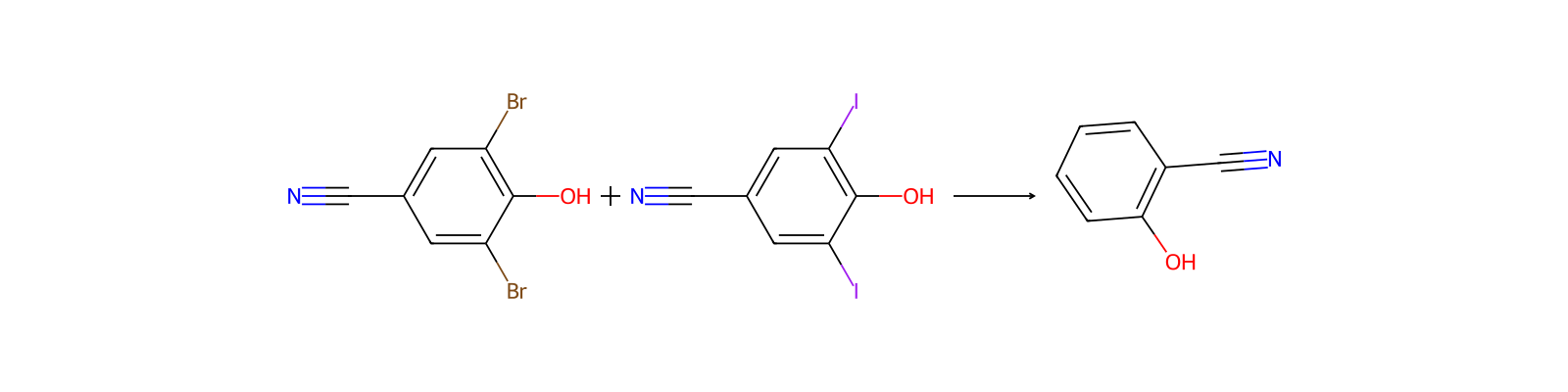
Zugehörige Reaktionen
10


Verknüpfte Notizen
Wird geladen…