StartseiteMCPWorkbenchSkills
StartseiteWorkbenchBenachrichtigungenMein Bereich
llms.txt · MCP-AnleitungDatenschutz · Nutzungsbedingungen · Supportv1.8.1
  1. Startseite
  2. /Verbindung

2-Brom-4,6-dinitroanilin

2-Bromo-4,6-dinitroaniline

HCID 15752
Neue Reaktion
Drucken

Daten werden ergänzt – lade die Seite später neu, um den aktuellen Stand zu sehen

GrundinformationenÜberblickNamen und BezeichnerEigenschaftenSicherheit und RegulatorischesChemie und IndustrieZugehörige ReaktionenNotizen zur Verbindung
TeilstruktursucheÄhnliche Strukturen suchen

Grundinformationen

CAS
1817-73-8
Standard-SMILES
Nc1c(Br)cc([N+](=O)[O-])cc1[N+](=O)[O-]
InChIKey
KWMDHCLJYMVBNS-UHFFFAOYSA-N
Summenformel
C6H4BrN3O4
Durchschnittliche Molmasse
262,02 g/mol
Monoisotopische Masse
260,93852

Überblick

2-bromo-4,6-dinitroaniline is a bright yellow powder. (NTP, 1992)

Namen und Bezeichner

Bevorzugter Name
2-Bromo-4,6-dinitroaniline
IUPAC
2-bromo-4,6-dinitroaniline
Lokaler Name
2-Brom-4,6-dinitroanilin
Englischer Name
2-Bromo-4,6-dinitroaniline
Summenformel
C6H4BrN3O4
Molmasse
262.02

Namen und Synonyme

2-BROMO-4,6-DINITROANILINE1817-73-8Benzenamine, 2-bromo-4,6-dinitro-6-Bromo-2,4-dinitroaniline2,4-Dinitro-6-bromoanilineBromo DNA2-Bromo-4,6-dinitroaminobenzeneAniline, 2-bromo-4,6-dinitro-NCI-C60844DTXSID40246462,4-Dinitro-6-bromoanilinBenzenamide, 2-bromo-4,6-dinitro-
Weitere Namen anzeigen
bromodna2-Bromo-4,6-dinitroa2-bromo-4,6-dinitro-anilin2-BROMO-4,6-DINITRONANILINE2,4-DINITRO-6-BROMO ANILINE2-Bromo-4,6-dinitroaniline,97%
NSC-16572DTXCID204646105X73C593RefChem:466406217-329-22,4-Dinitro-6-bromanilinAniline, 2,4-dinitro-6-bromo-MFCD00007146

Datenbank-Bezeichner

CAS
1817-73-8
PubChem CID

Eigenschaften

Berechnete StruktureigenschaftenWird ergänzt

XLogP
2,1
Polarare Oberfläche (TPSA)
118 Ų
H-Brücken-Donoren
1
H-Brücken-Akzeptoren
5
Frei drehbare Bindungen
0
Schwere Atome
14
Formalladung
0
Komplexität
250

Experimentelle und physikochemische Eigenschaften

Chemical ClassesNitrogen Compounds -> Nitroanilines
Color/FormYELLOW NEEDLES FROM ACETIC ACID OR ALCOHOL
Solubility · 2 Einträge

less than 1 mg/mL at 70 °F (NTP, 1992)

SOL IN HOT ACETIC ACID; VERY SOL IN HOT ALCOHOL & ACETONE

Boiling PointSublimes (NTP, 1992)
Melting Point · 2 Einträge

307 to 309 °F (NTP, 1992)

153 °C

Physical Description · 2 Einträge

2-bromo-4,6-dinitroaniline is a bright yellow powder. (NTP, 1992)

Yellow solid; [HSDB] Powder; [MSDSonline]

Other Experimental PropertiesSUBLIMES BEFORE REACHING BP

Physikochemische Eigenschaften

Sicherheit und Regulatorisches

Sicherheitsangaben dienen nur zur Orientierung und ersetzen weder das Sicherheitsdatenblatt (SDB) des Lieferanten noch geltende Vorschriften oder eine fachliche Bewertung.

GHS-Klassifizierung

GHS Classification · 4 Einträge

Danger

H228 (16.7%): Flammable solid [Danger Flammable solids]

P203, P210, P240, P241, P261, P264, P264+P265, P271, P280, P302+P352, P304+P340, P305+P351+P338, P318, P319, P321, P332+P317, P337+P317, P362+P364, P370+P378, P403+P233, P405, and P501 (click each P-code to see the statement)

Aggregated GHS information provided per 6 reports by companies from 3 notifications to the ECHA C&L Inventory. Each notification may be associated with multiple companies.

Gefahrenhinweise

Regulatory Information · 2 Einträge

REACH registered substance: 2-bromo-4,6-dinitroaniline (EC: 217-329-2)

Benzenamine, 2-bromo-4,6-dinitro-: Does not have an individual approval but may be used under an appropriate group standard

Fire HazardsFlash point data for this chemical are not available, but it is probably combustible. (NTP, 1992)
Health HazardsSYMPTOMS: Symptoms following exposure to this compound may include eye irritation.
Hazards SummaryA mutagen and mild eye irritant; Causes somnolence and weight loss in lethal-dose feeding studies of rats; [RTECS] Emergency treatment: Methemoglobinemia; [HSDB] An eye irritant; [CAMEO] An irritant; [MSDSonline]
Reactive GroupNitro, Nitroso, Nitrate, and Nitrite Compounds, Organic
Reactivity Profile · 1 Eintrag

A halogenated and nitrated aryl amine. Amines are chemical bases. They neutralize acids to form salts plus water. These acid-base reactions are exothermic. The amount of heat that is evolved per mole of amine in a neutralization is largely independent of the strength of the amine as a base. Amines may be incompatible with isocyanates, halogenated organics, peroxides, phenols (acidic), epoxides, anhydrides, and acid halides. Flammable gaseous hydrogen is generated by amines in combination with strong reducing agents, such as hydrides.

Chemie und Industrie

Verwendung und Herstellung

Uses · 3 Einträge

Used in the synthesis of monoazo dyes; [ChemIDplus] Used as a chemical intermediate for azo derivatives; [HSDB]

CHEM INT FOR AZO DERIVS (PROBABLE AZO DYE INT)

CHEM INT FOR DISPERSE VIOLET 7 & 24-NO CURRENT U.S. PRODN

U.S. Exports · 2 Einträge

(1979) No Data

(1981) No Data

U.S. Imports · 2 Einträge

(1979) 1.25X10+7 GRAMS (PRINCPL CUSTMS DISTS)

(1981) 4.54X10+7 GRAMS (PRINCPL CUSTMS DISTS)

U.S. Production · 2 Einträge

(1979) PROBABLY GREATER THAN 4.54X10+6 GRAMS

(1981) PROBABLY GREATER THAN 4.54X10+6 GRAMS

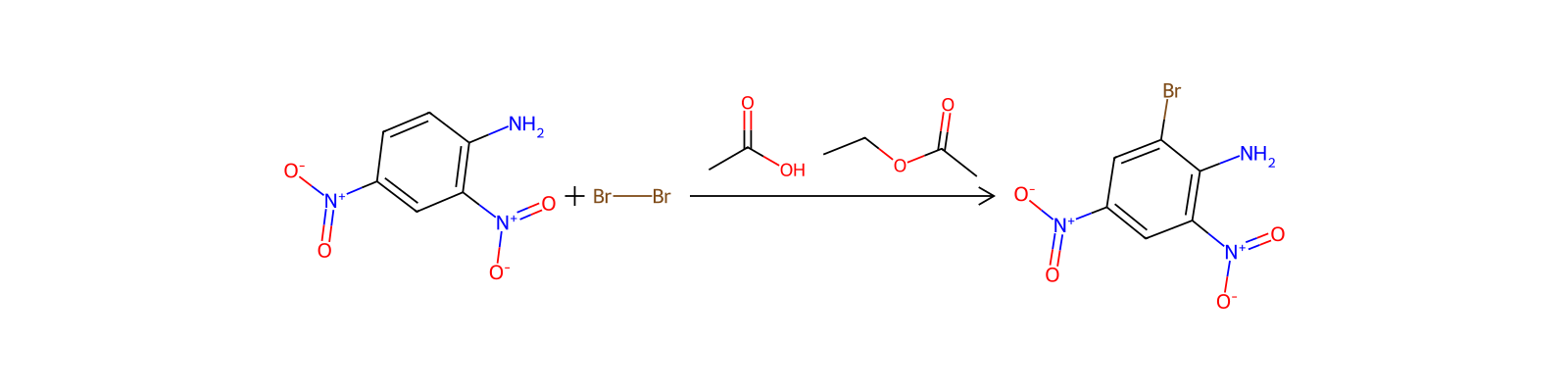
Methods of ManufacturingBROMINATION OF 2,4-DINITROANILINE SUSPENDED IN WATER
General Manufacturing InformationBenzenamine, 2-bromo-4,6-dinitro-: ACTIVE

Anwendungen

Verwenden2-Bromo-4,6-dinitroaniline was used as a model chemical in the inter-laboratory evaluation of the bioluminescent Salmonella reverse mutation assay for detecting mutagenicity.

Vor- und nachgelagerte Produkte

Vorgelagerte Rohstoffe

Natriumhypochlorit2,4-DinitroanilinGlass-lined reaction potNatriumsulfitBrom

Zugehörige Reaktionen

17
Reaktionsaufzeichnung erstellen
Reaktionsgleichung von HRID 94529
HRID 94529als EduktTraining data from https://doi.org/10.1039/C8SC04228D (2/10)
Reaktionsgleichung von HRID 318014
HRID 318014als ProduktTraining data from https://doi.org/10.1039/C8SC04228D (8/10)
Reaktionsgleichung von HRID 429577
HRID 429577als Produktuspto-grants-2001_11
Reaktionsgleichung von HRID 429582
HRID 429582als Eduktuspto-grants-2001_11
Reaktionsgleichung von HRID 712155
HRID 712155als Produktuspto-grants-2015_11
Reaktionsgleichung von HRID 1231735
HRID 1231735als ProduktTraining data from https://doi.org/10.1039/C8SC04228D (5/10)
Reaktionsgleichung von HRID 1399966
HRID 1399966als Produktuspto-grants-2014_12
Reaktionsgleichung von HRID 1622438
HRID 1622438als Eduktuspto-grants-2014_07
ZurückSeite 1 von 3

Notizen zur Verbindung

Auf dieser SeiteGrundinformationenÜberblickNamen und BezeichnerEigenschaftenSicherheit und RegulatorischesChemie und IndustrieZugehörige ReaktionenNotizen zur Verbindung
15752
DTXSID
DTXSID4024646
ChEMBL
CHEMBL167513
UNII
105X73C593
EC Number
217-329-2
Nikkaji
J38.265E
Schmelzpunkt
151 · 151-153 °C (lit.)
Siedepunkt
400.8 · 400.8±40.0 °C(Predicted)
Dichte
2.1534 · 2.1534 (rough estimate)
Brechungsindex
1.62 · 1.6200 (estimate)
storage temp.
2 · 2-8°C(protect from light)
Löslichkeit
Chloroform (Slightly), Methanol (Slightly, Sonicated)
pka
1 · pK1: -6.94(+1) (25°C)
Aggregatzustand
Solid
Farbe
Pale Yellow to Light Yellow
Henry's Law Constant
3.9 · 3.9×104 mol/(m3Pa) at 25℃, Zhang et al. (2010)
CAS Datenbank
1817 · 1817-73-8(CAS DataBase Reference)
EPA chemische Informationen
2 · 2-Bromo-4,6-dinitroaniline (1817-73-8)
Air and Water ReactionsThis material may be sensitive to exposure to air (NTP, 1992). Insoluble in water.
Hazard Classes and CategoriesFlam. Sol. 2 (16.7%)

Sicherheit und Schutzausrüstung

Fire FightingFires involving this compound can be controlled using a dry chemical, carbon dioxide or Halon extinguisher. (NTP, 1992)
First Aid · 1 Eintrag

EYES: First check the victim for contact lenses and remove if present. Flush victim's eyes with water or normal saline solution for 20 to 30 minutes while simultaneously calling a hospital or poison control center. Do not put any ointments, oils, or medication in the victim's eyes without specific instructions from a physician. IMMEDIATELY transport the victim after flushing eyes to a hospital even if no symptoms (such as redness or irritation) develop.

Nonfire Spill Response · 1 Eintrag

SMALL SPILLS AND LEAKAGE: If a spill of this chemical occurs, FIRST REMOVE ALL SOURCES OF IGNITION, then you should dampen the solid spill material with acetone and transfer the dampened material to a suitable container. Use absorbent paper dampened with acetone to pick up any remaining material. Seal your contaminated clothing and the absorbent paper in a vapor-tight plastic bag for eventual disposal. Solvent wash all contaminated surfaces with acetone followed by washing with a soap and water solution. Do not reenter the contaminated area until the Safety Officer (or other responsible person) has verified that the area has been properly cleaned.

Personal Protective Equipment (PPE) · 1 Eintrag

RECOMMENDED RESPIRATOR: Where the neat test chemical is weighed and diluted, wear a NIOSH-approved half face respirator equipped with an organic vapor/acid gas cartridge (specific for organic vapors, HCl, acid gas and SO2) with a dust/mist filter. (NTP, 1992)

Toxikologische Informationen

Adverse EffectsMethemoglobinemia - The presence of increased methemoglobin in the blood; the compound is classified as secondary toxic effect
TSCA Test Submissions · 5 Einträge

The ability of 2-bromo-4,6-dinitroaniline (BDNA) to induce morphological transformation in the BALB/3T3 mouse cell line (Cell Transformation Assay) was evaluated in the absence of added metabolic activation. Based on preliminary clonal toxicity determinations (exposure time=24 hrs), BDNA, in 0.1% (v/v) aqueous acetone, was tested at 5, 15 and 50 ug/ml, with cell survival ranging from 89.6-36.9% relative to solvent control. None of the tested concentrations produced significantly greater transformation frequencies (p > 0.05, Modified Poisson Distribution) relative to the solvent control.

The ability of 2-bromo-4,6-dinitroaniline (BDNA) to induce morphological transformation in the BALB/3T3 mouse cell line (Cell Transformation Assay) was evaluated in the absence of added metabolic activation. Based on preliminary clonal toxicity determinations (exposure time=24 hrs), BDNA, in 0.1% (v/v) aqueous acetone, was tested at 5, 15 and 50 ug/ml, with cell survival ranging from 94.0-77.3% relative to solvent control. At 15 ug/ml, a statistically significant (P<0.05, Modified Poisson Distribution) increase in the number of transformed foci was observed relative to the solvent control.

The ability of 2-bromo-4,6-dinitroaniline (BDNA) to induce morphological transformation in the BALB/3T3 mouse cell line (Cell Transformation Assay) was evaluated in the presence of added metabolic activation by Aroclor-induced rat liver S9 fraction. Based on preliminary clonal toxicity determinations (exposure time=2 hrs), BDNA, in 0.06% (v/v) aqueous acetone, was tested at 3, 10 and 30 ug/ml, with cell survival ranging from 94.8-94.5% relative to solvent control. None of the tested concentrations produced detectable transformation frequencies.

The mutagenicity of 2-bromo-4,6-dinitroaniline (BDNA) was evaluated in Salmonella tester strains TA98, TA100, TA1535, TA1537 and TA1538 (Ames Test), both in the presence and absence of added metabolic activation by Aroclor-induced rat liver S9 fraction. BDNA was tested for mutagenicity at concentrations ranging from 10-1000 ug/plate using the plate incorporation method. BDNA caused a positive response in all of the bacterial tester strains except TA1535, both in the presence and absence of metabolic activation.

The ability of trichlorobutylene oxide (TCBO) to cause unscheduled DNA synthesis in human lung fibroblast cells (WI-38) in vitro was evaluated both with and without metabolic activation by mouse liver S9 fraction. TCBO, dissolved in DMSO, was tested at concentrations of 0, 51, 128, 320, 800 or 2000 ug/ml in the absence of activation and at concentrations of 0, 1447, 1736, 2083, 2500 or 3000 ug/ml with activation. None of the tested concentrations caused an increase in unscheduled DNA synthesis as measured by the amount of tritiated thymidine incorporated into DNA of treated vs control cultures. Evidence of cytotoxicity was observed at each tested concentration.

Sicherheitsdaten

wgk
2
tsca
TSCA listed
ridadr
1325
hs_code
2921.42.9000
RTECS-Nr.
BW9303000
risk_code
36/37/38-11
Toxizität
rat,LD50,oral,4100mg/kg (4100mg/kg),BRAIN AND COVERINGS: RECORDINGS FROM SPECIFIC AREAS OF CNSBEHAVIORAL: SOMNOLENCE (GENERAL DEPRESSED ACTIVITY),Office of Toxic Substances Report. Vol. OTS,
hazard_code
Xi,F
safety_code
37/39-26-16
hazard_class
4.1
packing_group
III
Giftige Stoffe Daten
1817-73-8(Hazardous Substances Data)
Phenol,2-bromo-4,6-dinitro-
Benzene, 1-bromo-2-methoxy-3,5-dinitro-
1-Chlor-2,4-dinitrobenzol

Nachgelagerte Produkte

2,2'-[[5-Acetamid-4-[(2-brom-4,6-dinitrophenyl)azo]-2-ethoxyphenyl]imino]diethyldiacetatDISPERSE VIOLET BDisperse Blue 301N-[2-[(2-Brom-4,6-dinitrophenyl)azo]-5-(diethylamino)-4-methoxyphenyl]acetamid7-Bromo-1H-benzimidazol-5-amineDisperse blue 130C.I. Disperse Blue 90Disperse Blue 94C.I. Disperse Blue 75N-[2-[(2-Brom-4,6-dinitrophenyl)azo]-5-(diethylamino)phenyl]acetamidDISPERSEBLUE122Disperse Blue 301Disperse Blue 165:1C.I. Disperse Blue 139Dianix Navy Blue ER-FSDISPERSE BLUE 281