
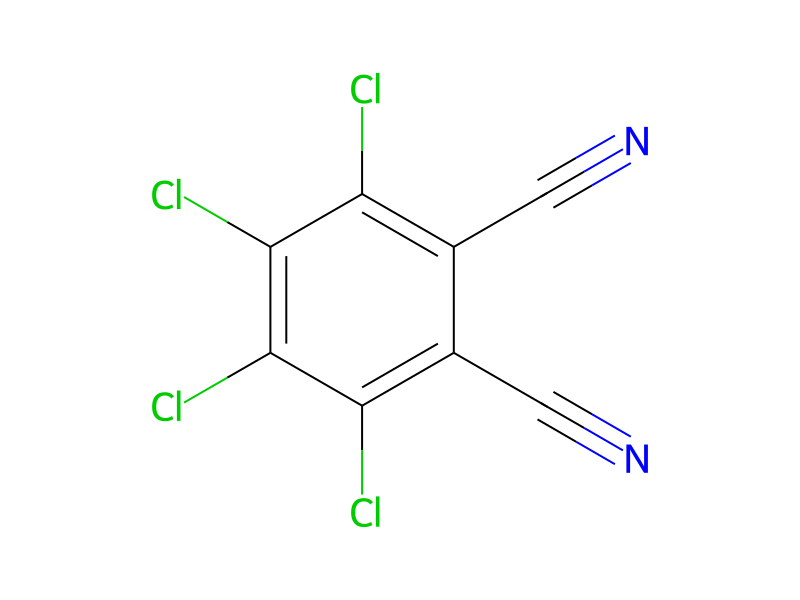
Grundinformationen
- Standard-SMILES
N#Cc1c(Cl)c(Cl)c(Cl)c(Cl)c1C#N- InChIKey
OQHXZZGZASQSOB-UHFFFAOYSA-N- Summenformel
- C8Cl4N2
- Durchschnittliche Molmasse
- 265,9 g/mol
- Monoisotopische Masse
- 263,88155872
Namen und Bezeichner
- Bevorzugter Name
- 1,2-Benzenedicarbonitrile, 3,4,5,6-tetrachloro-
- IUPAC
- 3,4,5,6-tetrachlorobenzene-1,2-dicarbonitrile
- Lokaler Name
- 3,4,5,6-Tetrachlorbenzol-1,2-dicarbonitril
- Englischer Name
- 3,4,5,6-Tetrachlorophthalonitrile
- Summenformel
- C8Cl4N2
- Molmasse
- 265.91
Namen und Synonyme
Tetrachlorophthalonitrile1953-99-73,4,5,6-Tetrachlorobenzene-1,2-dicarbonitrile3,4,5,6-Tetrachlorophthalonitrileo-TCPNo-Tetrachlorophthalodinitrileo-PHTHALODINITRILE, TETRACHLORO-3,4,5,6-Tetrachloro-1,2-benzenedicarbonitrile1,2-Benzenedicarbonitrile, 3,4,5,6-tetrachloro-GG84DM2R55EINECS 217-783-1BRN 1882303
Weitere Namen anzeigen
Z-CHLOROTHALONILPerchlorophthalonitrile6-TetrachlorophthalonitrileTetrachloro-o-phthalonitrile
DTXSID20173189RefChem:411088DTXCID90956801,2-Benzenedicarbonitrile, 3,4,5,6-tetrachloro-(9CI)Phthalonitrile, tetrachloro-Benzenedicarbonitrile, tetrachloro-MFCD00019740Tetrachlorophthalodinitrile
Datenbank-Bezeichner
- CAS
1953-99-7- PubChem CID
- 16057
- DTXSID
DTXSID20173189- UNII
- GG84DM2R55
- EC Number
- 217-783-1
- Nikkaji
- J35.440F
Eigenschaften
Berechnete Struktureigenschaften
- XLogP
- 2,9
- Polarare Oberfläche (TPSA)
- 47,6 Ų
- H-Brücken-Donoren
- 0
- H-Brücken-Akzeptoren
- 2
- Frei drehbare Bindungen
- 0
- Schwere Atome
- 14
- Formalladung
- 0
- Komplexität
- 282
Physikochemische Eigenschaften
- Schmelzpunkt
- 249 · 249-252 °C (dec.)(lit.)
- Siedepunkt
- 350 °C · 350°C (rough estimate)
- Dichte
- 1.7395 · 1.7395 (estimate)
- storage temp.
- Sealed in dry,Room Temperature
- Aggregatzustand
- powder to crystal
- Farbe
- White to Almost white
- CAS Datenbank
- 1953 · 1953-99-7(CAS DataBase Reference)
- NIST chemische Informationen
- 1 · 1,2-Benzenedicarbonitrile, 3,4,5,6-tetrachloro-(1953-99-7)
Sicherheit und Regulatorisches
GHS-Klassifizierung
GHS Classification
Warning
H312 (97.6%): Harmful in contact with skin [Warning Acute toxicity, dermal]
P261, P271, P280, P302+P352, P304+P340, P317, P321, P362+P364, and P501 (click each P-code to see the statement)
Aggregated GHS information provided per 41 reports by companies from 4 notifications to the ECHA C&L Inventory. Each notification may be associated with multiple companies.
Gefahrenhinweise
Regulatory Information1,2-Benzenedicarbonitrile, 3,4,5,6-tetrachloro-: Does not have an individual approval but may be used as a component in a product covered by a group standard. It is not approved for use as a chemical in its own right.
Hazard Classes and CategoriesAcute Tox. 4 (97.6%)
Sicherheitsdaten
- wgk
- 3
- ridadr
- UN 3077 9/PG III
- hs_code
- 2926.90.4801
- RTECS-Nr.
- TI8225000
- risk_code
- 20/21/22
- Toxizität
- mouse,LD50,intraperitoneal,66mg/kg (66mg/kg),BEHAVIORAL: SOMNOLENCE (GENERAL DEPRESSED ACTIVITY),Industrial Health. Vol. 4, Pg. 11, 1966.
- hazard_code
- Xn
- safety_code
- 36
- hazard_class
- 9
- packing_group
- III
Chemie und Industrie
Anwendungen
Verwenden3,4,5,6-Tetrachlorophthalonitrile can be used as a reagent in chemical reactions or as an intermediate in organic synthesis. 3,4,5,6-Tetrachlorophthalonitrile and 3,4,5,6-Tetrachlorophthalonitrile can be used as substrates with various phenoxy compounds in nucleophilic aromatic substitution reactions to prepare 3,4,6-trihalo-5-p-substituted phenoxyphthalonitrile containing four substituents other than hydrogen[1].
Vor- und nachgelagerte Produkte
Vorgelagerte Rohstoffe
Nachgelagerte Produkte
Anbieter50 Anbieter
梯希爱(上海)化成工业发展有限公司021-67121386 · [email protected]
阿诺西(上海)生物技术有限公司400-1107768 15058188853 · [email protected]
上海阿拉丁生化科技股份有限公司400-6206333 13167063860 · [email protected]
毕佳索(上海毕得医药科技股份有限公司)400-6005915 · [email protected]
上海麦克林生化科技股份有限公司021-50706066 15221275939 · [email protected]
武汉欣扬瑞和化学科技有限公司153-07155313 15307155313 · [email protected]
Dayang Chem (Hangzhou) Co.,Ltd.+86-0571-88938639 17705817739 · [email protected]
郑州鸿晟医药科技有限公司0371-55695890 15637198702 · [email protected]
北京安司莫森技术有限公司010-82954736 13391601435 · [email protected]
衢州明锋化工有限公司0570-3062502 13819002126;13819008176 · [email protected]
北京索莱宝科技有限公司010-50973130 17801761073 · [email protected]
江苏普乐司生物科技有限公司0513-66017706 18551496367 · [email protected]
安耐吉化学&3A(安徽泽升科技股份有限公司)400-0056266 · [email protected]
湖北兴琰新材料科技有限公司13129948835 · [email protected]
上海瀚鸿科技股份有限公司021-54306202 13764082696 · [email protected]
上海钰康生物科技有限公司+86-18930848214 +86-021-56762820 · [email protected]
上海景颜化工科技有限公司13817811078 · [email protected]
郑州研德生物科技有限公司0371-63682289 15538176268 · [email protected]
上海攀鸿化工科技有限公司021-56491756 13512199871 · [email protected]
武汉裕清嘉衡药业有限公司027-83850128 18207128853 · [email protected]
孝感深远化工有限公司15527621225; 15527621225 · [email protected]
山东西亚化学有限公司13355009207 13355009207 · [email protected]
武汉欣扬瑞和化学科技有限公司027-83855316 18171155316
上海特伯化学科技有限公司+86-21-60341587 · [email protected]
上海遐瑞医药科技有限公司+86 21 61551611
TOKYO CHEMICAL INDUSTRY CO., LTD.03-36680489 · [email protected]
无锡中坤生化科技有限公司+86 0510-85629785
上海毕得医药科技股份有限公司400-164-7117 18317119277 · [email protected]
上海笛柏生物科技有限公司400-008-9730,021-54359730 400-008-9730 · [email protected]
雷丁试剂0510-85629785 18013409632 · [email protected]
上海乾劲化工科技有限公司021-20900665 17321230821 · [email protected]
江苏艾康生物医药研发有限公司025-66028182 17714375163 · [email protected]
池州凯隆进出口贸易有限公司[email protected]
广东翁江化学试剂有限公司0751-2815987 13927875076 · [email protected]
厦门志信化学有限公司+86-5922680277 +86-13806087780 · [email protected]
泰安嘉岳生物化工有限公司15318151873 · [email protected]
安耐吉化学&3A(安徽泽升科技股份有限公司)400-0056266 · [email protected]
上海玻尔化学试剂有限公司19102157732 · [email protected]
韶关新润合生物科技有限公司19022763608 19022763608 · [email protected]
陕西缔都医药化工有限公司029-029-81120477 17792793610 · [email protected]
淄博百极荣创医药科技有限公司0533-6092686 13371592196 · [email protected]
河南沃咖斯生物科技有限公司18537671377 · [email protected]
山东崇成能源科技有限公司18253333366 · [email protected]
上海前衍生物科技有限公司02781293128 · [email protected]
上海源叶生物科技有限公司13636370518 · [email protected]
湖北阡陌生物科技有限公司0711-3812399 18062309155 · [email protected]
山东西亚化学有限公司4009903999 13395398332 · [email protected]
成都华纯科技有限公司400-1166-196 15982826727 · [email protected]
湖北世腾化工科技有限公司19086915685 18971850150 · [email protected]
深圳市森迪生物科技有限公司18126413629 0755-23311925 2355327053 · [email protected]
Zugehörige Reaktionen
9


Verknüpfte Notizen
Wird geladen…