StartseiteMCPWorkbenchSkills
StartseiteWorkbenchBenachrichtigungenMein Bereich
llms.txt · MCP-AnleitungDatenschutz · Nutzungsbedingungen · Supportv1.8.0
  1. Startseite
  2. /Verbindung

4-Chlorbiphenyl

4-Chlorobiphenyl
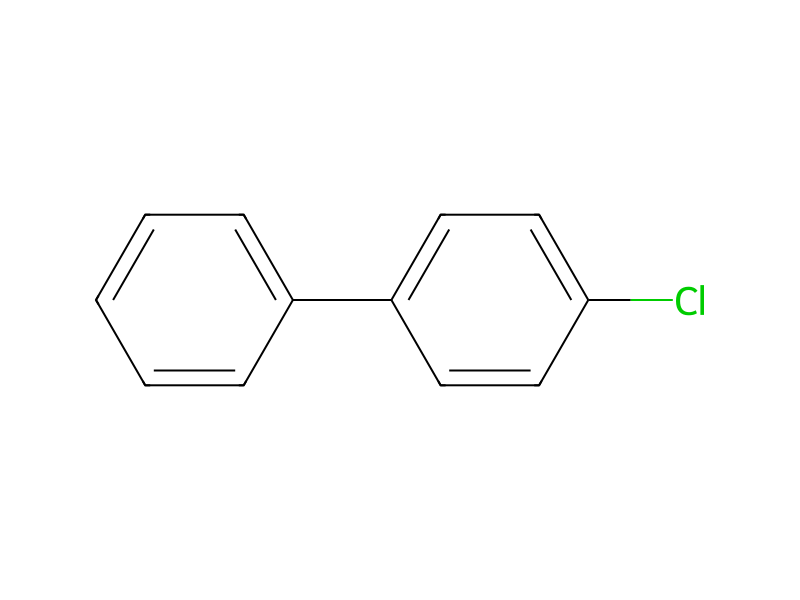
HCID 16323
Neue NotizNeue ReaktionAnfrage stellen
Druckvorschau
GrundinformationenÜberblickNamen und BezeichnerEigenschaftenSicherheit und RegulatorischesChemie und IndustrieZugehörige ReaktionenNotizen zur Verbindung
TeilstruktursucheÄhnliche Strukturen suchen

Grundinformationen

CAS
2051-62-9
Standard-SMILES
Clc1ccc(-c2ccccc2)cc1
InChIKey
FPWNLURCHDRMHC-UHFFFAOYSA-N
Summenformel
C12H9Cl
Durchschnittliche Molmasse
188,65 g/mol
Monoisotopische Masse
188,039278

Überblick

4-chlorobiphenyl appears as colorless crystals or shiny off-white flakes. (NTP, 1992)

Namen und Bezeichner

Bevorzugter Name
4-Chlorobiphenyl
IUPAC
1-chloro-4-phenylbenzene
Lokaler Name
4-Chlorbiphenyl
Englischer Name
4-Chlorobiphenyl
Summenformel
C12H9Cl
Molmasse
188.65

Namen und Synonyme

4-CHLOROBIPHENYL4-Chloro-1,1'-biphenyl2051-62-9p-Chlorobiphenylp-Chlorodiphenyl1-Chloro-4-phenylbenzene4-ChlorodiphenylBiphenyl, 4-chloro-4-Monochlorobiphenyl4-ChlorbiphenylPCB 34-Monochloro-biphenyl
Weitere Namen anzeigen
4-PCBBZNO 3PCB NO 3NSC 370664-PCB, PCB #34-chloro-biphenyρ-Chlorobiphenyl
DTXSID30403001-chloro-4-phenyl benzeneQA22Z3NGLUNSC-37066DTXCID1020300CHEBI:27757RefChem:53601218-127-7

Datenbank-Bezeichner

CAS
2051-62-9
PubChem CID
16323
DTXSID
DTXSID3040300
ChEMBL
CHEMBL276334
ChEBI
CHEBI:27757
UNII
QA22Z3NGLU
EC Number
218-127-7
Nikkaji
J47.611K

Eigenschaften

Berechnete Struktureigenschaften

XLogP
4,6
Polarare Oberfläche (TPSA)
0 Ų
H-Brücken-Donoren
0
H-Brücken-Akzeptoren
0
Frei drehbare Bindungen
1
Schwere Atome
13
Formalladung
0
Komplexität
141

Experimentelle und physikochemische Eigenschaften

SpringerMaterials Properties13C nuclear magnetic resonance spectrum
LogP4.63
Solubilityless than 1 mg/mL at 72 °F (NTP, 1992)
Endocrine DisruptorsPotential endocrine disrupting compound
Boiling Point556 °F at 760 mmHg (NTP, 1992)
Melting Point171.9 °F (NTP, 1992)
Vapor Pressure1 mmHg at 205.5 °F ; 10 mmHg at 294.8 °F; 760 mmHg at 559.2 °F (NTP, 1992)
Physical Description4-chlorobiphenyl appears as colorless crystals or shiny off-white flakes. (NTP, 1992)
Collision Cross Section134.1 Ų [M]+ [CCS Type: TIMS, Method: calibration with PAHs]

Physikochemische Eigenschaften

Sicherheit und Regulatorisches

Sicherheitsangaben dienen nur zur Orientierung und ersetzen weder das Sicherheitsdatenblatt (SDB) des Lieferanten noch geltende Vorschriften oder eine fachliche Bewertung.

GHS-Klassifizierung

GHS Classification · 4 Einträge

Warning

H373 (94.1%): May causes damage to organs through prolonged or repeated exposure [Warning Specific target organ toxicity, repeated exposure]

P260, P273, P319, P391, and P501 (click each P-code to see the statement)

Aggregated GHS information provided per 51 reports by companies from 6 notifications to the ECHA C&L Inventory. Each notification may be associated with multiple companies.

Gefahrenhinweise

Regulatory InformationSubstance: 4-chlorobiphenyl
DOT LabelClass 9
Fire HazardsFlash point data for this chemical are not available. It is probably combustible. (NTP, 1992)
Health HazardsSYMPTOMS: Symptoms of exposure to this chemical include skin, eye, mucous membrane and upper respiratory tract irritation.
Reactive GroupAryl Halides
Reactivity Profile · 1 Eintrag

Simple aromatic halogenated organic compounds, such as 4-CHLOROBIPHENYL, are very unreactive. Halogenated organics generally become less reactive as more of their hydrogen atoms are replaced with halogen atoms. Materials in this group may be incompatible with strong oxidizing and reducing agents. Also, they may be incompatible with many amines, nitrides, azo/diazo compounds, alkali metals, and epoxides.

Air and Water ReactionsInsoluble in water.
Hazard Classes and Categories

Chemie und Industrie

Pharmakologische Informationen

Metabolism/Metabolites · 1 Eintrag

PCBs are absorbed via inhalation, oral, and dermal routes of exposure. They are trasported in the blood, often bound to albumin. Due to their lipophilic nature they tend to accumulate in lipid-rich tissues, such as the liver, adipose, and skin. Metabolism of PCBs is very slow and varies based on the degree and position of chlorination. PCBs are metabolized by the microsomal monooxygenase system catalyzed by cytochrome P-450 enzymes to polar metabolites that can undergo conjugation with glutathione and glucuronic acid. The major metabolites are hydroxylated products which are excreted in the bile and faeces. The slow metabolism of PCBs means they tend to accumulate in body tissues. (L4, T6)

Verwendung und Herstellung

Uses · 1 Eintrag

PCBs were used as coolants and lubricants in transformers, capacitors, and other electrical devices (such as fluorescent lights and refridgerators) produced before 1977. PCBs may contaminate the air and water near hazardous waste sites. In addition, PCBs bioaccumulate in the environment and may be found in fish, meat, and dairy products. (L4)

Anwendungen

Verwenden4-Chloro-1,1’-biphenyl (cas# 2051-62-9) is a compound useful in organic synthesis.

Vor- und nachgelagerte Produkte

Vorgelagerte Rohstoffe

Benzenediazonium, p-chloro-, tetrafluoroborate(1-)Triethoxy(phenyl)silan(4-Chlorphenyl)hydrazin1,4-Dichlorbenzol

Zugehörige Reaktionen

48
Reaktionsaufzeichnung erstellen
Reaktionsgleichung von HRID 39606
HRID 39606als Eduktuspto-grants-2013_09
Reaktionsgleichung von HRID 50152
HRID 50152als Produktals Eduktuspto-grants-2004_03
Reaktionsgleichung von HRID 111433
HRID 111433als EduktTraining data from https://doi.org/10.1039/C8SC04228D (2/10)
Reaktionsgleichung von HRID 150732
HRID 150732als EduktTraining data from https://doi.org/10.1039/C8SC04228D (9/10)
Reaktionsgleichung von HRID 168091
HRID 168091als EduktTraining data from https://doi.org/10.1039/C8SC04228D (9/10)
Reaktionsgleichung von HRID 191269
HRID 191269als EduktTraining data from https://doi.org/10.1039/C8SC04228D (6/10)
Reaktionsgleichung von HRID 290209
HRID 290209als EduktTraining data from https://doi.org/10.1039/C8SC04228D (8/10)
Reaktionsgleichung von HRID 342735
HRID 342735als Eduktuspto-grants-1999_01
Seite 1 von 6

Notizen zur Verbindung

Wird geladen…

Auf dieser SeiteGrundinformationenÜberblickNamen und BezeichnerEigenschaftenSicherheit und RegulatorischesChemie und IndustrieZugehörige ReaktionenNotizen zur Verbindung
Weitere Aktionen
Neue NotizNeue ReaktionAnfrage stellen
Schmelzpunkt
32 °C · 32 °C(lit.)
Siedepunkt
130 °C/1mm · 130°C/1mm
Dichte
1.132 · 1.1320 (estimate)
Brechungsindex
1.583 · 1.5830 (estimate)
storage temp.
Refrigerator
Löslichkeit
Chloroform (Slightly), Ethyl Acetate (Slightly), Methanol (Slightly)
Aggregatzustand
Solid
Farbe
White to Off-White
Wasserlöslichkeit
0.1 g/100 · <0.1 g/100 mL at 22 ºC
Henry's Law Constant
2.8 · 2.8×10-2 mol/(m3Pa) at 25℃, Li et al. (2003)
Major Application
environmental
InChI
InChI=1S/C12H9Cl/c13-12-8-6-11(7-9-12)10-4-2-1-3-5-10/h1-9H
InChIKey
FPWNLURCHDRMHC-UHFFFAOYSA-N
SMILES
C1(C2=CC=CC=C2)=CC=C(Cl)C=C1
CAS Datenbank
2051 · 2051-62-9(CAS DataBase Reference)
NIST chemische Informationen
1 · 1,1'-Biphenyl, 4-chloro-(2051-62-9)
EPA chemische Informationen
4 · 4-Chlorobiphenyl (2051-62-9)
STOT RE 2 (94.1%)

Sicherheit und Schutzausrüstung

Fire FightingFires involving this material can be controlled with a dry chemical, carbon dioxide or Halon extinguisher. (NTP, 1992)
First Aid · 1 Eintrag

EYES: First check the victim for contact lenses and remove if present. Flush victim's eyes with water or normal saline solution for 20 to 30 minutes while simultaneously calling a hospital or poison control center. Do not put any ointments, oils, or medication in the victim's eyes without specific instructions from a physician. IMMEDIATELY transport the victim after flushing eyes to a hospital even if no symptoms (such as redness or irritation) develop.

Nonfire Spill Response · 1 Eintrag

SMALL SPILLS AND LEAKAGE: Should a spill occur while you are handling this chemical, FIRST REMOVE ALL SOURCES OF IGNITION, then you should dampen the solid spill material with 60-70% ethanol and transfer the dampened material to a suitable container. Use absorbent paper dampened with 60-70% ethanol to pick up any remaining material. Seal the absorbent paper, and any of your clothes, which may be contaminated, in a vapor-tight plastic bag for eventual disposal. Solvent wash all contaminated surfaces with 60-70% ethanol followed by washing with a soap and water solution. Do not reenter the contaminated area until the Safety Officer (or other responsible person) has verified that the area has been properly cleaned.

Isolation and EvacuationExcerpt from ERG Guide 171 [Substances (Low to Moderate Hazard)]:
Minimum Risk LevelIntermediate Oral: 0.03 ug/kg/day (L134)
Personal Protective Equipment (PPE) · 1 Eintrag

RECOMMENDED RESPIRATOR: Where the neat test chemical is weighed and diluted, wear a NIOSH-approved half face respirator equipped with an organic vapor/acid gas cartridge (specific for organic vapors, HCl, acid gas and SO2) with a dust/mist filter. (NTP, 1992)

Toxikologische Informationen

Treatment · 1 Eintrag

There are no specific treatments for PCB poisoning, since it is not usually recognized until after substantial chronic exposure. Only preventing further exposure and treating the observed symptoms can be done. Acute inhalation can be treated by administering oxygen. (L4)

Health Effects · 1 Eintrag

The most common health effects of PCBs are skin conditions such as chloracne and rashes. Chronic PCB exposure has also been shown to cause liver, stomach and kidney, damage, jaundice, edema, anemia, changes in the immune system, behavioral alterations, and impaired reproduction. (L4)

Exposure RoutesOral (L4) ; inhalation (L4) ; dermal (L4)
Toxicity Summary · 1 Eintrag

The mechanism of action varies with the specific PCB. Dioxin-like PCBs bind to the aryl hydrocarbon receptor, which disrupts cell function by altering the transcription of genes, mainly be inducing the expression of hepatic Phase I and Phase II enzymes, especially of the cytochrome P450 family. Most of the toxic effects of PCBs are believed to be results of Ah receptor binding. Other PBCs are believed to interfere with calcium channels and/or change brain dopamine levels. PCBs can also cause endocrine disurption by altering the production of thyroid hormones and binding to estrogen receptors, which can stimulate the growth of certain cancer cells and produce other estrogenic effects, such as reproductive dysfunction. They will bioaccumulate by binding to receptor proteins such as uteroglobin. (A3, A4, A30, A66)

Signs and SymptomsChronic PCB exposure results in symptoms such as abdominal pain, nausea, vomiting, diarrhea, headache, dizziness, depression, nervousness, dermal and ocular lesions, fatigue, irregular menstrual cycles and a lowered immune response. (A3)
Carcinogen Classification1, carcinogenic to humans. (L135)
Toxicity DataLD50: 1010 mg/kg (Oral, Rat) (T14) LD50: 880 mg/kg (Intraperitoneal, Mouse) (T14)

Sicherheitsdaten

wgk
3
ridadr
UN 3432 9/PG 2
hs_code
2903998090
RTECS-Nr.
DV2080000
risk_code
33-50/53-36/37/38
Toxizität
mammal (species unspecified),LDLo,oral,3500mg/kg (3500mg/kg),Journal of Industrial Hygiene. Vol. 13, Pg. 87, 1931.
hazard_code
N,Xi
hazard_note
Irritant
safety_code
35-60-61-36-26
hazard_class
9
packing_group
III
Speicherklasse
11 - Combustible Solids
Hazard Classifications
Aquatic Acute 1Aquatic Chronic 1STOT RE 2

Nachgelagerte Produkte

4-Isopropylbiphenyl4-BiphenylacetonitrileN-4-BiphenylylbenzenesulfonamidePhosphine sulfide, tris([1,1'-biphenyl]-4-yl)-

Ergänzende Hinweise

DefinitionChEBI: A monochlorobiphenyl carrying a chloro substituent at position 4.