StartseiteMCPWorkbenchSkills
StartseiteWorkbenchBenachrichtigungenMein Bereich
llms.txt · MCP-AnleitungDatenschutz · Nutzungsbedingungen · Supportv1.8.0
  1. Startseite
  2. /Verbindung

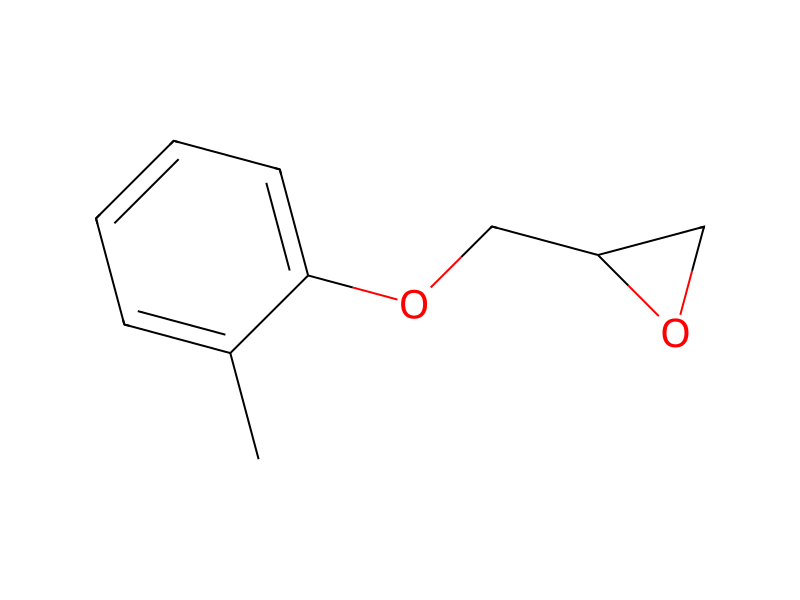
2,3-Epoxypropyl-o-tolylether

o-CRESYL GLYCIDYL ETHER

HCID 16640
Neue NotizNeue ReaktionAnfrage stellen
Druckvorschau

Daten werden ergänzt – lade die Seite später neu, um den aktuellen Stand zu sehen
GrundinformationenÜberblickNamen und BezeichnerEigenschaftenSicherheit und RegulatorischesChemie und IndustrieZugehörige ReaktionenNotizen zur Verbindung
TeilstruktursucheÄhnliche Strukturen suchen

Grundinformationen

CAS
2210-79-9
Standard-SMILES
Cc1ccccc1OCC1CO1
InChIKey
KFUSXMDYOPXKKT-UHFFFAOYSA-N
Summenformel
C10H12O2
Durchschnittliche Molmasse
164,2 g/mol
Monoisotopische Masse
164,08372962

Überblick

O-cresyl glycidyl ether is a clear light yellow liquid. (NTP, 1992)

Namen und Bezeichner

Bevorzugter Name
o-CRESYL GLYCIDYL ETHER
IUPAC
2-[(2-methylphenoxy)methyl]oxirane
Lokaler Name
2,3-Epoxypropyl-o-tolylether
Englischer Name
2-[(2-Methylphenoxy)methyl]oxirane
Summenformel
C10H12O2
Molmasse
164.2

Namen und Synonyme

2210-79-9O-CRESYL GLYCIDYL ETHERGlycidyl 2-methylphenyl etherGlycidyl o-tolyl ether2-Methylphenyl glycidyl etherAraldite DY 0231,2-Epoxy-3-(2-methylphenoxy)propane1-(2-Methylphenoxy)-2,3-epoxypropaneDTXSID80248621-(o-Methylphenoxy)-2,3-epoxypropane((2-Methylphenoxy)methyl)oxirane1,2-Epoxy-3-(o-tolyloxy)propane
Weitere Namen anzeigen
DY 023Nsc11571o-cresylHeloxy 62Epodil 742aralditedy0232-((o-Tolyloxy)o-Cresolglycidylethero-Kresol-glycidaether
Glycidyl o-methylphenyl etherPropane, 1,2-epoxy-3-(o-tolyloxy)-Oxirane, ((2-methylphenoxy)methyl)-(2-Methylphenoxymethyl)oxirane2,3-Epoxypropyl o-tolyl etherNSC-11571NSC-20291Oxirane, [(2-methylphenoxy)methyl]-

Datenbank-Bezeichner

CAS
2210-79-9

Eigenschaften

Berechnete StruktureigenschaftenWird ergänzt

XLogP
2,4
Polarare Oberfläche (TPSA)
21,8 Ų
H-Brücken-Donoren
0
H-Brücken-Akzeptoren
2
Frei drehbare Bindungen
3
Schwere Atome
12
Formalladung
0
Komplexität
147

Experimentelle und physikochemische Eigenschaften

PolymersPlastics & Rubber -> Glycidyl Ethers
Density · 2 Einträge

1.09 at 68 °F (NTP, 1992) - Denser than water; will sink

Relative density (water = 1): 1.08

Solubility · 2 Einträge

less than 1 mg/mL at 72 °F (NTP, 1992)

Solubility in water: none

Flash Point · 3 Einträge

200 °F (NTP, 1992)

200 °F

113 °C c.c.

Boiling Point · 2 Einträge

498 °F at 760 mmHg (NTP, 1992)

at 0.533kPa: 109-111 °C

Vapor DensityRelative vapor density (air = 1): 5.7
Physical Description · 4 Einträge

O-cresyl glycidyl ether is a clear light yellow liquid. (NTP, 1992)

Liquid

Clear light yellow liquid; [CAMEO]

COLOURLESS LIQUID.

Sicherheit und Regulatorisches

Sicherheitsangaben dienen nur zur Orientierung und ersetzen weder das Sicherheitsdatenblatt (SDB) des Lieferanten noch geltende Vorschriften oder eine fachliche Bewertung.

GHS-Klassifizierung

GHS Classification · 6 Einträge

Warning

H315: Causes skin irritation [Warning Skin corrosion/irritation]

P203, P261, P264, P272, P273, P280, P302+P352, P318, P321, P332+P317, P333+P317, P362+P364, P391, P405, and P501 (click each P-code to see the statement)

Warning

H315 (100%): Causes skin irritation [Warning Skin corrosion/irritation]

P203, P261, P264, P272, P273, P280, P302+P352, P318, P321, P332+P317, P333+P317, P362+P364, P391, P405, and P501 (click each P-code to see the statement)

Gefahrenhinweise

Regulatory Information · 5 Einträge

Chemical: Oxirane, [(2-methylphenoxy)methyl]-

Oxirane, 2-[(2-methylphenoxy)methyl]- is listed on the EPA's Chemical Data Reporting (CDR) system. Manufacturers and importers of Oxirane, 2-[(2-methylphenoxy)methyl]- are required to report information about their production and use of this chemical to the EPA under the Toxic Substances Control Act (TSCA). (40 eCFR Part 711)

TP - indicates a substance that is the subject of a proposed TSCA section 4 test rule.

Status: Active Update: 05-04-2023 https://echa.europa.eu/registration-dossier/-/registered-dossier/14553

Oxirane, [(2-methylphenoxy)methyl]-: Does not have an individual approval but may be used under an appropriate group standard

Other Safety InformationIMAP assessments - Oxirane, [(2-methylphenoxy)methyl]-: Environment tier I assessment
DOT LabelClass 9
Fire Hazards · 2 Einträge

This chemical is combustible. (NTP, 1992)

Combustible.

Health HazardsSYMPTOMS: Symptoms of exposure to this compound may include irritation of the skin and eyes, and allergic dermatitis.

Chemie und Industrie

Verwendung und Herstellung

Uses · 2 Einträge

Glycidyl ethers are used as reactive diluents in epoxy resins. [LaDou, p. 550]

Plastic Composites Manufacturing [Category: Industry]

U.S. Production2023: 250,000 - <400,000 lb
Consumer UsesViscosity modifiers
Industry UsesDiluent
Household ProductsInformation on 3 consumer products that contain O-Cresyl glycidyl ether in the following categories is provided:
General Manufacturing Information · 2 Einträge

Custom Compounding of Purchased Resins

Oxirane, 2-[(2-methylphenoxy)methyl]-: ACTIVE

Zugehörige Reaktionen

20
Reaktionsaufzeichnung erstellen
Reaktionsgleichung von HRID 98643
HRID 98643als EduktTraining data from https://doi.org/10.1039/C8SC04228D (2/10)
Reaktionsgleichung von HRID 111813
HRID 111813als EduktTraining data from https://doi.org/10.1039/C8SC04228D (2/10)
Reaktionsgleichung von HRID 224893
HRID 224893als Eduktuspto-grants-1980_11
Reaktionsgleichung von HRID 224894
HRID 224894als Eduktuspto-grants-1980_11
Reaktionsgleichung von HRID 239022
HRID 239022als Eduktuspto-grants-2014_02
Reaktionsgleichung von HRID 728836
HRID 728836als Eduktuspto-grants-1991_09
Reaktionsgleichung von HRID 745506
HRID 745506als Eduktuspto-grants-1986_07
Reaktionsgleichung von HRID 745507
HRID 745507als Eduktuspto-grants-1986_07
Seite 1 von 3

Notizen zur Verbindung

Wird geladen…

Auf dieser SeiteGrundinformationenÜberblickNamen und BezeichnerEigenschaftenSicherheit und RegulatorischesChemie und IndustrieZugehörige ReaktionenNotizen zur Verbindung
Weitere Aktionen
Neue NotizNeue ReaktionAnfrage stellen
PubChem CID
16640
DTXSID
DTXSID8024862
ChEMBL
CHEMBL1445408
UNII
8Z744RD471
EC Number
218-645-3
Nikkaji
J475.256B、J59.926C

Physikochemische Eigenschaften

Siedepunkt
109 · 109-111 °C/4 mmHg (lit.)
Dichte
1.079 g/mL · 1.079 g/mL at 25 °C (lit.)
Dampfdichte
1 · >1 (vs air)
Dampfdruck
0.514 Pa · 0.514Pa at 20℃
Brechungsindex
20 · n20/D 1.529(lit.)
Flammpunkt
230 °F · >230 °F
Aggregatzustand
liquid
Wasserlöslichkeit
840 mg/L · 840mg/L at 21℃
BRN
4585 · 4585
InChI
InChI=1S/C10H12O2/c1-8-4-2-3-5-10(8)12-7-9-6-11-9/h2-5,9H,6-7H2,1H3
InChIKey
KFUSXMDYOPXKKT-UHFFFAOYSA-N
SMILES
O1CC1COC1=CC=CC=C1C
LogP
2.5 at · 2.5 at 21℃
CAS Datenbank
2210 · 2210-79-9(CAS DataBase Reference)
NIST chemische Informationen
Oxirane, [(2-methylphenoxy)methyl]-(2210-79-9)
EPA chemische Informationen
o-Cresyl glycidyl ether (2210-79-9)
Hazards SummaryMay cause skin sensitization; [ICSC] Danger of skin sensitization; [MAK]
Reactive GroupEthers
EC ClassificationSymbol: Xn, N; R: 38-43-68-51/53; S: (2)-36/37-61; Note: C
Reactivity ProfileO-CRESYL GLYCIDYL ETHER may attack some forms of plastics. (NTP, 1992)
Chemical DangersThe substance can presumably form explosive peroxides. Reacts with acids, amines, bases and strong oxidants.
Air and Water ReactionsInsoluble in water.
Hazard Classes and Categories · 6 Einträge

Skin Irrit. 2 (100%)

Skin irritation - category 2

Serious eye damage/eye irritation - Category 2B

Skin sensitization - Category 1A

Skin corrosion/irritation - Category 2

Muta. 2

Sicherheit und Schutzausrüstung

Fire Fighting · 2 Einträge

Fires involving this material can be controlled with a dry chemical, carbon dioxide or Halon extinguisher. (NTP, 1992)

Use water spray, foam, powder, carbon dioxide.

First Aid Measures · 4 Einträge

Fresh air, rest.

Remove contaminated clothes. Rinse and then wash skin with water and soap.

First rinse with plenty of water for several minutes (remove contact lenses if easily possible), then refer for medical attention.

Rinse mouth.

First Aid · 1 Eintrag

EYES: First check the victim for contact lenses and remove if present. Flush victim's eyes with water or normal saline solution for 20 to 30 minutes while simultaneously calling a hospital or poison control center. Do not put any ointments, oils, or medication in the victim's eyes without specific instructions from a physician. IMMEDIATELY transport the victim after flushing eyes to a hospital even if no symptoms (such as redness or irritation) develop.

Safe StorageSeparated from strong oxidants, strong bases, strong acids and amines. Cool. Keep in the dark.
Nonfire Spill Response · 1 Eintrag

SMALL SPILLS AND LEAKAGE: If you spill this chemical, FIRST REMOVE ALL SOURCES OF IGNITION. Then, use absorbent paper to pick up all liquid spill material. Your contaminated clothing and absorbent paper should be sealed in a vapor-tight plastic bag for eventual disposal. Solvent wash all contaminated surfaces with ethanol followed by washing with a soap and water solution. Do not reenter the contaminated area until the Safety Officer (or other responsible person) has verified that the area has been properly cleaned.

Spillage Disposal · 1 Eintrag

Personal protection: particulate filter respirator adapted to the airborne concentration of the substance. Collect leaking and spilled liquid in covered containers as far as possible. Absorb remaining liquid in sand or inert absorbent. Then store and dispose of according to local regulations.

Isolation and EvacuationExcerpt from ERG Guide 171 [Substances (Low to Moderate Hazard)]:
Eye PreventionWear safety goggles or eye protection in combination with breathing protection.
Fire PreventionNO open flames.
Inhalation RiskNo indication can be given about the rate at which a harmful concentration of this substance in the air is reached on evaporation at 20 °C.
Skin PreventionProtective gloves. Protective clothing.
Exposure PreventionAVOID ALL CONTACT!

Toxikologische Informationen

Adverse EffectsSkin Sensitizer - An agent that can induce an allergic reaction in the skin.
Signs and Symptoms · 3 Einträge

Cough. Sore throat.

Redness. Pain.

Redness.

Toxicity DataLC50 (rat) = 6,090 mg/m3/4h

Sicherheitsdaten

wgk
2
tsca
TSCA listed
ridadr
UN 3082 9/PG 3
hs_code
29109000
RTECS-Nr.
TZ3700000
risk_code
36/37/38-68-51/53-43-38
hazard_code
Xi,N,Xn
safety_code
26-37/39-61-36/37
hazard_class
9
packing_group
III
Speicherklasse
10 - Combustible liquids
Hazard Classifications
Aquatic Chronic 2Muta. 2Skin Irrit. 2Skin Sens. 1A