
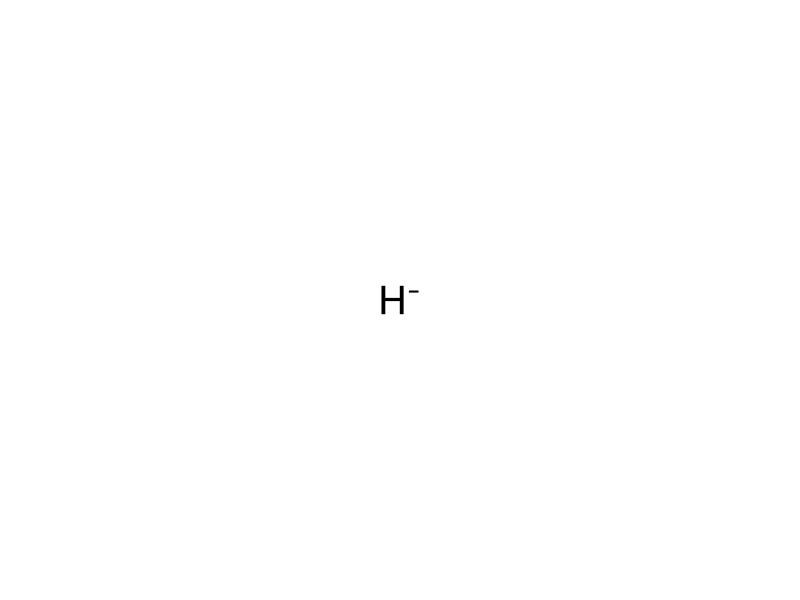
Grundinformationen
- Standard-SMILES
[H-]- InChIKey
KLGZELKXQMTEMM-UHFFFAOYSA-N- Summenformel
- H-
- Durchschnittliche Molmasse
- 1,008 g/mol
- Monoisotopische Masse
- 1,00782503
Namen und Bezeichner
- Bevorzugter Name
- Hydride
- IUPAC
- hydride
Namen und Synonyme
Hydride12184-88-2DTXSID6075306CHEBI:29239RefChem:147037DTXCID3033721hydrogen anionKLGZELKXQMTEMM-UHFFFAOYSA-NH(-)Q29004
Datenbank-Bezeichner
- CAS
12184-88-2- PubChem CID
- 166653
- DTXSID
DTXSID6075306- ChEBI
CHEBI:29239
Eigenschaften
Berechnete Struktureigenschaften
- XLogP
- 0
- Polarare Oberfläche (TPSA)
- 0 Ų
- H-Brücken-Donoren
- 0
- H-Brücken-Akzeptoren
- 1
- Frei drehbare Bindungen
- 0
- Schwere Atome
- 0
- Formalladung
- -1
- Komplexität
- 0
Experimentelle und physikochemische Eigenschaften
Physical Description
Metal hydrides are either liquids or solids shipped within a solution. This material will react vigorously in water or upon exposure to air to generate flammable fumes. Contact with the material may cause burns to skin, eyes, and mucous membranes, and it may be toxic by ingestion, inhalation or skin absorption.
Sicherheit und Regulatorisches
Gefahrenhinweise
DOT LabelDangerous When Wet
Fire Hazards
Excerpt from ERG Guide 138 [Substances - Water-Reactive (Emitting Flammable Gases)]:;Produce flammable gases on contact with water. May ignite on contact with water or moist air. Some react vigorously or explosively on contact with water. May be ignited by heat, sparks or flames. May re-ignite after fire is extinguished. Some are transported in highly flammable liquids. Runoff may create fire or explosion hazard. (ERG, 2024)
Health Hazards
Excerpt from ERG Guide 138 [Substances - Water-Reactive (Emitting Flammable Gases)]:;Inhalation or contact with vapors, substance or decomposition products may cause severe injury or death. May produce corrosive solutions on contact with water. Fire will produce irritating, corrosive and/or toxic gases. Runoff from fire control or dilution water may cause environmental contamination. (ERG, 2024)
Reactive GroupMetal Hydrides, Metal Alkyls, Metal Aryls, and Silanes
Reactivity AlertsStrong Reducing Agent;Water-Reactive;Pyrophoric
Reactivity Profile
Metal hydrides are reducing agents and react rapidly and dangerously with oxygen and with other oxidizing agents, even weak ones. Thus, they are likely to ignite on contact with alcohols. Hydrides are incompatible with acids, alcohols, amines, and aldehydes. May be ignited by heat, sparks or flames. May re-ignite after fire is extinguished. Some are transported in highly flammable liquids.
Air and Water ReactionsIgnites in air or react violently, sometimes explosively, with water or air of high humidity [Bretherick, 1979 p. 107]. Produce flammable gas (H2) on contact with water. May ignite on contact with water or moist air.
Sicherheit und Schutzausrüstung
Fire Fighting
Excerpt from ERG Guide 138 [Substances - Water-Reactive (Emitting Flammable Gases)]:;DO NOT USE WATER OR FOAM.;SMALL FIRE: Dry chemical, soda ash, lime or sand.;LARGE FIRE: DRY sand, dry chemical, soda ash or lime or withdraw from area and let fire burn. If it can be done safely, move undamaged containers away from the area around the fire.;FIRE INVOLVING METALS OR POWDERS (ALUMINUM, LITHIUM, MAGNESIUM, ETC.): Use dry chemical, DRY sand, sodium chloride powder, graphite powder or class D extinguishers; in addition, for Lithium you may use Lith-X® powder or copper powder. Also, see ERG Guide 170.;FIRE INVOLVING TANKS, RAIL TANK CARS OR HIGHWAY TANKS: Fight fire from maximum distance or use unmanned master stream devices or monitor nozzles. Do not get water inside containers. Cool containers with flooding quantities of water until well after fire is out. Withdraw immediately in case of rising sound from venting safety devices or discoloration of tank. ALWAYS stay away from tanks in direct contact with flames. (ERG, 2024)
First Aid
Excerpt from ERG Guide 138 [Substances - Water-Reactive (Emitting Flammable Gases)]:;Refer to the "General First Aid" section. Specific First Aid: In case of contact with substance, wipe from skin immediately; flush skin or eyes with running water for at least 20 minutes. (ERG, 2024)
Nonfire Spill Response
Excerpt from ERG Guide 138 [Substances - Water-Reactive (Emitting Flammable Gases)]:;ELIMINATE all ignition sources (no smoking, flares, sparks or flames) from immediate area. Do not touch or walk through spilled material. Stop leak if you can do it without risk. Use water spray to reduce vapors or divert vapor cloud drift. Avoid allowing water runoff to contact spilled material. DO NOT GET WATER on spilled substance or inside containers.;SMALL SPILL: Cover with DRY earth, DRY sand or other non-combustible material followed with plastic sheet to minimize spreading or contact with rain. Dike for later disposal; do not apply water unless directed to do so.;POWDER SPILL: Cover powder spill with plastic sheet or tarp to minimize spreading and keep powder dry. DO NOT CLEAN-UP OR DISPOSE OF, EXCEPT UNDER SUPERVISION OF A SPECIALIST. (ERG, 2024)
Isolation and Evacuation
Excerpt from ERG Guide 138 [Substances - Water-Reactive (Emitting Flammable Gases)]:;IMMEDIATE PRECAUTIONARY MEASURE: Isolate spill or leak area in all directions for at least 50 meters (150 feet) for liquids and at least 25 meters (75 feet) for solids.;LARGE SPILL: Consider initial downwind evacuation for at least 300 meters (1000 feet).;FIRE: If tank, rail tank car or highway tank is involved in a fire, ISOLATE for 800 meters (1/2 mile) in all directions; also, consider initial evacuation for 800 meters (1/2 mile) in all directions. (ERG, 2024)
Personal Protective Equipment (PPE)
Excerpt from ERG Guide 138 [Substances - Water-Reactive (Emitting Flammable Gases)]:;Wear positive pressure self-contained breathing apparatus (SCBA). Wear chemical protective clothing that is specifically recommended by the manufacturer when there is NO RISK OF FIRE. Structural firefighters' protective clothing provides thermal protection but only limited chemical protection. (ERG, 2024)
Zugehörige Reaktionen
25.156







Verknüpfte Notizen
Wird geladen…