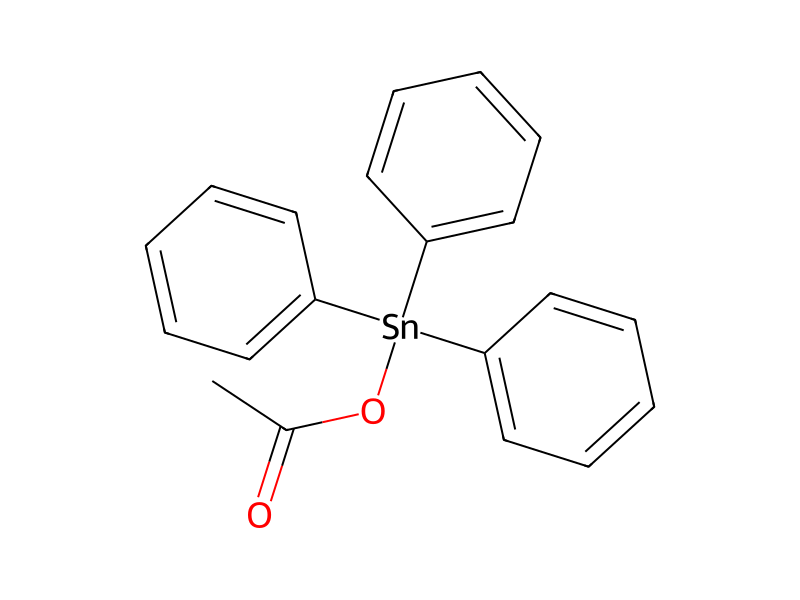
Grundinformationen
- Standard-SMILES
CC(=O)[O][Sn]([c]1ccccc1)([c]1ccccc1)[c]1ccccc1- InChIKey
WDQNIWFZKXZFAY-UHFFFAOYSA-M- Summenformel
- C20H18O2Sn
- Durchschnittliche Molmasse
- 409,1 g/mol
- Monoisotopische Masse
- 410,03287452
Überblick
Stannane, acetoxytriphenyl- appears as a white crystalline solid. Melting point 123-131 °C (253-268 °F). Used as a fungicide, algaecide and molluscicide. Controls early and late blight on potatoes.
Namen und Bezeichner
- Bevorzugter Name
- Fentin acetate
- IUPAC
- triphenylstannyl acetate
Namen und Synonyme
Weitere Namen anzeigen
Datenbank-Bezeichner
- CAS
900-45-8、900-95-8- PubChem CID
- 16682804
- DTXSID
DTXSID6021408- ChEBI
CHEBI:81918- EC Number
- 212-984-0
Eigenschaften
Berechnete Struktureigenschaften
- Polarare Oberfläche (TPSA)
- 26,3 Ų
- H-Brücken-Donoren
- 0
- H-Brücken-Akzeptoren
- 2
- Frei drehbare Bindungen
- 5
- Schwere Atome
- 23
- Formalladung
- 0
- Komplexität
- 332
Experimentelle und physikochemische Eigenschaften
Pesticides
Fungicides, Herbicides
Active substance -> EU Pesticides database: Not approved
Density
1.55 at 68 °F (EPA, 1998) - Denser than water; will sink
1.55 g/cu cm @ 20 °C
Color/Form
Colorless crystals
Small needles
Solubility
In water, about 9 mg/l at pH 5 and 20 °C.
In ethanol 22, ethyl acetate 82, dichloromethane 460, hexane 5, toluene 89 (all in g/l at 20 °C).
0.009 mg/mL at 20 °C
Decomposition
Converted to fentin hydroxide in the presence of water.
When heated to decomp it emits acrid smoke and fumes /of tin/.
Unstable in acids & alkalis (22 °C), decomp half-time <3 hr (pH 5,7 or 9).
Decomposed by sunlight and by atmospheric oxygen.
Melting Point
252 °F (EPA, 1998)
122-123 °C
121 - 123 °C
122 °C
Vapor Pressure
1.4e-08 mmHg at 140 °F (EPA, 1998)
0.00000048 [mmHg]
Vapor pressure: 1.43X10⁻⁵ mm Hg @ 60 °C
Physical Description
Stannane, acetoxytriphenyl- appears as a white crystalline solid. Melting point 123-131 °C (253-268 °F). Used as a fungicide, algaecide and molluscicide. Controls early and late blight on potatoes.
Colorless solid; [HSDB] White solid; [CAMEO] White odorless solid; [INCHEM] White powder; [MSDSonline]
Solid
Sicherheit und Regulatorisches
GHS-Klassifizierung
GHS Classification
Danger
H301: Toxic if swallowed [Danger Acute toxicity, oral]
P203, P260, P261, P262, P264, P264+P265, P270, P271, P273, P280, P284, P301+P316, P302+P352, P304+P340, P305+P354+P338, P316, P317, P318, P319, P320, P321, P330, P332+P317, P361+P364, P362+P364, P391, P403+P233, P405, and P501 (click each P-code to see the statement)
Danger
H301+H311 (94.4%): Toxic if swallowed or in contact with skin [Danger Acute toxicity, oral; acute toxicity, dermal]
P203, P260, P261, P262, P264, P264+P265, P270, P271, P273, P280, P284, P301+P316, P302+P352, P304+P340, P305+P354+P338, P308+P316, P316, P317, P318, P319, P320, P321, P330, P332+P317, P361+P364, P362+P364, P391, P403+P233, P405, and P501 (click each P-code to see the statement)
Gefahrenhinweise
Regulatory Information
Regulation (EC) No 1107/2009 (amended)
2002/478/EC
The New Jersey Worker and Community Right to Know Act requires public and private employers to provide information about hazardous substances at their workplaces. (N.J.S.A. 34:5A-1 et. seq.)
Hazards Summary
Animals given a single lethal dose have tremor, drowsiness, and ataxia; In other animal studies, has effects on the immune and reproductive systems; Workers who were patch tested in Italy had irritant, not allergic, contact dermatitis. [Reference #1] Converted by water to triphenyltin hydroxide; [HSDB] A skin irritant; [CAMEO] Generally has low toxicity, but may cause liver damage and injury to the immune and reproductive systems; Allergic skin reactions are common; Workers may report respiratory and mucosal irritation; [Reference #2] A skin and respiratory tract irritant; May cause serious eye injury; [eChemPortal: ESIS] An irritant; May cause serious eye injury; May cause skin sensitization; Can be absorbed through skin; [MSDSonline] See ORGANOMETALS. See Tin, organic compounds.
DOT Hazard Classification
Fentin acetate
Severe marine pollutant
CERCLA Reportable Quantities
Releases of CERCLA hazardous substances are subject to the release reporting requirement of CERCLA section 103, codified at 40 CFR part 302, in addition to the requirements of 40 CFR part 355. Stannane, acetoxytriphenyl- is an extremely hazardous substance (EHS) subject to reporting requirements when stored in amounts in excess of its threshold planning quantity (TPQ) of 500 or 10,000 lbs. Extremely hazardous substances that are solids are subject to either of two threshold planning quantities ... The lower quantity applies only if the solid exists in powdered for and has a particle size less than 100 microns; or is handled in solution or in molten form; or meets the criteria for a National Fire Protection Association (NFPA) rating of 2, 3 or 4 for reactivity. If the solid does not meet any of these criteria, it is subject to the upper ... threshold planning quantity ... .
Sicherheit und Schutzausrüstung
Fire Fighting
(Non-Specific -- Organotin pesticide, n.o.s.) Stay upwind; keep out of low areas. Ventilate closed spaces before entering them. Wear positive pressure breathing apparatus and special protective clothing. Move container from fire area if you can do so without risk. Fight fire from maximum distance. Dike fire control water for later disposal; do not scatter the material.
First Aid
Signs and Symptoms of Stannane, Acetoxytriphenyl- Exposure: Acute exposure to stannane, acetoxytriphenyl- may result in severe headache, nausea, vomiting, cramping, abdominal pain, skin burns or dermatitis, visual defects including photophobia (sensitivity to light), convulsions, and loss of consciousness. Occasionally bronchitis may also be noted.
Nonfire Spill Response
(Non-Specific -- Organotin pesticide, n.o.s.) Keep unnecessary people away; isolate hazard area and deny entry. Stay upwind; keep out of low areas. Ventilate closed spaces before entering them. Remove and isolate contaminated clothing at the site. Do not touch spilled material; stop leak if you can do it without risk. Use water spray to reduce vapors.
Disposal Methods
SRP: At the time of review, criteria for land treatment or burial (sanitary landfill) disposal practices are subject to significant revision. Prior to implementing land disposal of waste residue (including waste sludge), consult with environmental regulatory agencies for guidance on acceptable disposal practices.
Fentin acetate should be buried. It is stable when dry, but relatively easily decomposed when exposed to air and light finally forming inorganic tin compounds. Recommendable method: Landfill.
Preventive Measures
Keep out of reach of children. Keep away from food, drink & animal feeding stuffs. If you feel unwell, seek medical advice (show the label where possible).
SRP: Contaminated protective clothing should be segregated in such a manner so that there is no direct personal contact by personnel who handle, dispose, or clean the clothing. Quality assurance to ascertain the completeness of the cleaning procedures should be implemented before the decontaminated protective clothing is returned for reuse by the workers. All contaminated clothing should not be taken home at end of shift, but should remain at employee's place of work for cleaning.
Threshold Limit Values (TLV)
0.1 [mg/m3], as Sn
0.2 [mg/m3], as Sn
8 hr Time Weighted Avg (TWA): 0.1 mg/cu m; 15 min Short Term Exposure Limit (STEL): 0.2 mg/cu m, skin. /Organic tin cmpd, as Sn/
A4; Not classifiable as a human carcinogen. /Organic tin cmpd, as Sn/
Protective Action Criteria (PAC)
0.69 [mg/m3]
20 [mg/m3]
28 [mg/m3]
Toxikologische Informationen
Environmental Fate
TERRESTRIAL FATE: AROMATIC LABELED (14)C-TRIPHENYLTIN ACETATE ... ADDED TO SOIL AT LEVELS OF 5.0 & 10.0 PPM & SHIELDED FROM LIGHT ... /HAD HALF-LIFE OF/ APPROX 140 DAYS. CONSTANT LINEAR RATE OF CARBON DIOXIDE EVOLUTION OCCURRED UP TO 80TH DAY, AT WHICH TIME 1/3 OF PHENYL CARBON HAD BEEN RELEASED. RATE THEN FELL TO LESS THAN HALF INITIAL RATE.
TERRESTRIAL FATE: If triphenyltin acetate is released to soil, it either exists as or is rapidly converted to triphenyltin oxides, hydroxides, carbonates, or hydrated cations(1). In a laboratory soil leaching study, triphenyltins were strongly attached to soil(2). This also suggests that triphenyltins (such as triphenyltin acetate) may be expected to have low mobility in soil(SRC). The Freundlich parameters, log k and 1/n, for triphenyltin to sediment were 1.81 and 0.793, respectively(3). Volatilization from moist soil surfaces is not expected to be an important fate process because the cation, oxides, hydroxides, or carbonates are not expected to volatilize(SRC). Triphenyltin acteate is not expected to volatilize from dry soil surfaces(SRC) based upon an estimated vapor pressure of 4.8X10⁻⁷ mm Hg(4). Triphenyltin acetate undergoes biodegradation in the environment(SRC). Bacteria have been reported to cleave aryl-tin bonds in triphenyltin acetate(5). Triphenyltin acetate degrades in normal, fertile, agricultural field at 11-16 °C in <6 wks under aerobic conditions and 6-18 weeks under anaerobic conditions(6).
AQUATIC FATE: If triphenyltin acetate is released to soil, it either exists as or is rapidly converted to triphenyltin oxides, carbonates, or hydrated cations(1). Triphenyltin cation may react with water and behave like a simple protic acid with the formation of triphenyltin hydroxide(2). In seawater, the chloride ion may compete effectively with hydroxide ions resulting in the presence of triphenyltin chloride(2). Triphenyltin compounds may react with sulfides present in sediment, leading to the formation of bis(triphenyltin) sulfide(1). Cations, such as triphenyltin cation, generally adsorb to suspended solids and sediment(SRC). Volatilization from water surfaces is not expected to be an important fate process because the cation is not expected to volatilize(SRC). Triphenyltin cation may be susceptible to photolysis in water since triphenyltin hydroxide dissolved in pure water was approx 72% photodegraded by sunlight in 36 days apparently by a radical process; diphenyltin species were the only products observed(3). Triphenyltin acetate on a watch glass is degraded to diphenyl-, monophenyl-, and inorganic tin species when irradiated at wavelengths >350 nm(1). According to a classification scheme(4), a BCF of 800 for rainbow trout(5), suggests the potential for bioconcentration of triphenyltin cation in aquatic organisms is high(SRC). Triphenyltin may biodegrade in aquatic environments(SRC). Bacteria have been reported to cleave aryl-tin bonds in triphenyltin acetate(6). Triphenyltin acetate degrades in normal, fertile, agricultural field at 11-16 °C in <6 wks under aerobic conditions and 6-18 weeks under anaerobic conditions(7).
ATMOSPHERIC FATE: According to a model of gas/particle partitioning of semivolatile organic compounds in the atmosphere(1), triphenyltin acetate, which has an estimated vapor pressure of 4.8X10⁻⁷ mm Hg at 25 °C(2) will exist in both the vapor and particulate phases in the ambient atmosphere(SRC). Vapor-phase triphenyltin acetate is degraded in the atmosphere by reaction with photochemically-produced hydroxyl radicals(SRC); the half-life for this reaction in air is estimated to be 2.7 days(SRC), calculated from its rate constant of 5.9X10⁻¹² cu cm/molecule-sec at 25 °C(SRC) determined using a structure estimation method(3). Particulate-phase triphenyltin acetate may be removed from the air by wet and dry deposition(SRC).
Milk Concentrations
During oral dosing of sheep for 20 days with fentin acetate at the rate of 10 mg/day, (113)tin was found in the milk at an average concentration of 0.0017 ppm.
Cows fed sugar beets leaves containing triphenyltin acetate at 1 mg/kg had concn of 0.004 mg/kg in their milk(1).
Toxicity Summary
IDENTIFICATION: Triphenyltin compounds are triphenyl derivatives of tetravalent tin. They are colorless solids with low vapor pressures. They are lipophilic and have low solubility in water. Triphenyltin compounds have been used extensively as algicides and molluscicides in antifouling paints since the 1960s. Use of triorganotins in antifouling paints has been restricted in many countries because of their catastrophic effects on the oyster industry and more general effects on the aquatic ecosystem. HUMAN EXPOSURE: There are no data concerning the occupational exposure to triphenyltin compounds. A few poisoning case reports does describe neurotoxic effecys, which appeared to persist. Exposure of the general public to triphenyltin compounds occurs mostly from ingestion of contaminated seafood. ANIMAL/PLANT STUDIES: Triphenyltin compounds given orally to rats are not readily absorbed and are excreted primarily in the feces and partly in the urine. They are metabolized to diphenyltin, and monophenyltin, and non-extractable bound residues. Absorbed triphenyltin compounds accumulate in the kidney and liver to the greatest extent, with smaller amounts in other organs. Triphenyltin compounds, applied dermally can penetrate through the skin in a time and dose dependent manner. Triphenyltin exerts a variety of health effects in various animal species, including effects on the immune system, reproductive/developmental effects at levels near those that are maternially toxic, hyperplasia/adenomas in endocrine organs, apoptosis in thymus cells, calcium release in sarcoplasmic reticulum cells, and eye irritation. Triphenyltin compounds are moderately acutely toxic to rats. They are not carcinogenic, but some data show that they are co-clastogenic. Reproductive and developmental effects include a decrease in the number of inplantations and live fetuses (at 1.0 mg triphenyltin acetate/kg body weight per day in a rabbit gavage study), reduction in litter size/pup weight and in relative thymus or spleen weightin the weanlings (at 1.5 mg triphenyltin acetate/kg body weight per day in the diet of a two generation reproduction study in rats). Triphenyltin compounds affect the immune system. Triphenyltin compounds exert deleterous effects on aquatic organisms at low concentrations. Triphenyltin is considered an endocrine disruptor, because of imposex, a phenomenon in which female gastropods develop male sex organs. /Triphenyltin cmpd & Triphenyltin acetate/
Organotin compounds produce neurotoxic and immunotoxic effects. Organotins may directly activate glial cells contributing to neuronal cell degeneration by local release of pro-inflammatory cytokines, tumor necrosis factor-_, and/or interleukins. They may also induce apoptosis by direct action on neuronal cells. Organotin compounds stimulate the neuronal release of and/or decrease of neuronal cell uptake of neurotransmitters in brain tissue, including aspartate, GABA, glutamate, norepinephrine, and serotonin. This may be either a contributing factor to or result of the neuronal cell loss. The immunotoxic effects of organotins are characterized by thymic atrophy caused by the suppression of proliferation of immature thymocytes and apoptosis of mature thymocytes. Organotin compounds are believed to exert these effects by suppressing DNA and protein synthesis, inducing the expression of genes involved in apoptosis (such as nur77), and disrupting the regulation of intracellular calcium levels, giving rise to the uncontrolled production of reactive oxygen species, release of cytochrome c to the cytosol, and the proteolytic and nucleolytic cascade of apoptosis. The suppression of proliferation of immature thymocytes further results in the suppression of T-cell-mediated immune responses. Organotins are also endocrine disruptors and are believed to contribute to obesity by inappropriate receptor activation, leading to adipocyte differentiation. Inorganic tin triggers eryptosis, contributing to tin-induced anemia. (L308, A182, A184)
Soil Adsorption/Mobility
If triphenyltin acetate is released to soil, it either exists as, or rapidly converted to oxides, hydroxides, carbonates, or hydrated cations(1). Oxides, hydroxides, carbonates or cations are not expected to leach through soil into groundwater(SRC). In a laboratory soil leaching study, triphenyltins were strongly attached to soil(2). This also suggests that triphenyltins (such as triphenyltin acetate) may be expected to have low mobility in soil(SRC). The Freundlich parameters, log k and 1/n, for triphenyltin to sediment were 1.81 and 0.793, respectively(3).
Human Toxicity Excerpts
Several human poisonings from occupational exposures have been described but no deaths. Severe headache is a common symptom, as are nausea, vomiting, and epigastric pain, even in respiratory exposures. Glycosuria and hyperglycemia were encountered in several victims, as was dizziness, ... loss of consciousness occurred in 2 farmers after spraying.
Liver damage, in one case irreversible, has been reported in people spraying triphenyltin acetate, although exposure to other toxic compounds cannot be excluded. General malaise, headache, dizziness, & enlarged liver were the main symptoms in a patient who had 48 ug tin/l in his blood & 113 ug tin/l in his urine at the time of admission to hospital, after spraying a 60% triphenyltin acetate solution. Nine days after admission he developed diffuse erythema, but completely recovered 3 days later.
The majority of accidental poisonings involving systemic effects have been due to occupational exposure to triphenyltin acetate. Systemic effects reported to have followed both dermal & inhalation exposure include general malaise, gastric pain, dryness of the mouth, visual disturbances & shortness of breath. An enlarged liver & elevated levels of liver aminotransferase activity have been found in some cases. Recovery has generally been complete but in one case, where a man spilled an agricultural cmpd on his hands & chest, the liver damage persisted for 2 yr.
A case of triphenyltin acetate poisoning is described. The patient, who had been exposed mainly to cutaneous absorption, showed acute stages of an urticarial eruption, signs of hepatic injury, slight glucose intolerance, & EEG abnormalities. Concomitant with the highest concns of tin in plasma & the peak of tin excretion in urine, neutrophils did not show the normal incr in actin polymerization after stimulation with a chemotactic peptide (100 nM fMLP). The peak of urinary excretion of tin occurred between the fifth & the sixth day after poisoning; subsequently, the rate of excretion became slow, suggesting biphasic kinetics with the possibility of a cumulative trend.
For more Human Toxicity Excerpts (Complete) data for TRIPHENYLTIN ACETATE (6 total), please visit the HSDB record page.
Environmental Biodegradation
SEVERAL ASPERGILLUS SPECIES WERE ABLE TO DEGRADE FENTIN IN LIQ CULTURE WITH RELEASE OF (14)CARBON DIOXIDE. A GRAM-NEGATIVE BACTERIUM WAS ALSO ABLE TO METABOLIZE FENTIN.
In soil, the half-life for total mineralization of triphenyltin acetate has been determined to be approximately 140 days(1). In the field of a variety of crops, the half-life of triphenyltins has been reported to be 3-14 days(1). Bacteria have been reported to cleave aryl-tin bonds in triphenyltin acetate(2). Triphenyl tin acetate degrades in normal, fertile, agricultural field at 11-16 °C in <6 wks under aerobic conditions and 6-18 weeks under anaerobic conditions(3).
Sediment/Soil Concentrations
SEDIMENT: The concns of triphenyltin in harbor sediment in Lake Lucerne, Switzerland was high, up to 380 ug/g(1). High concns were restricted to the upper 4 cm and decreased significantly below. The dating of cores suggest that triphenyltin may persist for more than a decade in sediment. Small amounts of the mono- and di- phenyltin were also found in the upper layers of sediment.
Regulatorische Informationen
CERCLA Reportable Quantities
Releases of CERCLA hazardous substances are subject to the release reporting requirement of CERCLA section 103, codified at 40 CFR part 302, in addition to the requirements of 40 CFR part 355. Stannane, acetoxytriphenyl- is an extremely hazardous substance (EHS) subject to reporting requirements when stored in amounts in excess of its threshold planning quantity (TPQ) of 500 or 10,000 lbs. Extremely hazardous substances that are solids are subject to either of two threshold planning quantities ... The lower quantity applies only if the solid exists in powdered for and has a particle size less than 100 microns; or is handled in solution or in molten form; or meets the criteria for a National Fire Protection Association (NFPA) rating of 2, 3 or 4 for reactivity. If the solid does not meet any of these criteria, it is subject to the upper ... threshold planning quantity ... .
Chemie und Industrie
Pharmakologische Informationen
Mechanism of Action
The phasic distribution of spermatogenesis tubules after treatment with triphenyltin acetate and triphenyltin chloride was investigated in rats. Male albino Holtzman rats were divided into groups and administered triphenyltin acetate and triphenyltin chloride in the diet at 20 mg/kg/day for 20 days. Four animals from each group were killed on day 21 of treatment. Testes were removed and studied histologically for the presence or absence of sperm in tubules. Remaining animals were placed on regular food from day 25 of treatment for an additional 70 days and then treated as other animals. Although all eight phases of spermatogenesis were evident in triphenyltin acetate treated animals, as in controls, a general paucity of mature sperms and a relative predominance of earlier phases was evident. Sperm deficiencies were noted in phases 3 through 5 and the number of tubules was 33 percent of controls in phase 8. The latter indicated a possible effect of triphenyltin acetate on sertoli cells. In triphenyltin chloride treated animals, the tubules contained few sperm, especially in phases 2 to 5, and showed no normal phase distribution characteristics. No tubules advanced beyond phase 5. Triphenyltin chloride treated animals differed significantly in phase 4, indicating and interruption in the meiotic process. After normal diet for 70 days, triphenyltin acetate treated animals showed spermatogenesis similar to that of controls in all phases and in maturity of sperm. In the triphenyltin chloride treated group, spermatogenesis was similar to controls in all respects. The phasic distribution and tubule appearance were indicative of complete recovery of spermatogenic epithelium. /It was/ concluded that the difference in effects of the two triphenyltin compounds on the phasic distribution of cell association in tubules may be due to the actual concentration of the triphenyltin moiety reaching the active site.
Biological Half-Life
... /ANIMALS/ HAVE A BIOLOGICAL HALF-LIFE OF 20 HR WHILE /THEIR/ METABOLIC PRODUCTS ... HAVE BIOLOGICAL HALF-LIFE OF 8-70 DAYS.
BIOLOGICAL HALF TIME WAS EST AT 9.4 DAYS FROM SC INJECTION OF (113)TIN-TRIPHENYLTIN IN GUINEA PIGS. /TRIPHENYL TIN/
Metabolism/Metabolites
INTACT (113)TIN-DIPHENYLTIN & (113)TIN-MONOPHENYLTIN WERE ONLY CMPD IDENTIFIED IN FECES OF GUINEA PIGS ADMIN (113)TIN-TRIPHENYLTIN ACETATE SUBCUTANEOUSLY.
Triphenyltin acetate, which is resistant to the in-vitro dealkylation system, /the microsome-soluble reduced nicotinamide adenine dinucleotide system containing cytochrome p450 dependent mono-oxygenase/ is metabolized, probably by some other mechanism to diphenyl- & monophenyltin, & inorganic tin.
Though tin metal is very poorly absorbed, tin compounds may be absorbed via oral, inhalation, or dermal routes, with organotin compounds being much more readily absorbed than inorganic tin compounds. Tin may enter the bloodstream and bind to hemoglobin, where it is distributed and accumulates mainly in the kidney, liver, lung, and bone. Organotin compounds may undergo dealkylation, hydroxylation, dearylation, and oxidation catalyzed by cytochrome P-450 enzymes in the liver. The alkyl products of dealkylation are conjugated with glutathione and further metabolized to mercapturic acid derivatives. Tin and its metabolites are excreted mainly in the urine and feces. (L308)
MeSH Pharmacological Classification
Chemicals that kill or inhibit the growth of fungi in agricultural applications, on wood, plastics, or other materials, in swimming pools, etc.
An agent that causes the production of physical defects in the developing embryo.
Absorption, Distribution and Excretion
... /Based on oral & ip admin to rats, mice & guinea pigs/ absorption from the GI tract is poor compared with that from the peritoneum.
Absorption from the skin is poor. During oral dosing of sheep for 20 days with fentin acetate at the rate of 10 mg/day, tin was found in milk at an avg concn of 0.0017 ppm. (113)Tin was present as fentin acetate & in 2 unidentified forms. Seventeen days after dosing was stopped, the concn had fallen to the limits of detectability. During treatment, the concn of (113)tin was 0.0029 ppm in the blood & 0.0075 ppm in the urine. Eight days after dosing was stopped, the liver, kidney, lung, pancreas, gall bladder, & brain contained higher concn of (113)tin than did other organs, & the level was still incr in the liver after 218 days. In cows & sheep, triphenyltin is excreted chiefly in the feces. Triphenyltin is rapidly distributed to all tissues, including the brain of rats. It can still be detected in the brain of rats & guinea pigs more than 30 days after a single dose.
WHEN TAKEN IN BY ANIMALS, PROBABLY AS RESIDUE ON GREEN FODDER ... /IT/ WAS RAPIDLY EXCRETED WITH /FECES/. ... SMALL AMT ABSORBED WAS PARTLY EXCRETED IN URINE & PARTLY DISTRIBUTED THROUGHOUT WHOLE BODY.
CUTANEOUS APPLICATION OF (113)TIN-TRIPHENYLTIN ACETATE IN GUINEA PIGS RESULTED IN 3.04% & 7.97% OF DOSE BEING ABSORBED THROUGH SKIN, WHILE 16.3% & 12.4% WERE FOUND IN APPLICATION AREA 1 & 2 DAYS AFTER TREATMENT. RADIOACTIVITY WAS FOUND IN LIVER, KIDNEY & BRAIN IN LARGE AMT FOLLOWING SC INJECTION OF (113)TIN-TRIPHENYLTIN ACETATE, ALTHOUGH ABSORPTION PROCEEDED SLOWLY FROM INJECTION SITE. ABOUT 83% OF DOSE WAS ELIMINATED THROUGH FECES WITHIN 20 DAYS & BIOLOGICAL HALF TIME WAS EST AT 9.4 DAYS FROM SC INJECTION OF (113)TIN-TRIPHENYLTIN IN GUINEA PIGS. INTACT (113)TIN-DIPHENYLTIN & (113)TIN-MONOPHENYLTIN WERE ONLY CMPD IDENTIFIED IN FECES AFTER SC ADMIN.
For more Absorption, Distribution and Excretion (Complete) data for TRIPHENYLTIN ACETATE (8 total), please visit the HSDB record page.
Verwendung und Herstellung
Uses
Used as an acaricide (miticide) and algaecide in rice and potato rot; [Ullmann] Used as fungicide on potatoes, sugar beets, and nuts; Not currently registered with the EPA for use in the US; [HSDB] Used as molluscicide; [CAMEO]
Banned for use as a pesticide for plant protection and biocide in the EU; [eChemPortal: ESIS]
Farming (Pesticides) [Category: Industry]
For Triphenyltin acetate (USEPA/OPP Pesticide Code: 496700) there are 0 labels match. /SRP: Not registered for current use in the U.S., but approved pesticide uses may change periodically and so federal, state and local authorities must be consulted for currently approved uses./
Fungicide. Controls early and late blight on potatoes. Cercospora on sugar beets, peanuts, scab on pecans. /Former use/
Triphenyl tin compounds are ... also used as a biocide in antifouling paints. /Triphenyltin compounds/ /Former/
Formulations/Preparations
USEPA/OPP Pesticide Code 496700; Trade Names: Brestan. /Former/
WETTABLE POWDER (190 & 540 G AI/KG). 'BRESTAN', WETTABLE POWDER (540 G FENTIN ACETATE + 160 G MANEB/KG)
Tech grade is >94% pure
Tinestan WP 20 (Fentin acetate 20%); Tinestan WP 60 (Fentin acetate 60%).
Flowable suspension, wettable powder.
Zugehörige Reaktionen
Keine Reaktionsaufzeichnungen unter den aktuellen Filterkriterien.
Verknüpfte Notizen
Wird geladen…