HRID 2582als Edukt
Trimethylaluminum
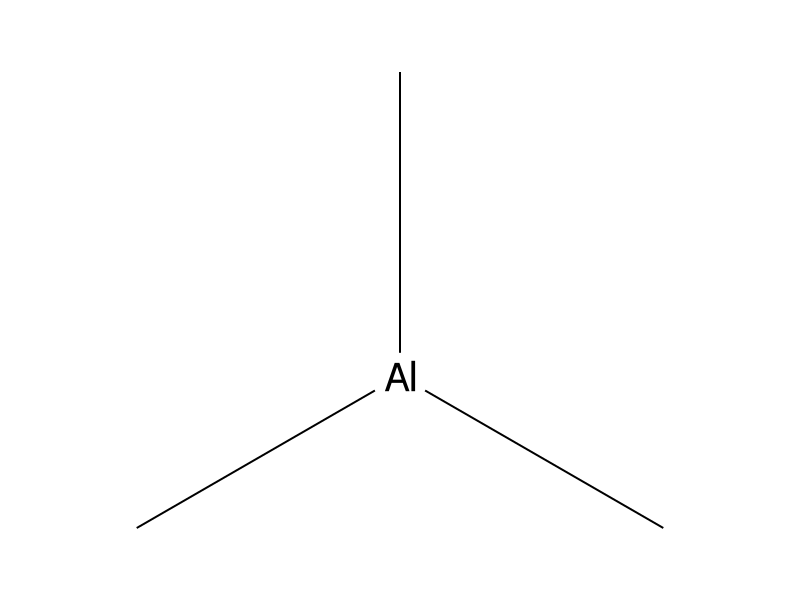
75-24-1[CH3][Al]([CH3])[CH3]JLTRXTDYQLMHGR-UHFFFAOYSA-NTrimethylaluminium (TMA) is an organoaluminium compound. It is used in the production of methylaluminoxane and Tebbe's reagent, as well as in semiconductor fabrication to grow thin film, high-k dielectrics. Aluminum is the most abundant metal in the earth's crust and is always found combined with other elements such as oxygen, silicon, and fluorine. (L739, L740, L782)
75-24-1DTXSID9058787Metals -> Metals, Organic Compounds
Flammable agents - 3rd degree
12.4 [mmHg]
69.3 [mm Hg] @60 °C
Liquid; CBI
Clear colorless liquid; mp = 15 deg C; [Merck Index]
Sicherheitsangaben dienen nur zur Orientierung und ersetzen weder das Sicherheitsdatenblatt (SDB) des Lieferanten noch geltende Vorschriften oder eine fachliche Bewertung.
Danger
H250 (98.9%): Catches fire spontaneously if exposed to air [Danger Pyrophoric liquids]
P210, P222, P223, P231, P231+P232, P233, P260, P264, P264+P265, P280, P301+P330+P331, P302+P335+P334, P302+P361+P354, P304+P340, P305+P354+P338, P316, P317, P321, P363, P370+P378, P402+P404, P405, and P501 (click each P-code to see the statement)
Aggregated GHS information provided per 350 reports by companies from 12 notifications to the ECHA C&L Inventory. Each notification may be associated with multiple companies.
Chemical: Aluminium, trimethyl-
Aluminum, trimethyl- is listed on the EPA's Chemical Data Reporting (CDR) system. Manufacturers and importers of Aluminum, trimethyl- are required to report information about their production and use of this chemical to the EPA under the Toxic Substances Control Act (TSCA). (40 eCFR Part 711)
REACH registered substance: Trimethylaluminium (EC: 200-853-0)
Trimethylaluminum: HSNO Approval: HSR006351 Approved with controls
The New Jersey Worker and Community Right to Know Act requires public and private employers to provide information about hazardous substances at their workplaces. (N.J.S.A. 34:5A-1 et. seq.)
Pyrophoric and corrosive; Reacts violently with water; [Merck Index] Pyrophoric; Reacts violently with water evolving flammable gases; Causes burns; Inhalation may cause corrosive injuries to upper respiratory tract; [Sigma-Aldrich MSDS] See Triethylaluminum.
Aluminum is poorly absorbed following either oral or inhalation exposure and is essentially not absorbed dermally. The bioavailability of aluminum is strongly influenced by the aluminum compound and the presence of dietary constituents which can complex with aluminum and enhance or inhibit its absorption. Aluminum binds to various ligands in the blood and distributes to every organ, with highest concentrations found in bone and lung tissues. In living organisms, aluminum is believed to exist in four different forms: as free ions, as low-molecular-weight complexes, as physically bound macromolecular complexes, and as covalently bound macromolecular complexes. Absorbed aluminum is excreted principally in the urine and, to a lesser extent, in the bile, while unabsorbed aluminum is excreted in the faeces. (L739)
Used as a reagent and catalyst in organic chemistry and as a source of aluminum in semiconductors; [Merck Index]
Semiconductor Manufacturing [Category: Industry]
Trimethylaluminium is used in the production of methylaluminoxane and Tebbe's reagent, as well as in semiconductor fabrication to grow thin film, high-k dielectrics. (L782)
Electrical Equipment, Appliance, and Component Manufacturing
Aluminum, trimethyl-: ACTIVE
VerwendenTrimethylaluminium can be used as catalyst for olefin polymerization, pyrophoric fuel, manufacture of straight-chain primary alcohols and olefins, to produce luminous trails in upper atmosphere to track rockets.
Pyr. Liq. 1 (98.9%)
Flammable agents - 3rd degree, Reactive agents - 3rd degree
CSL00130
TETRAFLUORO-1,4-BENZOQUINONE + TRIMETHYLALUMINUM
Chemical & Engineering News (20 May 1996) Vol. 74, No. 21, pp. 4. Aluminum compounds with perfluorophenol substituents have been identified as potentially explosive [Organometallics, 10, 1917 (1991)]. I wish to communicate my experience as well as that of my colleagues. Adding 1,4-tetrafluorodihydroquinone (1 mol equivalent) in toluene to a toluene solution of trimethyl aluminum (1.1 mol equivalents) resulted in a gel-like reaction mixture. Filtration and drying gave a white solid that was isolated in a nitrogen-filled glove box. A 50-mg sample of this solid detonated violently when pressed gently between a stainless-steel spatula and a glass surface. Fortunately, no one was hurt in this incident. Tris(pentafluorophenyl)aluminum etherate has been reported to be explosive when heated [Naturforschg., 20b, 5 (1965)]. Clearly, extreme caution should be used when handling compounds of aluminum with fluorinated ligands.
Explosive
Aluminum complexes with fluorinated ligands
Not Available
11 [mg/m3]
120 [mg/m3]
710 [mg/m3]
Aluminum targets the nervous system and causes decreased nervous system performance and is associated with altered function of the blood-brain barrier. The accumulation of aluminum in the body may cause bone or brain diseases. High levels of aluminum have been linked to Alzheimer's disease. A small percentage of people are allergic to aluminium and experience contact dermatitis, digestive disorders, vomiting or other symptoms upon contact or ingestion of products containing aluminium. (L739, L740)
The main target organs of aluminum are the central nervous system and bone. Aluminum binds with dietary phosphorus and impairs gastrointestinal absorption of phosphorus. The decreased phosphate body burden results in osteomalacia (softening of the bones due to defective bone mineralization) and rickets. Aluminum's neurotoxicity is believed to involve several mechanisms. Changes in cytoskeletal protein functions as a results of altered phosphorylation, proteolysis, transport, and synthesis are believed to be one cause. Aluminum may induce neurobehavioral effects by affecting permeability of the blood-brain barrier, cholinergic activity, signal transduction pathways, lipid peroxidation, and impair neuronal glutamate nitric oxide-cyclic GMP pathway, as well as interfere with metabolism of essential trace elements because of similar coordination chemistries and consequent competitive interactions. It has been suggested that aluminum's interaction with estrogen receptors increases the expression of estrogen-related genes and thereby contributes to the progression of breast cancer (A235), but studies have not been able to establish a clear link between aluminum and increased risk of breast cancer (A15468). Certain aluminum salts induce immune responses by activating inflammasomes. (L739, A235, A236)
Inhalating aluminum dust causes coughing and abnormal chest X-rays. A small percentage of people are allergic to aluminium and experience contact dermatitis, digestive disorders, vomiting or other symptoms upon contact or ingestion of products containing aluminium. (L739, L740)
Not listed by IARC. IARC classified aluminum production as carcinogenic to humans (Group 1), but did not implicate aluminum itself as a human carcinogen. (L135) A link between use of aluminum-containing antiperspirants and increased risk of breast cancer has been proposed (A235), but studies have not been able to establish a clear link (A15468).
DefinitionA colorless liquid produced by the sodium reduction of dimethyl aluminum chloride. It ignites spontaneously on contact with air and reacts violently with water, acids, halogens, alcohols, and amines. Aluminum alkyls are used in the Ziegler process for the manufacture of high-density polyethene.