
Ammoniumdodecylsulfat
Ammonium Lauryl Sulfate
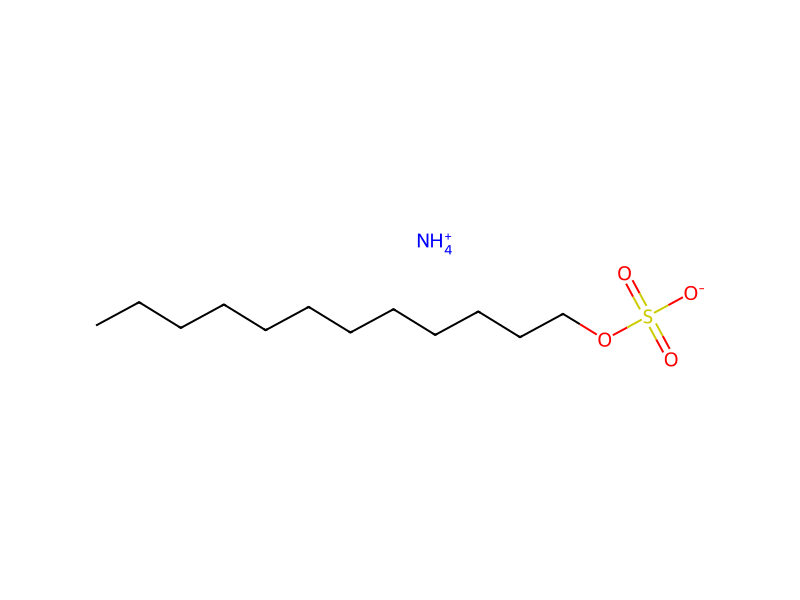
Grundinformationen
- CAS
2235-54-3- Standard-SMILES
CCCCCCCCCCCCOS(=O)(=O)[O-].[NH4+]- InChIKey
BTBJBAZGXNKLQC-UHFFFAOYSA-N- Summenformel
- C12H26O4S.H3N
- Durchschnittliche Molmasse
- 283,43 g/mol
- Monoisotopische Masse
- 283,18172958
Überblick
Ammonium lauryl sulfate appears as light yellow liquid. May float or sink and mix with water. (USCG, 1999)
Namen und Bezeichner
- Bevorzugter Name
- Ammonium Lauryl Sulfate
- IUPAC
- azanium dodecyl sulfate
- Lokaler Name
- Ammoniumdodecylsulfat
- Englischer Name
- Ammonium lauryl sulfate
- Summenformel
- C12H26O4S.H3N
- Molmasse
- 283.43
Namen und Synonyme
Ammonium dodecyl sulfate2235-54-3AMMONIUM LAURYL SULFATEPresulinAmmonium dodecyl sulphateSinoponTexapon specialConco sulfate AMaprofix NHRichonol AMSterling AMNeopon LAM
Weitere Namen anzeigen
Hydroxypyrimidineneoponlamsiponla30siprol422siproll22Texapon Amaprofixnhrichonolam
Akyposal als 33Montopol LA 20Siprol L22Siprol 422Texapon A 400Lauryl ammonium sulfateSipon LA 30Caswell No. 044B
Datenbank-Bezeichner
- CAS
2235-54-3- PubChem CID
- 16700
- DTXSID
DTXSID2027462- UNII
- Q7AO2R1M0B
- EC Number
- 218-793-9
Eigenschaften
Berechnete Struktureigenschaften
- Polarare Oberfläche (TPSA)
- 75,8 Ų
- H-Brücken-Donoren
- 1
- H-Brücken-Akzeptoren
- 4
- Frei drehbare Bindungen
- 11
- Schwere Atome
- 18
- Formalladung
- 0
- Komplexität
- 230
Experimentelle und physikochemische Eigenschaften
Chemical ClassesNitrogen Compounds -> Ammonium Compounds
Cosmetics
Cosmetic ingredients (Ammonium Lauryl Sulfate) -> CIR (Cosmetic Ingredient Review)
Cleansing; Foaming; Surfactant
Density1.03 at 68 °F (USCG, 1999) - Denser than water; will sink
Color/FormClear liquid
Food Contact SubstancesFCS -> FDA Inventory of Food Contact Substances Listed in 21 CFR
Physical Description
Ammonium lauryl sulfate appears as light yellow liquid. May float or sink and mix with water. (USCG, 1999)
Liquid
Clear liquid; [HSDB] Light yellow liquid; [CAMEO] Commercial material is liquid; Pure material is light yellow solid; [CHEMINFO] Opaque yellow liquid (30% aqueous solution); [MSDSonline]
Physikochemische Eigenschaften
- Dichte
- 1.02 g/mL · 1.02 g/mL at 20 °C
- Brechungsindex
- 20 · n20/D 1.37
- Flammpunkt
- 110 °C · 110 °C
- storage temp.
- 15 · 15-25°C
- Löslichkeit
- 20 °C · water: soluble at 20 °C
- Aggregatzustand
- liquid
- Farbe
- Colorless to Very Light Yellow and Colorless to Very Light Green-Yellow
- PH
- 6.8 · 6.8
- Wasserlöslichkeit
- 20 °C · water: soluble at20°C
- BRN
- 5188379 · 5188379
- Stabilität
- Stable. Incompatible with strong oxidizing agents.
- Major Application
- cleaning products
- Kosmetik-Inhaltsstoffe Funktionen
- CLEANSINGFOAMINGSURFACTANT - CLEANSING
- InChI
- InChI=1S/C12H26O4S.H3N/c1-2-3-4-5-6-7-8-9-10-11-12-16-17(13,14)15;/h2-12H2,1H3,(H,13,14,15);1H3
- InChIKey
- BTBJBAZGXNKLQC-UHFFFAOYSA-N
- SMILES
- [NH4+].S([O-])(OCCCCCCCCCCCC)(=O)=O
- LogP
- 5.395 · 5.395 (est)
- CAS Datenbank
- 2235 · 2235-54-3(CAS DataBase Reference)
- EPA chemische Informationen
- Ammonium lauryl sulfate (2235-54-3)
Sicherheit und Regulatorisches
Sicherheitsangaben dienen nur zur Orientierung und ersetzen weder das Sicherheitsdatenblatt (SDB) des Lieferanten noch geltende Vorschriften oder eine fachliche Bewertung.
GHS-Klassifizierung
GHS Classification
This chemical does not meet GHS hazard criteria for 0.3% (2 of 617) of reports.
Danger
H302 (71.8%): Harmful if swallowed [Warning Acute toxicity, oral]
P264, P264+P265, P270, P280, P301+P317, P302+P352, P305+P351+P338, P305+P354+P338, P317, P321, P330, P332+P317, P337+P317, P362+P364, and P501 (click each P-code to see the statement)
Aggregated GHS information provided per 617 reports by companies from 9 notifications to the ECHA C&L Inventory. Each notification may be associated with multiple companies.
Danger
Gefahrenhinweise
Regulatory Information
Chemical: Sulfuric acid, monododecyl ester, ammonium salt
Sulfuric acid, monododecyl ester, ammonium salt (1:1) is listed on the EPA's Chemical Data Reporting (CDR) system. Manufacturers and importers of Sulfuric acid, monododecyl ester, ammonium salt (1:1) are required to report information about their production and use of this chemical to the EPA under the Toxic Substances Control Act (TSCA). (40 eCFR Part 711)
Dodecyl ammonium sulphate: Does not have an individual approval but may be used under an appropriate group standard
Other Safety InformationIMAP assessments - Sodium, ammonium and potassium lauryl sulfate: Human health tier II assessment
Fire HazardsSpecial Hazards of Combustion Products: Toxic oxides of nitrogen and sulfur may form in fires. (USCG, 1999)
Health HazardsContact with liquid irritates eyes and may have drying effect on the skin. Prolonged contact will cause skin irritation. (USCG, 1999)
Hazards Summary
A skin and eye irritant; Emergency treatment: Detergents and soaps- anionic and nonionic; [HSDB] Moderate eye irritant and severe skin irritant in rabbits; [RTECS] Concentrations greater than 20% may be corrosive to skin and eyes; [CHEMINFO] An irritant; May cause serious eye injury; May cause respiratory sensitization (28% aqueous solution); [Medisca MSDS]
Reactive GroupEsters, Sulfate Esters, Phosphate Esters, Thiophosphate Esters, and Borate Esters
EPA Safer ChemicalChemical: Ammonium lauryl sulfate
FIFRA Requirements
As the federal pesticide law FIFRA directs, EPA is conducting a comprehensive review of older pesticides to consider their health and environmental effects and make decisions about their future use. Under this pesticide reregistration program, EPA examines health and safety data for pesticide active ingredients initially registered before November 1, 1984, and determines whether they are eligible for reregistration. In addition, all pesticides must meet the new safety standard of the Food Quality Protection Act of 1996. Pesticides for which EPA had not issued Registration Standards prior to the effective date of FIFRA, as amended in 1988, were divided into three lists based upon their potential for human exposure and other factors, with List B containing pesticides of greater concern and List D pesticides of less concern. Ammonium lauryl sulfate is found on List D. Case No: 4061; Pesticide type: insecticide, fungicide, rodenticide, antimicrobial; Case Status: RED Approved 09//93; OPP has made a decision that some/all uses of the pesticide are eligible for reregistration, as reflected in a Reregistration Eligibility Decision (RED) document.; Active ingredient (AI): Ammonium lauryl sulfate; AI Status: The active ingredient is no longer contained in any registered pesticide products ... "cancelled."
Reactivity Profile
Acidic inorganic salts, such as AMMONIUM LAURYL SULFATE, are generally soluble in water. The resulting solutions contain moderate concentrations of hydrogen ions and have pH's of less than 7.0. They react as acids to neutralize bases. These neutralizations generate heat, but less or far less than is generated by neutralization of inorganic acids, inorganic oxoacids, and carboxylic acid.
Air and Water ReactionsWater soluble.
Hazard Classes and Categories
Acute Tox. 4 (71.8%)
Eye damage - category 1
Skin, Eye, and Respiratory IrritationsIrritating to skin and eyes.
Sicherheit und Schutzausrüstung
First AidEYES OR SKIN: flush with water. (USCG, 1999)
Firefighting HazardsPoisonous gases may be produced in fire.
Disposal Methods
SRP: At the time of review, criteria for land treatment or burial (sanitary landfill) disposal practices are subject to significant revision. Prior to implementing land disposal of waste residue (including waste sludge), consult with environmental regulatory agencies for guidance on acceptable disposal practices.
Personal Protective Equipment (PPE)
Rubber gloves; goggles or face shield (USCG, 1999)
Personal Protective Equipment: Rubber gloves; googles or face shield
Toxikologische Informationen
Health EffectsIn high concentrations ALS may cause severe irritation to eyes and skin. Inhalation and ingestion may also cause irritation. ALS may react to produce nitrosamines, which are believed to be carcinogenic. (L1890, L1891)
Adverse EffectsDermatotoxin - Skin burns.
Exposure RoutesOral (L1891) ; inhalation (L1891) ; dermal (L1891)
Toxicity Summary
Sodium Lauryl Sulfate and Ammonium Lauryl Sulfate appear to be safe in formulations designed for discontinuous, brief use followed by thorough rinsing from the surface of the skin. In products intended for prolonged contact with skin, concentrations should not exceed 1%.
Safe for use in cosmetics, with qualifications
While ammonium lauryl sulfate itself is not toxic, it is a nitrosating agent. Nitrosating agents may decompose and/or react to cause nitrosamine contamination. Nitrosamines are produced from secondary amines and amides in the presence of nitrite ions and are believed to be carcinogenic. Once in the body, nitrosamines are activated by cytochrome P-450 enzymes. They are then believed to induce their carcinogenic effects by forming DNA adducts at the N- and O-atoms. (L1889, L1890, A2878, A2879, A2880)
Signs and SymptomsIn high concentrations ALS may cause severe irritation to eyes and skin. Inhalation and ingestion may also cause irritation. (L1891)
Human Toxicity Excerpts
BRANCHED-CHAIN PRODUCTS HAVE...SIGNIFICANT PERCUTANEOUS TOXICITY. SKIN IRRITATION MAY BE ENCOUNTERED... /ALKYL SODIUM SULFATES/
Contact with liquid irritates eyes and may have drying effect on the skin. Prolonged contact will cause skin irritation.
Carcinogen ClassificationNot listed by IARC. Certain nitrosamines are classified by IARC as either probably or possibly carcinogenic to humans (Groups 2A and 2B, respectively). (L135)
Non-Human Toxicity Excerpts
SURFACTANTS FOR PREPN OF MYCOBACTERIAL SUSPENSIONS CAUSED INDUCTION OF CHROMOGENIC STRAINS IN M TUBERCULOSIS & BOVIS, AMMONIUM LAURYL SULFATE WAS LESS EFFECTIVE THAN NA LAURYL SULFATE. GUINEA PIGS INOCULATED WITH THESE STRAINS SHOWED NO TUBERCULOUS LESIONS.
EVALUATION OF IRRITANCY OF SURFACE ACTIVE AGENTS UPON UPPER RESP TRACT OF GUINEA-PIGS, MICE & RABBITS.
Regulatorische Informationen
FIFRA Requirements
As the federal pesticide law FIFRA directs, EPA is conducting a comprehensive review of older pesticides to consider their health and environmental effects and make decisions about their future use. Under this pesticide reregistration program, EPA examines health and safety data for pesticide active ingredients initially registered before November 1, 1984, and determines whether they are eligible for reregistration. In addition, all pesticides must meet the new safety standard of the Food Quality Protection Act of 1996. Pesticides for which EPA had not issued Registration Standards prior to the effective date of FIFRA, as amended in 1988, were divided into three lists based upon their potential for human exposure and other factors, with List B containing pesticides of greater concern and List D pesticides of less concern. Ammonium lauryl sulfate is found on List D. Case No: 4061; Pesticide type: insecticide, fungicide, rodenticide, antimicrobial; Case Status: RED Approved 09//93; OPP has made a decision that some/all uses of the pesticide are eligible for reregistration, as reflected in a Reregistration Eligibility Decision (RED) document.; Active ingredient (AI): Ammonium lauryl sulfate; AI Status: The active ingredient is no longer contained in any registered pesticide products ... "cancelled."
Sicherheitsdaten
- wgk
- 3
- tsca
- TSCA listed
- risk_code
- 36/38-52/53-51/53
- hazard_code
- Xi,N
- safety_code
- 26-36/37-61
- Speicherklasse
- 10 - Combustible liquids
- Giftige Stoffe Daten
- 2235-54-3(Hazardous Substances Data)
- Hazard Classifications
- Aquatic Chronic 3Eye Irrit. 2Skin Irrit. 2
Chemie und Industrie
Pharmakologische Informationen
Metabolism/MetabolitesNitrosamines can enter the body via ingestion, inhalation, or dermal contact. Once in the body, nitrosamines are metabolized by cytochrome P-450 enzymes, which essentially activates them into carcinogens. (A2878, A2879)
Verwendung und Herstellung
Uses
CIR ingredient: Ammonium Lauryl Sulfate
Used as an anionic detergent or surface-active agent in hair and rug shampoos, bath products, detergents, skin cleansing preparations, hand soaps, hair dyes, conditioners, and shaving products; [CHEMINFO]
Dressing Hair [Category: Other]
The active ingredient is no longer contained in any registered pesticide products ... "cancelled."
SURFACE-ACTIVE INGREDIENT OF HAIR SHAMPOOS, RUG SHAMPOOS
ANIONIC DETERGENT /ALKYL SODIUM SULFATES/
U.S. Exports(1972) No Data
U.S. Imports(1972) No Data
U.S. Production
2023: 250,000 - <400,000 lb
(1972) 1.21X10+9 GRAMS
Consumer UsesSurfactant (surface active agent)
Industry UsesIntermediate
Methods of ManufacturingREACTION OF N-DODECYL ALCOHOL WITH CHLOROSULFONIC ACID FOLLOWED BY NEUTRALIZATION WITH AMMONIA
Formulations/Preparations28-30% and 27-29% Active anionics, pale yellow liquid grades.
Household ProductsInformation on 278 consumer products that contain Ammonium lauryl sulfate in the following categories is provided:
Use Classification
EPA Safer Chemical Functional Use Classes -> Surfactants
Safer Chemical Classes -> Green circle - The chemical has been verified to be of low concern
Cosmetics -> Cleansing; Foaming; Surfactant
General Manufacturing Information
Soap, Cleaning Compound, and Toilet Preparation Manufacturing
Sulfuric acid, monododecyl ester, ammonium salt (1:1): ACTIVE
Anwendungen
Verwendenammonium lauryl sulfate is a surfactant with emulsifying capabilities. given its detergent properties, at mild acidic pH levels it can be used as an anionic surfactant cleanser. It is considered one of the most irritating surfactants, causing dryness and skin redness. Today, it is either combined with anti-irritant ingredients to reduce sensitivity or replaced with a less irritating but similar surfactant, such as ammonium laureth sulfate.
Zugehörige Reaktionen
1
Notizen zur Verbindung
Wird geladen…