HuagongsheHuagongshe Chemie-Druckbericht · Nur für Forschungszwecke
Percoll
abs9102 · PERCOLL · PERCOLL(R) · CENTRICOLL · PERCOLL(TM) · CENTRICOLL(TM) · Percoll (1.131) · PERCOLL(R)(2-8℃)
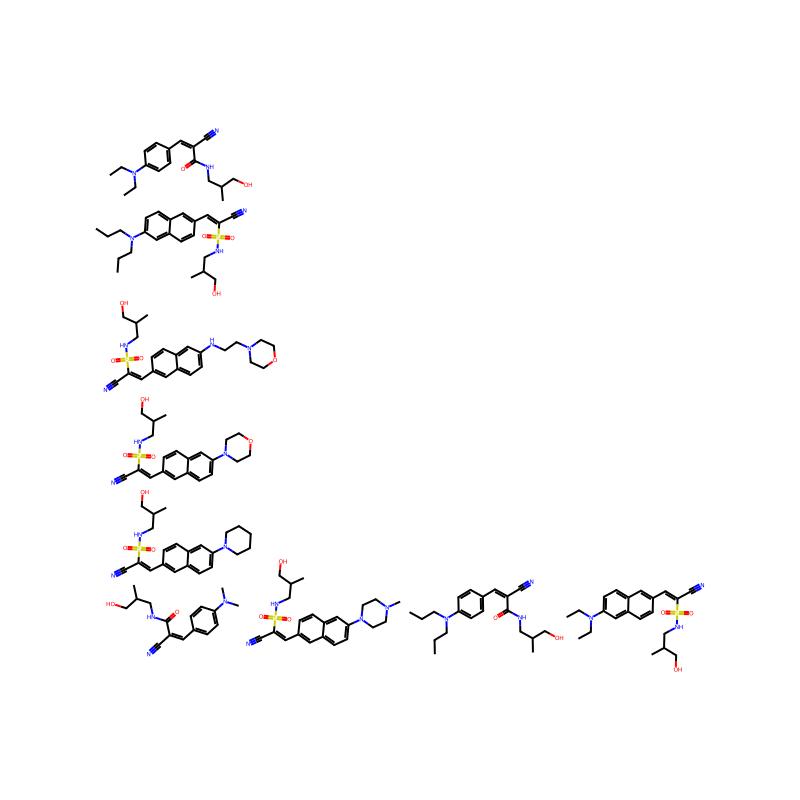
Identifikatoren & physikalische Daten
| CAS No. | 65455-52-9 |
|---|---|
| Summenformel | C186H243N29O26S6 |
| Durchschnittliche Molmasse | 3.493 g/mol |
| Monoisotopische Masse | 3.490,690836 g/mol |
| SMILES | CC(CO)CNC(=O)C(C#N)=Cc1ccc(N(C)C)cc1.CC(CO)CNS(=O)(=O)C(C#N)=Cc1ccc2cc(N3CCCCC3)ccc2c1.CC(CO)CNS(=O)(=O)C(C#N)=Cc1ccc2cc(N3CCN(C)CC3)ccc2c1.CC(CO)CNS(=O)(=O)C(C#N)=Cc1ccc2cc(N3CCOCC3)ccc2c1.CC(CO)CNS(=O)(=O)C(C#N)=Cc1ccc2cc(NCCN3CCOCC3)ccc2c1.CCCN(CCC)c1ccc(C=C(C#N)C(=O)NCC(C)CO)cc1.CCCN(CCC)c1ccc2cc(C=C(C#N)S(=O)(=O)NCC(C)CO)ccc2c1.CCN(CC)c1ccc(C=C(C#N)C(=O)NCC(C)CO)cc1.CCN(CC)c1ccc2cc(C=C(C#N)S(=O)(=O)NCC(C)CO)ccc2c1 |
| InChIKey | RZPNYVYWMSGMNL-UHFFFAOYSA-N |
| PubChem CID | 168009829 |
| EC No. | 306-819-2 |
Chemische & physikalische Eigenschaften
| Polarare Oberfläche (TPSA) | 874 |
|---|---|
| H-Brücken-Donoren | 19 |
| H-Brücken-Akzeptoren | 52 |
| Frei drehbare Bindungen | 75 |
| Schwere Atome | 247 |
| Formalladung | 0 |
| Komplexität | 5.640 |
| Polymers | Plastics & Rubber -> Polymers |
| Kosmetika | Skin conditioning |
| Physical Description | White odorless suspension[Research Organics MSDS] |
| Dichte | 1.1 g/mL at 25 °C(lit.) |
| Lagerbedingungen | 2-8°C |
| Farbe | clear colorless to faint yellow |
| pH | 8.9 (20°C) |
Sicherheit & Vorschriften
| Gefahrenübersicht | May cause irritation[Research Organics MSDS] |
|---|---|
| Protective Action Criteria (PAC) | 30 [mg/m3]330 [mg/m3]2000 [mg/m3] |
| Wassergefährdungsklasse (WGK) | 3 |
Anwendungen & Verwendung
Verwenden
Percoll consists of colloidal silica particles of 15-30 nm diameter (23% w/w in water) which have been coated with polyvinylpyrrolidone (PVP). It is used to establish non-toxic low viscosity, low osmolarity density gradients that can be used to isolate cells, organelles and viruses. It has been used to separate inner and outer membrane vesicles from E. coli. Percoll is isosmotic throughout the gradient, non-toxic, and is easily removed from the purified materials.