
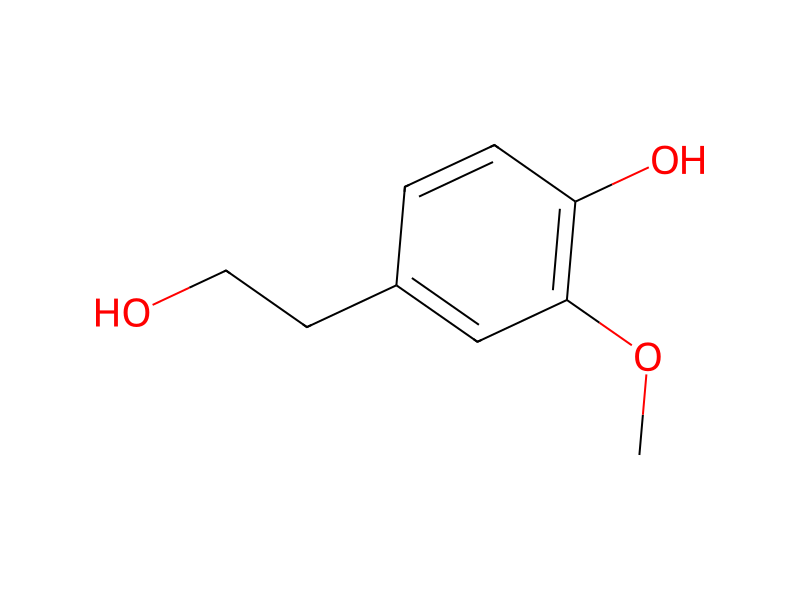
Grundinformationen
- Standard-SMILES
COc1cc(CCO)ccc1O- InChIKey
XHUBSJRBOQIZNI-UHFFFAOYSA-N- Summenformel
- C9H12O3
- Durchschnittliche Molmasse
- 168,19 g/mol
- Monoisotopische Masse
- 168,07864424
Namen und Bezeichner
- Bevorzugter Name
- Homovanillyl alcohol
- IUPAC
- 4-(2-hydroxyethyl)-2-methoxyphenol
- Englischer Name
- Homovanillyl alcohol
- Summenformel
- C9H12O3
- Molmasse
- 168.19
Namen und Synonyme
Homovanillyl alcohol2380-78-14-(2-Hydroxyethyl)-2-methoxyphenol3-METHOXY-4-HYDROXYPHENYLETHANOLBenzeneethanol, 4-hydroxy-3-methoxy-MOPET9A7EE8MS6ADTXSID40178494MHPERefChem:788469Hydroxymethoxyphenethyl AlcoholAlcohol, Hydroxymethoxyphenethyl
Weitere Namen anzeigen
Mechanistically2-(4-guaiacyl)-ethanolVilanterol Impurity 77Homovanillyl alcohol,99%Homovanillyl alcohol 99%2-(4Fluorophenoxy)ethanol3,4-Dibromobenzyl alcohol
3 Methoxy 4 hydroxyphenylethanolDTXCID70100985219-175-1Methoxyhydroxyphenylethanol4-Hydroxy-3-methoxyphenethanolVanillylmethanolGuaiacyl ethanol4-(2-Hydroxyethyl)guaiacol
Datenbank-Bezeichner
- CAS
2380-78-1- PubChem CID
- 16928
- DTXSID
DTXSID40178494- ChEMBL
CHEMBL3747068- ChEBI
CHEBI:173769- UNII
- 9A7EE8MS6A
- EC Number
- 219-175-1
- Nikkaji
- J172D
Eigenschaften
Berechnete Struktureigenschaften
- XLogP
- 0,5
- Polarare Oberfläche (TPSA)
- 49,7 Ų
- H-Brücken-Donoren
- 2
- H-Brücken-Akzeptoren
- 3
- Frei drehbare Bindungen
- 3
- Schwere Atome
- 12
- Formalladung
- 0
- Komplexität
- 127
Experimentelle und physikochemische Eigenschaften
LogP0.47
Melting Point40 - 42 °C
Physical DescriptionSolid
Kovats Retention Index
1534;1542;1526;1530
2830;2830;2807;2786;2805;2802
Physikochemische Eigenschaften
- Schmelzpunkt
- 40 · 40-42 °C(lit.)
- Siedepunkt
- 316.8 · 316.8±27.0 °C(Predicted)
- Dichte
- 1.182 · 1.182±0.06 g/cm3(Predicted)
- Flammpunkt
- 230 °F · >230 °F
- storage temp.
- Sealed in dry,Room Temperature
- Löslichkeit
- Chloroform (Slightly), Methanol (Slightly)
- Aggregatzustand
- Solid
- pka
- 10.23 · 10.23±0.18(Predicted)
- Farbe
- White to Off-White
- InChI
- 1S/C9H12O3/c1-12-9-6-7(4-5-10)2-3-8(9)11/h2-3,6,10-11H,4-5H2,1H3
- InChIKey
- XHUBSJRBOQIZNI-UHFFFAOYSA-N
- SMILES
- COc1cc(CCO)ccc1O
- LogP
- 0.47 · 0.470
- CAS Datenbank
- 2380 · 2380-78-1(CAS DataBase Reference)
- NIST chemische Informationen
- Homovanillyl alcohol(2380-78-1)
Sicherheit und Regulatorisches
GHS-Klassifizierung
GHS Classification
Warning
H315 (100%): Causes skin irritation [Warning Skin corrosion/irritation];H319 (100%): Causes serious eye irritation [Warning Serious eye damage/eye irritation];H335 (100%): May cause respiratory irritation [Warning Specific target organ toxicity, single exposure; Respiratory tract irritation]
P261, P264, P264+P265, P271, P280, P302+P352, P304+P340, P305+P351+P338, P319, P321, P332+P317, P337+P317, P362+P364, P403+P233, P405, and P501 (click each P-code to see the statement)
Aggregated GHS information provided per 39 reports by companies from 2 notifications to the ECHA C&L Inventory. Each notification may be associated with multiple companies.;Information may vary between notifications depending on impurities, additives, and other factors. The percentage value in parenthesis indicates the notified classification ratio from companies that provide hazard codes. Only hazard codes with percentage values above 10% are shown. For more detailed information, please visit ECHA C&L website.
Gefahrenhinweise
Hazard Classes and CategoriesSkin Irrit. 2 (100%);Eye Irrit. 2 (100%);STOT SE 3 (100%)
Sicherheitsdaten
- wgk
- 3
- hs_code
- 2909500090
- risk_code
- 36/37/38
- hazard_code
- Xi
- safety_code
- 26-36
- Speicherklasse
- 11 - Combustible Solids
- Hazard Classifications
- Eye Irrit. 2Skin Irrit. 2STOT SE 3
Chemie und Industrie
Pharmakologische Informationen
Cellular LocationsCytoplasm;Extracellular
Anwendungen
VerwendenHomovanillyl alcohol is a biological metabolite of Hydroxytyrosol. Hydroxytyrosol is a phenolic compound that is present in virgin olive oil (VOO) and wine. Homovanillyl alcohol protects red blood cells (RBCs) from oxidative injury and has protective effect on cardiovascular disease. It was used in the preparation of galactosides.
Vor- und nachgelagerte Produkte
Nachgelagerte Produkte
Anbieter50 Anbieter
銘瑞集團有限公司17318633522 · [email protected]
Hebei Chuanghai Biotechnology Co., Ltd+86-17732866630 · [email protected]
上海麦克林生化科技股份有限公司021-50706066 15221275939 · [email protected]
上海毕得医药科技股份有限公司400-1647117 13681763483 · [email protected]
江苏星科元信息科技有限公司400-605-7200 15335295587
武汉众志诚生物技术有限公司13628624121 13628604890 · [email protected]
成都普睿法药物研发有限公司82633860 18982077548 · [email protected]
陕西德莱维特生物科技有限公司15780788769 18292741956 · [email protected]
河北枫嘉新材料科技有限公司+86-0311-87836622 +86-18712993135 · [email protected]
武汉易泰科技有限公司上海分公司18930552037 · [email protected]
安耐吉化学&3A(安徽泽升科技股份有限公司)400-0056266 · [email protected]
上海柯维化学技术有限公司021-64609169 18901607656 · [email protected]
成都普思生物科技股份有限公司028-85370565-229 18080489829 · [email protected]
銳迪國際科技有限公司18024082417 · [email protected]
湖北成海化工有限公司027-59220433 18327245847 · [email protected]
宁波奕睿生物科技有限公司15221000252 · [email protected]
云南西力生物技术股份有限公司0871-65217109 · [email protected]
斯百全化学(上海)有限公司021-021-021-67601398-809-809-809 15221380277 · [email protected]
陕西麟邦实业有限公司17709134430 · [email protected]
上海湄水化工科技有限公司021-60549325 18616193163
四川省维克奇生物科技有限公司028-81700200 18116577057 · [email protected]
雷丁试剂0510-85629785 18013409632 · [email protected]
天津普西唐生物医药科技有限公司010-60605840 · [email protected]
阳谷荣科商贸有限公司15863541132 · [email protected]
上海寰川实业有限公司021-61478794 · [email protected]
凯试(上海)科技有限公司021-50135380 · [email protected]
Sigma-Aldrich西格玛奥德里奇(上海)贸易有限公司021-61415566 800-8193336 · [email protected]
上海一研生物科技有限公司021-69985186 13611928337 · [email protected]
武汉天植生物技术有限公司18607101326 15172504745 · [email protected]
上海昕凯医药科技有限公司21-619849051-1 18521059765 · [email protected]
上海陶术生物科技股份有限公司+1-781-999-5354; +1-00000000000 · [email protected]
上海萄普生物医药技术有限公司15900573766 18018507602 · [email protected]
Henan Alfa Chemical Co., Ltd+8618339805032 · [email protected]
HANGZHOU LEAP CHEM CO., LTD.+86-571-87711850 +86-15355479329 · [email protected]
艾吉析科技(上海)有限公司17721401538;17717235263 17721401538 · [email protected]
上海阿拉丁生化科技股份有限公司6206333 13167063860 · [email protected]
EMMX Biotechnology LLC888-539-0666 · [email protected]
上海源叶生物科技有限公司13636370518 · [email protected]
菏泽星达医药科技有限公司13583079096 · [email protected]
上海依赫生物科技有限公司021-68882955 17721395025 · [email protected]
BOC Sciences[email protected]
湖北扬信医药科技有限公司15374522761 · [email protected]
Mensura Group Limited18780014153 · [email protected]
Shanghai Acmec Biochemical Technology Co., Ltd.+86-18621343501 · [email protected]
Shaanxi Didu New Materials Co. Ltd+86-86-17392712779 +86-13289823923 · [email protected]
江苏艾康生物医药研发有限公司025-58851090 13913916777 · [email protected]
厦门盈融达化工有限公司+86-0592-6210733 · [email protected]
天津希恩思生化科技有限公司400-6387771-6039 18920764717 · [email protected]
career henan chemical co+86-0371-86658258 · [email protected]
河南阿尔法化工有限公司0371-55051623 18137891487 · [email protected]
Ergänzende Hinweise
DefinitionChEBI: Homovanillyl alcohol is a member of methoxybenzenes and a member of phenols.It is a key component of QMP, has been shown to modulate aversive learning behavior in young worker bees.
Zugehörige Reaktionen
24


Verknüpfte Notizen
Wird geladen…