
4-Nitro-m-kresol
3-Methyl-4-nitrophenol
Daten werden ergänzt – lade die Seite später neu, um den aktuellen Stand zu sehen
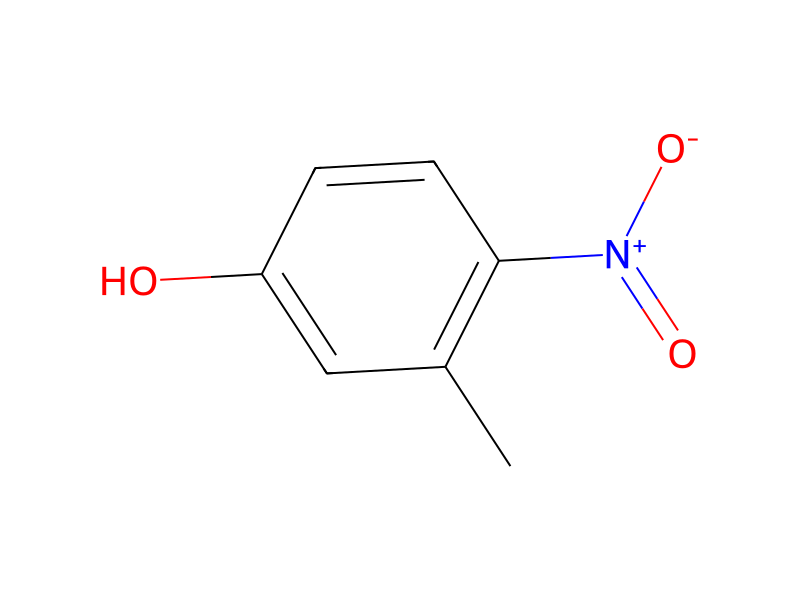
Grundinformationen
- CAS
2581-34-2- Standard-SMILES
Cc1cc(O)ccc1[N+](=O)[O-]- InChIKey
PIIZYNQECPTVEO-UHFFFAOYSA-N- Summenformel
- C7H7NO3
- Durchschnittliche Molmasse
- 153,14 g/mol
- Monoisotopische Masse
- 153,04259308
Überblick
4-nitro-m-cresol is a C-nitro compound in which the nitro group is attached at C-4 of m-cresol. It is functionally related to a m-cresol.
Namen und Bezeichner
- Bevorzugter Name
- 3-Methyl-4-nitrophenol
- IUPAC
- 3-methyl-4-nitrophenol
- Lokaler Name
- 4-Nitro-m-kresol
- Englischer Name
- 3-Methyl-4-nitrophenol
- Summenformel
- C7H7NO3
- Molmasse
- 153.14
Namen und Synonyme
3-Methyl-4-nitrophenol2581-34-24-Nitro-m-cresol4-Nitro-3-cresol5-Hydroxy-2-nitrotoluene4-Nitro-3-methylphenol2-Nitro-5-hydroxytoluenePhenol, 3-methyl-4-nitro-4-Nitro-5-methylphenolm-Cresol, 4-nitro-P-NITRO-M-CRESOL2CC94832EU
Weitere Namen anzeigen
-4-nitrophenoL3-methyl-4-nitro-phenoHA 01-01964-nitro-m-cresoNitrocresol,98%
NSC-69190DTXSID2062535CHEBI:38683RefChem:94775DTXCID2037398219-952-5MFCD000073334-Nitro-1-hydroxy-3-methylbenzene
Datenbank-Bezeichner
- CAS
2581-34-2- PubChem CID
- 17412
- DTXSID
DTXSID2062535- ChEBI
CHEBI:38683- UNII
- 2CC94832EU
- EC Number
- 219-952-5
- Nikkaji
- J55.423E、J886.766F
Eigenschaften
Berechnete StruktureigenschaftenWird ergänzt
- XLogP
- 2,5
- Polarare Oberfläche (TPSA)
- 66,1 Ų
- H-Brücken-Donoren
- 1
- H-Brücken-Akzeptoren
- 3
- Frei drehbare Bindungen
- 0
- Schwere Atome
- 11
- Formalladung
- 0
- Komplexität
- 154
Experimentelle und physikochemische Eigenschaften
Chemical Classes
Nitrogen Compounds -> Nitrophenols
Industrial compound
SpringerMaterials PropertiesFusion temperature
Pesticides
Environmental transformation -> Pesticide transformation products (metabolite, successor)
Pesticide (Fenitrothion metabolite (3-Methyl-4-nitrophenol)) -> USDA PDB
Endocrine DisruptorsPotential endocrine disrupting compound
Vapor Pressure0.000632 [mmHg]
Physical DescriptionDark yellow powder; [Sigma-Aldrich MSDS]
Physikochemische Eigenschaften
- Schmelzpunkt
- 125 · 125-130 °C(lit.)
- Siedepunkt
- 200 ℃ · 200℃(decomposition)
- Dichte
- 1.2744 · 1.2744 (estimate)
Sicherheit und Regulatorisches
Sicherheitsangaben dienen nur zur Orientierung und ersetzen weder das Sicherheitsdatenblatt (SDB) des Lieferanten noch geltende Vorschriften oder eine fachliche Bewertung.
GHS-Klassifizierung
GHS Classification
Warning
H302 (93.6%): Harmful if swallowed [Warning Acute toxicity, oral]
P261, P264, P264+P265, P270, P271, P280, P301+P317, P302+P352, P304+P340, P305+P351+P338, P317, P319, P321, P330, P332+P317, P337+P317, P362+P364, P403+P233, P405, and P501 (click each P-code to see the statement)
Aggregated GHS information provided per 47 reports by companies from 5 notifications to the ECHA C&L Inventory. Each notification may be associated with multiple companies.
Danger
H302: Harmful if swallowed [Warning Acute toxicity, oral]
Gefahrenhinweise
Regulatory Information
Chemical: Phenol, 3-methyl-4-nitro-
3-Methyl-4-nitrophenol: Does not have an individual approval but may be used under an appropriate group standard
Other Safety InformationEvaluation - Chemicals not considered for in depth evaluation - Not commercially active in Australia
Hazards Summary
Transient excretion of glucose to urine observed in 6-month oral study of rats at 1,500 ppm (no other adverse effects observed); A preliminary reproductive/developmental study of rats demonstrated decreased locomotor activity and thrombi in the kidney, heart, and lung in males at 300 mg/kg/day, but no evidence of reproductive or developmental toxicity; Mutagenic effects observed in vitro and in vivo; [OECD SIDS: 3-Methyl-4-nitrophenol - 1994] No adverse effects observed in mice orally administered 25 mg/kg during gestation; [Shepard's Catalog of Teratogenic Agents] An irritant that may cause serious eye injury; Harmful by ingestion, inhalation, and skin absorption; [Sigma-Aldrich MSDS]
Hazard Classes and Categories
Chemie und Industrie
Verwendung und Herstellung
UsesUsed as an intermediate for pesticides; [OECD SIDS: 3-Methyl-4-nitrophenol - 1994]
Use ClassificationEnvironmental transformation -> Pesticide transformation products (metabolite, successor)
General Manufacturing InformationPhenol, 3-methyl-4-nitro-: INACTIVE
Anwendungen
Verwenden3-Methyl-4-nitrophenol is a biochemical used in the preparation of phosphorothioamidate analogues as antimalarial agents. 3-methyl-4-nitrophenol has anti-androgenic activity. PNMC significantly inhibits basal and hCG-stimulated testosterone production in rats.
Vor- und nachgelagerte Produkte
Vorgelagerte Rohstoffe
Nachgelagerte Produkte
Zugehörige Reaktionen
50


Notizen zur Verbindung
Wird geladen…