
Methyl-(triphenylphosphoranyliden)acetat
Acetic acid, 2-(triphenylphosphoranylidene)-, methyl ester
Daten werden ergänzt – lade die Seite später neu, um den aktuellen Stand zu sehen

Grundinformationen
- CAS
2605-67-6- Standard-SMILES
COC(=O)C=P(c1ccccc1)(c1ccccc1)c1ccccc1- InChIKey
NTNUDYROPUKXNA-UHFFFAOYSA-N- Summenformel
- C21H19O2P
- Durchschnittliche Molmasse
- 334,3 g/mol
- Monoisotopische Masse
- 334,11226684
Namen und Bezeichner
- Bevorzugter Name
- Acetic acid, 2-(triphenylphosphoranylidene)-, methyl ester
- IUPAC
- methyl 2-(triphenyl-λ5-phosphanylidene)acetate
- Lokaler Name
- Methyl-(triphenylphosphoranyliden)acetat
- Englischer Name
- Methyl (triphenylphosphoranylidene)acetate
- Summenformel
- C21H19O2P
- Molmasse
- 334.35
Namen und Synonyme
2605-67-6Methyl (triphenylphosphoranylidene)acetate(Carbomethoxymethylene)triphenylphosphoraneAcetic acid, (triphenylphosphoranylidene)-, methyl ester(Triphenylphosphoranylidene)acetic acid methyl esterTriphenyl(carbomethoxymethylene)phosphoraneMethyl triphenylphosphoranylideneacetateAcetic acid, 2-(triphenylphosphoranylidene)-, methyl ester((Methoxycarbonyl)methylene)triphenylphosphoraneEINECS 220-018-4[(Methoxycarbonyl)methylene]triphenylphosphoraneNSC 117573
Weitere Namen anzeigen
(METHOXYCARBONYLMETHYLENE)TRIPHENYLPHOSPHORANEmethyl 2-(triphenyl-λ-phosphanylidene)acetateCMETPPAURORA KA-874idene)acetatemethyl 2-(triphenyl-Aceticacid,(triphenylphosphoranylideneMethyl (triphenylphosphoranylidene)acet
NSC 407395DTXSID6062549RefChem:552122DTXCID5037440220-018-4InChI=1/C21H19O2P/c1-23-21(22)17-24(18-11-5-2-6-12-18,19-13-7-3-8-14-19)20-15-9-4-10-16-20/h2-17H,1HMethyl 2-(triphenylphosphoranylidene)acetateCARBOMETHOXYMETHYLENE TRIPHENYLPHOSPHORANE
Datenbank-Bezeichner
- CAS
2605-67-6- PubChem CID
- 17453
- DTXSID
DTXSID6062549- ChEMBL
CHEMBL1715161- UNII
- D9MZ753Q8K
- EC Number
- 220-018-4
- Nikkaji
- J24.865G
Eigenschaften
Berechnete StruktureigenschaftenWird ergänzt
- XLogP
- 4
- Polarare Oberfläche (TPSA)
- 26,3 Ų
- H-Brücken-Donoren
- 0
- H-Brücken-Akzeptoren
- 2
- Frei drehbare Bindungen
- 5
- Schwere Atome
- 24
- Formalladung
- 0
- Komplexität
- 400
Experimentelle und physikochemische Eigenschaften
SpringerMaterials PropertiesCrystal structure
Physikochemische Eigenschaften
- Schmelzpunkt
- 168 · 168-172 °C (lit.)
- Siedepunkt
- 165 · 165~170℃
- Dichte
- 1.17 · 1.17±0.1 g/cm3(Predicted)
- storage temp.
- Keep in dark place,Sealed in dry,Room Temperature
- Löslichkeit
- Acetonitrile (Slightly), Chloroform (Slightly)
- Aggregatzustand
- Powder
- Farbe
- White to off-white
- Wasserlöslichkeit
- insoluble
- BRN
- 618430 · 618430
- InChI
- InChI=1S/C21H19O2P/c1-23-21(22)17-24(18-11-5-2-6-12-18,19-13-7-3-8-14-19)20-15-9-4-10-16-20/h2-17H,1H3
- InChIKey
- NTNUDYROPUKXNA-UHFFFAOYSA-N
- SMILES
- C(OC)(=O)C=P(C1=CC=CC=C1)(C1=CC=CC=C1)C1=CC=CC=C1
- CAS Datenbank
- 2605 · 2605-67-6(CAS DataBase Reference)
- EPA chemische Informationen
- Acetic acid, (triphenylphosphoranylidene)-, methyl ester (2605-67-6)
Sicherheit und Regulatorisches
Sicherheitsangaben dienen nur zur Orientierung und ersetzen weder das Sicherheitsdatenblatt (SDB) des Lieferanten noch geltende Vorschriften oder eine fachliche Bewertung.
GHS-Klassifizierung
GHS Classification
This chemical does not meet GHS hazard criteria for 50% (2 of 4) of reports.
Danger
H301 (50%): Toxic if swallowed [Danger Acute toxicity, oral]
P261, P264, P264+P265, P270, P271, P280, P301+P316, P302+P352, P304+P340, P305+P351+P338, P319, P321, P330, P332+P317, P337+P317, P362+P364, P403+P233, P405, and P501 (click each P-code to see the statement)
Aggregated GHS information provided per 4 reports by companies from 2 notifications to the ECHA C&L Inventory. Each notification may be associated with multiple companies.
Gefahrenhinweise
Regulatory Information
Chemical: Acetic acid, (triphenylphosphoranylidene)-, methyl ester
REACH registered substance: Methyl (triphenylphosphoranylidene)acetate (EC: 220-018-4)
Hazard Classes and CategoriesAcute Tox. 3 (50%)
Sicherheitsdaten
- wgk
- 3
- tsca
- TSCA listed
- hs_code
- 29319090
- risk_code
- 36/37/38-25
- hazard_code
- T,Xi
- hazard_note
- Irritant
- safety_code
- 22-24/25-36-26
- Speicherklasse
- 11 - Combustible Solids
Chemie und Industrie
Verwendung und Herstellung
General Manufacturing InformationAcetic acid, 2-(triphenylphosphoranylidene)-, methyl ester: ACTIVE
Anwendungen
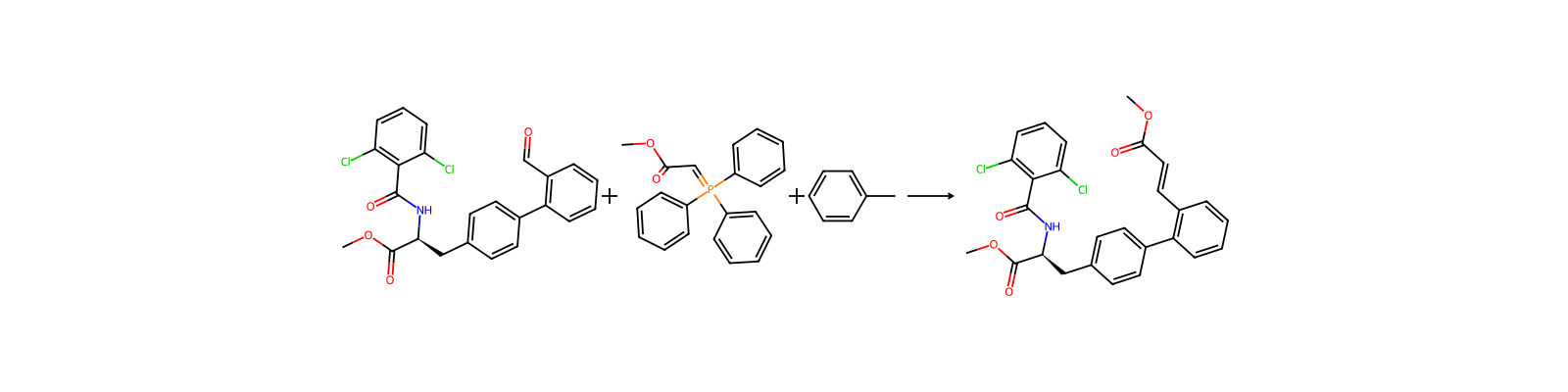
Verwenden(Methoxycarbonylmethylene)triphenylphosphorane is used in olefination reactions. Wittig reagent for the two-carbon homologation of aldehydes to α,β-unsaturated esters. it undergoes the Wittig reaction with aldehydes to give substituted methyl acrylates. used in an efficient synthesis of pyrazoles via reaction with methyl diazoacetate in the presence of triethylamine. It is used in the preparation of (triphenylphosphoranylidene)-ketene. The Wittig reaction we performed in class involved the reaction of 2-nitrobenzaldehyde (1) with methyl (triphenylphosphoranylidene) acetate (2) to produce methyl (2E)-3-(2-nitrophenyl) acrylate (3) with a triphenylphosphine oxide (4) side product, and took place in a silica gel matrix to ensure even product dispersion for chromatography.
Vor- und nachgelagerte Produkte
Nachgelagerte Produkte
Zugehörige Reaktionen
461


Notizen zur Verbindung
Wird geladen…