Diethyl Carbonate
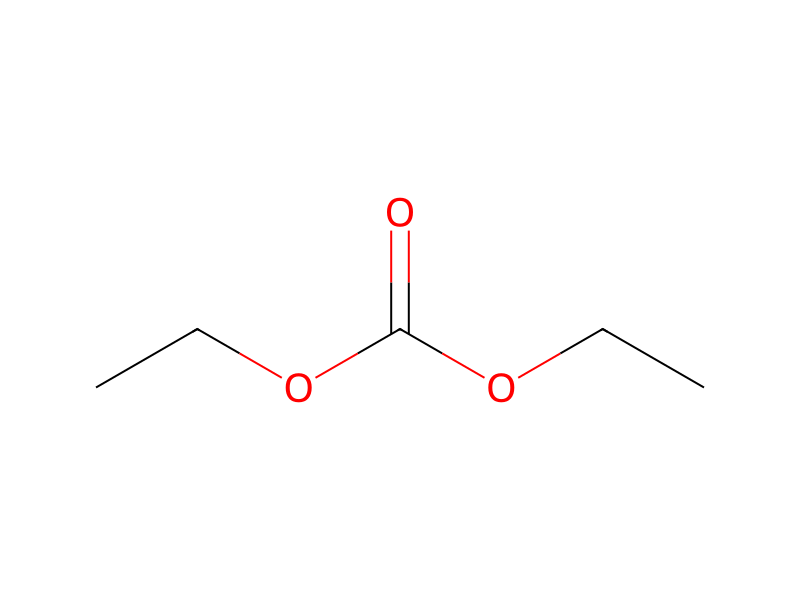
Grundinformationen
- CAS
76619-83-5- Standard-SMILES
CCOC(=O)OCC- InChIKey
OIFBSDVPJOWBCH-UHFFFAOYSA-N- Summenformel
- C5H10O3
- Durchschnittliche Molmasse
- 118,13 g/mol
Überblick
Diethyl carbonate appears as a colorless liquid with a mild pleasant odor. It is slightly less dense than water and insoluble in water. Hence floats on water. Flash point 77 °F. Vapors are heavier than air. When heated to high temperatures it may emit acrid smoke. Used as a solvent.
Namen und Bezeichner
- Bevorzugter Name
- Diethyl Carbonate
- IUPAC
- diethyl carbonate
- Englischer Name
- Carbonic acid, diethyl ester, radical ion(1-) (9CI)
- Summenformel
- C5H10O3
- Molmasse
- 118.13
Namen und Synonyme
Weitere Namen anzeigen
Datenbank-Bezeichner
- CAS
76619-83-5- ChEMBL
CHEMBL1533495- ChEBI
CHEBI:173463- UNII
- 3UA92692HG
- EC Number
- 203-311-1、803-728-4
- Nikkaji
- J5.045H
Eigenschaften
Berechnete Struktureigenschaften
- XLogP
- 1,2
- Polarare Oberfläche (TPSA)
- 35,5 Ų
- H-Brücken-Donoren
- 0
- H-Brücken-Akzeptoren
- 3
- Frei drehbare Bindungen
- 4
- Schwere Atome
- 8
- Formalladung
- 0
- Komplexität
- 62,1
Experimentelle und physikochemische Eigenschaften
LogP
log Kow= 1.21
1.21
Odor
Pleasant ethereal odor
Mild odor
Density
0.975 at 68 °F (USCG, 1999) - Less dense than water; will float
0.9752 @ 20 °C/4 °C
Relative density (water = 1): 0.98
0.9752 @ 20°C
Solubility
Insoluble (NTP, 1992)
Soluble in ehtyl ether, ethanol, and chloroform
Miscible with ketones, esters, aromatic hydrocarbons, some aliphatic solvents
In water, 1.88X10+4 mg/l @ 20 °C
Solubility in water: none
Flash Point
77 °F (NTP, 1992)
25 °C (CLOSED CUP)
25 °C c.c.
Boiling Point
259 °F at 760 mmHg (NTP, 1992)
126 °C
126 °C
126 °C @760 [mm Hg]
Sicherheit und Regulatorisches
GHS-Klassifizierung
GHS Classification
This chemical does not meet GHS hazard criteria for 2.9% (12 of 412) of reports.
Warning
H226 (97.1%): Flammable liquid and vapor [Warning Flammable liquids]
P210, P233, P240, P241, P242, P243, P261, P264, P264+P265, P271, P280, P302+P352, P303+P361+P353, P304+P340, P305+P351+P338, P319, P321, P332+P317, P337+P317, P362+P364, P370+P378, P403+P233, P403+P235, P405, and P501 (click each P-code to see the statement)
Aggregated GHS information provided per 412 reports by companies from 13 notifications to the ECHA C&L Inventory. Each notification may be associated with multiple companies.
Warning
Gefahrenhinweise
Regulatory Information
Chemical: Carbonic acid, diethyl ester
Carbonic acid, diethyl ester is listed on the EPA's Chemical Data Reporting (CDR) system. Manufacturers and importers of Carbonic acid, diethyl ester are required to report information about their production and use of this chemical to the EPA under the Toxic Substances Control Act (TSCA). (40 eCFR Part 711)
Status: Active Update: 10-06-2022 https://echa.europa.eu/registration-dossier/-/registered-dossier/14116
Carbonic acid, diethyl ester: HSNO Approval: HSR001081 Approved with controls
The New Jersey Worker and Community Right to Know Act requires public and private employers to provide information about hazardous substances at their workplaces. (N.J.S.A. 34:5A-1 et. seq.)
Fire Hazards
Excerpt from ERG Guide 128 [Flammable Liquids (Water-Immiscible)]:
· HIGHLY FLAMMABLE: Will be easily ignited by heat, sparks or flames.
Flammable. Above 25 °C explosive vapour/air mixtures may be formed. Risk of fire and explosion on contact with strong oxidizing agents.
Health Hazards
High vapor concentrations can cause headache, irritation of eyes and respiratory tract, dizziness, nausea, weakness, loss of consciousness. (USCG, 1999)
CAUTION: Petroleum crude oil (UN1267) may contain TOXIC hydrogen sulphide gas.
Reactivity Profile
DIETHYL CARBONATE reacts with acids to liberate heat along with ethanol and carbon dioxide. Strong oxidizing acids may cause a vigorous reaction that is sufficiently exothermic to ignite the reaction products. Heat is also generated by the interaction with caustic solutions. Flammable hydrogen is generated by mixing with alkali metals and hydrides.
Sicherheit und Schutzausrüstung
Fire Fighting
Excerpt from ERG Guide 128 [Flammable Liquids (Water-Immiscible)]:
Use AFFF, alcohol-resistant foam, powder, carbon dioxide. In case of fire: keep drums, etc., cool by spraying with water.
First Aid Measures
Fresh air, rest.
Rinse and then wash skin with water and soap.
First rinse with plenty of water for several minutes (remove contact lenses if easily possible), then refer for medical attention.
Rinse mouth. Rest.
Accidental Release Measures
· CALL 911. Then call emergency response telephone number on shipping paper. If shipping paper not available or no answer, refer to appropriate telephone number listed on the inside back cover.
· ELIMINATE all ignition sources (no smoking, flares, sparks or flames) from immediate area.
First Aid
EYES: First check the victim for contact lenses and remove if present. Flush victim's eyes with water or normal saline solution for 20 to 30 minutes while simultaneously calling a hospital or poison control center. Do not put any ointments, oils, or medication in the victim's eyes without specific instructions from a physician. IMMEDIATELY transport the victim after flushing eyes to a hospital even if no symptoms (such as redness or irritation) develop.
General First Aid:
Fire Fighting Procedures
... FOAM, CARBON DIOXIDE, DRY CHEMICAL
If material on fire or involved in fire: Do not extinguish fire unless flow can be stopped or safely confined. Use water in flooding quantities as fog. Solid streams of water may spread fire. Cool all affected containers with flooding quantities of water. Apply water from as far a distance as possible. Use foam, dry chemical, or carbon dioxide.
Disposal Methods
SRP: At the time of review, criteria for land treatment or burial (sanitary landfill) disposal practices are subject to significant revision. Prior to implementing land disposal of waste residue (including waste sludge), consult with environmental regulatory agencies for guidance on acceptable disposal practices.
Spillage Disposal
Personal protection: filter respirator for organic gases and vapours adapted to the airborne concentration of the substance. Collect leaking and spilled liquid in sealable containers as far as possible. Absorb remaining liquid in sand or inert absorbent. Then store and dispose of according to local regulations.
Preventive Measures
If material not on fire and not involved in fire: Keep sparks, flames, and other sources of ignition away. Keep material out of water sources and sewers. Build dikes to contain flow as necessary. Attempt to stop leak if without undue personnel hazard. Use water spray to knock-down vapors.
Personnel protection: Avoid breathing vapors. Keep upwind. ... Do not handle broken packages unless wearing appropriate personal protective equipment. Wash away any material which may have contacted the body with copious amounts of water or soap and water.
Isolation and Evacuation
Excerpt from ERG Guide 128 [Flammable Liquids (Water-Immiscible)]:
Immediate precautionary measure
Toxikologische Informationen
Environmental Fate
TERRESTRIAL FATE: Based on a classification scheme(1), an estimated Koc value of 100(SRC), determined from a log Kow of 1.21(2) and a regression-derived equation(3), indicates that diethyl carbonate is expected to have high mobility in soil(SRC). Volatilization of diethyl carbonate from moist soil surfaces is expected to be an important fate process(SRC) given an estimated Henry's Law constant of 8.9X10⁻⁵ atm-cu m/mole(SRC), calculated from a vapor pressure of 10.8 mm Hg(4) and water solubility of 18,800 mg/l(5). Diethyl carbonate may volatilize from dry soil surfaces(SRC) based upon its vapor pressure(4). Although no biodegradation data for diethyl carbonate was located, chemically similar short alkyl chain esters have been shown to biodegrade(6).
AQUATIC FATE: Based on a classification scheme(1), an estimated Koc value of 100(SRC), determined from a log Kow of 1.21(2) and a regression-derived equation(3), indicates that diethyl carbonate is not expected to adsorb to suspended solids and sediment in water(SRC). Volatilization from water surfaces is expected to be an important fate process(3) based upon an estimated Henry's Law constant of 8.9X10⁻⁵ atm-cu m/mole(SRC), calculated from a vapor pressure of 10.8 mm Hg(4) and water solubility of 18,800 mg/l(5). Using this Henry's Law constant and an estimation method(3), volatilization half-lives for a model river and model lake are 8 hours and 8 days, respectively(SRC). Diethyl carbonate may undergo hydrolysis in water since esters are susceptible to hydrolysis(3). Although no biodegradation data for diethyl carbonate was located, chemically similar short alkyl chain esters have been shown to biodegrade(6). According to a classification scheme(7), an estimated BCF of 2(SRC), from its log Kow(2) and a regression-derived equation(8), suggests the potential for bioconcentration in aquatic organisms is low(SRC).
ATMOSPHERIC FATE: According to a model of gas/particle partitioning of semivolatile organic compounds in the atmosphere(1), diethyl carbonate, which has a vapor pressure of 10.8 mm Hg at 25 °C(2), is expected to exist solely as a vapor in the ambient atmosphere. Vapor-phase diethyl carbonate is degraded in the atmosphere by reaction with photochemically-produced hydroxyl radicals(SRC); the half-life for this reaction in air is estimated to be 5 days(SRC), calculated from its estimated rate constant of 3.3X10⁻¹² cu cm/molecule-sec at 25 °C(SRC) determined using a structure estimation method(3). Diethyl carbonate may also undergo direct photolysis in the environment since this compound contains a functional group that can absorb light greater than 290 nm(4).
Signs and Symptoms
Cough. Nausea. Sore throat.
Redness. Pain.
Soil Adsorption/Mobility
The Koc of diethyl carbonate is estimated as 100(SRC), using a log Kow of 1.21(1) and a regression-derived equation(2). According to a classification scheme(3), this estimated Koc value suggests that diethyl carbonate is expected to have high mobility in soil(SRC).
Human Toxicity Excerpts
MODERATELY TOXIC BY INGESTION & INHALATION; STRONG IRRITANT.
Mildly toxic by subcutaneous route. Questionable carcinogen with experimental tumorigenic and teratogenic data.
Environmental Bioconcentration
An estimated BCF of 2 was calculated for diethyl carbonate(SRC), using a log Kow of 1.21(1) and a regression-derived equation(2). According to a classification scheme(3), this BCF suggests the potential for bioconcentration in aquatic organisms is low(SRC).
Chemie und Industrie
Verwendung und Herstellung
Uses
Used as a solvent (nitrocellulose, cellulose ethers, and resins) and for organic synthesis; [HSDB]
Solvent for nitrocellulose; mfr radio tubes; fixing rare earths to cathode elements
Solvent for cellulose ethers, many synthetic and natural resins
CHEM INT FOR PHARMACEUTICALS (EG PHENOBARBITAL); CHEM INT FOR ORG COMPD
U.S. Production
2023: 1,000,000 - <5,000,000 lb
(1972) PROBABLY GREATER THAN 9.08X10+5 GRAMS
(1975) PROBABLY GREATER THAN 9.08X10+5 GRAMS
Methods of Manufacturing
REACTION OF PHOSGENE AND ETHYL ALCOHOL TO PRODUCE ETHYL CHLOROCARBONATE FOLLOWED BY REACTION WITH ANHYDROUS ETHYLALCOHOL AT ELEVATED TEMPERATURES
Prepn: Palomaa et al, Ber 72, 313 (1939). Mfr: Mador, Blackham, US patent 3,114,762 (1963 to Natl Distillers and Chem).
Steps in its mfr are: (a) reacting chlorine and carbon monoxide to produce (COCl2); (b) reacting phosgene with ethyl alc to make ethyl chlorocarbonate (ClCO2C2H5); (c) reacting ethyl chlorocarbonate with anhyd ethyl alc to produce diethyl carbonate.
General Manufacturing Information
All Other Basic Organic Chemical Manufacturing
Carbonic acid, diethyl ester: ACTIVE
Anbieter1 Anbieter
Zugehörige Reaktionen
Keine Reaktionsaufzeichnungen unter den aktuellen Filterkriterien.
Notizen zur Verbindung
Wird geladen…